Class 9 Social Science Chapter 3 “Atmosphere and Climate” introduces students to the composition, structure and importance of the Earth’s atmosphere and its role in supporting life. The chapter explains the different layers of the atmosphere, weather and climate, factors affecting climate, heat zones, air pressure, winds, humidity, clouds and rainfall. It also highlights the influence of climate on natural vegetation, human activities, agriculture and daily life, along with the importance of understanding climate change and environmental conservation. These NCERT Solutions provide clear explanations, key terms, intext answers, important questions, MCQs, competency-based questions, long answers, summaries and FAQs to help students build conceptual understanding and prepare confidently according to the latest CBSE syllabus (2026–27).
Table of Contents (Quick Links):
1. Chapter Introduction
2. Key Terms & Definitions
3. NCERT Intext Questions
4. Exercise Questions
5. MCQs with Explanations
6. Assertion & Reason MCQs
7. Case-Based MCQs
8. Competency-Based Questions
9. Long Answer Questions
10. Common Mistakes & Exam Tips
11. Chapter Summary
Chapter Introduction:
Class 9 Social Science Chapter 3 – Atmosphere and Climate introduces students to the Earth’s atmosphere and its vital role in supporting life. The chapter explains the composition and layers of the atmosphere, the role of gravity, and the difference between weather and climate. It also covers the elements of weather, the four seasons of India, and the mechanism of the south-west and north-east monsoons. Students learn about climate change, carbon footprints, and sustainable practices to protect the environment. The chapter concludes with the Punjab Floods (2025) case study, helping students relate geographical concepts to real-life environmental challenges.
Key Terms and Definitions:
Blanket of Air: The blanket of air refers to the Earth’s atmosphere, which contains different gases essential for life and weather processes.
Gravity: Gravity is the force that pulls everything towards the Earth and keeps the atmosphere firmly surrounding the planet.
Temperature: Temperature is the degree of hotness or coldness of the air at a particular place and time.
Humidity: Humidity is the amount of water vapour present in the atmosphere.
Air Pressure: Air pressure is the force exerted by the weight of air on the Earth’s surface.
Altitude: Altitude is the height of a place above mean sea level.
Troposphere: The troposphere is the lowest layer of the atmosphere where weather changes, clouds and rainfall occur.
Stratosphere: The stratosphere lies above the troposphere and contains the ozone layer that protects life from harmful ultraviolet rays.
Mesosphere: The mesosphere is the third atmospheric layer where most meteors burn up before reaching the Earth.
Thermosphere: The thermosphere is a very hot atmospheric layer where the ionosphere is located and radio communication takes place.
Exosphere: The exosphere is the outermost layer of the atmosphere that gradually merges into outer space.
Weather: Weather is the day-to-day condition of the atmosphere at a particular place.
Climate: Climate is the average weather condition of a place over a long period, usually about 30 years.
Precipitation: Precipitation is any form of water, such as rain, snow, sleet or hail, that falls from the atmosphere to the Earth.
Insolation: Insolation is the incoming solar radiation received by the Earth.
Atmospheric Pressure: Atmospheric pressure is the pressure exerted by the entire column of air above a particular point on the Earth’s surface.
Low-Pressure Area: A low-pressure area is a region where warm air rises, often leading to cloud formation and rainfall.
High-Pressure Area: A high-pressure area is a region where cool air sinks, generally resulting in clear and dry weather.
Sea Breeze: Sea breeze is a cool wind that blows from the sea towards the land during the daytime.
Land Breeze: Land breeze is a cool wind that blows from the land towards the sea during the night.
Winter Season: Winter is the cold season in India, generally experienced from December to February.
Summer (Pre-Monsoon) Season: The summer or pre-monsoon season extends from March to May and is characterised by high temperatures and local storms.
Monsoon (Rainy) Season: The monsoon season generally lasts from June to September, bringing most of India’s annual rainfall through the south-west monsoon.
Post-Monsoon Season: The post-monsoon season occurs from October to November, marking the retreat of the south-west monsoon and the arrival of the north-east monsoon in some regions.
Lunar Mansions: Lunar Mansions (Nakshatras) are divisions of the sky traditionally used in India to observe the Moon’s movement and understand seasonal changes.
National Monsoon Mission: The National Monsoon Mission is an Indian initiative to improve the accuracy of monsoon forecasting using advanced weather models.
Carbon Footprint: A carbon footprint is the total amount of greenhouse gases released into the atmosphere through human activities.
Climate Change: Climate change refers to long-term changes in the Earth’s climate caused mainly by human activities and increased greenhouse gas emissions.
India Meteorological Department (IMD): The India Meteorological Department (IMD) is the government agency responsible for weather forecasting, climate monitoring and issuing warnings about severe weather events.
NCERT Intext Questions
1. What is the composition of the atmosphere?
Answer:
The atmosphere is mainly composed of 78% nitrogen and 21% oxygen. The remaining 1% includes argon, carbon dioxide, water vapour and other gases that support weather, climate and life on Earth.
Explanation:
The Earth’s atmosphere is a mixture of gases. It contains about 78% nitrogen, 21% oxygen and nearly 1% other gases such as argon, carbon dioxide, water vapour and trace gases. Nitrogen supports the natural nitrogen cycle, oxygen is essential for breathing and carbon dioxide helps plants prepare food through photosynthesis. For example, plants absorb carbon dioxide and release oxygen, maintaining the balance of gases in the atmosphere.
2. How do the different layers of the atmosphere affect the planet Earth?
Answer:
Each atmospheric layer performs a unique function. The troposphere supports weather, the stratosphere contains the ozone layer, the mesosphere burns meteors, the thermosphere enables communication and the exosphere merges into space.
Explanation:
The atmosphere is divided into several layers, each playing an important role. The troposphere is where clouds, rainfall and weather occur. The stratosphere contains the ozone layer, which protects Earth from harmful ultraviolet rays. The mesosphere burns most meteors before they reach the Earth, while the thermosphere supports radio communication and satellites. For example, aeroplanes usually fly in the stratosphere because the weather there is more stable.
3. What is the mechanism of monsoon?
Answer:
The monsoon is caused by the unequal heating of land and sea. Seasonal differences in air pressure create winds that bring moisture-laden air, resulting in rainfall over most parts of India.
Explanation:
The monsoon develops because land heats and cools faster than the sea. During summer, low pressure forms over land, attracting moisture-filled winds from the ocean that bring heavy rainfall. In winter, the pressure pattern reverses and dry winds blow from land towards the sea. For example, the south-west monsoon brings most of India’s annual rainfall between June and September.
4. How can we reduce our carbon footprint?
Answer:
We can reduce our carbon footprint by saving electricity, using public transport, planting trees, reducing waste and choosing renewable energy. These actions lower greenhouse gas emissions and help slow climate change.
Explanation:
A carbon footprint can be reduced by using energy efficiently, travelling by public transport or bicycle, planting more trees, recycling waste and using renewable energy such as solar or wind power. These practices reduce greenhouse gas emissions and protect the environment. For example, replacing ordinary bulbs with LED lights saves electricity and reduces carbon emissions over time.
5. Can you imagine what would happen if there were no atmosphere? Discuss your thoughts with your friends and teachers.
Answer:
Without the atmosphere, Earth would have no air to breathe, no weather and no protection from harmful solar radiation or meteors. Life would not exist because the planet would become extremely hot during the day and freezing at night.
Explanation:
The atmosphere makes life on Earth possible. Without it, there would be no oxygen for breathing, no clouds or rainfall and no protection from harmful ultraviolet rays or meteors. Temperatures would become extremely hot during the day and extremely cold at night. For example, the Moon has no atmosphere, so it experiences extreme temperatures and cannot support life like Earth.
6. How is nitrogen useful for plants?
Answer:
Nitrogen helps plants grow by forming proteins and chlorophyll. Although plants cannot use nitrogen directly from the air, they obtain it from the soil through the natural nitrogen cycle.
Explanation:
Nitrogen is an essential nutrient for healthy plant growth. It helps plants produce proteins, enzymes and chlorophyll, which are necessary for photosynthesis. Plants cannot absorb nitrogen directly from the atmosphere; instead, they obtain it from the soil through nitrogen-fixing bacteria and natural processes. For example, farmers often grow pulse crops because they help increase nitrogen in the soil naturally.
7. You might have noticed that sometimes the wind is so strong that it is difficult to walk against it. Can you think of some other times when strong winds have caused problems for you?
Answer:
Strong winds can uproot trees, damage houses, interrupt electricity and make travelling unsafe. Dust storms and cyclones also create difficulties by reducing visibility and affecting people’s daily activities.
Explanation:
Strong winds can create many problems in daily life. They may damage buildings, uproot trees, disrupt electricity supply and make roads unsafe. Dust storms reduce visibility, while cyclones can cause severe destruction in coastal regions. For example, during cyclones, strong winds often force schools to close and delay transport services until conditions become safe again.
8. Find out other categories of wind based on speed and their common effects and share your findings in class.
Answer:
Winds are classified by their speed, ranging from light breeze to cyclone or hurricane-force winds. Stronger winds can uproot trees, damage buildings, raise high waves and disrupt transport and communication.
Explanation:
Winds are grouped according to their speed and intensity. Gentle breezes create pleasant weather, while strong winds such as gales, cyclones and hurricanes can cause serious damage. High-speed winds may uproot trees, damage houses, create dust storms and disturb transport. For example, cyclonic winds along India’s eastern coast often require evacuation to protect people from dangerous weather conditions.
9. Note down the weather report from a local newspaper for two weeks and observe the changes occurring in the weather.
Answer:
After observing the weather for two weeks, I found daily changes in temperature, humidity, rainfall, wind and cloud cover. Some days were sunny, while others were cloudy or rainy, showing that weather changes regularly.
Explanation:
I observed the local weather report for two weeks and noticed changes in temperature, humidity, wind speed, rainfall and cloud cover. Some days were hot and sunny, while others were cloudy with light or heavy rain. Wind direction and humidity also varied from day to day. For example, one day recorded heavy rainfall, whereas the next day remained clear and sunny, showing that weather changes frequently.
10. Hindustani Classical music associates certain ragas with specific seasons. Find out which ragas are connected to each season with the help of your elders and teachers.
Answer:
Many Hindustani classical ragas are linked with seasons. Raga Basant is associated with spring, Megh and Miyan ki Malhar with the rainy season and Bahar celebrates the beauty of nature.
Explanation:
In Hindustani Classical music, different ragas are traditionally connected with different seasons. Raga Basant is sung during spring, while Megh and Miyan ki Malhar are associated with the monsoon because they reflect the mood of rainfall. Raga Bahar also celebrates the arrival of spring. For example, these seasonal ragas express the beauty and emotions of nature through music.
11. Describe in your own words how monsoon affects the lives of the people around you.
Answer:
The monsoon provides water for agriculture, fills rivers and reservoirs and lowers temperatures. However, excessive rainfall may cause floods, waterlogging, traffic disruptions and damage to crops and property.
Explanation:
The monsoon plays an important role in the lives of people around me. It provides rainfall needed for farming, drinking water and hydroelectric power generation. At the same time, heavy rainfall can cause floods, waterlogging, traffic jams and crop damage in some areas. For example, farmers welcome timely monsoon rains because they help produce good crops, while excessive rain may create difficulties for everyone.
12. To what extent did natural factors cause these floods compared to human activities?
Answer:
The floods were caused by both natural and human factors. Heavy rainfall was the main natural cause, while poor drainage, encroachment of floodplains, rapid urbanisation and deforestation increased the severity of flooding.
Explanation:
The Punjab floods resulted from a combination of natural processes and human activities. Intense monsoon rainfall caused rivers to overflow, while unplanned urbanisation, blocked drainage systems, construction on floodplains and deforestation worsened the situation. These human activities reduced the land’s ability to absorb excess water. For example, settlements built in low-lying flood-prone areas experienced greater damage than properly planned locations.
13. Do you think better planning could have reduced the damage? How?
Answer:
Yes. Proper land-use planning, improved drainage, flood forecasting, early warning systems, afforestation and avoiding construction in flood-prone areas could have significantly reduced the loss of lives and property.
Explanation:
Better planning could have greatly reduced the impact of the floods. Scientific land-use planning, stronger embankments, efficient drainage systems, accurate weather forecasts and timely evacuation help minimise flood damage. Protecting wetlands and avoiding construction on floodplains also reduce risks. For example, early warning systems allow people to move to safer places before floodwaters reach their homes.
14. What are the guidelines for the management of floods according to the National Disaster Management Authority (NDMA)?
Answer:
The NDMA recommends flood forecasting, early warning systems, evacuation planning, strong embankments, public awareness, proper drainage, emergency shelters, rescue operations and coordinated disaster management to reduce flood risks.
Explanation:
According to the National Disaster Management Authority (NDMA), flood management should include accurate weather forecasting, timely warnings, evacuation plans, proper drainage, flood-resistant infrastructure, emergency shelters and public awareness programmes. Coordination among government agencies and local communities is also essential. For example, timely evacuation based on flood warnings has saved many lives during recent floods in different parts of India.
15. What role can students/youth play in helping with disaster preparedness?
Answer:
Students and youth can spread awareness, participate in disaster drills, plant trees, conserve resources, follow safety guidelines, volunteer during emergencies and encourage their communities to prepare for natural disasters.
Explanation:
Students and young people play an important role in disaster preparedness by learning safety measures, participating in mock drills, spreading awareness, protecting the environment and helping vulnerable people during emergencies. They can also encourage responsible use of natural resources and support community preparedness programmes. For example, students can organise awareness campaigns on flood safety, emergency kits and evacuation procedures in their schools and neighbourhoods.
Exercise Questions and Answers:
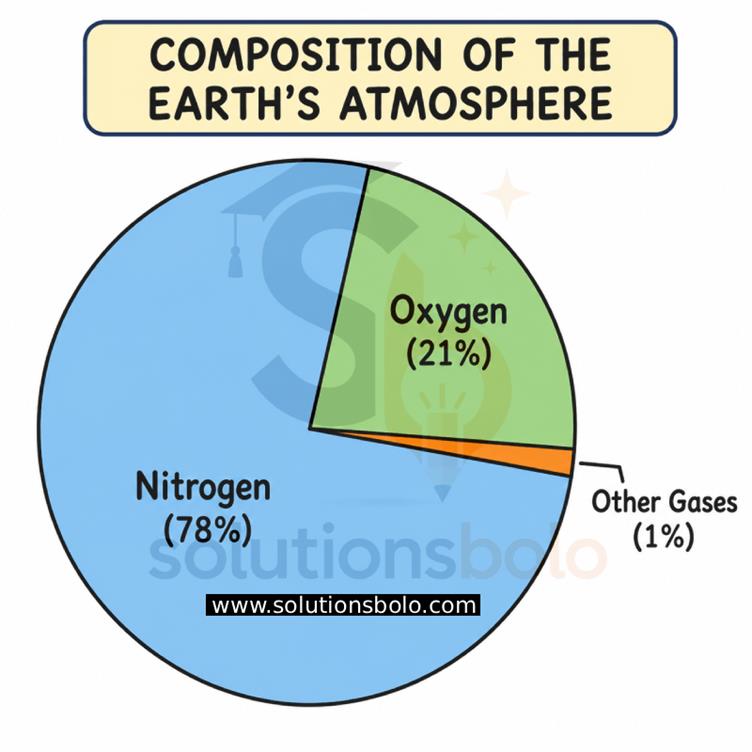
1. What is atmosphere? Explain its composition with the help of a pie diagram.
Answer:
The atmosphere is the blanket of gases surrounding the Earth. It mainly consists of 78% nitrogen, 21% oxygen and 1% other gases, including argon, carbon dioxide, water vapour and trace gases that support life.
Explanation:
The atmosphere is a protective blanket of gases surrounding the Earth. It supports life by providing oxygen for respiration, carbon dioxide for photosynthesis and shielding the Earth from harmful solar radiation and meteors. Gravity holds the atmosphere close to the Earth’s surface.
The composition of the atmosphere is:
Nitrogen (N₂): 78%
Oxygen (O₂): 21%
Other gases (1%), including argon, carbon dioxide, water vapour, neon, helium and ozone.
Nitrogen helps maintain the nitrogen cycle, oxygen is essential for living organisms and carbon dioxide supports photosynthesis and helps regulate Earth’s temperature.
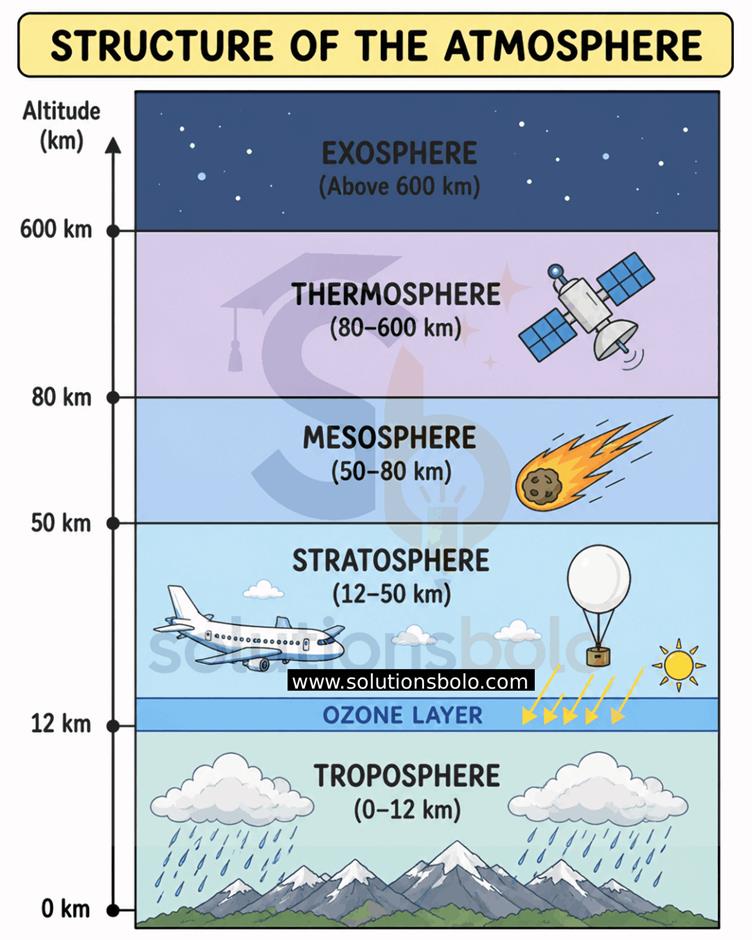
2. Draw a labelled diagram of the structure of atmosphere.
Answer:
The atmosphere has five main layers: Troposphere, Stratosphere, Mesosphere, Thermosphere and Exosphere. Each layer has different characteristics and performs important functions that protect life and influence weather, climate and communication.
Explanation:
The Earth’s atmosphere is divided into five layers according to changes in temperature and altitude.
• Troposphere – Weather, clouds and rainfall occur here.
• Stratosphere – Contains the ozone layer that absorbs harmful ultraviolet rays.
• Mesosphere – Most meteors burn up in this layer.
• Thermosphere – Contains the ionosphere and supports radio communication.
• Exosphere – The outermost layer that gradually merges into outer space.
(Draw and label the five atmospheric layers in your notebook.)
3. Which are the four main seasons of India?
Answer:
India experiences four main seasons: Winter, Summer (Pre-Monsoon), Monsoon (Rainy) and Post-Monsoon. These seasons occur due to changes in temperature, air pressure and the seasonal movement of monsoon winds.
Explanation:
India has four major seasons:
1. Winter (December–February) – Cool and dry weather.
2. Summer or Pre-Monsoon (March–May) – High temperatures and local storms.
3. Monsoon or Rainy Season (June–September) – South-west monsoon brings most of the annual rainfall.
4. Post-Monsoon (October–November) – Retreating monsoon and pleasant weather in most regions.
These seasonal changes greatly influence agriculture, water resources and the daily lives of people across India.
4. Why do you not feel the pressure of the atmosphere?
Answer:
We do not feel atmospheric pressure because it acts equally in all directions. The pressure inside our body balances the external air pressure, preventing us from feeling its continuous force.
Explanation:
The atmosphere exerts pressure on everything on the Earth’s surface. However, we do not feel this pressure because our body’s internal pressure balances the atmospheric pressure acting from outside. Since the pressure acts equally in all directions, it does not crush or harm us.
For example, we only notice pressure changes while climbing mountains or travelling in aeroplanes, when atmospheric pressure decreases with altitude.
5. In which layer of the atmosphere do aeroplanes fly and why?
Answer:
Most commercial aeroplanes fly in the lower stratosphere because this layer has stable weather, very few clouds and less turbulence, making air travel smoother, safer and more fuel-efficient.
Explanation:
Commercial aeroplanes generally fly in the lower part of the stratosphere. Unlike the troposphere, this layer experiences very little weather activity, almost no clouds and less air turbulence. As a result, flights are smoother, safer and more fuel-efficient.
For example, passenger aircraft usually cruise above the weather systems found in the troposphere, reducing delays caused by storms and heavy rainfall.
6. Distinguish between the following:
a. The troposphere and stratosphere
| Troposphere | Stratosphere |
| It is the lowest layer of the atmosphere. | It lies above the troposphere. |
| Weather changes occur here. | Weather is generally calm and stable. |
| Clouds and rainfall are found here. | Contains the ozone layer. |
| Temperature decreases with height. | Temperature increases with height due to ozone absorption of UV rays. |
| Supports most living organisms. | Commercial aeroplanes usually fly in its lower part. |
b. The south-west monsoon and north-east monsoon
| South-West Monsoon | North-East Monsoon |
| Blows from June to September. | Blows from October to December. |
| Winds blow from sea towards land. | Winds blow from land towards sea. |
| Brings most of India’s annual rainfall. | Mostly dry, but gives rainfall to Tamil Nadu And nearby regions. |
| Originates over the Arabian Sea & Bay of Bengal. | Originates over the Indian landmass. |
| Essential for agriculture and water supply. | Marks the retreat of the South-West Monsoon. |
7. Do it yourself: Table 3.3 shows the average monthly temperatures and rainfall amounts for 10 representative stations. Study these figures on your own and convert them into ‘temperature and rainfall’ graphs. The visual representations will help you grasp their similarities and differences at a glance. One such graph (Fig. 3.14) is already prepared for you. See if you can arrive at some broad generalisations about our diverse climatic conditions.
Answer:
The graphs show that India’s climate varies greatly. Coastal areas have moderate temperatures, Himalayan regions remain cold, deserts receive little rainfall, while the north-east and western coast experience heavy rainfall during the monsoon season.
Explanation:
The graphs clearly show that India’s climate is highly diverse due to differences in latitude, altitude, distance from the sea and relief features. Coastal stations such as Mumbai, Chennai and Thiruvananthapuram have moderate temperatures throughout the year because of the sea’s influence. Leh remains cold because of its high altitude, while Delhi and Jodhpur experience greater seasonal temperature variations. Shillong receives the highest rainfall, whereas Leh receives the least. The graphs also show that most parts of India receive maximum rainfall during the south-west monsoon (June to September), though Chennai receives heavy rainfall during the retreating monsoon.
7.1. Now look at Table 3.3 again. Re-arrange the 10 stations according to their distance from the equator.
Answer:
From nearest to farthest from the Equator: Thiruvananthapuram, Bengaluru, Chennai, Mumbai, Shillong, Kolkata, Nagpur, Jodhpur, Delhi and Leh.
Explanation:
| Rank | Station | Latitude |
| 1. | Thiruvananthapuram | 8°29’N |
| 2. | Bengaluru | 12°58’N |
| 3. | Chennai | 13°4’ N |
| 4. | Mumbai | 19°N |
| 5. | Nagpur | 21°9’N |
| 6. | Kolkata | 22°34’N |
| 7. | Shilong | 24°34’N |
| 8. | Jodhpur | 26°18’N |
| 9. | Delhi | 29°N |
| 10. | Leh | 34°N |
7.2 Find out:
a. Two stations with the most extreme climate.
b. Two stations influenced by retreating monsoons.
c. The two hottest stations in the months of
(i) February (ii) June
7.2 (a) Answer:
Delhi and Leh have the most extreme climates. Delhi experiences very hot summers and cold winters, while Leh has freezing winters, cool summers and very low rainfall due to its high altitude.
Explanation:
The two stations with the most extreme climates are:
• Delhi – Very hot summers and cold winters with a large annual temperature range.
• Leh – Extremely cold winters, cool summers and the lowest annual rainfall because it lies in the rain-shadow region of the Himalayas at a very high altitude.
7.2 (b) Answer:
Chennai and Thiruvananthapuram are influenced by the retreating monsoon. They receive significant rainfall during October and November due to the north-east monsoon winds.
Explanation:
The stations mainly influenced by the retreating (north-east) monsoon are:
• Chennai
• Thiruvananthapuram
The table shows increased rainfall during October and November, especially in Chennai, which receives much of its annual rainfall from the retreating monsoon.
7.2 (c) Answer: (i) February
The hottest stations in February are Chennai (25.7°C) and Mumbai (24.4°C) according to Table 3.3.
Explanation:
According to the table:
1. Chennai – 25.7°C
2. Mumbai – 24.4°C
These coastal cities remain warm throughout the year because they are strongly influenced by the nearby sea.
7.2 (c) Answer: (ii) June
The hottest stations in June are Jodhpur (33.9°C) and Chennai (32.5°C) according to the data given in Table 3.3.
Explanation:
The June temperatures show:
1. Jodhpur – 33.9°C
2. Chennai – 32.5°C
Jodhpur experiences intense summer heat because it lies in the Thar Desert, while Chennai remains hot due to its tropical coastal location.
7.3. Now find out:
a. Why does Shillong experience more rainfall than Kolkata?
Answer:
Shillong receives more rainfall because moisture-laden monsoon winds are forced to rise over the Khasi Hills, causing heavy orographic rainfall. Kolkata, located on the plains, receives comparatively less rainfall.
Explanation:
Shillong receives much more rainfall than Kolkata because it is situated on the Khasi Hills. Moisture-laden south-west monsoon winds rise along these hills, cool rapidly and produce heavy orographic rainfall. Kolkata, although affected by the monsoon, lies on the plains and does not experience the same strong uplift of moist air. Therefore, Shillong records significantly higher annual rainfall than Kolkata.
b. Why does Delhi receive more rainfall than Jodhpur?
Answer:
Delhi receives more rainfall because it is influenced by the south-west monsoon and western disturbances. Jodhpur lies in the arid Thar Desert, where monsoon winds lose much of their moisture before reaching the region.
Explanation:
Delhi receives more rainfall because it benefits from both the south-west monsoon and western disturbances during winter. Jodhpur, located in the Thar Desert, has an arid climate and receives very little rainfall because the monsoon winds become weaker and drier by the time they reach western Rajasthan. Consequently, Delhi records much higher annual rainfall than Jodhpur.
7.4. Now think why:
a. Thiruvananthapuram has an equable climate?
Answer:
Thiruvananthapuram has an equable climate because it is located near the sea. The Arabian Sea moderates temperatures throughout the year, preventing extreme heat or cold and keeping the weather pleasant.
Explanation:
Thiruvananthapuram experiences an equable climate because it is situated on the south-west coast of India and is surrounded by the Arabian Sea. The sea heats up and cools down more slowly than land, reducing seasonal temperature variations. As a result, summers are not extremely hot, winters are not very cold and humidity remains high throughout the year. For example, the monthly temperatures remain nearly uniform in Table 3.3, showing only a small annual range.
b. Chennai has more rainfall only after the fury of the monsoon is over in most parts of the country?
Answer:
Chennai receives most of its rainfall during October and November because the retreating or north-east monsoon picks up moisture from the Bay of Bengal before reaching the Tamil Nadu coast.
Explanation:
Unlike most parts of India, Chennai receives heavy rainfall during the retreating (north-east) monsoon. After the south-west monsoon withdraws, dry winds from northern India pass over the Bay of Bengal, collect moisture and bring rainfall to Tamil Nadu’s eastern coast. Therefore, October and November become the rainiest months for Chennai. Table 3.3 clearly shows that Chennai records much higher rainfall during these months than during the main south-west monsoon season.
c. Leh has moderate precipitation almost throughout the year?
Answer:
Leh lies in the rain-shadow region of the Himalayas. Moisture-laden monsoon winds cannot reach it easily, so it receives very little and fairly uniform precipitation throughout the year.
Explanation:
Leh receives low and fairly uniform precipitation because it is located in the rain-shadow region of the Himalayas. The high mountain ranges block the moisture-laden south-west monsoon winds, preventing heavy rainfall. Most precipitation occurs as light snowfall or occasional rain. Table 3.3 shows that Leh receives very little rainfall throughout the year, giving it a cold desert climate.
7.5. Despite these differences across regions, can you observe any substantial evidence to conclude that the monsoons provide a very strong framework, lending overall climatic unity to the whole country?
Answer:
Yes. Although India’s climate varies from region to region, most places receive rainfall during the monsoon months. This seasonal rainfall pattern gives the country a common climatic rhythm and supports agriculture.
Explanation:
Yes. India has diverse climatic conditions because of differences in latitude, altitude, relief and distance from the sea. However, the monsoon system provides a common climatic framework across the country. Most regions receive the majority of their annual rainfall during the monsoon season, which supports agriculture, fills rivers and reservoirs and influences daily life. Even though the amount and timing of rainfall vary, the monsoon remains the most important climatic feature uniting India.
8. Collect pictures of houses and clothing of people from different regions of India. Examine whether they reflect any relationship with the climatic conditions or the relief of those regions.
Answer:
Yes. Houses and clothing differ according to climate and relief. Cold regions have woollen clothes and sloping-roof houses, while hot and coastal regions have light cotton clothes and well-ventilated houses.
Explanation:
Yes. Climate and relief greatly influence the design of houses and the type of clothing people wear. In cold Himalayan regions, people wear woollen clothes and live in houses with sloping roofs to prevent snow accumulation. In hot and humid coastal areas, light cotton clothes and well-ventilated houses are common. In desert regions, thick walls and loose cotton clothing help protect people from extreme heat. These adaptations enable people to live comfortably in different climatic conditions across India.
Multiple Choice Questions (MCQs)
1. Which gas is present in the largest proportion in the Earth’s atmosphere?
A. Oxygen
B. Carbon dioxide
C. Nitrogen
D. Argon
Answer: C. Nitrogen
Explanation:
Nitrogen forms about 78% of the Earth’s atmosphere, making it the most abundant gas. Although humans cannot breathe nitrogen directly, it is essential for the nitrogen cycle and helps plants grow by supporting the formation of proteins after nitrogen fixation.
2. Which layer of the atmosphere contains the ozone layer?
A. Troposphere
B. Stratosphere
C. Mesosphere
D. Thermosphere
Answer: B. Stratosphere
Explanation:
The ozone layer is located in the stratosphere. It absorbs most of the Sun’s harmful ultraviolet (UV) rays, protecting humans, animals and plants from harmful radiation. Without the ozone layer, life on Earth would be severely affected.
3. Weather phenomena such as clouds, rainfall and storms mainly occur in which layer?
A. Troposphere
B. Stratosphere
C. Mesosphere
D. Exosphere
Answer: A. Troposphere
Explanation:
The troposphere is the lowest layer of the atmosphere and contains most of the air and water vapour. Since weather-related activities occur in this layer, it directly influences our daily lives, agriculture and climatic conditions.
4. Why do most commercial aeroplanes fly in the lower stratosphere?
A. It contains more oxygen.
B. It has stable weather and less turbulence.
C. It is the hottest atmospheric layer.
D. It receives maximum rainfall.
Answer: B. It has stable weather and less turbulence.
Explanation:
Commercial aeroplanes usually fly in the lower stratosphere because this layer has very little cloud formation, fewer storms and less air turbulence than the troposphere. These conditions make flights smoother, safer and more fuel-efficient.
5. Which season brings the highest rainfall to most parts of India?
A. Winter
B. Summer (Pre-Monsoon)
C. South-West Monsoon
D. Post-Monsoon
Answer: C. South-West Monsoon
Explanation:
The south-west monsoon, active from June to September, provides nearly three-fourths of India’s annual rainfall. It is vital for agriculture, replenishes rivers and reservoirs and supports water availability across most parts of the country.
6. Chennai receives most of its rainfall during which season?
A. Winter
B. South-West Monsoon
C. Retreating (North-East) Monsoon
D. Spring
Answer: C. Retreating (North-East) Monsoon
Explanation:
Unlike most parts of India, Chennai receives heavy rainfall during the retreating or north-east monsoon. Moisture-laden winds from the Bay of Bengal bring rain mainly during October and November, making these the wettest months for the city.
7. Why does Thiruvananthapuram experience an equable climate?
A. It is located in a desert region.
B. It lies close to the sea.
C. It is situated at a very high altitude.
D. It receives no rainfall.
Answer: B. It lies close to the sea.
Explanation:
The Arabian Sea moderates the temperature of Thiruvananthapuram throughout the year. As water heats and cools more slowly than land, the city experiences neither extremely hot summers nor very cold winters, resulting in an equable climate.
8. Which factor is mainly responsible for climate change?
A. Increased greenhouse gas emissions
B. Earth’s rotation
C. Ocean tides
D. Lunar phases
Answer: A. Increased greenhouse gas emissions
Explanation:
Climate change is mainly caused by the increasing concentration of greenhouse gases such as carbon dioxide and methane. These gases trap heat in the atmosphere, leading to global warming, changing rainfall patterns and more frequent extreme weather events.
9. Which of the following activities helps reduce a person’s carbon footprint?
A. Burning more fossil fuels
B. Cutting forests
C. Using public transport and planting trees
D. Wasting electricity
Answer: C. Using public transport and planting trees
Explanation:
A carbon footprint can be reduced by saving electricity, using public transport, planting trees, recycling waste and choosing renewable energy. These actions lower greenhouse gas emissions and help reduce the impact of climate change on the environment.
10. Why do we not feel the pressure of the atmosphere?
A. The atmosphere has no weight.
B. Atmospheric pressure acts equally in all directions and is balanced by our body’s internal pressure.
C. Gravity removes atmospheric pressure.
D. Air pressure exists only at high altitudes.
Answer: B. Atmospheric pressure acts equally in all directions and is balanced by our body’s internal pressure.
Explanation:
The atmosphere exerts pressure on our bodies from all directions. We do not feel this pressure because it is balanced by the internal pressure of our body. This balance prevents us from experiencing the enormous weight of the air above us.
11. Which of the following best explains the difference between weather and climate?
A. Weather changes daily, while climate describes long-term weather patterns.
B. Climate changes every day, while weather remains constant.
C. Weather occurs only in summer.
D. Climate refers only to rainfall.
Answer: A. Weather changes daily, while climate describes long-term weather patterns.
Explanation: Weather is short-term, whereas climate is the average weather of a place over many years.
12. Why do most commercial aeroplanes fly in the lower stratosphere?
A. It contains more oxygen.
B. It has stable weather and less turbulence.
C. It is warmer than all other layers.
D. It receives maximum rainfall.
Answer: B
Explanation: The lower stratosphere has calm weather and very little turbulence, making flights smoother.
13. Which season brings the maximum rainfall to most parts of India?
A. Winter
B. Summer (Pre-Monsoon)
C. South-West Monsoon
D. Post-Monsoon
Answer: C. South-West Monsoon
Explanation: Most regions of India receive their annual rainfall during the south-west monsoon.
Directions: Choose the correct option.
A. Both Assertion (A) and Reason (R) are true and R is the correct explanation of A.
B. Both Assertion (A) and Reason (R) are true, but R is not the correct explanation of A.
C. Assertion (A) is true, but Reason (R) is false.
D. Assertion (A) is false, but Reason (R) is true.
Assertion & Reason MCQs
1. Assertion (A): Weather changes frequently, while climate remains relatively stable over long periods.
Reason (R): Climate is the average weather conditions of a place observed over many years.
Answer: A
Explanation:
Weather refers to the day-to-day condition of the atmosphere and can change within hours or days. Climate represents the average pattern of weather over a long period, usually around 30 years. Therefore, the reason correctly explains why climate is more stable than weather.
2. Assertion (A): The stratosphere is important for protecting life on Earth.
Reason (R): The ozone layer present in the stratosphere absorbs most of the Sun’s harmful ultraviolet (UV) rays.
Answer: A
Explanation:
The stratosphere contains the ozone layer, which acts as a protective shield by absorbing harmful ultraviolet radiation from the Sun. Without this layer, living organisms would be exposed to dangerous UV rays, increasing health and environmental risks.
3. Assertion (A): Most commercial aeroplanes fly in the lower stratosphere.
Reason (R): The lower stratosphere has more stable weather and less turbulence than the troposphere.
Answer: A
Explanation:
Commercial aircraft generally fly in the lower stratosphere because it has calm air, fewer clouds and very little turbulence. These conditions make flights smoother, safer and more fuel-efficient compared to flying in the troposphere.
4. Assertion (A): Chennai receives most of its annual rainfall during October and November.
Reason (R): Chennai is mainly influenced by the retreating (north-east) monsoon.
Answer: A
Explanation:
Unlike most parts of India, Chennai receives heavy rainfall from the retreating or north-east monsoon. Moisture-laden winds from the Bay of Bengal bring significant rainfall during October and November, making these the wettest months for the city.
5.Assertion (A): Reducing our carbon footprint helps reduce the effects of climate change.
Reason (R): Activities such as saving electricity, using public transport and planting trees reduce greenhouse gas emissions.
Answer: A
Explanation:
A carbon footprint measures the amount of greenhouse gases released due to human activities. By conserving energy, using cleaner transport, planting trees and reducing fossil fuel use, greenhouse gas emissions decrease, helping to slow global warming and climate change.
Case-Based MCQs
Case Study 1: Atmosphere – The Protective Blanket
Riya learned that the Earth is surrounded by a blanket of gases called the atmosphere. It contains nitrogen, oxygen, carbon dioxide and other gases. Besides providing air for breathing, the atmosphere protects Earth from harmful ultraviolet rays and helps maintain a suitable temperature for life.
Question:
Which atmospheric layer contains the ozone layer that protects life from harmful ultraviolet rays?
A. Troposphere
B. Stratosphere
C. Mesosphere
D. Thermosphere
Answer: B. Stratosphere
Explanation:
The ozone layer is located in the stratosphere, where it absorbs most of the Sun’s harmful ultraviolet (UV) radiation. This natural shield protects humans, animals and plants, making life on Earth possible.
Case Study 2: India’s Monsoon
A farmer in Maharashtra eagerly waits for the arrival of the south-west monsoon every year. Good rainfall helps him grow crops successfully, while delayed or weak monsoons often reduce agricultural production and create water shortages.
Question:
Which season provides the highest rainfall to most parts of India?
A. Winter
B. Summer (Pre-Monsoon)
C. South-West Monsoon
D. Post-Monsoon
Answer: C. South-West Monsoon
Explanation:
The south-west monsoon, active mainly from June to September, brings nearly three-fourths of India’s annual rainfall. It is essential for agriculture, drinking water, hydroelectric power generation and maintaining the country’s water resources.
Case Study 3: Climate and Human Adaptation
Two students compared different parts of India. One visited Leh and wore heavy woollen clothes, while the other visited Thiruvananthapuram and wore light cotton clothes. They noticed that houses and lifestyles were also different.
Question:
Which factor mainly explains these differences?
A. Similar weather throughout the year
B. Differences in climate and relief
C. Population density only
D. Distance from the Equator alone
Answer: B. Differences in climate and relief
Explanation:
Climate and relief strongly influence the way people live. Cold mountainous regions require warm clothing and insulated houses, whereas hot and humid coastal regions favour light clothing and well-ventilated homes suited to local climatic conditions.
Case Study 4: Climate Change
Rahul’s school organised a campaign encouraging students to use bicycles, plant trees and save electricity. The aim was to reduce greenhouse gas emissions and protect the environment from the effects of climate change.
Question:
Which action directly helps reduce a person’s carbon footprint?
A. Increasing fossil fuel use
B. Cutting forests
C. Using public transport and planting trees
D. Wasting electricity
Answer: C. Using public transport and planting trees
Explanation:
A carbon footprint refers to the greenhouse gases released through human activities. Using cleaner transport, conserving electricity, planting trees and reducing fossil fuel consumption help lower emissions and slow climate change.
Case Study 5: Weather and Climate
A tourist visited Delhi in January and found the weather cold. He returned in May and experienced extremely hot conditions. His friend explained that these were seasonal weather changes and not changes in the city’s climate.
Question:
Which statement correctly distinguishes weather from climate?
A. Weather is the long-term average of atmospheric conditions.
B. Climate changes every day.
C. Weather refers to short-term atmospheric conditions, while climate describes long-term weather patterns.
D. Weather and climate have the same meaning.
Answer: C. Weather refers to short-term atmospheric conditions, while climate describes long-term weather patterns.
Explanation:
Weather changes from day to day due to variations in temperature, rainfall, humidity and wind. Climate is the average pattern of weather observed over a long period, usually about 30 years and describes the typical conditions of a place.
Competency-Based Questions
1. During summer, two friends planned holidays. One visited Leh, while the other visited Thiruvananthapuram. They experienced completely different weather conditions. Explain the geographical reasons for this difference.
Answer:
The difference is mainly due to altitude and distance from the sea. Leh is located at a high altitude in the Himalayas, so temperatures remain low even during summer. Thiruvananthapuram is situated along the Arabian Sea, where the sea moderates temperatures and creates an equable climate. Thus, physical features and location greatly influence the climate of different regions.
Key Learning:
Climate varies from place to place because of factors such as altitude, latitude, distance from the sea and relief features.
2. A farmer notices that the south-west monsoon has arrived two weeks later than usual. How might this affect agriculture and people’s lives in the region?
Answer:
A delayed monsoon can postpone sowing, reduce crop production and increase the risk of drought. Farmers may face financial losses, while water shortages can affect drinking water, livestock and electricity generation. This shows how closely agriculture and daily life depend on the timely arrival of the monsoon.
Key Learning:
The timely arrival of the monsoon is essential for agriculture, water resources, food production and the livelihoods of millions of people in India.
3. Your school plans to organise an awareness campaign on reducing carbon footprints. Suggest any four practical measures that students can adopt and explain how they help the environment.
Answer:
Students can use public transport or bicycles, save electricity, plant trees and reduce plastic waste by recycling. These measures reduce greenhouse gas emissions, conserve natural resources, improve air quality and help slow climate change. Small individual actions together make a significant positive impact on the environment.
Key Learning:
Small individual actions, when adopted by many people, can significantly reduce carbon emissions and help protect the environment.
4. A weather forecast predicts heavy rainfall and strong winds in your district over the next two days. As a responsible student, what precautions would you suggest to your family and neighbours?
Answer:
I would advise everyone to stay updated through official weather forecasts, avoid flooded roads, keep emergency supplies ready, charge mobile phones, switch off electricity if necessary and follow instructions issued by local authorities. Early preparedness helps reduce risks and protects lives and property during extreme weather events.
Key Learning:
Disaster preparedness, early warnings and responsible actions help minimise the loss of life and property during extreme weather events.
5. A city experiences frequent flooding during the monsoon even though the annual rainfall has not increased significantly. Based on your understanding of the chapter, explain two possible human causes and suggest suitable solutions.
Answer:
Frequent flooding may result from poor drainage systems, rapid urbanisation, construction on natural drainage channels and loss of green spaces. Improving drainage, protecting wetlands, increasing tree plantation, preventing encroachment on floodplains and planning sustainable urban development can significantly reduce flood risks.
Key Learning:
Unplanned urbanisation and poor drainage increase flood risks, while sustainable development and proper planning help reduce disasters.
Hypothetical Questions and Answers
1. Imagine that everyone in your town started using bicycles or public transport instead of private vehicles. What changes would you expect?
Think like a Geographer:
Using bicycles and public transport would reduce traffic congestion, fuel consumption and air pollution. Greenhouse gas emissions would decrease, helping to reduce carbon footprints and improve air quality. People would also enjoy better health through increased physical activity, contributing to a cleaner and more sustainable environment.
2. Imagine the south-west monsoon failed completely for one year. What effects would it have on India?
Think like a Geographer:
If the south-west monsoon failed for one year, India would face severe water shortages, droughts, poor agricultural production and food scarcity. Rivers, reservoirs and groundwater levels would decline, affecting drinking water and hydroelectric power generation. Farmers would suffer heavy financial losses and food prices could rise. This shows how important the monsoon is for India’s economy, agriculture and daily life.
3. Suppose there were no atmosphere around the Earth. What would happen to life on our planet?
Think like a Geographer:
Without the atmosphere, there would be no oxygen for breathing, no carbon dioxide for photosynthesis and no protection from harmful ultraviolet rays or meteors. Rainfall, winds and weather would not exist and temperatures would become extremely hot during the day and freezing at night. Under such conditions, plants, animals and humans would not be able to survive.
4. What if forests disappeared from a region due to large-scale deforestation? How would it affect the environment and people?
Think like a Geographer:
If forests disappeared, biodiversity would decline, wildlife would lose its habitat and soil erosion would increase. Rainfall patterns could change, temperatures might rise and the risk of floods and droughts would become greater. The amount of carbon dioxide in the atmosphere would also increase, worsening climate change. People depending on forests for food, fuel and livelihoods would face serious difficulties.
5. Imagine your city experienced unusually high temperatures every summer because of climate change. What steps would you suggest to reduce its impact?
Think like a Geographer:
I would encourage tree plantation, protection of green spaces, rainwater harvesting, energy conservation and greater use of public transport. People should reduce fossil fuel use, recycle waste and use renewable energy wherever possible. These measures help lower greenhouse gas emissions, reduce urban heat and make cities more climate-resilient.
6. Suppose weather forecasts were not available before cyclones or heavy rainfall. How would this affect people and disaster management?
Think like a Geographer:
Without weather forecasts, people would not receive timely warnings about approaching disasters. Evacuation would become difficult, increasing the loss of life, property, crops and livestock. Rescue operations would also become more challenging. Accurate weather forecasting is therefore essential for disaster preparedness, planning and reducing the impact of natural hazards.
Long Answer Questions
1. Explain the composition and structure of the atmosphere. How does each layer contribute to making life possible on Earth?
Answer:
The atmosphere is a blanket of gases surrounding the Earth, held in place by gravity. It is essential for life because it provides oxygen for breathing, carbon dioxide for photosynthesis and nitrogen for the nitrogen cycle. It also protects the Earth from harmful solar radiation and helps regulate temperature.
The atmosphere is composed of about 78% nitrogen, 21% oxygen and 1% other gases, including argon, carbon dioxide, water vapour and ozone.
The atmosphere has five main layers:
• Troposphere: The lowest layer where weather phenomena such as clouds, rainfall, winds and storms occur. It supports almost all life on Earth.
• Stratosphere: Contains the ozone layer, which absorbs harmful ultraviolet (UV) rays from the Sun and protects living organisms.
• Mesosphere: Most meteors burn up in this layer before reaching the Earth’s surface.
• Thermosphere: Contains the ionosphere, which helps in radio communication and reflects radio waves.
• Exosphere: The outermost layer that gradually merges with outer space and is the region where many artificial satellites orbit.
Each layer performs a unique function. Together, they protect the Earth, regulate climate and create conditions that make life possible.
2. Explain the mechanism of the Indian monsoon. Why is the monsoon considered the lifeline of India’s economy?
Answer:
The Indian monsoon is a seasonal wind system caused by the unequal heating and cooling of land and water. During summer, the Indian landmass heats up rapidly and develops a low-pressure area, while the surrounding Indian Ocean remains comparatively cooler with high pressure. Moisture-laden winds blow from the sea towards the land, bringing heavy rainfall across most parts of India. This is known as the south-west monsoon.
During winter, the land cools faster than the sea, creating high pressure over the land. Winds then blow from land to sea as the north-east (retreating) monsoon. These winds bring significant rainfall mainly to the Tamil Nadu coast after collecting moisture from the Bay of Bengal.
The monsoon is called the lifeline of India’s economy because it supports agriculture, which provides livelihoods to millions of people. It replenishes rivers, lakes, reservoirs and groundwater, ensuring water for drinking, irrigation, industries and hydroelectric power generation. A good monsoon leads to better crop production and economic growth, while a weak or delayed monsoon can result in droughts, crop failures, water shortages and financial losses.
3. Explain the causes and effects of climate change. Suggest practical measures that individuals, communities and governments can take to reduce its impact.
Answer:
Climate change refers to long-term changes in the Earth’s temperature and weather patterns. Although natural factors influence climate, recent climate change is mainly caused by human activities such as burning fossil fuels, deforestation, industrialisation and rapid urbanisation. These activities increase the concentration of greenhouse gases, especially carbon dioxide and methane, which trap heat in the atmosphere and cause global warming.
Climate change has many serious effects. It increases the frequency and intensity of heatwaves, floods, droughts, cyclones and heavy rainfall. Melting glaciers and rising sea levels threaten coastal areas, while changing rainfall patterns affect agriculture, water resources, biodiversity and human health. These impacts also increase the risk of natural disasters and economic losses.
Reducing climate change requires collective action. Individuals can save electricity, use public transport, plant trees, reduce waste, recycle materials and adopt renewable energy wherever possible. Communities can protect forests, conserve water and spread environmental awareness. Governments can promote clean energy, strengthen disaster management, enforce environmental laws and encourage sustainable development. Working together will help protect the environment and ensure a safer future for coming generations.
Common Mistakes & Exam Tips
1. Confusing Weather with Climate
Common Mistake: Students often write weather and climate as the same concept.
Exam Tip: Remember that weather refers to short-term atmospheric conditions, whereas climate is the average weather of a place over a long period (about 30 years). Always mention this difference in descriptive answers.
2. Mixing Up Atmospheric Layers
Common Mistake: Many students confuse the functions of the troposphere and stratosphere.
Exam Tip: Remember:
• Troposphere = Weather
• Stratosphere = Ozone Layer
• Mesosphere = Meteors Burn
• Thermosphere = Ionosphere & Radio Communication
• Exosphere = Outermost Layer
A simple memory trick helps you answer MCQs and short questions correctly.
3. Forget the Monsoon Mechanism
Common Mistake: Students memorise the names of the monsoons but cannot explain how they form.
Exam Tip: Write the sequence clearly:
Unequal heating → Low pressure over land → High pressure over sea → Moisture-laden winds → Rainfall.
This step-by-step explanation earns better marks.
4. Ignoring Reasons in Long Answers
Common Mistake: Students write only facts without explaining the reasons behind them.
Exam Tip: Whenever a question asks “Why” or “Explain”, include the geographical reason along with the fact. This makes your answer complete and more convincing.
5. Confusing Weather Elements
Common Mistake: Students mix up temperature, humidity, air pressure, precipitation and wind.
Exam Tip: Revise the meaning and role of each weather element. Understanding these terms will help you solve MCQs, case-based and competency-based questions more accurately.
6. Forgetting Why Chennai Receives Winter Rainfall
Common Mistake: Students assume the entire country receives maximum rainfall from the south-west monsoon.
Exam Tip: Remember that Chennai is different. It receives most of its rainfall during the retreating (north-east) monsoon in October and November.
7. Writing One-Word Answers in Competency-Based Questions
Common Mistake: Students answer application-based questions with only one or two sentences.
Exam Tip: Always explain the concept using the chapter’s ideas and, if possible, include a suitable example. This demonstrates understanding and helps secure full marks.
8. Ignoring Climate Change Solutions
Common Mistake: Students mention only the causes of climate change and forget the solutions.
Exam Tip: Always conclude climate change answers with practical measures such as planting trees, conserving energy, using public transport, recycling and adopting renewable energy.
9. Forgetting Real-Life Examples
Common Mistake: Students write only textbook points without connecting them to real life.
Exam Tip: Support your answers with simple examples such as:
• Leh – Cold desert climate
• Thiruvananthapuram – Equable climate
• Chennai – Retreating monsoon rainfall
• Punjab Floods (2025) – Extreme weather event
Examples make answers more effective and memorable.
10. Skipping Maps, Diagrams and Labels
Common Mistake: Students avoid drawing diagrams or forget to label them correctly.
Exam Tip: Practise drawing simple diagrams of the atmospheric layers, monsoon mechanism and pie chart of atmospheric composition. A neat, correctly labelled diagram can improve presentation and help fetch better marks.
Chapter Summary
Class 9 Social Science Chapter 3 – Atmosphere and Climate explains how the atmosphere supports life on Earth and influences weather, climate and human activities. The atmosphere is a blanket of gases held around the Earth by gravity. It is mainly composed of 78% nitrogen, 21% oxygen and small amounts of other gases such as carbon dioxide, argon and water vapour. Besides providing essential gases for life, the atmosphere protects the Earth from harmful ultraviolet (UV) rays, regulates temperature and makes life possible.
The chapter describes the five layers of the atmosphere—Troposphere, Stratosphere, Mesosphere, Thermosphere and Exosphere—and explains the importance of each layer. Weather phenomena such as clouds, rainfall and storms occur in the troposphere, while the stratosphere contains the ozone layer, which shields the Earth from harmful solar radiation.
Students also learn the difference between weather and climate, along with the main elements of weather, including temperature, humidity, air pressure, wind and precipitation. The chapter explains how these elements vary from place to place and influence daily life, agriculture, transport and the environment.
A major focus of the chapter is the Indian monsoon. It explains how differences in heating between land and sea create seasonal winds that bring rainfall to the country. India experiences four major seasons—Winter, Summer (Pre-Monsoon), Monsoon and Post-Monsoon. The chapter also highlights how climate differs across regions because of factors such as latitude, altitude, distance from the sea and relief. For example, Thiruvananthapuram has an equable climate due to its coastal location, Leh remains cold because of its high altitude and Chennai receives most of its rainfall during the retreating (north-east) monsoon.
The chapter further discusses climate change and the need to reduce our carbon footprint through sustainable practices such as saving energy, planting trees, using public transport and conserving natural resources. It also includes the Punjab Floods (2025) case study to show how both natural processes and human activities can increase the impact of disasters. Overall, the chapter develops scientific understanding, environmental awareness and responsible decision-making while helping students understand the close relationship between the atmosphere, climate and life on Earth.
Frequently Asked Questions (FAQs)
1. What is the atmosphere?
Answer: The atmosphere is the blanket of gases surrounding the Earth, held in place by gravity. It provides oxygen for breathing, carbon dioxide for photosynthesis, protects the Earth from harmful solar radiation and helps maintain suitable temperatures for life.
2. What is the composition of the atmosphere?
Answer: The atmosphere is mainly composed of 78% nitrogen, 21% oxygen and 1% other gases, including argon, carbon dioxide, water vapour and trace gases. These gases together support life, regulate climate and protect the Earth.
3. What is the difference between weather and climate?
Answer: Weather refers to the day-to-day condition of the atmosphere at a place, while climate is the average pattern of weather observed over a long period, usually about 30 years.
4. What are the five layers of the atmosphere?
Answer: The atmosphere has five layers: Troposphere, Stratosphere, Mesosphere, Thermosphere and Exosphere. Each layer has unique characteristics and plays an important role in weather, protection from solar radiation, communication and supporting life on Earth.
5. Why is the ozone layer important?
Answer: The ozone layer, located in the stratosphere, absorbs most of the Sun’s harmful ultraviolet (UV) rays. It protects humans, animals and plants from harmful radiation, making life on Earth safer.
6. What is the Indian monsoon?
Answer: The Indian monsoon is a seasonal wind system caused by differences in heating between land and sea. It brings rainfall to most parts of India and is essential for agriculture, water resources and the country’s economy.
7. Why does Chennai receive most of its rainfall in October and November?
Answer: Chennai receives most of its rainfall from the retreating (north-east) monsoon. Moisture-laden winds from the Bay of Bengal bring heavy rainfall during October and November after the south-west monsoon withdraws.
8. What is climate change?
Answer: Climate change refers to long-term changes in the Earth’s temperature and weather patterns. It is mainly caused by increased greenhouse gas emissions from human activities such as burning fossil fuels and deforestation.
9. What is a carbon footprint?
Answer: A carbon footprint is the total amount of greenhouse gases released by a person organisation or activity. It can be reduced by saving energy, using public transport, planting trees, recycling and using renewable energy.
10. Why is the atmosphere important for life on Earth?
Answer: The atmosphere supports life by providing essential gases, regulating temperature, protecting the Earth from harmful radiation and meteors and making weather and the water cycle possible. Without it, life on Earth could not exist.
11. Why do aeroplanes fly in the stratosphere?
Answer: Commercial aeroplanes usually fly in the lower stratosphere because this layer has stable weather, fewer clouds and less turbulence than the troposphere. These conditions make flights smoother, safer and more fuel-efficient.
12. What are the four main seasons of India?
Answer: India experiences four main seasons: Winter (December–February), Summer or Pre-Monsoon (March–May), Monsoon or Rainy Season (June–September) and Post-Monsoon (October–November). These seasons are mainly influenced by the monsoon wind system.