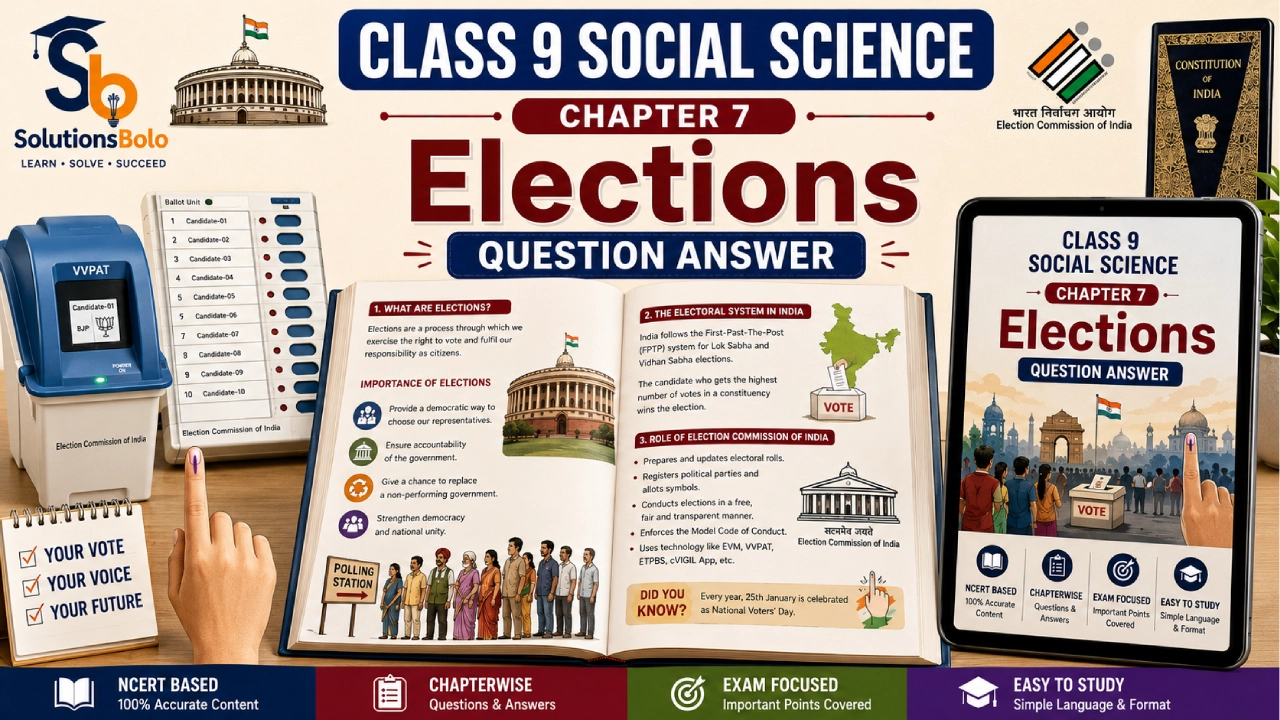
NCERT Class 9 Social Science Chapter 7 “Elections” explains how elections strengthen democracy by enabling citizens to choose their representatives through free and fair voting. The chapter introduces the First-Past-The-Post (FPTP) electoral system, the role of the Election Commission of India (ECI), voter registration, electoral rolls and important election laws that ensure free, fair and transparent elections. It also discusses political representation, the Model Code of Conduct, coalition governments, electoral challenges and the responsibilities of informed voters. These NCERT Solutions provide clear explanations, key terms, intext answers, important questions, MCQs, assertion-reason questions, case-based questions, competency-based questions, long answers and FAQs to help students strengthen conceptual understanding and prepare confidently according to the latest CBSE syllabus (2026–27).
Table of Contents (Quick Links):
1. Chapter Introduction
2. Key Terms and Definitions
3. Intext Question and Answer
4. Exercise Questions and Answers
5. Multiple Choice Questions (MCQs)
6. Assertion Reason Questions
7. Case-Based Questions and Answers
8. Common Mistakes Students Should Avoid & Exam Tips
9. Long Answer Questions
10. Frequently Asked Questions (FAQs)
Chapter Introduction
Chapter 7: Elections explains how elections form the foundation of democracy by enabling citizens to choose their representatives through free and fair voting. This chapter introduces the First-Past-The-Post (FPTP) electoral system, the role of the Election Commission of India, voter registration, electoral laws and the importance of political representation. It also discusses challenges such as misinformation and money power, along with measures to ensure free and fair elections. Understanding this chapter helps students appreciate the value of responsible voting and active participation in strengthening Indian democracy.
Keywords and definitions:
Act
An Act is a law that comes into force after a Bill is passed by the legislature and receives the required approval.
Law
A law is a rule made by the government to maintain order, protect rights and ensure justice.
Bill
A Bill is a “proposal” for making a new law or changing an existing one.
Elections
Elections are the process through which eligible citizens choose their representatives by voting.
Democratic system
A democratic system is a form of government in which people elect their representatives through free and fair elections.
Electoral systems
An electoral system is the method used to conduct elections and elect representatives to the legislature.
Political representation
Political representation means elected representatives act and make decisions on behalf of the people.
Lok Sabha
The Lok Sabha is the House of the People, whose members are directly elected by the citizens of India.
Vidhan Sabha
The Vidhan Sabha is the Legislative Assembly of a State, whose members are directly elected by the people of the State.
Direct Elections
Direct elections are elections in which citizens directly vote to elect their representatives.
Indirect Elections
Indirect elections are elections in which representatives are elected by an elected body instead of the people directly.
Elected representatives
Elected representatives are people chosen by citizens to represent them and make decisions on their behalf.
Right to vote
The right to vote is the right of every eligible citizen to cast a vote in an election.
Legitimacy
Legitimacy means the public acceptance and lawful authority of a government formed through elections.
Accountability
Accountability means that elected representatives are answerable to the people for their actions and decisions.
Representation
Representation means acting or making decisions on behalf of the people in a democratic system.
Equality
Equality means every citizen has an equal right and equal value in the electoral process.
Psephology
Psephology is the study and analysis of elections, voting patterns and election results.
Election Commission of India
The Election Commission of India (ECI) is an independent constitutional body that conducts free and fair elections in India.
Our Constitution
Our Constitution is the supreme law of India that lays down the rules and principles for governing the country.
Electoral System
An electoral system is the method used to conduct elections and elect representatives to the legislature.
First-Past-The-Post
The First-Past-The-Post (FPTP) system elects the candidate who secures the highest number of votes.
Bicameral structure
A bicameral structure is a legislature consisting of two Houses. In India, Parliament has two Houses—the Lok Sabha (House of the People) and the Rajya Sabha (Council of States).
Vidhan Parishad
The Vidhan Parishad is the Upper House of the State Legislature in some states
State nominates
State nominates means the State Government appoints a person for a specific constitutional position or responsibility.
Representation of the People Act 1950
The Representation of the People Act, 1950 provides for the preparation and revision of electoral rolls.
Representation of the People Act 1951
The Representation of the People Act, 1951 lays down the rules for conducting elections and resolving election disputes.
The Presidential and Vice-Presidential Act, 1952
This Act provides the procedure for conducting the elections of the President and Vice-President of India.
Excise officers
Excise officers are government officials who help enforce election laws by checking the illegal use of liquor during elections.
Delimitation Commission
The Delimitation Commission redraws the boundaries of constituencies based on population changes.
Member of Parliament
A Member of Parliament (MP) is an elected representative of the people in the Parliament of India.
Article 82
Article 82 provides for the readjustment of parliamentary constituencies after each Census.
Articles 324 to 329
Articles 324 to 329 deal with the conduct and supervision of elections in India.
Chief Electoral Officer of the State
The Chief Electoral Officer supervises and coordinates election work in a State.
Tahsildars
Tahsildars are revenue officers who assist in preparing and updating electoral rolls.
Electoral roll
An electoral roll is the official list of eligible voters in a constituency.
Special Intensive Revision (SIR)
SIR is a special drive to prepare and update electoral rolls before elections.
ETPBS
ETPBS is a system that allows service voters to receive and cast postal ballots electronically.
Quasi-judicial body
A quasi-judicial body has the authority to hear cases and make decisions like a court in specific matters.
National Voters’ Day
National Voters’ Day is observed every year on 25 January to encourage voter awareness and participation.
Particularly Vulnerable Tribal Groups
PVTGs are tribal communities identified for special protection and development due to their vulnerability.
ERONET
ERONET is an online system for processing voter registration forms and managing electoral rolls.
International Election Visitors’ Programme
The IEVP promotes international cooperation among election management bodies.
International Foundation for Electoral Systems
IFES is an international organisation that supports democratic elections worldwide.
International IDEA
International IDEA is an international organisation that promotes democracy and electoral processes.
Defection
Defection is the act of leaving the political party on whose ticket a member was elected.
Anti-Defection Law
The Anti-Defection Law discourages elected members from changing political parties after being elected.
National security
National security means protecting the country from internal and external threats.
Constitutional Amendment Act
A Constitutional Amendment Act is a law that changes or adds provisions to the Constitution of India.
RPA
RPA refers to the Representation of the People Acts, 1950 and 1951, which govern elections in India.
Voter Verifiable Paper Audit Trail (VVPAT)
VVPAT is a system that lets voters verify that their vote has been recorded correctly.
Model Code of Conduct
The Model Code of Conduct is a set of guidelines that political parties and candidates must follow during elections.
(page – 161)
Intext Questions and Answers:
1. Why are elections essential to a democratic system?
Answer:
Elections are essential because they allow citizens to choose their representatives, form governments and hold leaders accountable. They ensure people’s participation, equality and legitimacy, making democracy responsive to the will of the people.
Explanation:
1. Elections are the foundation of a democratic system because they give citizens the right to choose their representatives through voting.
2. They ensure that governments derive their authority from the people’s consent and remain accountable for their actions.
3. Regular, free and fair elections promote equality, participation and peaceful transfer of power.
4. By allowing every eligible citizen an equal voice, elections strengthen democracy and protect the rights and interests of the people.
2. How do electoral systems and rules shape political representation and fairness?
Answer:
Electoral systems decide how representatives are elected, while election rules ensure fairness, transparency and equal opportunities. Together, they provide proper political representation, protect voters’ rights and strengthen public confidence in the democratic electoral process.
Explanation:
Role of Electoral System:
Electoral systems determine how representatives are elected and how people’s votes are reflected in the legislature. They ensure that citizens are represented through a recognised method of election.
(i) The First-Past-The-Post (FPTP) system elects the candidate who secures the highest number of votes.
(ii) Different electoral systems help elect representatives at different levels of government.
Role of Electoral Rules:
Election rules ensure that the electoral process remains free, fair and transparent. They provide equal opportunities to voters and candidates during elections.
(i) Electoral rolls and constituency delimitation help conduct elections fairly.
(ii) Election laws and procedures promote transparency, equality and public confidence in elections.
3. What role do institutions and laws play in ensuring free and fair elections?
Answer:
Institutions like the Election Commission of India and laws such as the Representation of the People Acts ensure free, fair and transparent elections by regulating the electoral process and protecting voters’ rights.
Explanation:
Institutions play an important role in conducting elections independently and impartially. They supervise the electoral process and ensure that elections are conducted in a free, fair and transparent manner.
(i) Election Commission of India (ECI) conducts and supervises elections across the country.
(ii) Chief Electoral Officers and election officials prepare electoral rolls and manage election arrangements.
Laws provide the legal framework for conducting elections and protecting democratic values. They regulate the electoral process and ensure fairness and accountability.
(i) Representation of the People Acts; 1950 & 1951 govern voter registration and the conduct of elections.
(ii) Articles 324–329 of the Constitution empower the Election Commission and regulate elections in India.
4. What challenges do elections face in practice and how can these challenges affect democracy?
Answer:
Elections face challenges such as misinformation, fake news, intimidation and electoral malpractices. These can influence voters unfairly, reduce public trust and weaken the fairness and credibility of democratic elections.
Explanation:
Election faces the challenges:
Elections face several practical challenges that may influence voters and affect the fairness of the electoral process. These challenges make it difficult to ensure completely free and fair elections.
(i) Misinformation and fake news can mislead voters and influence their decisions.
(ii) Money power and electoral malpractices may reduce fairness and create an uneven electoral process.
Challenges affect democracy:
These challenges can weaken democracy by reducing public confidence in elections and affecting informed decision-making. They also make it difficult to uphold democratic values and fairness.
(i) Public trust in elections may decline if people doubt the fairness of the process.
(ii) Democratic values may weaken when elections are not conducted freely and fairly.
(page – 162)
5. Fig. 7.1. Importance of elections in a democracy. (Fill in the two empty boxes to indicate why elections are important for democratic functioning and discuss how each one of them is ensured through elections.)
Answer:
Elections are important because they promote participation, representation, equality, legitimacy, accountability and transparency, strengthening democracy by ensuring that governments reflect the will of the people.
Explanation:
Elections are essential for democratic functioning because they allow citizens to choose their representatives, make governments accountable and strengthen democratic values.
Legitimacy: A government formed through free and fair elections gains the people’s trust and lawful authority.
Accountability: Regular elections make elected representatives answerable to the people for their performance.
Representation: People elect representatives who express their views and make decisions on their behalf.
Equality: Every eligible citizen has one vote, giving everyone an equal opportunity to participate.
Participation: (Empty Box 1): Elections encourage citizens to take an active part in the democratic process by casting their votes.
Transparency: (Empty Box 2): Election laws, the Election Commission, EVMs and VVPAT help ensure that elections are conducted fairly and openly.
LET’S EXPLORE (Page – 165)
6. Different democracies use different electoral systems. Make groups of 5–6 students. Each group will select six countries from different continents. Prepare and present a case study on the type of electoral system(s) operating in those countries and discuss their latest election results of those countries.
(Answer will be upload shortly)
Don’t Miss Out (Page – 166)
7. Article 82 of the Constitution of India mandates the establishment of a Delimitation Commission. India has had four Delimitation Commissions—in 1952, 1963, 1973 and 2002. “Can you find out the reason for the long interval between 1973 and 2002 with the help of your teacher?”
Answer:
The long gap occurred because the 42nd Constitutional Amendment (1976) froze the readjustment of constituencies based on population until after the 2001 Census to promote family planning and maintain fair representation.
Explanation:
The long interval between the 1973 and 2002 Delimitation Commissions was due to the 42nd Constitutional Amendment Act, 1976, which froze the readjustment of Lok Sabha and State Assembly constituencies based on population. This freeze was introduced to encourage family planning and ensure that states controlling population growth were not placed at a disadvantage. After the 2001 Census, the 84th Constitutional Amendment Act, 2001 allowed delimitation, leading to the establishment of the 2002 Delimitation Commission.
THINK ABOUT IT (page – 168)
7. You will turn 18 in a few years. As a responsible citizen, you should register yourself as a voter. Find out the various steps of the procedure for registration and the list of required documents for the same.
Answer:
Register as a voter through the Election Commission portal or Voter Helpline App, fill the application form, upload age and address proof with a photograph, submit it for verification and wait for your name to be included in the electoral roll.
Explanation:
Steps for Voter Registration
1. Visit the Election Commission’s voter registration portal or use the Voter Helpline App.
2. Fill in the voter registration form with the required details.
3. Upload the necessary documents.
4. Submit the application for verification.
5. After successful verification, your name is added to the electoral roll.
Required Documents
(i) Proof of age (ii) Proof of address (iii) Recent passport-size photograph (iv) Identity proof (if required)
8. Discuss, with anyone who has just turned 18 and has registered as a voter, the ease or difficulty faced in the voter registration process.
Answer:
A newly registered voter shared that the online registration process was simple and convenient. However, document verification and updating details took some time. Overall, the experience was smooth and encouraged responsible participation in democracy.
Explanation:
Today, voter registration is much simpler than before. While most paper-based procedures have been replaced by digital services, applicants may still face minor difficulties during document verification or approval.
Easy Online Registration: The application can be submitted easily through the Voter Helpline App or the Election Commission portal.
Document Verification: Uploading documents is simple, though verification may take some time before approval.
Positive Experience: The voter felt proud to be registered and appreciated the smooth, transparent registration process.
LET’S EXPLORE (page – 168)
9. Find out who are classified as service voters and who can vote using ETPBS?
Answer:
Service voters include members of the Armed Forces, certain government employees serving abroad and their eligible spouses. They can cast their votes through the Electronically Transmitted Postal Ballot System (ETPBS).
Explanation:
Service voters are citizens who serve the nation away from their home constituencies. They are given special voting facilities to ensure they can exercise their democratic right.
Service voters:
• Members of the Armed Forces.
• Members of the Armed Police Force serving outside their state.
• Certain Government of India employees posted abroad.
• Eligible spouses of service voters (where applicable).
Vote using ETPBS:
Eligible service voters can cast their votes through the Electronically Transmitted Postal Ballot System (ETPBS), which enables them to vote without being physically present in their constituency.
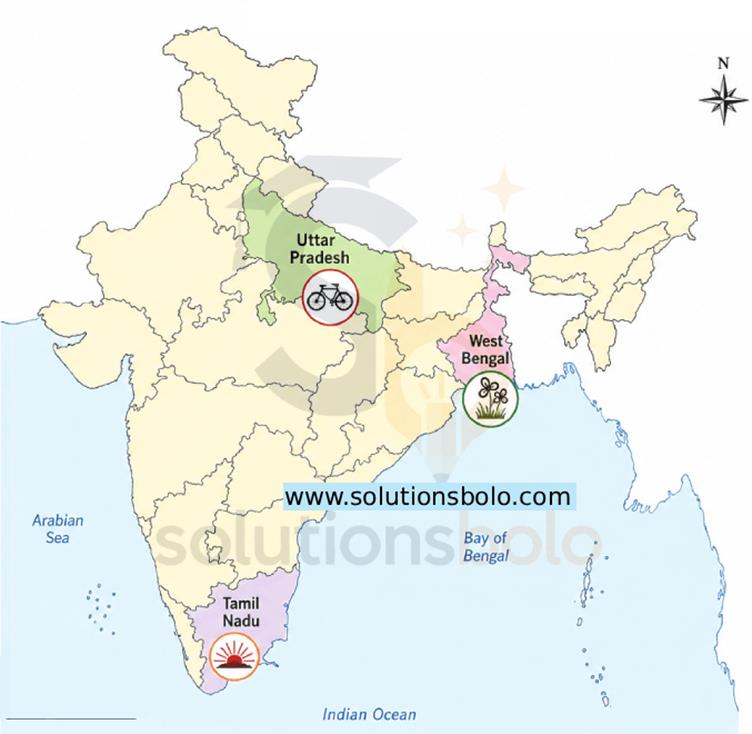
10. Choose any three states (including yours). Find the symbols of state parties belonging to those states and plot them on the given map of India. List down their major agenda, as mentioned in their manifesto in the latest Lok Sabha/Vidhan Sabha/Local Body Elections.
Answer:
| State 1: Uttar Pradesh |
State Party: Samajwadi Party (SP)
Election Symbol: Bicycle
Major Agenda (Manifesto):
• Employment generation
• Better education
• Farmers’ welfare
| State 2: West Bengal |
State Party: All India Trinamool Congress (AITC)
Election Symbol: Flowers and Grass
Major Agenda (Manifesto):
• Social welfare schemes
• Women’s empowerment
• Rural development
| State 3: Tamil Nadu |
State Party: Dravida Munnetra Kazhagam (DMK)
Election Symbol: Rising Sun
Major Agenda (Manifesto):
• Social justice
• Quality education
• Economic development
Activity:
Plot the election symbols of the above state parties on the outline map of India at their respective states.
11. Form groups of 4–6 students. Identify and compare the policy preferences on the following parameters for two political parties in the last Lok Sabha Elections using credible sources like party manifestos, newspapers, etc. Present the points of comparison in a poster using bullet points, symbols, colour coding, etc.
| Policy Area | Party’s Viewpoint | Any policy/law that … point | Source |
| Education | |||
| National Security | |||
| Social Welfare | |||
| Environment | |||
| Economy | |||
| Health |
Answer:
Party 1:
Bharatiya Janata Party (BJP)
| Policy Viewpoints |
Education: Focus on quality education, skill development and digital learning.
National Security: Strengthening national security and modernising defence forces.
Social Welfare: Welfare schemes for women, farmers, poor families and weaker sections.
Environment: Promotion of renewable energy, cleanliness and environmental conservation.
Economy: Infrastructure development, manufacturing, employment and economic growth.
Health: Improving healthcare facilities and expanding affordable health services.
| Policies/Laws Supporting These Viewpoints |
• National Education Policy (NEP) 2020
• Ayushman Bharat
• PM Kisan Samman Nidhi
• Swachh Bharat Mission
• Digital India
• PM Gati Shakti (or other relevant infrastructure initiatives)
| Source |
• Official BJP Manifesto (Latest Lok Sabha Election)
• Official BJP Website
• Credible Newspapers
Party 2:
Indian National Congress (INC)
| Policy Viewpoints |
Education: Equal access to quality education and strengthening public education.
National Security: National security with emphasis on institutional strengthening and strategic preparedness.
Social Welfare: Social justice, employment and support for disadvantaged groups.
Environment: Climate action, environmental protection and sustainable development.
Economy: Employment generation, support for MSMEs and inclusive economic growth.
Health: Strengthening public healthcare and affordable medical services.
| Policies/Commitments Supporting These Viewpoints |
• Public healthcare initiatives proposed in the manifesto
• Employment and social welfare commitments
• Education reforms proposed in the manifesto
• Environmental sustainability commitments
| Source |
• Official INC Manifesto (Latest Lok Sabha Election)
• Official INC Website
• Credible Newspapers
LET’S EXPLORE (page -176)
12. Find out the number of State parties and Registered Unrecognised Political Parties (RUPP). You may visit the website of ECI.
Answer:
According to the latest information available from the Election Commission of India (ECI), India has 60 State Parties and 2,049 Registered Unrecognised Political Parties (RUPPs). These numbers may change as the ECI updates party recognition.
Explanation:
The Election Commission of India (ECI) periodically reviews the recognition status of political parties. According to the latest available information, India has 60 recognised State Parties and 2,049 Registered Unrecognised Political Parties (RUPPs). These figures may change when new parties are recognised, existing parties lose recognition, merge with others or are delisted by the ECI. Students should always refer to the latest ECI records for updated information
13. The year 1967 witnessed an end to the era of single-party dominated elections in India and an era of alliances began. Even though various states witnessed politics of alliance starting from 1967, it was in 1977 that various political parties formed an alliance as the Janata Party against the backdrop of the National Emergency (1975–1977). The Janata Party formed the first coalition government at the national level, which was popularly known as the Janata Government. Since the late 1990s, the National Democratic Alliance (NDA), led by the Bharatiya Janata Party (BJP) and the United Progressive Alliance (UPA), led by the Indian National Congress (INC) until its dissolution in 2023 and subsequent reconstitution as the Indian National Developmental Inclusive Alliance, have been the major political alliances in Indian elections.
Find out the name and the composition (number and name of the national and state parties) of the alliances that won in the following elections to the Lok Sabha.
| Year | Alliance Won | National parties | State parties |
| 1977 | |||
| 1999 | |||
| 2004 | |||
| 2009 | |||
| 2014 | |||
| 2019 | |||
| 2024 |
Answer:
| Year: 1977 Alliance Won: Janata Party Alliance National Parties (No. & Names): 1 – Janata Party State Parties (No. & Names): 2 – Shiromani Akali Dal, AIADMK (major regional ally) |
| Year: 1999 Alliance Won: National Democratic Alliance (NDA) National Parties (No. & Names): 1 – Bharatiya Janata Party (BJP) State Parties (No. & Names): 4 – Janata Dal (United), Shiv Sena, Biju Janata Dal, Shiromani Akali Dal |
| Year: 2004 Alliance Won: United Progressive Alliance (UPA) National Parties (No. & Names): 1 – Indian National Congress (INC) State Parties (No. & Names): 5 – Dravida Munnetra Kazhagam (DMK), Rashtriya Janata Dal (RJD), Nationalist Congress Party (NCP), Jharkhand Mukti Morcha (JMM), Telangana Rashtra Samithi (TRS) |
| Year: 2009 Alliance Won: United Progressive Alliance (UPA) National Parties (No. & Names): 1 – Indian National Congress (INC) State Parties (No. & Names): 4 – Dravida Munnetra Kazhagam (DMK), All India Trinamool Congress (AITC), National Conference (NC), Nationalist Congress Party (NCP) |
| Year: 2014 Alliance Won: National Democratic Alliance (NDA) National Parties (No. & Names): 1 – Bharatiya Janata Party (BJP) State Parties (No. & Names): 5 – Shiv Sena, Telugu Desam Party (TDP), Lok Janshakti Party (LJP), Shiromani Akali Dal (SAD), Apna Dal |
| Year: 2019 Alliance Won: National Democratic Alliance (NDA) National Parties (No. & Names): 1 – Bharatiya Janata Party (BJP) State Parties (No. & Names): 5 – Janata Dal (United), Shiv Sena, Lok Janshakti Party (LJP), AIADMK, Apna Dal (S) |
| Year: 2024 Alliance Won: National Democratic Alliance (NDA) National Parties (No. & Names): 1 – Bharatiya Janata Party (BJP) State Parties (No. & Names): 6 – Telugu Desam Party (TDP), Janata Dal (United), Shiv Sena (Eknath Shinde), Lok Janshakti Party (Ram Vilas), Jana Sena Party, Apna Dal (S) |
LET’S EXPLORE (Page – 165)
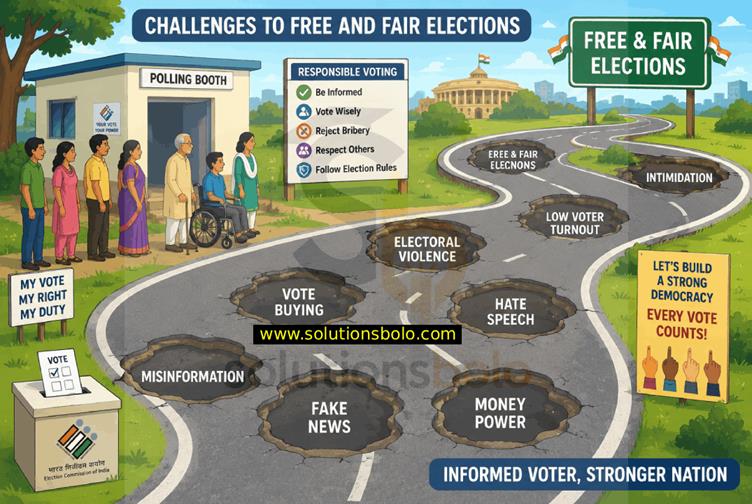
14. Look at the road to free and fair elections above (Fig. 7.13). Fill in the empty potholes with some more challenges after discussing them with your teachers and parents. How can we overcome these challenges?
Answer:
Free and fair elections may face challenges such as money power, vote buying, hate speech, misinformation and low voter turnout. These can be overcome through strict enforcement of election laws, responsible voting, fact-checking and ethical campaigning.
Explanation:
Some More Challenges to Free and Fair Elections
Free and fair elections may face several practical challenges. After discussing with teachers and parents, students may identify some additional problems that can affect the fairness and transparency of the electoral process.
Money Power: Excessive spending during elections may influence voters unfairly.
Vote Buying: Offering money or gifts can affect the free choice of voters.
Hate Speech: Divisive speeches may create tension and disturb peaceful elections.
Misuse of Social Media: False or misleading online content can confuse voters.
Low Voter Turnout: When many eligible citizens do not vote, public representation becomes weaker.
Electoral Violence: Violence or threats may prevent people from voting freely.
Overcome These Challenges:
These challenges can be reduced through responsible behaviour by citizens, political parties and election authorities. The following measures help ensure free and fair elections.
Take Strict Action: The Election Commission should act firmly against electoral malpractices.
Promote Peaceful Elections: Citizens should reject violence, bribery and unfair practices.
Verify Information: Check facts before believing or sharing news related to elections.
Encourage Voting: Every eligible citizen should participate in elections without fear or pressure.
Follow Election Rules: Political parties and candidates should strictly follow election laws and the Model Code of Conduct.
(Page – 179)
Exercise Question Answer:
1. What reforms have been introduced by the ECI to make voting more inclusive for the following groups?
a. People with Disabilities
b. Service Voters
c. Senior Citizens-60 years and above; and 80 years and above
d. Prisoners
e. Persons in preventive detention
Answer:
The Election Commission of India (ECI) has introduced several reforms to make voting more inclusive by providing accessible facilities for Persons with Disabilities, postal ballot and ETPBS for service voters, home voting for eligible senior citizens and special voting provisions for persons in preventive detention.
Explanation:
(a) People with Disabilities (PwDs)
The Election Commission of India (ECI) has introduced several measures to ensure that Persons with Disabilities (PwDs) can vote independently, safely and with dignity.
• Accessible polling stations with ramps and wheelchairs.
• Braille-enabled Electronic Voting Machines (EVMs).
• Volunteers and assistance at polling stations.
• Option of home voting for eligible PwDs with benchmark disability (40% or more) in specified categories.
(b) Service Voters
Service voters include members of the Armed Forces, certain government employees serving outside India and eligible spouses.
Reforms introduced by the ECI include:
• Electronically Transmitted Postal Ballot System (ETPBS) for faster voting.
• Postal ballot facility for eligible service voters.
• Secure and timely transmission of ballot papers.
• Opportunity to vote even while serving away from their home constituency.
(c) Senior Citizens (60 years and above; and 80 years and above)
The ECI has taken special steps to encourage greater participation of senior citizens.
For Senior Citizens (60 years and above):
• Priority arrangements at polling stations.
• Wheelchairs, seating facilities, drinking water and assistance.
• Voter awareness programmes encouraging participation.
For Senior Citizens (80 years and above):
• Optional home voting facility through postal ballot, subject to ECI guidelines.
• Easier and more convenient voting without visiting the polling station.
(d) Prisoners
The ECI follows the provisions of election law regarding prisoners.
• Convicted prisoners and undertrial prisoners lodged in jail are generally not allowed to vote.
• However, this restriction does not apply to persons in preventive detention.
(e) Persons in Preventive Detention
Unlike ordinary prisoners, persons kept under preventive detention are allowed to exercise their voting rights.
The ECI provides:
• Postal ballot facility to eligible persons under preventive detention.
• Arrangements to ensure that they can vote without visiting the polling station.
• Equal opportunity to participate in the democratic process.
2. What are the various functions of the Election Commission of India? Which of these functions is most important for the conduct of free and fair elections? Explain.
Answer:
The Election Commission of India (ECI) prepares electoral rolls, conducts elections, announces election schedules, registers political parties, allots election symbols, promotes inclusive voting and ensures free and fair elections. Its most important function is conducting impartial, transparent and peaceful elections.
Explanation:
Functions of the Election Commission of India (ECI)
1. Prepares and Updates Electoral Rolls
The ECI prepares and regularly updates the electoral roll so that every eligible citizen can vote, while removing duplicate or ineligible entries.
2. Conducts Elections
It conducts elections to the Lok Sabha, Rajya Sabha, State Legislative Assemblies, State Legislative Councils and the offices of the President and Vice-President of India.
3. Announces Election Schedule
The ECI decides the election dates after considering factors such as weather conditions, agricultural activities, festivals and school or university examinations.
4. Registers Political Parties and Allots Election Symbols
It registers political parties, classifies them as national or state parties according to prescribed criteria and allots election symbols to recognised parties and independent candidates.
5. Ensures Free and Fair Elections
The ECI supervises the entire election process, enforces election laws and the Model Code of Conduct (MCC), promotes voter awareness and works to prevent electoral malpractices.
6. Promotes Inclusive Voting
It introduces special facilities for Persons with Disabilities (PwDs), senior citizens, service voters, transgender persons and other eligible voters to ensure that everyone can participate in elections.
As we know that “ensuring free and fair elections” is the Election Commission’s most important function. It conducts elections impartially, enforces election laws, prevents malpractices, protects voters’ rights and ensures that the people’s genuine choice is reflected in democratic governance.
3. Elections are the soul of a democracy. Do you agree? Why or why not?
Answer:
Yes, elections are the soul of a democracy because they enable citizens to choose their representatives, ensure accountable government, promote people’s participation, allow peaceful transfer of power and strengthen democratic values through free, fair and regular elections.
Explanation: Elections are the foundation of a democratic system.
Reasons:
1. People’s Participation: Elections allow citizens to exercise their right to vote and take part in the democratic process.
2. Representation: Citizens elect representatives who express their views and work for the welfare of their constituencies.
3. Accountability: Regular elections make elected representatives answerable to the people for their actions and performance.
4. Peaceful Transfer of Power: Elections enable governments to change peacefully according to the people’s mandate without violence or conflict.
5. Strengthening Democracy: Free and fair elections promote equality, transparency, public trust and respect for constitutional values.
Conclusion
Therefore, elections are rightly called the soul of democracy because they empower citizens, ensure accountable governance and strengthen democratic institutions.
4. Explain at least three differences between the national and state/regional political parties.
Answer:
National parties operate across several states and focus on national issues, whereas state/regional parties mainly work within one state and address regional concerns. Their recognition by the Election Commission is based on different national and state-level criteria.
Explanation:
The following points explain the differences between national and state/regional political parties:
| National Party |
Area of Operation: Functions across several states and contests elections at the national level.
Recognition: Recognised by the Election Commission based on national-level criteria.
Main Focus: Addresses national issues and policies affecting the entire country.
Examples: Bharatiya Janata Party (BJP), Indian National Congress (INC).
| State/Regional Party |
Area of Operation: Mainly operates within one particular state or region.
Recognition: Recognised by the Election Commission based on criteria applicable to a particular state.
Main Focus: Focuses mainly on the interests, development and issues of a particular state or region.
Examples: Dravida Munnetra Kazhagam (DMK), All India Trinamool Congress (AITC), Biju Janata Dal (BJD).
Conclusion
Both national and state/regional parties are essential for India’s democracy. Together, they strengthen the country’s federal democratic system.
5. Why should you vote? Arrange the following in the descending order of your choice. Discuss the reasons for your choice.
a. Opportunity to choose my representative
b. Makes me a responsible person
c. Opportunity to change the non-performing representative
d. Strengthens democracy
Answer:
Voting strengthens democracy by enabling citizens to choose their representatives and replace non-performing governments through elections. It promotes responsible citizenship, ensures government accountability and reflects the will of the people in a democratic system.
Explanation:
Suggested Descending Order:
1. (d) Strengthens democracy
2. (a) Opportunity to choose my representative
3. (c) Opportunity to change the non-performing representative
4. (b) Makes me a responsible person
Reasons:
1. Strengthens Democracy
Voting is the foundation of democracy. When citizens participate in elections, they help form a government that reflects the will of the people. Higher voter participation strengthens democratic values and promotes accountable governance.
2. Opportunity to Choose My Representative
Voting allows citizens to elect representatives who can work for their welfare, raise public issues and make laws in their interest. It ensures that people’s voices are represented in government.
3. Opportunity to Change the Non-performing Representative
Regular elections give citizens the power to replace representatives who fail to perform their duties effectively. This makes elected representatives accountable to the people and encourages better governance.
4. Makes Me a Responsible Person
Voting is an important democratic responsibility. By voting honestly and thoughtfully, citizens contribute to nation-building and promote responsible citizenship.
6. What is the Special Intensive Revision (SIR) initiative of the ECI? Explain the objectives and the necessity of conducting SIR.
Answer:
The Special Intensive Revision (SIR) is an Election Commission initiative to update and verify electoral rolls. It ensures inclusion of eligible voters, removal of incorrect or duplicate entries, improves transparency and accuracy and helps conduct free, fair, inclusive and credible elections.
Explanation:
The Special Intensive Revision (SIR) is a special initiative of the Election Commission of India (ECI) to prepare and update the electoral roll. During this process, electoral officials verify voter details through house-to-house visits and public participation to ensure that the electoral roll remains accurate and up to date.
Objectives of SIR
1. To Prepare an Accurate Electoral Roll
SIR helps include all eligible voters and remove duplicate, incorrect or ineligible entries from the electoral roll.
2. To Register Eligible Citizens
It ensures that citizens who have attained 18 years of age or become eligible to vote are enrolled in the electoral roll.
3. To Improve Transparency
The revision process increases the accuracy and reliability of voter records, making elections more transparent and credible.
4. To Encourage Public Participation
Citizens can check their details, submit claims or objections and help maintain a correct electoral roll.
Necessity of Conducting SIR
The Special Intensive Revision is necessary because the electoral roll changes continuously due to new voters attaining the age of 18, deaths, migration and changes of residence. Regular revision helps maintain an updated electoral roll, prevents duplicate or incorrect entries and ensures that every eligible citizen gets an equal opportunity to vote.
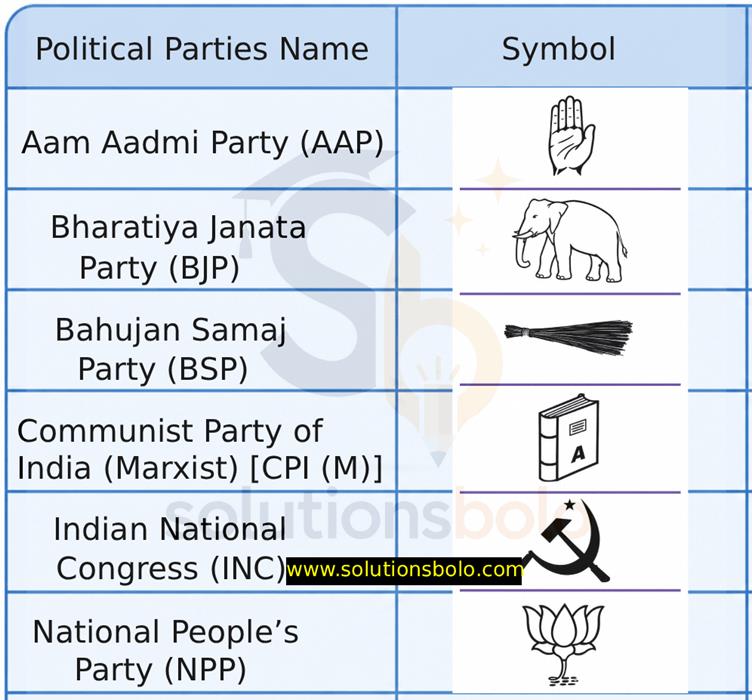
7. Match the political party name with its symbol.
Answer:
Aam Aadmi Party (AAP) — Broom
Bharatiya Janata Party (BJP) — Lotus
Bahujan Samaj Party (BSP) — Elephant
Communist Party of India (Marxist) [CPI (M)] — Hammer, Sickle and Star
Indian National Congress (INC) — Hand
National People’s Party (NPP) — Book
8. Read the case study below and answer the following questions. Ishani and her mother were in the local market, day before the state assembly elections. She noticed wall writing and campaign posters pasted everywhere. Large groups of campaigners were distributing pamphlets and raising slogans in support of the respective candidates. Ishani has turned 18 and will be voting for the first time. She had registered to vote through the ECI’s online portal. The next morning, she, along with her mother and her disabled elder brother, went to the polling station, which was well guarded by the police personnel. A wheelchair was made available to them and volunteers guided them to the polling booth. Inside the polling booth, there were only three people who were performing all duties. Ishani had forgotten her voter ID card and Aadhaar card, but she was surprised as no one asked for them. After casting her vote, she was also able to see the VVPAT slip. While leaving, she wondered how the police personnel vote, as they must be on duty from early morning till late evening. When she went home, she narrated her entire experience to her 89-year-old grandmother, who cast her vote from home.
a. What initiatives were taken by the ECI to enable the voters to cast their vote?
Answer:
The ECI introduced online voter registration, accessible polling stations, wheelchairs, volunteer assistance, VVPAT, adequate security and home voting for eligible senior citizens and persons with disabilities, ensuring inclusive and convenient voting.
Explanation:
The Election Commission of India (ECI) introduced several initiatives to make voting inclusive, accessible and convenient for all eligible voters.
Online Voter Registration: Ishani registered herself through the ECI’s online portal.
Accessible Polling Station: Wheelchair and volunteer assistance were provided for Persons with Disabilities (PwDs).
Safe Voting Environment: Police personnel ensured security and peaceful polling.
VVPAT Facility: Voters could verify that their vote was recorded correctly.
Home Voting: Ishani’s 89-year-old grandmother was able to cast her vote from home under the ECI’s home voting facility.
b. If Ishani was allowed to vote even without carrying her Voter ID card or Aadhaar card, which other document might she be carrying that is valid for voting?
Answer:
Ishani could have produced another ECI-approved identity document, such as a Passport, Driving Licence, PAN Card, MNREGA Job Card, Bank Passbook with photograph or Government Service Identity Card.
Explanation:
Ishani could have carried any other identity document approved by the Election Commission of India, such as:
(i) Passport (ii) Driving License (iii) PAN Card (iv) MNREGA Job Card (v) Passbook with Photograph issued by a Bank or Post Office (v) Government-issued Service Identity Card
Any one of these valid identity documents can be used for voter identification at the polling station.
c. Cite the examples of violations of the Model Code of Conduct.
Answer:
Examples include unauthorised wall writing, pasting campaign posters, distributing pamphlets and raising election slogans near polling stations during the prohibited campaign period, which may influence voters unfairly.
Explanation:
The following activities mentioned in the passage are examples of violations of the Model Code of Conduct, if carried out during the prohibited campaign period:
(i) Wall writing without permission.
(ii) Pasting campaign posters in unauthorised places.
(iii) Distributing pamphlets near polling stations.
(iv) Raising election slogans or campaigning near the polling booth.
Such activities may influence voters and disturb the fairness of the electoral process.
[Note: Campaigning is prohibited within the prescribed period before polling and near polling stations, as per election rules.]
d. Give a suitable title to the passage.
Answer:
“An Inclusive and Fair Voting Experience”
e. Find out how the police and army personnel cast their votes.
Answer:
Police personnel on election duty and members of the Armed Forces cast their votes through the Electronically Transmitted Postal Ballot System (ETPBS) or postal ballot as eligible service voters.
Explanation:
Police Personnel: Police personnel on election duty away from their home constituency can cast their votes through the Electronically Transmitted Postal Ballot System (ETPBS) or other postal ballot facilities provided by the Election Commission of India (ECI).
Army Personnel: Members of the Armed Forces are classified as service voters and can cast their votes through the Electronically Transmitted Postal Ballot System (ETPBS) or postal ballot while serving away from their home constituency.
9. A comparative chart of three countries is given below. Based on the information given in the chart, answer the questions.
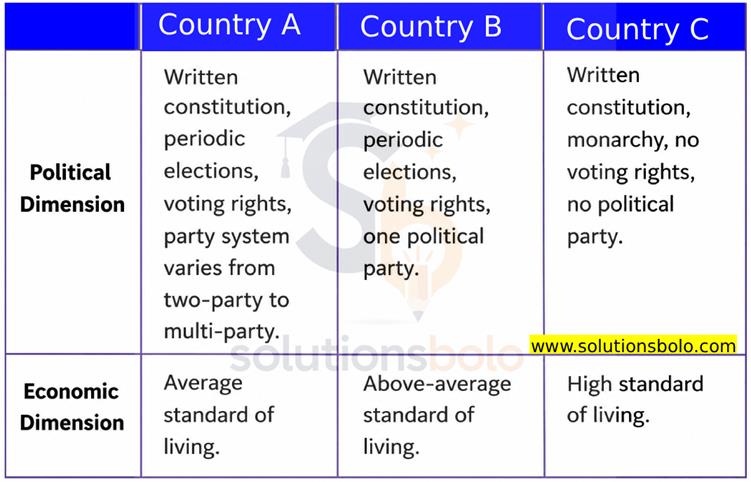
a. What is the difference between having a voting right in a country with a multi-party system and another with a single-party system?
Answer:
In a multi-party system, citizens can choose from different political parties and candidates, giving them greater political choice and encouraging healthy competition. In a single-party system, voters have little or no real choice because only one political party contests elections. Therefore, a multi-party system provides broader representation, greater political participation and strengthens democratic decision-making.
b. In which of the above countries would you like to stay and why?
Answer:
I would prefer to live in Country A because it has a written Constitution, periodic elections, voting rights and a multi-party system. These democratic features protect citizens’ rights, provide freedom to choose representatives, ensure government accountability and encourage public participation. Therefore, Country A offers a stronger democratic environment despite having only an average standard of living.
10. What are the challenges to conducting free and fair elections?
Answer:
Free and fair elections face challenges such as misinformation, fake news, intimidation, money power, vote buying, hate speech, electoral violence and low voter participation. The Election Commission addresses these challenges through election laws, the Model Code of Conduct, voter awareness, EVMs and VVPAT.
Explanation:
Free and fair elections may face several challenges that can influence voters or affect the transparency, fairness and credibility of the electoral process. Some of the major challenges are explained below.
Major Challenges to Free and Fair Elections
Misinformation and Fake News: False information may mislead voters and influence their decisions.
Intimidation: Threats or pressure may prevent people from voting freely.
Money Power and Vote Buying: Offering money or gifts can unfairly influence voters.
Hate Speech: Divisive speeches may create tension and disturb peaceful elections.
Misuse of Social Media: Unverified online content can spread rumours and confusion.
Low Voter Participation: Fewer voters reduce effective public representation.
Electoral Violence: Violence or fear may discourage people from exercising their voting rights.
Measures to Overcome These Challenges:
(i) Strict enforcement of election laws and the Model Code of Conduct (MCC).
(ii) Use of Electronic Voting Machines (EVMs) and Voter Verifiable Paper Audit Trail (VVPAT) for transparent voting.
(iii) Voter awareness campaigns to promote informed and ethical voting.
(iv) Fact-checking and responsible use of social media.
(v) Active participation of citizens in reporting electoral malpractices.
(vi) Equal opportunities and accessible voting facilities for all eligible voters.
11. On the Stage.
Elections are to be held in your school for the posts of Head Girl, Head Boy and Sports Captain. Assume the roles of an Election Commissioner, Returning Officer, Polling Agent, Candidate, Campaigner, Polling Officer, Police Personnel and a Journalist and perform their roles while ensuring free, fair and transparent elections
Answer:
A mock school election helps students understand how different election officials perform their responsibilities. By following election rules, maintaining fairness, respecting voters’ rights and ensuring transparency, students learn the values and functioning of democracy through practical experience.
Explanation:
Each participant should perform their role honestly and fairly to ensure free, fair and transparent elections.
Roles and Responsibilities:
1. Election Commissioner
(i) Announces the election schedule.
(ii) Frames election rules and ensures fair conduct.
(iii) Resolves complaints and supervises the entire election process.
2. Returning Officer
(i) Accepts nomination forms.
(ii) Scrutinises nominations.
(iii) Conducts counting of votes and officially declares the results.
3. Polling Officer
(i) Verifies the identity of voters.
(ii) Issues ballot papers or allows voting through EVM (if used).
(iii) Maintains order inside the polling booth.
4. Polling Agent
(i) Represents a candidate at the polling station.
(ii) Observes the voting process.
(iii) Ensures that voting is conducted fairly without any malpractice.
5. Candidate
(i) Files nomination papers.
(ii) Presents ideas and plans to students.
(iii) Follows election rules and the Model Code of Conduct.
6. Campaigner
(i) Promotes the candidate peacefully.
(ii) Distributes pamphlets and explains the candidate’s manifesto.
(iii) Avoids hate speech, bribery or false promises.
7. Police Personnel
(i) Maintains law and order.
(ii) Prevents violence or intimidation.
(iii) Ensures that voters can cast their votes without fear.
8. Journalist
(i) Reports election events objectively.
(ii) Interviews candidates and voters.
(iii) Shares accurate information without spreading rumours or fake news.
Conclusion: Therefore, every eligible citizen should vote responsibly to strengthen democracy.
12. Try and make videos or audios on topics like: My Vote My Nation; No Voter to be Left Behind; How to Eliminate the Ill of Money Power, etc.
Answer:
My Vote, My Nation: My vote strengthens democracy by choosing responsible representatives.
No Voter to be Left Behind: Every eligible voter deserves equal opportunity, accessible voting facilities and respectful participation in free and fair elections.
How to Eliminate the Ill of Money Power: Reject bribery, vote ethically, follow election laws and protect democracy from the harmful influence of money power.
Explanation:
My Vote, My Nation
“My vote is my voice in a democracy. By voting responsibly, I help choose honest and capable representatives. Every vote strengthens democracy and promotes accountable governance. I will always vote without fear, pressure or inducement because my vote contributes to the progress and development of our nation.”
No Voter to be Left Behind
“Every eligible citizen has the right to vote. The Election Commission of India provides facilities for persons with disabilities, senior citizens and service voters to ensure inclusive elections. Equal participation makes elections free, fair and representative. Every vote matters and no eligible voter should be left behind.”
How to Eliminate the Ill of Money Power
“Money power weakens free and fair elections by influencing voters unfairly. Citizens should reject gifts, bribery and false promises while voting. Strict enforcement of election laws, voter awareness and ethical voting help ensure transparent elections and strengthen democracy through the people’s genuine choice.”
13. Select one national or state political party. Using authentic and reliable sources such as the Election Commission of India (ECI) website, the official website of the selected political party and newspapers. Prepare a comparative chart of the last two State Legislative Assembly elections. The chart should include the following details for the chosen party:
a. Some promises made in the Election manifesto
b. Percentage of votes polled
c. Number of seats won
d. Number of women who contested
e. Number of women candidates elected
Present the data for both elections in a clear and comparative format, citing all sources used.
Answer:
The comparative chart shows that the BJP won 109 seats in the 2018 Madhya Pradesh Assembly election and 163 seats in 2023. It also compares manifesto promises, vote share and women’s participation in both elections.
Explanation:
Selected State: Madhya Pradesh
Selected Political Party: Bharatiya Janata Party (BJP)
| 2018 Assembly Election |
Some Major Manifesto Promises – Farmers’ welfare, employment, infrastructure development
Percentage of Votes Polled – 41.02%
Number of Seats Won – 109
Number of Women Who Contested – Students should refer to the official ECI Statistical Report.
Number of Women Candidates Elected – Students should refer to the official ECI Statistical Report.
| 2023 Assembly Election |
Some Major Manifesto Promises – Women empowerment, farmers’ welfare, infrastructure, youth employment, welfare schemes
Percentage of Votes Polled – 48.55%
Number of Seats Won – 163
Number of Women Who Contested – 28
Number of Women Candidates Elected – 18
14. Do you think ‘One Nation, One Election’ can improve the efficiency of the electoral process? Divide the class and discuss into two groups—one to examine its potential advantages and the other to analyse its limitations
Answer:
‘One Nation, One Election’ may improve electoral efficiency by reducing costs, saving time and simplifying election management. However, it also raises concerns about state-specific issues, constitutional changes and achieving political consensus before implementation.
Explanation:
‘One Nation, One Election’ means conducting Lok Sabha and State Legislative Assembly elections simultaneously. Its potential advantages and limitations are as follows:
Group A: Potential Advantages of ‘One Nation, One Election’
• Reduces the overall cost of conducting elections.
• Saves time and administrative resources.
• Minimises disruption caused by the repeated Model Code of Conduct.
• Enables governments to focus more on governance and development.
• Simplifies election management and improves administrative efficiency.
Group B: Limitations of ‘One Nation, One Election’
• Simultaneous elections may reduce focus on state-specific issues.
• Mid-term dissolution of a government may create practical difficulties.
• Conducting nationwide elections together requires extensive planning and logistics.
• Constitutional and legal changes may be necessary before implementation.
• Achieving political consensus among all parties may be challenging.
Conclusion:
Any electoral reform should strengthen democracy while protecting the interests of both the Union and the States.
Multiple Choice Questions (MCQs)
1. Why are elections considered essential in a democratic system?
(A) They help governments collect taxes.
(B) They allow citizens to choose their representatives.
(C) They appoint judges to courts.
(D) They increase the number of political parties.
Correct Answer: (B) They allow citizens to choose their representatives.
Explanation:
Elections are the foundation of democracy because they give eligible citizens the right to choose their representatives through voting. This ensures people’s participation in governance and makes the government accountable to the public.
2. Which electoral system is used for elections to the Lok Sabha in India?
(A) Proportional Representation
(B) First-Past-The-Post System
(C) Single Transferable Vote
(D) Open List System
Correct Answer: (B) First-Past-The-Post System
Explanation:
India follows the First-Past-The-Post (FPTP) system for Lok Sabha elections. The candidate receiving the highest number of valid votes in a constituency is declared elected, even without securing an absolute majority.
3. Which constitutional body conducts free and fair elections in India?
(A) Supreme Court
(B) Parliament
(C) Election Commission of India
(D) Finance Commission
Correct Answer: (C) Election Commission of India
Explanation:
The Election Commission of India is an independent constitutional body responsible for conducting free, fair and transparent elections. It supervises electoral rolls, election schedules, polling, counting and enforcement of election rules.
4. Which of the following is a major principle of democratic elections?
(A) Hereditary rule
(B) Equality of votes
(C) Rule by monarchy
(D) Selection by nomination only
Correct Answer: (B) Equality of votes
Explanation:
Democratic elections are based on political equality, where every eligible citizen has one vote of equal value. This principle ensures equal participation and fairness in the democratic process.
5. Which law mainly deals with the conduct of elections in India?
(A) Representation of the People Act, 1951
(B) Right to Education Act
(C) Consumer Protection Act
(D) Forest Conservation Act
Correct Answer: (A) Representation of the People Act, 1951
Explanation:
The Representation of the People Act, 1951 provides legal provisions relating to elections, qualifications and disqualifications of candidates, election procedures and settlement of election disputes in India.
6. What is the primary purpose of electoral rolls?
(A) To list government employees
(B) To record political parties
(C) To prepare the list of eligible voters
(D) To register election candidates
Correct Answer: (C) To prepare the list of eligible voters
Explanation:
An electoral roll is the official list of eligible voters in a constituency. Only citizens whose names appear on the electoral roll are entitled to cast their votes during elections.
7. Which of the following can weaken free and fair elections?
(A) Peaceful campaigning
(B) Voter awareness
(C) Fake news and misinformation
(D) Secret ballot
Correct Answer: (C) Fake news and misinformation
Explanation:
Fake news and misinformation may mislead voters by spreading incorrect information. Such practices can influence public opinion unfairly and reduce the transparency and credibility of the electoral process.
8. What is the main purpose of the Model Code of Conduct?
(A) To increase voter age
(B) To ensure ethical behaviour during elections
(C) To prepare the Union Budget
(D) To appoint judges
Correct Answer: (B) To ensure ethical behaviour during elections
Explanation:
The Model Code of Conduct provides guidelines for political parties and candidates during elections. It promotes fairness, prevents misuse of official machinery and ensures a level playing field for all contestants.
9. Who is eligible to vote in elections in India?
(A) Every resident above 16 years
(B) Every Indian citizen aged 18 years or above whose name appears in the electoral roll
(C) Only government employees
(D) Only taxpayers
Correct Answer: (B) Every Indian citizen aged 18 years or above whose name appears in the electoral roll
Explanation:
An Indian citizen who is 18 years of age or above and whose name is included in the electoral roll has the constitutional right to vote in elections.
10. Which of the following best reflects the importance of elections in a democracy?
(A) They establish dictatorship.
(B) They strengthen representation, legitimacy, equality and accountability.
(C) They remove the Constitution.
(D) They eliminate political parties.
Correct Answer: (B) They strengthen representation, legitimacy, equality and accountability.
Explanation:
Elections strengthen democracy by ensuring political representation, legitimacy of government, equality of citizens and accountability of elected representatives. These principles help build public trust and encourage responsible governance.
Assertion–Reason Questions
Directions: Choose the correct option.
(A) Both Assertion (A) and Reason (R) are true and Reason (R) is the correct explanation of Assertion (A).
(B) Both Assertion (A) and Reason (R) are true, but Reason (R) is not the correct explanation of Assertion (A).
(C) Assertion (A) is true, but Reason (R) is false.
(D) Assertion (A) is false, but Reason (R) is true.
1. Assertion (A): Elections are essential for the successful functioning of a democratic system.
Reason (R): Elections allow citizens to choose their representatives and hold them accountable.
Correct Answer: (A)
Explanation:
Elections are the foundation of democracy because they enable citizens to elect their representatives through voting. This process ensures public participation, political accountability and the legitimacy of the government formed after elections.
2. Assertion (A): India follows the First-Past-The-Post (FPTP) system for Lok Sabha elections.
Reason (R): The Election Commission of India conducts Lok Sabha elections.
Correct Answer: (B)
Explanation:
India follows the First-Past-The-Post (FPTP) system for Lok Sabha elections. The Election Commission indeed conducts these elections, but conducting elections does not explain why India follows the FPTP system. Hence, both statements are true, but the Reason is not the correct explanation.
3. Assertion (A): Every Indian citizen automatically becomes a voter after attaining 18 years of age.
Reason (R): A citizen must also have their name included in the electoral roll to vote.
Correct Answer: (D)
Explanation:
Attaining 18 years of age makes an Indian citizen eligible to register as a voter, but voting is allowed only after the person’s name is included in the electoral roll. Therefore, the Assertion is false, while the Reason is true.
4. Assertion (A): The Election Commission of India plays an important role in ensuring free and fair elections.
Reason (R): It conducts elections, prepares electoral rolls and supervises the entire election process.
Correct Answer: (A)
Explanation:
The Election Commission of India is an independent constitutional body responsible for conducting elections, preparing electoral rolls, monitoring polling and enforcing election rules to ensure fairness, transparency and public confidence in the electoral process.
5. Assertion (A): Fake news and misinformation can weaken democracy.
Reason (R): Fake news helps voters make informed and unbiased decisions during elections.
Correct Answer: (C)
Explanation:
Fake news and misinformation can mislead voters, reduce transparency and weaken democracy. However, the Reason is false because fake news spreads misleading information rather than helping voters make informed and unbiased decisions.
Case-Based Question and Answer
Case-Based Question – 1
Read the passage carefully and answer the following questions.
India is the world’s largest democracy, where citizens elect their representatives through free and fair elections. The Election Commission of India conducts elections and ensures that the electoral process remains transparent and impartial. Elections give citizens an opportunity to choose their representatives, hold governments accountable and strengthen democratic values. However, challenges such as misinformation, fake news, money power and low voter participation may affect the fairness of elections. Responsible citizens, political parties and election authorities must work together to ensure that elections remain free, fair and peaceful.
Answer the following questions:
(a) Why are elections considered essential in a democratic system?
Answer:
Elections enable citizens to choose their representatives, ensure public participation in governance and make governments accountable to the people.
(b) Which constitutional body conducts elections in India?
(A) Finance Commission
(B) Election Commission of India
(C) Supreme Court
(D) Union Public Service Commission
Answer: (B) Election Commission of India
Explanation:
The Election Commission of India (ECI) is an independent constitutional body responsible for conducting free and fair elections. It prepares electoral rolls, supervises the election process and ensures that elections are conducted impartially across the country.
(c) Mention any two challenges that may affect free and fair elections.
Answer:
• Misinformation and Fake News
• Money Power
Explanation:
Misinformation and Fake News:
False or misleading information can confuse voters and influence their decisions unfairly, reducing transparency and informed participation in elections.
Money Power:
Excessive use of money during elections may influence voters unfairly and create an unequal electoral process, affecting the principle of free and fair elections.
(d) Suggest any two measures to ensure free and fair elections.
Answer:
• Verify information before sharing or believing it.
• Encourage ethical voting and strict enforcement of election laws.
Explanation:
Verify information before sharing or believing it:
Citizens should check the accuracy of news and information before sharing it. This helps prevent the spread of misinformation and enables voters to make informed and responsible decisions.
Encourage ethical voting and strict enforcement of election laws:
Citizens should vote honestly and responsibly, while the Election Commission should strictly enforce election laws and the Model Code of Conduct to maintain free, fair and peaceful elections.
Case-Based Question – 2
Read the passage carefully and answer the following questions.
India follows the First-Past-The-Post (FPTP) system for elections to the Lok Sabha and State Legislative Assemblies. Under this system, the candidate receiving the highest number of valid votes in a constituency is declared elected. Every eligible citizen aged 18 years or above whose name appears in the electoral roll has the right to vote. Electoral rolls are prepared and updated by the Election Commission to ensure that every eligible voter gets an opportunity to participate in the democratic process.
(a) Which electoral system is followed for Lok Sabha elections in India?
(A) Proportional Representation
(B) First-Past-The-Post
(C) Single Transferable Vote
(D) List System
Answer: (B) First-Past-The-Post
Explanation:
India follows the First-Past-The-Post electoral system for Lok Sabha elections. Under this system, the candidate securing the highest number of valid votes in a constituency is declared elected.
(b) Who is eligible to vote in India?
Answer:
An Indian citizen aged 18 years or above whose name appears in the electoral roll.
Explanation:
Every Indian citizen who has attained 18 years of age and whose name is included in the electoral roll is eligible to vote in elections and participate in the democratic process.
(c) Why is the electoral roll important?
Answer:
It contains the names of all eligible voters.
Explanation:
The electoral roll is the official list of eligible voters. Only citizens whose names appear in this list are allowed to vote, ensuring fairness, transparency and proper voter identification.
(d) Why is the First-Past-The-Post system considered simple?
Answer:
The candidate with the highest number of valid votes is declared elected.
Explanation:
The First-Past-The-Post system is simple because the candidate receiving the highest number of valid votes wins the election. It is easy to understand, conduct and determine the election results.
Case-Based Question – 3
Read the passage carefully and answer the following questions.
After the 1967 elections, many Indian states witnessed coalition governments instead of governments formed by a single political party. In 1977, the Janata Party formed the first coalition government at the national level after defeating the ruling party. Since the late 1990s, alliances such as the National Democratic Alliance (NDA) and the United Progressive Alliance (UPA) have played an important role in Indian politics. Coalition governments are formed when two or more political parties join together to secure a majority in the Lok Sabha and form the government.
(a) Why are coalition governments formed in India?
Answer:
Coalition governments are formed when no single political party secures a majority in the Lok Sabha.
Explanation:
A coalition government is formed when no political party wins enough seats to form the government independently. Two or more parties join together to obtain a majority and provide a stable government.
(b) Which was the first coalition government formed at the national level in India?
(A) Congress Government
(B) Janata Government
(C) NDA Government
(D) UPA Government
Answer: (B) Janata Government
Explanation:
Following the 1977 Lok Sabha elections, the Janata Party formed India’s first coalition government at the national level. It came to power after the National Emergency and marked a significant political change.
(c) Name any two major political alliances mentioned in the chapter.
Answer:
• National Democratic Alliance (NDA)
• United Progressive Alliance (UPA)
Explanation:
National Democratic Alliance (NDA):
The NDA is a coalition of political parties led by the Bharatiya Janata Party (BJP). It has formed the Union Government in several Lok Sabha elections.
United Progressive Alliance (UPA):
The UPA was a coalition led by the Indian National Congress (INC). It governed India after the 2004 and 2009 Lok Sabha elections.
(d) How do political alliances strengthen democratic governance?
Answer:
(i) They encourage cooperation among political parties.
(ii) They help form a government with majority support.
Explanation:
Cooperation among Parties: Political alliances encourage parties to work together, discuss common issues and develop shared policies for governing the country.
Majority Support: Alliances help form a stable government when no single party wins a majority, ensuring continuity in governance and democratic decision-making.
Common Mistakes Students Should Avoid
1. Confusing Direct Elections with Indirect Elections
Many students mix up direct and indirect elections. Remember that members of the Lok Sabha and Vidhan Sabha are elected directly by the people, while the President, Vice-President and Rajya Sabha members are elected indirectly.
Exam Tip: Learn one example of each type of election to avoid confusion in MCQs and short-answer questions.
2. Misunderstanding the First-Past-The-Post (FPTP) System
Students often think that a winning candidate must secure more than 50% of the total votes. Under the First-Past-The-Post (FPTP) system, the candidate with the highest number of valid votes is declared elected.
Exam Tip: Remember that highest votes, not absolute majority, decide the winner.
3. Assuming Every 18-Year-Old Can Vote Automatically
Many students believe that every citizen becomes a voter immediately after turning 18. In reality, a citizen must also have their name included in the electoral roll.
Exam Tip: Eligibility to vote depends on age as well as registration in the electoral roll.
4. Confusing the Election Commission with the Government
Some students think that the Election Commission works under the government. It is actually an independent constitutional body responsible for conducting free and fair elections.
Exam Tip: Remember that the Election Commission functions independently to ensure impartial elections.
5. Ignoring the Importance of the Electoral Roll
Students sometimes overlook the role of the electoral roll. Only those whose names appear in the electoral roll are allowed to vote.
Exam Tip: Revise the term electoral roll, as it is frequently asked in competency-based and case-based questions.
6. Forgetting the Role of the Model Code of Conduct (MCC)
Students may confuse the Model Code of Conduct with election laws. The MCC provides guidelines for the conduct of political parties and candidates during elections.
Exam Tip: Know the purpose of the Model Code of Conduct and how it promotes free and fair elections.
7. Mixing Up National Parties and State Parties
Students often fail to distinguish between national parties and state parties.
Exam Tip: Understand the basic difference and revise examples mentioned in the chapter.
8. Ignoring Constitutional Articles and Important Acts
Many students skip important constitutional provisions and laws such as Articles 324–329, Article 82 and the Representation of the People Acts, 1950 and 1951.
Exam Tip: Memorise the purpose of these Articles and Acts rather than only their numbers.
9. Overlooking Current Election Challenges
Students often focus only on election procedures and ignore practical challenges such as misinformation, fake news, money power and electoral malpractices.
Exam Tip: Prepare at least two challenges and two measures to ensure free and fair elections for competency-based questions.
10. Writing Only Definitions Instead of Explaining Concepts
In descriptive answers, students often write only definitions without explaining the concept or giving an example.
Exam Tip: Whenever possible, support your answer with one relevant explanation or example to score better in long and competency-based questions.
Long Question and Answer
1. Explain the importance of elections in a democratic country. How do the Election Commission of India and election laws help ensure free and fair elections?
Answer:
1. Importance of Elections in a Democracy
Elections are the foundation of a democratic system. They give citizens the opportunity to choose their representatives and participate in the governance of the country. Elections also make the government accountable to the people and allow citizens to replace a government peacefully through voting.
2. Role of the Election Commission of India (ECI)
The Election Commission of India (ECI) is an independent constitutional body established under Article 324 of the Constitution. It conducts elections, prepares and updates electoral rolls, allots election symbols, supervises polling and ensures that elections are conducted freely, fairly and impartially across the country.
3. Role of Election Laws
Election laws, including the Representation of the People Act, 1950 and the Representation of the People Act, 1951, provide the legal framework for conducting elections. They regulate voter registration, electoral rolls, qualifications of candidates, election procedures and settlement of election-related matters. These laws help maintain transparency, fairness and public confidence in the electoral process.
4. Ensuring Free and Fair Elections
The Election Commission enforces the Model Code of Conduct (MCC) and takes action against electoral malpractices such as bribery, misuse of official machinery and violations of election rules. These measures provide equal opportunities to all candidates and help protect the integrity of elections.
Conclusion
Free and fair elections are essential for the success of democracy. The Election Commission, supported by constitutional provisions and election laws, ensures that every eligible citizen can participate in a transparent, impartial and democratic electoral process.
2. Describe the electoral process in India. Explain the role of the electoral roll, the First-Past-The-Post (FPTP) system and responsible citizens in strengthening democracy.
Answer:
1. Electoral Process in India
The electoral process begins with the preparation and revision of the electoral roll, which contains the names of all eligible voters. Elections are then conducted by the Election Commission of India, allowing citizens to elect their representatives through a democratic process.
2. Role of the Electoral Roll
The electoral roll is the official list of eligible voters in a constituency. Every Indian citizen aged 18 years or above can apply for voter registration. However, a person can vote only if their name appears in the electoral roll. This ensures that only eligible citizens participate in elections.
3. First-Past-The-Post (FPTP) System
India follows the First-Past-The-Post (FPTP) system for elections to the Lok Sabha and State Legislative Assemblies. Under this system, the candidate who secures the highest number of valid votes in a constituency is declared elected. The system is simple, easy to understand and enables quick declaration of election results.
4. Role of Responsible Citizens
Responsible citizens strengthen democracy by registering as voters, verifying information before believing or sharing it, rejecting misinformation and electoral malpractices and voting freely without fear or inducement. Active and informed participation helps elect accountable representatives and promotes democratic values.
Conclusion
The electoral process ensures that the will of the people is reflected in the government. An accurate electoral roll, the First-Past-The-Post system and responsible participation by citizens together strengthen democracy and ensure free and fair elections.
3. Explain why merely attaining 18 years of age does not automatically make a person a voter. Describe the procedure for voter registration and explain the importance of responsible voting in a democracy.
Answer:
1. Eligibility to Become a Voter
Attaining the age of 18 years makes every Indian citizen eligible to apply for voter registration, but it does not automatically make the person a voter. A citizen can vote only after their name is included in the electoral roll prepared by the Election Commission of India.
2. Procedure for Voter Registration
An eligible citizen must apply for voter registration through the Election Commission of India using the prescribed online or offline procedure. The applicant submits the required documents for age, identity and residence verification. After successful verification, the person’s name is entered in the electoral roll, making them eligible to vote.
3. Importance of Responsible Voting
Responsible voting is an important duty of every citizen. Voters should verify information before believing or sharing it, reject misinformation, bribery and other electoral malpractices and vote freely without fear or inducement. Responsible participation helps elect accountable representatives and strengthens democracy.
Conclusion
Voting is not only a constitutional right but also a democratic responsibility. Registering as a voter and participating honestly in elections helps strengthen democratic values and ensures better governance.
Frequently Asked Question (FAQs)
1. Why are elections important in a democracy?
Answer:
Elections allow citizens to choose their representatives, participate in governance and hold the government accountable. They ensure peaceful transfer of power, protect democratic values and provide equal opportunities for people to express their political choices.
2. What is the First-Past-The-Post (FPTP) system?
Answer:
The First-Past-The-Post (FPTP) system is India’s electoral system for Lok Sabha and State Assembly elections. Under this system, the candidate receiving the highest number of valid votes in a constituency is declared elected.
3. Who conducts elections in India?
Answer:
The Election Commission of India (ECI) conducts elections in the country. It prepares electoral rolls, supervises polling, enforces election rules, allots election symbols and ensures that elections are conducted freely, fairly and impartially.
4. Can every Indian citizen vote after turning 18?
Answer:
No. Attaining 18 years of age makes a citizen eligible to apply for voter registration. A person can vote only after their name is included in the electoral roll prepared by the Election Commission of India.
5. What is an electoral roll?
Answer:
An electoral roll is the official list of eligible voters in a constituency. Only citizens whose names appear in this list are allowed to vote in elections, ensuring fairness, transparency and proper voter identification.
6. What is the role of the Election Commission of India?
Answer:
The Election Commission of India conducts elections, prepares electoral rolls, supervises polling, enforces the Model Code of Conduct and ensures that elections are free, fair, transparent and conducted according to constitutional provisions and laws.
7. What is the Model Code of Conduct (MCC)?
Answer:
The Model Code of Conduct is a set of guidelines issued by the Election Commission for political parties and candidates during elections. It promotes ethical campaigning and helps ensure free, fair and peaceful elections.
8. What are the major challenges to free and fair elections?
Answer:
Major challenges include misinformation, fake news, money power, electoral malpractices and low voter participation. These challenges may influence voters unfairly, reduce transparency and weaken public confidence in the democratic electoral process.
9. What is the minimum age for voting in India?
Answer:
The minimum age for voting in India is 18 years. Every eligible Indian citizen who has attained this age and whose name appears in the electoral roll can vote in elections.
10. How do responsible citizens strengthen democracy?
Answer:
Responsible citizens strengthen democracy by registering as voters, casting their votes honestly, verifying information before sharing it, rejecting misinformation and bribery and participating actively in free, fair and peaceful elections.