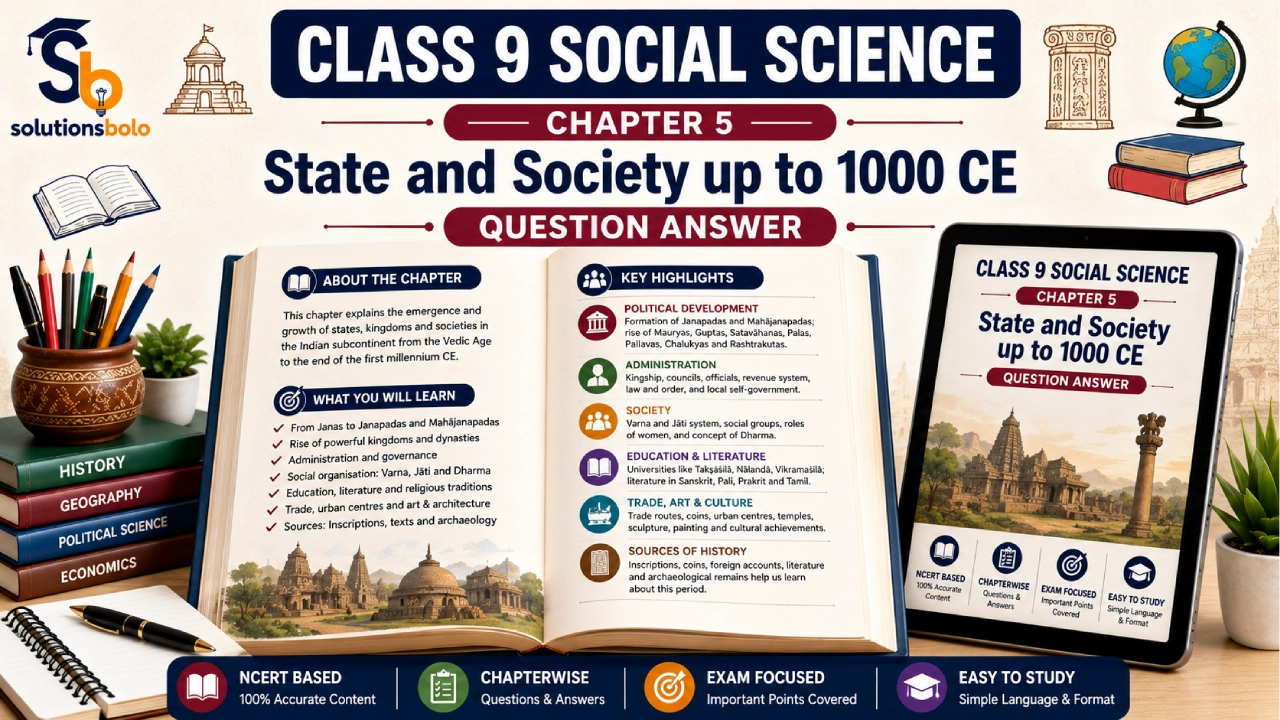
Class 9 Social Science Chapter 5 “State and Society up to 1000 CE” introduces students to the emergence and development of states, kingdoms and societies in the Indian subcontinent from the Vedic Age to the end of the first millennium CE. The chapter explains the evolution of janas, janapadas and mahājanapadas, the growth of powerful dynasties such as the Mauryas, Guptas, Satavāhanas, Pallavas, Chalukyas, Rashtrakutas and Palas and the changing systems of administration, governance and local self-government. It also highlights the importance of the Vedas, Sangam literature, inscriptions, universities, trade routes, social organisation, varṇa and jāti, dharma, education, art, architecture and cultural exchanges in understanding early Indian history. These NCERT Solutions provide clear explanations, key terms, intext answers, important questions, MCQs, assertion and reason questions, case-based questions, competency-based questions and FAQs to help students build conceptual understanding and prepare confidently according to the latest CBSE syllabus (2026–27).
Table of Contents (Quick Links):
1. Chapter Introduction
2. Key Terms & Definitions
3. NCERT Intext Questions
4. Exercise Questions
5. MCQs with Explanations
6. Case-Based MCQs
7. Assertion & Reason MCQs
8. Competency-Based Questions
9. Important Literary Works and Historical Sources
10. Common Mistakes & Exam Tips
11. Frequently Asked Questions (FAQs)
Chapter Introduction
Chapter 5 “State and Society up to 1000 CE” explores the growth of states, kingdoms and societies in the Indian subcontinent from the Vedic period to the end of the first millennium CE. It explains how janas developed into janapadas and mahājanapadas, leading to the rise of powerful dynasties such as the Mauryas, Guptas, Satavāhanas, Pallavas and Chalukyas. The chapter also discusses systems of governance, administration, social organisation, education, trade, literature and religion. Through inscriptions, ancient texts and archaeological evidence, students learn how political institutions and cultural traditions shaped early Indian civilisation and laid the foundation for many features of Indian society that continue to influence the country today.
Key Terms and Definitions
Vedic and Religious Terms
(These keywords introduce the religious ideas, Vedic literature and spiritual concepts discussed in this chapter.)
BCE (Before Common Era):
Refers to the years before 1 CE, used to date historical events before the Common Era.
CE (Common Era):
Refers to the years from 1 CE onwards, the standard dating system used worldwide.
Ṛig Veda:
The oldest Vedic Sanskrit text, containing 1,028 hymns (sūktas) dedicated mainly to various deities and philosophical ideas.
Yajur Veda:
Contains prayers, chants, sacrificial formulas and ritual instructions for performing Vedic yajñas, mostly written in prose.
Sāma Veda:
Consists mainly of Ṛig Veda hymns arranged for musical chanting, forming the foundation of Indian classical music.
Atharva Veda:
Contains hymns, prayers and rituals for protection, healing and physical and mental well-being.
Sūkta:
A sacred Vedic hymn or collection of verses dedicated to deities, nature or philosophical ideas.
Saṁhitā:
The collection of Vedic hymns forming the earliest and foundational part of each Veda.
Brāhmaṇa:
Prose texts explaining the meaning, procedures and significance of Vedic yajñas and rituals.
Āraṇyaka:
Vedic texts discussing meditation, philosophical ideas and the deeper meaning of rituals.
Upaniṣhad:
Philosophical texts explaining Ātman, Brāhman and the pursuit of spiritual knowledge.
Yajña:
A Vedic sacrificial ritual performed with prayers and offerings to honour deities and seek blessings.
Ātman:
The individual soul or inner self, regarded as eternal in Indian philosophy.
Dharma:
Moral duty, righteous conduct and ethical principles guiding individual and social life.
Artha:
The pursuit of wealth, livelihood and material prosperity through righteous means.
Kāma:
The pursuit of desires, happiness and enjoyment within the limits of dharma.
Mokṣha:
Liberation from the cycle of birth and death, considered the highest goal of life.
Aśhvamedha Yajña:
A royal Vedic horse sacrifice symbolising a king’s sovereignty and political supremacy.
Rājasūya Yajña:
A royal Vedic ritual performed to establish a king’s supreme political authority.
Puruṣhasūkta:
A famous Ṛig Veda hymn describing the symbolic origin of the four varṇas.
Gurukula:
A residential education system where students lived with their guru to learn knowledge, discipline and values.
Śhramaṇa:
An ascetic who renounced worldly life to pursue spiritual knowledge through meditation and self-discipline.
Parivrājaka:
A wandering ascetic travelling in search of spiritual wisdom, truth and knowledge.
Sattvaśhuddhi:
Purity of mind and character attained through self-discipline, honesty and righteous living.
Political and Administrative Terms
(These terms explain how kingdoms were governed and how administration was organised in ancient India.)
State:
An organised political system with a defined territory, government, laws and people under its authority.
Society:
A community of people connected through social, cultural, economic and political relationships.
Governance:
The process of administering a state, making laws, ensuring justice, security and public welfare.
Jana:
A Vedic tribe or community sharing a common ancestry, culture and identity.
Kula:
The family or household, considered the basic unit of Vedic society.
Janapada:
A territorial settlement where a jana established permanent political control.
Mahājanapada:
One of the sixteen large kingdoms or republics that flourished around the sixth century BCE.
Gaṇa:
A republican political system where governance was shared by a group instead of a hereditary king.
Saṁgha:
A republican assembly where important political decisions were taken collectively.
Rājya:
A kingdom ruled by a king over a defined territory and its people.
Chakravarti Samrāṭ:
An ideal universal ruler exercising sovereignty over the entire Bhāratavarṣha.
Adhirāja:
A powerful ruler who exercised authority over several subordinate kings.
Mantri-Pariṣhad:
The council of ministers that advised the king on administration, justice and governance.
Saptāṅga Theory:
Kauṭilya’s theory describing seven essential elements of a strong and effective state.
Brahmadeya:
Tax-free land granted to Brāhmaṇas for learning, teaching and religious activities.
Agrahāram:
A Brāhmaṇa settlement established through royal land grants for education and religious purposes.
Mandalam:
A large provincial administrative division in several South Indian kingdoms.
Valanāḍu:
An administrative subdivision of a Mandalam in the Chola Empire.
Nāḍu:
A local administrative unit comprising a group of villages in South India.
Viṣhaya:
An administrative district governed by officials appointed by the king.
Bhukti:
A provincial administrative division, especially during the Gupta period.
Grāmika:
The village head responsible for local administration and maintaining law and order.
Pradeśhika:
A district officer responsible for administration, justice and revenue collection.
Variyams:
Chola village committees managing irrigation, gardens, temples and other public works.
Kudavolai System:
A lottery-based method of selecting members for Chola village committees using palm-leaf slips.
Social Life and Society
(These keywords describe the social organisation, family system and everyday life of people in ancient India.)
Varṇa:
The four broad social categories described in ancient Indian texts based on duties and responsibilities.
Brāhmaṇas:
Traditionally associated with learning, teaching, performing rituals and preserving sacred knowledge.
Kṣhatriyas:
Responsible for governance, warfare and protecting the kingdom and its people.
Vaiśhyas:
Engaged in agriculture, trade, animal husbandry and other economic activities.
Śhūdras:
Performed diverse occupations and services that supported society and the economy.
Jātis:
Social groups that developed over time based on occupation, region or community.
Endogamous:
The practice of marrying within one’s own social group, caste or community.
Gotra:
A family lineage or clan tracing descent from a common ancestor.
Patrilineal:
A system tracing family lineage, inheritance and succession through the father’s line.
Ṣhoḍaśha Saṁskāras:
The sixteen traditional rites of passage marking important stages of a person’s life.
Economic and Trade Terms
(These terms explain trade, crafts, markets and important trade routes that supported economic growth.)
Guild (Śhreṇī):
An association of merchants or craftsmen that regulated trade, production and protected members’ interests.
Dakṣhiṇāpatha:
The major southern trade route linking northern India with the Deccan and peninsular India.
Uttarāpatha:
An important northern trade route connecting northern India with Central Asia and neighbouring regions.
Silk Route:
A network of trade routes connecting India, China, Central Asia and the Mediterranean for commerce and cultural exchange.
Painted Grey Ware (PGW):
Fine grey pottery with black-painted designs, associated with early Iron Age settlements in northern India.
Northern Black Polished Ware (NBPW):
Fine glossy pottery associated with urbanisation, trade and the Mahājanapada period.
Dynasties and Kingdoms
(These keywords introduce the major dynasties and kingdoms that shaped ancient India’s political history.)
Cheras:
One of the three major Tamil dynasties, renowned for maritime trade, agriculture and Sangam literature.
Cholas:
A powerful South Indian dynasty known for efficient administration, naval power, overseas trade and magnificent temples.
Pandyas:
An early South Indian dynasty famous for pearl fishing, maritime trade and patronage of Tamil literature.
Satavāhana Empire:
A powerful Deccan empire that promoted agriculture, trade and cultural development for nearly five centuries.
Kuṣhāṇas:
A powerful dynasty that ruled north-western India and Central Asia, promoting Silk Route trade.
Guptas:
A powerful northern Indian dynasty remembered for remarkable achievements in science, mathematics, literature and art.
Vākāṭakas:
An important Deccan dynasty that patronised literature, religion and the Ajanta Caves.
Pallava Dynasty:
A South Indian dynasty renowned for rock-cut temples, architecture and the monuments of Mahabalipuram.
Chālukya Dynasty:
A powerful Deccan dynasty known for efficient administration and remarkable temple architecture.
Rāṣhṭrakūṭas:
A powerful Deccan dynasty famous for military strength, cultural patronage and the Kailasa Temple at Ellora.
Pālas:
An eastern Indian dynasty that patronised Buddhism, education and renowned universities like Nalanda and Vikramashila.
Gurjara-Pratihāras:
A major North Indian dynasty that controlled vast territories and competed for Kannauj.
Maukharīs:
An early medieval North Indian dynasty that contributed to regional political developments before Harṣhavardhana.
Maitrakas:
A western Indian dynasty that established Vallabhī as an important centre of learning and administration.
Tripartite Struggle:
A prolonged conflict among the Gurjara-Pratihāras, Pālas and Rāṣhṭrakūṭas for control of Kannauj.
Literature and Historical Sources
(These terms describe important literary works and historical sources that help us understand ancient India.)
Sangam Literature:
A collection of ancient Tamil poems describing the society, culture, economy and rulers of early Tamilakam.
Kauṭilya’s Arthaśhāstra:
An ancient Sanskrit treatise explaining statecraft, administration, diplomacy, economics and good governance.
Mahābhārata:
One of the world’s longest epics, teaching dharma, kingship, justice and moral values.
Śhānti Parva:
A section of the Mahābhārata discussing kingship, governance, justice and the duties of rulers.
Milindapañho:
A Buddhist text presenting philosophical dialogues between King Milinda and the monk Nāgasena.
Amarakoṣha:
An ancient Sanskrit lexicon compiled by the scholar Amarasiṁha.
Tolkāppiyam:
The earliest known Tamil grammatical work and an important source on ancient Tamil society.
Pattinappālai:
A celebrated Sangam poem describing the prosperous port city of Poompuhar and its vibrant trade.
Silappadikāram:
A renowned Tamil epic depicting the culture, society and political life of ancient Tamilakam.
Manu-smṛiti:
An ancient Sanskrit text discussing social duties, laws and ethical conduct.
Aśhokan Inscriptions:
Rock and pillar edicts issued by Emperor Aśhoka promoting Dhamma, morality and good governance.
Junagadh Rock Inscription:
An inscription recording rulers, public works and the restoration of Sudarshana Lake over centuries.
Votive Inscriptions:
Inscriptions recording religious donations, dedications or acts of devotion by individuals.
Education and Centres of Learning
(These keywords explain the traditional system of education and the famous centres of learning in ancient India.)
Nalanda University:
One of the world’s earliest residential universities, renowned for Buddhism, philosophy, medicine, mathematics and astronomy.
Vallabhī University:
A renowned western Indian university famous for administration, law, religion and literary studies.
Vikramśhila University:
A renowned Buddhist university established by the Pālas, known for advanced learning and international scholarship.
Important Places and Regions
(These terms introduce important regions, cities and places mentioned in this chapter.)
Sapta-Sindhu:
The land of the seven rivers where early Vedic communities flourished.
Tamilakam:
The ancient Tamil-speaking region ruled mainly by the Cheras, Cholas and Pandyas.
Bhāratavarṣha:
An ancient name for the Indian subcontinent used in literary and religious traditions.
Jambudvīpa:
An ancient term referring to the Indian subcontinent in early Indian literature and inscriptions.
Kāmarūpa:
An important ancient kingdom located in present-day Assam.
Kanchipuram:
A renowned South Indian centre of education, religion and temple architecture.
Poompuhar:
A flourishing Chola port city famous for maritime trade and commercial prosperity.
Gangaikonda:
A Chola capital established by Rajendra I to commemorate his northern conquests.
Architecture and Monuments
(These keywords explain some of the important temples, monuments and architectural achievements of ancient India.)
Mahabalipuram Rock-cut Temples:
Magnificent rock-cut temples built by the Pallavas during Narasimhavarman I’s reign, renowned for exquisite sculptures.
Kailasa Temple:
A magnificent monolithic temple at Ellora, built by the Rāṣhṭrakūṭas, showcasing exceptional rock-cut architecture.
Martanda Sun Temple:
A grand Sun temple in Kashmir, celebrated for its remarkable early Indian temple architecture.
Brihadeeshwara Temple:
A magnificent Chola temple at Thanjavur, built by Rajaraja I, renowned for its architectural and engineering excellence.
Nashik Caves:
Ancient Buddhist rock-cut caves containing inscriptions that reveal important historical and religious information.
Sudarshana Lake:
An ancient artificial reservoir restored by several rulers for irrigation and public welfare.
Important Personalities
(These terms introduce the rulers, scholars, travellers and other important personalities discussed in this chapter.)
Kauṭilya:
Kauṭilya was a scholar of the Maurya Period. Chief advisor of Chandragupta Maurya. Author of the Arthaśhāstra, a famous treatise on governance, administration and economics.
Āryabhaṭa:
Āryabhaṭa was a mathematician of the Gupta Period. Author of the Āryabhaṭīya. Famous for contributions to mathematics, astronomy and the value of π (pi).
Kālidāsa:
Kālidāsa was a Sanskrit poet of the Gupta Period. Famous for Abhijñānaśākuntalam, Meghadūta and Raghuvaṁśa.
Faxian:
Faxian was a Chinese Buddhist traveller of the Gupta Period. Visited India during Chandragupta II’s reign. Recorded valuable observations on Indian society and Buddhism.
Harṣhavardhana:
Harṣhavardhana was a ruler of the Pushyabhuti (Vardhana) Dynasty. Succeeded Rājyavardhana. United much of North India. Encouraged education, religion and learning.
Gautamīputra Śhātakarṇi:
Gautamīputra Śhātakarṇi was a king of the Satavāhana Dynasty. Succeeded Śhivasvāti. Defeated the Śhakas. Mentioned in the Nashik Cave Inscription.
Narasimhavarman I:
Narasimhavarman I was a king of the Pallava Dynasty. Succeeded Mahendravarman I. Defeated Pulakeśhin II. Developed Mahabalipuram.
Skandagupta:
Skandagupta was a king of the Gupta Dynasty. Succeeded Kumaragupta I. Defeated the Hunas (Huns). Achievements are recorded in the Junagadh Rock Inscription.
Lalitāditya Muktapīḍa:
Lalitāditya Muktapīḍa was a king of the Karkota Dynasty. Expanded the Kashmir Kingdom. Encouraged art, architecture and learning.
Puṣhyagupta:
Puṣhyagupta was a governor of the Maurya Empire under Chandragupta Maurya. Supervised the construction of the Sudarshana Lake in Gujarat.
Apālā:
Apālā was a Ṛig Vedic woman sage (ṛiṣhikā). Composer of hymns in the Ṛig Veda. Among the earliest known women poets of India.
Viśhvavārā:
Viśhvavārā was a Ṛig Vedic woman sage (ṛiṣhikā). Composer of hymns in the Ṛig Veda. Known for her wisdom and spiritual knowledge.
Ghoṣhā:
Ghoṣhā was a Ṛig Vedic woman sage (ṛiṣhikā). Composer of hymns in the Ṛig Veda. Remembered for her devotion and learning.
Lopāmudrā:
Lopāmudrā was a Ṛig Vedic woman sage (ṛiṣhikā). Composer of hymns in the Ṛig Veda. Associated with the sage Agastya.
Intext Question and Answer:
1. How did society and state organise themselves prior to 1000 CE?
Answer:
Prior to 1000 CE, society evolved from kinship-based clans to territorial settlements, guided by the varṇa and jāti systems. The state progressed from early assemblies to complex empires featuring highly decentralised administration.
Explanation:
Prior to 1000 CE, the organisation of society and state underwent a massive transformation from simple tribal structures to complex empires:
Evolution of Society: Early society was organised around the family (kula) and clan (jana). Over time, society was structured functionally through the varṇa categories, which gradually evolved into numerous jātis based on occupation, migration and region. Occupational guilds (śhreṇīs) also played a major role in social organisation.
Evolution of the State: Political authority began with clan chiefs (rājā) who were guided by democratic assemblies like the Sabhā and Samiti. As people developed territorial identities, states evolved into janapadas and mahājanapadas, which included both monarchies (rājyas) and republics (gaṇas or saṁghas).
Administrative Organisation: Massive empires (like the Mauryas, Guptas and Cholas) were eventually established. The state governed through a council of ministers (mantri-pariṣhad) and decentralised power by dividing the kingdom into provinces (bhuktis/manḍalams), districts (viṣhayas/nāḍus) and highly autonomous village assemblies.
2. How did states and societies emerge and spread to different parts of the Indian subcontinent?
Answer:
States and societies expanded from the Sapta-Sindhu region to the fertile Ganga plains, aided by iron implements and agriculture. Extensive trade routes and port cities facilitated further expansion into southern and central India.
Explanation:
The emergence and spread of states and societies across the Indian subcontinent was driven by agricultural expansion, technological advancements and vibrant trade networks:
From North-West to the Ganga Plains: Early Vedic society was concentrated in the Sapta-Sindhu region (northwestern India). By the first millennium BCE, the use of iron implements and new pottery (PGW, NBPW) enabled large-scale agricultural expansion into the fertile Ganga plains. This surplus production led to the rise of larger territorial states called mahājanapadas around 600 BCE.
Rise of Regional Empires: The consolidation of power in the north led to the formation of the Mauryan and Gupta empires. Simultaneously, strong states emerged in the Deccan (like the Satavāhanas, Vākāṭakas and Chālukyas). In deep southern India (Tamilakam), early kingdoms like the Cheras, Cholas and Pandyas flourished in the fertile, rice-growing river valleys.
The Role of Trade and Guilds: The spread of state and society was heavily supported by major land routes (like Dakṣhiṇāpatha and Uttarāpatha) and thriving maritime coastal ports (like Muziris and Poompuhar). This vast trade network integrated the subcontinent economically and culturally.
3. How did the ideas of dharma and chakravarti samrat help create unity in social values and governance and promote the idea of the Indian subcontinent as one political entity?
Answer:
Dharma provided a universal ethical code emphasizing duty, justice and social harmony. The chakravarti samrāṭ ideal created a pan-Indian geopolitical vision, uniting the subcontinent under the shared aspiration of a paramount, righteous ruler.
Explanation:
The ancient concepts of dharma and chakravarti samrāṭ played a foundational role in integrating the Indian subcontinent culturally and politically:
Dharma and Social Unity: Dharma refers to duty, obligation and righteous moral conduct. It acted as a universal ethical code that guided both rulers and citizens, fostering harmony, justice and the welfare of all beings. Ashoka’s promotion of dhamma (emphasising non-violence and respect) is a prime example of using ethics to culturally unite diverse populations.
The Chakravarti Samrāṭ Ideal: The concept of a chakravarti samrāṭ refers to a universal paramount ruler who governed a vast, unified territory (chakravarti kśhetra) with justice.
A Shared Geopolitical Vision: This ideal promoted the idea of the Indian subcontinent as a single political entity. Terms like Jambudvīpa, Bhāratavarṣha and Prithivi (the area between the Himalayas and the sea) reflected a pan-Indian geopolitical awareness. Rulers from the north (like the Mauryas) and the south (like Chera King Nedunjeral Adan and Chola ruler Rajendra I) all performed rituals like the aśhvamedha yajña and aspired to this ideal, creating a continuous political unity across the subcontinent.
4. How did different social, administrative and occupational groups take shape over time and come together culturally?
Answer:
Social, administrative and occupational groups evolved through functional divisions like Varṇa, specialized administrative tiers (Bhuktis, Nāḍus) and professional guilds (Śhreṇīs). They merged culturally through shared ethical values, Dharma and devotional traditions like Bhakti.
Explanation:
Over time, ancient Indian society witnessed the gradual formation of complex social, administrative and occupational groups that eventually integrated into a unified cultural framework:
1. Shape and Evolution of Different Groups:
Social Groups (Varṇa and Jāti): Initially, social identity was flexible and shaped by occupation and diversity within families. Over time, the four functional varṇas (Brāhmaṇas, Kṣhatriyas, Vaiśhyas, Śhūdras) transitioned into numerous endogamous jātis due to intermarriage, territorial shifts and migrating communities.
Administrative Groups: As small clans (janas) expanded into large empires, a multi-layered bureaucracy emerged. This led to specialized administrative classes, including central ministers (Mantri-Pariṣhad), regional governors, district heads (Pradeśhikas) and village headmen (Grāmika).
Occupational Groups (Guilds or Śhreṇīs): Economic expansion led to the creation of powerful professional associations of traders, artisans and craftspersons known as guilds (śhreṇīs). These guilds regulated production, fixed prices and even functioned as independent financial and banking institutions.
2. How They Came Together Culturally:
The Principle of Dharma and Samatva: Despite structural and occupational differences, communities were bound together by core ethical concepts like Dharma (righteous conduct) and Samatva (the principle of sameness and cosmic order), which heavily critiqued discrimination and emphasized the welfare of all beings.
Shared Educational and Life Frameworks: The traditional system of education (Gurukula) and the universal framework of the four goals of life (Purushārthas—Dharma, Artha, Kāma, Mokṣha) along with life-stage rituals (Ṣhoḍaśha Saṁskāras) created common moral and social values across different groups.
The Integration through Bhakti: The emergence of the Bhakti tradition offered a direct, emotional connection with personal deities without elaborate rituals. Accessible to all sections of society regardless of class, caste or gender, devotional movements (like the Ālvārs and Nāyanmārs) acted as a massive cultural bridge that brought diverse social groups together.
5. In previous grades, you have read that the name ‘Bharata’ first appears in the Rig Veda. It is used in reference to the ‘Bharata jana’ or the people who were ruled by the family of the Bharatas. What does this tell us about how early communities identified themselves and their rulers?
Answer:
Early communities identified themselves through kinship ties and clan lineages (jana) rather than fixed territories. Rulers were recognized as chiefs of people, making political loyalty deeply personal and community-driven.
Explanation:
The reference to the ‘Bharata jana’ in the Rig Veda provides important historical insights into the social and political structure of early Indian communities:
Identity Based on Kinship (Jana): Early Rig Vedic societies identified themselves primarily through their clan, tribe or kinship ties (jana or kula) rather than a fixed geographical territory. Their sense of belonging was attached to the people of their community, not to a specific land.
Ruler as a Clan Leader: The rājā during this period was not a territorial king but a clan chief. The title or name of the kingdom was derived directly from the family or tribe he led (like the family of the Bharatas ruling the Bharata jana).
Personalized Political Loyalty: The relationship between the ruler and the subjects was deeply personal and blood-bound. Rulers were looked upon as protectors of the clan who led them in warfare and ensured community security.
Transition to Territorial Identity: This initial phase shows a stepping stone in Indian history; it tells us that before communities developed a concrete territorial identity (janapadas), they bound themselves together through shared ancestry, social customs and collective tribal loyalty.
6. Do the roles of the rājā and the assemblies in Vedic times suggest a similar principle? Can we say that systems of governance in Indian history-since their early institutionalised forms were guided by the idea of ensuring people’s participation in the political process?
Answer:
Yes, the Vedic rājā and assemblies (Sabhā, Samiti, Vidhata) suggest early democratic principles. Since antiquity, Indian governance was institutionalised to ensure collective decision-making and active public participation in political affairs.
Explanation:
The political structure described in early Vedic texts provides fascinating insights into the participatory nature of ancient Indian governance:
Vedic Assemblies and Democratic Principles:
Check on Absolute Power: The Vedic rājā was not an absolute autocrat; he functioned primarily as a clan chief bound by the decisions of popular bodies.
Role of the Assemblies: The presence of three distinct assemblies—Sabhā (judicial body of select elites), Samiti (larger assembly representing the broader population for policy decisions) and Vidhata (popular community gathering for political/warfare discussions)—strongly mirrors the principles of modern parliaments and constitutional checks.
Accountability and Selection: Historical evidence from texts like the Rig Veda and Atharva Veda indicates that kings could be elected or even expelled if they lost the trust of these bodies, establishing early accountability.
Ensuring People’s Participation through History:
Foundational Participatory Culture: We can confidently state that Indian governance systems since their earliest institutionalised forms were deeply guided by the idea of public participation.
Evolution of Republics (Gaṇas and Saṁghas): This participatory ethos evolved further during the 6th century BCE with the rise of republican states (gaṇas or saṁghas), where governing power was shared collectively by an assembly rather than a single hereditary ruler.
Grassroots Democracy (The Southern Matrix): Even within monarchical empires, local governance remained fiercely autonomous and participatory. A brilliant historical example is the Chola Kudavolai (ballot-pot) system described in the Uttaramerur inscription, where village committee members (variyams) were democratically selected by the public through a transparent lottery system.
7. Texts such as the Mahābhārata and the Arthaśhāstra describe the king’s duties as protecting people and ensuring justice. Why do you think it was important for rulers to protect people and ensure justice? What do these descriptions tell us about ideas of governance and the relationship between rulers and subjects during that period?
Answer:
Protection and justice ensured social stability, economic growth and the king’s legitimacy. These texts show that ancient governance was duty-bound (Dharma), viewing the relationship between rulers and subjects as mutually supportive, not absolute.
Explanation:
Ancient Indian texts like the Mahābhārata (Shanti Parva) and Kautilya’s Arthaśhāstra place immense emphasis on the king’s responsibility to protect people and ensure justice due to the following reasons:
Maintaining Social Order and Stability: Without a strong ruler to enforce justice, society would fall into lawlessness. Protection prevented internal disorder and shielded subjects from external threats.
Economic Prosperity: A secure environment allowed agriculture, trade networks and crafts to flourish. If subjects felt safe from robbery and exploitation.
Moral and Spiritual Duty (Dharma): Ensuring justice was considered the ultimate moral obligation of a king. It was believed that a righteous king who judged fairly brought balance and blessings to the entire kingdom.
Governance and the ruler-subject relationship:
Governance Guided by Ethics, Not Absolute Power: Rulers were not above the law; their authority was bound by Dharma (duty and righteousness). The Arthaśhāstra famously notes that a king’s happiness lies in the happiness of his subjects.
A Mutually Supportive Relationship: The relationship was based on mutual obligations. The subjects paid taxes (like the fixed one-sixth land revenue) and obeyed laws and in return, the ruler owed them safety, fair justice and public welfare.
Accountability of the Ruler: Historical references to kings being expelled or elected suggest that if a ruler failed to protect his people or became unjust, his absolute right to rule could be challenged.
8. Why do you think different rulers chose to record their inscriptions on the same stone instead of a new one? Discuss your answers with your classmates.
Answer:
Different rulers often engraved inscriptions on the same rock because it was already an important public site. This linked their rule with earlier rulers and ensured that their messages reached people visiting the place.
Explanation:
Many rulers chose to engrave their inscriptions on existing rocks or pillars that already carried earlier inscriptions. For example, the Junagadh Rock Inscription in present-day Gujarat contains inscriptions from Emperor Aśhoka, the Śaka ruler Rudradāman I and later the Gupta ruler Skandagupta. Each ruler added his own inscription at the same place rather than selecting a new rock.
This suggests that such sites had already become recognised public places where royal messages could reach many people. By recording their inscriptions on the same rock, later rulers also associated themselves with earlier traditions and important historical locations.
9. How would dividing a kingdom into provinces, districts and villages have helped rulers manage their empires? What similarities can you identify between these administrative divisions and the system of governance in India today?
Answer:
Dividing a kingdom ensured effective governance, revenue collection and law enforcement across vast territories. Similarly, modern India is divided into States (provinces), Districts and Villages (Panchayats) to decentralise power and manage local administration efficiently.
Explanation:
Dividing a large empire into smaller administrative units like provinces, districts and villages provided significant advantages to ancient rulers and shares clear similarities with modern Indian governance:
Ancient rulers manage their empires:
Better Administration and Control: Large empires were difficult to govern from a single central capital without modern communication. Dividing them into provinces (like Bhuktis or Mandalams) and districts (like Vishayas or Nadus) made it easier to maintain law and order.
Efficient Revenue Collection: Local officers like the Gramika (village headman) or district governors (Pradeshikas) could assess crops and collect taxes systematically at the grassroots level.
Local Autonomy and Welfare: It allowed village assemblies and committees (Variyams) to look after immediate local needs like irrigation, temples and roads independently, without overburdening the king.
Similarities with the system of governance in India today:
Provinces to States: The ancient provinces (Bhuktis or Mandalams) are similar to the States of modern India.
Divisions to Districts: The ancient administrative subdivisions (Vishayas or Valanadus) closely resemble our modern Districts.
Villages to Panchayats: The self-reliant ancient village administration supervised by local headmen and assemblies is the historical counterpart to our current Gram Panchayat and Local Bodies system.
(page – 118)
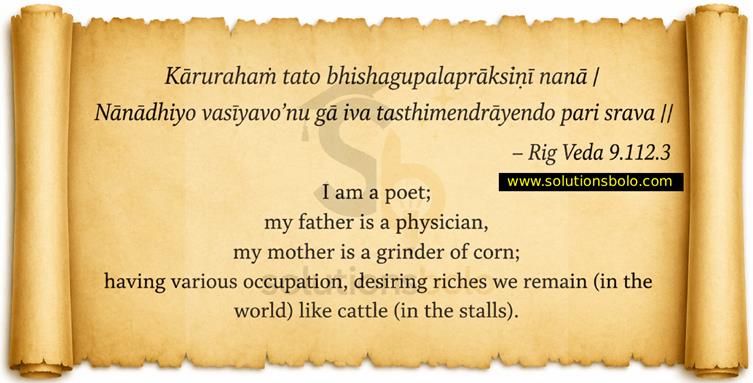
1. What does the source tell us? (Evidence)
Answer:
The verse tells us that members of one family followed different occupations. The speaker was a poet, his father a physician and his mother a grinder of corn, showing occupational diversity in Vedic society.
2. What can we understand from it? (Interpretation)
Answer:
The verse suggests that different occupations existed within the same family. It reflects occupational diversity and indicates that occupations may not always have been strictly fixed by birth in early Vedic society.
3. What might it not tell us? (Limits of the Source)
Answer:
The verse does not explain whether all families followed similar occupations. It also gives no information about social status, wealth, education or the lives of all sections of Vedic society.
Now Answer the Following
1. What occupations are mentioned in the family described in the verse? What does this indicate about the nature of occupations in Vedic society?
Answer:
Occupations Mentioned: The verse explicitly highlights three completely different professions practiced by members of the exact same household: the narrator is a poet, the father is a physician (healer) and the mother is a grinder of corn.
Nature of Vedic Occupations: This clearly proves that early Vedic society did not have a rigid division of labor. Occupations were independent of one’s family line and members within a single family were free to pursue diverse economic paths based on their skills, choices and desires to earn a livelihood.
2. How does the above verse challenge the idea that social status and occupation were fixed by birth?
Answer:
No Hereditary Restriction: If social status and occupation had been fixed strictly by birth during the early Vedic period, the son of a physician would have been forced to become a physician.
Proof of Flexibility: However, this verse explicitly challenges that notion because the son chooses to be a poet while the mother handles a separate manual craft (grinding corn). It provides solid historical evidence that early social identities were fluid, mobile and functional, completely contradicting the later rigid, birth-based caste system.
3. What different occupations do you find in contemporary society?
Answer:
Diversity in Modern Professions: In contemporary society, we find a massive array of specialized occupations driven by technology, education and individual merit. These include digital fields (software developers, data analysts), professional services (doctors, teachers, lawyers), creative arts (writers, designers, musicians) and mechanical/manual trades.
4. What does this tell us about how historians use evidence to understand the past?
Answer:
Primary Source Interpretation: When historians read a historical verse, they treat it as an primary piece of evidence. A single verse provides clues about everyday life, familial bonds and economic ambitions (“desiring riches”) of ancient people.
Subjectivity and Limits: Comparing different group responses shows that history involves interpretation. While the text clearly states facts about occupations, it has limits—it doesn’t tell us if this flexibility was common for every single tribe or how things changed over later centuries. Historians must cross-reference multiple sources to form a balanced, accurate view of the past.
10. Compare your school life with the life of a student in a gurukula in early India. Think about aspects such as daily routine, subjects studied, relationship with teachers, discipline and living arrangements. What advantages and challenges do you think each system of education might have for students?
Answer:
Modern school life features digital learning, diverse subjects and returning home daily. In contrast, Gurukula life was a residential, holistic system focusing on moral values, life skills and deep reverence for the teacher.
Explanation:
A comparative analysis of modern school life and the ancient Gurukula system across various aspects reveals distinct features, along with their respective advantages and challenges:
Advantages and Challenges of Each System:
Modern Education System:
Advantages: Provides access to global scientific knowledge, exposes students to modern technology and allows them to enjoy family support daily.
Challenges: High academic stress, lesser focus on moral character building and sometimes a lack of close personal attention from teachers.
Ancient Gurukula System:
Advantages: Cultivated strong inner moral values (sattvaśhuddhi), fostered independent life skills through community living and provided complete emotional stability.
Challenges: Complete separation from family at a young age, lack of exposure to rapidly evolving global technologies and rigid routines that might not suit every individual.
11. Why do you think irrigational structures like dams and canals were considered so important that their construction was recorded in inscriptions?
Answer:
Irrigation structures secured agricultural production, which was the backbone of state revenue. Recording them on inscriptions legitimized the ruler’s welfare works, ensured institutional memory and demonstrated imperial prosperity.
Explanation:
Recording the construction of dams (like the Sudarshana Lake) and canals in permanent inscriptions was a crucial administrative and political act for several reasons:
Backbone of Imperial Economy: Agriculture was the primary source of survival for society and the chief source of revenue for the state.
Proving the King’s Righteousness (Dharma): In ancient India, a king’s highest duty was public welfare. Carving a public work like the Grand Anicut on stone or copper plates served as a permanent testimony that the ruler was actively fulfilling his Dharma by looking after his subjects.
Administrative and Legal Records: These inscriptions served as permanent legal blueprints. They documented who built the structure, who repaired it (as seen on the Junagadh rock where Maurya, Satrap and Gupta works are co-recorded) and managed local water distribution rights across generations.
(page – 134)
Exercise Questions and Answers
1. How did political organisation change from the Vedic period to the age of large empires such as the Mauryas and the Guptas? Explain the administrative system of the early Indian states.
Answer:
Political organisation evolved from small kinship-based clans to powerful territorial empires. Administration gradually developed from tribal assemblies into an organised, multi-level system that combined central authority with efficient local self-government.
Explanation:
1. Shift in Political Organisation
Vedic Period
Early political organisation was based on janas (tribes) led by a rājā (chief). His authority was guided by popular assemblies such as the Sabhā and Samiti, which participated in important political and judicial decisions.
Janapadas and Mahājanapadas
Between 1000 BCE and 600 BCE, tribal communities settled permanently and formed janapadas. These later developed into the Sixteen Mahājanapadas, including powerful monarchies such as Magadha and republican states like the Vajji Saṁgha.
Imperial Phase
Over time, the Mahājanapadas expanded into large empires. The Mauryan Empire, founded by Chandragupta Maurya and strengthened by Emperor Ashoka, established one of India’s earliest centralised administrations. Later, the Gupta rulers, especially Samudragupta and Chandragupta II, further strengthened imperial administration while encouraging local self-government.
2. Administrative System of Early Indian States
Central Administration
The King was the head of the state and was assisted by the Mantri-Pariṣhad (Council of Ministers), which included ministers, military commanders, treasurers and other senior officials. Kauṭilya’s Arthaśhāstra explains the duties of the king and the organisation of an efficient administration.
Provincial and District Administration
Large empires were divided into provinces, known as Bhuktis during the Gupta period and Mandalams under the Cholas. These were further divided into districts (Viṣhayas) supervised by officers such as the Pradeśhika, who looked after administration and revenue collection.
Village Administration
The village was the smallest administrative unit and was headed by the Grāmika. Village assemblies managed local administration, irrigation, taxation and public works. In the Chola Empire, committees called Variyams were selected through the Kudavolai System, demonstrating an advanced form of local self-government.
2. Describe the role of the king, important officers and the methods used to govern large territories.
Answer:
The king ruled as a righteous protector bound by Dharma. Important officials handled ministries, law and local governance, utilizing methods like administrative subdivisions, infrastructure development and autonomous village councils.
Explanation:
1. Role of the King:
Righteous Ruler and Protector: Rulers adopted grand titles like Mahārāja or Samrāṭ, but their power was checked by Dharma (duty and moral law).
Dispenser of Justice: The king was primarily responsible for protecting subjects from external threats, maintaining internal order and administering impartial justice.
Public Welfare: As emphasized in the Arthaśhāstra, the king was expected to be energetically active, finding his personal happiness in the welfare of his subjects.
2. Important Officers:
Mantri-Pariṣhad: A multi-layered administrative council that included civil heads (amatya or kumārāmātyas), tax collectors and legal advisors.
Defence and Diplomacy: Key officials included the commander-in-chief (danda) and the new ‘minister of peace and war’ (sāndhivigrahika) introduced during the Gupta era.
Local Governors: Regional heads administered provinces, while the Grāmika (village headman) executed laws at the grassroots level.
3. Methods Used to Govern Large Territories:
Territorial Subdivision: Large empires were systematically split into provinces, divisions, districts and villages for administrative convenience.
Consultative Decision-Making: District officials routinely consulted local elites, including chief bankers, artisan heads and caravan leaders, before executing regional policies.
Infrastructure and Public Works: States actively constructed and maintained vital irrigation structures like canals and dams (e.g., Sudarshana Lake) to secure the agricultural economy and state revenue.
Autonomous Grants: Rulers utilized tax-free land grants, such as Brahmadeya or Agrahārams, to decentralize education and religious administration.
3. After studying this chapter, what do you think were the most important features of the state and society in India before 1000 CE?
Answer:
Before 1000 CE, India developed organised states, efficient administration and vibrant societies. Governance was guided by Dharma and local participation, while society evolved through varṇas, jātis, trade, education and cultural traditions.
Explanation:
The history of early India up to 1000 CE highlights a remarkable blend of institutional continuity and structural evolution across the state and society:
Important Features of the State:
Pan-Indian Geopolitical Awareness: Rulers possessed an understanding of the subcontinent as a single political and cultural entity, often expressed through concepts such as Bhāratavarṣha, Jambudvīpa and the ideal of the Chakravarti Samrāṭ, followed by rulers like Ashoka and later Rajendra Chola I, reflected this vision.
Decentralization and Local Autonomy: Although the king was the head of the state, local administration remained strong. In the Chola Empire, members of the Variyams were chosen through the Kudavolai System.
Ethical Framework of Governance: Governance was guided by Dharma. Texts such as the Mahābhārata and Kauṭilya’s Arthaśhāstra describe the king’s duty to protect people, ensure justice and promote public welfare.
Important Features of Society:
Social Fluidity to Complexity: Society transitioned from flexible Vedic structures—where occupations were not fixed by birth—into a more defined framework of four varṇas and numerous jātis became more organised and occupation-based.
Vibrant Economic and Trade Network: Agriculture, Śhreṇīs (guilds) and trade routes such as Uttarāpatha and Dakṣhiṇāpatha promoted economic growth. Important ports like Poompuhar supported overseas trade.
Holistic Education and Devotional Integration: Advanced residential universities like Nalanda and Vallabhī cultivated extensive knowledge traditions. Concurrently, the rise of the Bhakti movement (Ālvārs and Nāyanmārs) created a unified cultural fabric by offering an inclusive spiritual path open to all classes and genders.
Architectural and Cultural Achievements: Magnificent monuments such as the Brihadeeshwara Temple, Kailasa Temple, Mahabalipuram Rock-cut Temples and Nashik Caves reflect the artistic, engineering and religious achievements of early India.
4. What do early texts such as the Rig Veda, Arthashastra and the Mahābhārata reveal about political and social life?
Answer:
These texts reveal an evolution from kinship-based clans to highly structured territorial empires. They highlight a social structure guided by Dharma, decentralized administrative frameworks and extensive trans-continental trade networks.
Explanation:
Ancient texts serve as primary windows into the political and social evolution of early India:
Rig Veda (Early Vedic Life): Reveals a pastoral, kinship-based society organized into clans (janas). Politically, the king’s power was limited by popular assemblies (Sabhā and Samiti). Socially, occupations were fluid and not strictly determined by birth.
Arthashastra (Statecraft & Administration): Written by Kautilya, it provides a comprehensive blueprint of a highly structured imperial state. It introduces the Saptāṅga theory (seven elements of the state) and describes a vast network of spies, ministers (Mantri-Pariṣhad) and systematic urban and rural tax collection systems.
Mahābhārata (Ethics & Governance): The Śhānti Parva section deeply discusses the moral obligations of kingship. It emphasizes that the ruler’s ultimate duty (Rajadharma) is to protect the subjects and ensure absolute justice, establishing that governance must be rooted in righteousness, not arbitrary force.
5. What can we learn from early Indian society about varņa and the role of women?
Answer:
Early Indian society shows that the varṇa system was initially flexible and based on occupation but gradually became more birth-based. Women enjoyed respected social and religious positions in the early Vedic period, though their status changed over time.
Explanation:
1. Dynamics of the Varṇa System:
Initial Fluidity: Early Vedic society followed a flexible varṇa system based mainly on occupation and ability. A hymn of the Ṛig Veda (9.112.3) shows members of the same family following different professions, indicating occupational freedom.
Gradual Hardening: Over time, the varṇa system became more closely associated with birth, leading to the development of numerous jātis and the practice of endogamous marriages in many communities.
2. The Evolving Role of Women:
Spiritual and Intellectual Status: In the early Vedic period, women held respected positions. Women scholars and sages like Apālā, Ghoṣhā and Lopāmudrā actively composed sacred Vedic hymns and participated in philosophical debates.
Women in Administration: Although society gradually became patrilineal, some royal women exercised political authority. Prabhavati Gupta, daughter of Chandragupta II, ruled the Vākāṭaka Kingdom as regent and issued land grants in her own name.
6. Explain how assemblies like sabhā and samiti limited the power of the rājā. Which modern institutions perform similar functions today?
Answer:
The Sabhā and Samiti limited the authority of the rājā by encouraging collective decision-making and participation in important political matters. In modern times, institutions like Parliament, Judiciary and Election Commission perform similar roles by ensuring accountability and balanced governance.
Explanation:
1. Role of Sabhā and Samiti in Limiting Royal Power
The early Vedic rājā was not an absolute ruler. The Samiti was a larger community assembly that discussed important political matters, while the Sabhā was a smaller council of respected elders and important persons. These assemblies advised the ruler and influenced decisions related to governance, warfare and social issues.
2. Modern Institutions Performing Similar Functions
Parliament:
Like the ancient assemblies, the Parliament represents people’s views, debates laws and checks the actions of the executive.
Judiciary:
Modern courts ensure justice, interpret laws and prevent misuse of power.
Election Commission:
It conducts free and fair elections, allowing citizens to choose their representatives and hold rulers accountable.
7. What do the terms varņa and jāti refer to in early Indian society? How were they different and what factors may have contributed to the formation of various jātis?
Answer:
Varṇa refers to four broad social categories, while jāti refers to smaller hereditary social and occupational groups. Various jātis developed over time due to intermarriages, regional migrations, specialised occupations and the integration of different communities.
Explanation:
Meaning of Varṇa and Jāti:
Varṇa refers to the four broad social categories—Brāhmaṇas, Kṣhatriyas, Vaiśhyas and Śhūdras—described in ancient Indian texts. Jāti refers to smaller social groups that gradually developed based on occupation, region, family traditions and community identity.
Key Differences:
The varṇa system provided a broad social framework consisting of four categories, whereas jātis were numerous local groups with their own customs and occupations. Over time, many jātis became hereditary and followed endogamous (within the group) marriages.
Factors Responsible for the Formation of Jātis:
The number of jātis increased with the growth of agriculture, specialised occupations, migration to new regions, intermarriages and the integration of tribal and artisan communities into expanding kingdoms and settlements.
8. Why do you think education in early India emphasised both knowledge and moral values? How might this have benefited society?
Answer:
Education in early India emphasised both knowledge and moral values to promote intellectual growth and good character. This approach helped create responsible citizens, ethical rulers and a harmonious society.
Explanation:
Emphasis on Knowledge and Moral Values:
Ancient centres of learning such as Nalanda and Vallabhī believed that education should develop both knowledge and character. Students studied subjects like philosophy, medicine, mathematics, astronomy and law while also learning Dharma, discipline and sattvaśhuddhi (purity of mind) through the guru-śhiṣhya paramparā.
Benefits to Society:
This balanced education prepared administrators to govern justly, merchants to trade honestly and scholars to serve society responsibly. By combining knowledge with moral values, it promoted justice, social harmony and public welfare.
9. Look at the major trade routes of early India (Fig 5.12). How do you think these routes helped people in the exchange of goods, skills, beliefs and cultural practices.
Answer:
Major trade routes such as Uttarāpatha and Dakṣhiṇāpatha connected different regions of India. They promoted the exchange of goods, skills, ideas, religious beliefs and cultural traditions, strengthening economic growth and cultural unity.
Explanation:
Exchange of Goods:
Major trade routes connected important cities such as Pāṭaliputra, Ujjayinī and Takṣhaśhilā with ports like Muziris, Tamralipti and Bhārukachchha. Merchants and śhreṇīs (guilds) traded textiles, spices, agricultural produce, metals, precious stones and other goods across the subcontinent.
Exchange of Skills and Knowledge:
Travelling merchants, artisans and craftsmen shared new techniques in metalwork, pottery, weaving and irrigation. These routes also helped spread improved technologies and artistic traditions to different regions.
Spread of Beliefs and Culture:
Monks, pilgrims and śhramaṇas travelled along these routes, spreading Buddhism, Jainism and Vedic traditions. The movement of people encouraged the exchange of languages, customs, art and cultural practices, creating stronger links between different parts of India.
10. What might have been the advantages and challenges of ruling a large empire in the absence of modern communication systems?
Answer:
Ruling a large empire encouraged decentralised administration and local self-governance. However, slow communication made it difficult to control distant regions, enforce laws uniformly and respond quickly to emergencies.
Explanation:
Advantages of Large Empires:
Large kingdoms were divided into provinces, districts and villages, each managed by local officials. Officers such as the Grāmika and Pradeśhika, along with village assemblies, looked after administration, taxation, irrigation and public welfare. This decentralised system helped the empire function efficiently.
Challenges of Slow Communication:
Since messages travelled slowly, rulers could not respond quickly to rebellions or emergencies. It was also difficult to supervise distant officials, collect revenue regularly and ensure that laws were implemented uniformly throughout the empire.
Rulers Overcame These Challenges:
To maintain effective control, rulers appointed trusted governors, divided the empire into administrative units such as Bhuktis, Viṣhayas and Mandalams and gave local bodies enough authority to manage day-to-day affairs.
11. Many ideas about governance come from texts composed by scholars and advisors of the king. What might be some limitations of relying only on such sources?
Answer:
Texts written by scholars and royal advisors mainly present the ruler’s viewpoint and the ideal system of governance. They may not fully reflect the everyday lives of ordinary people or actual administrative practices.
Explanation:
Ideal Rather than Reality:
Works such as Kauṭilya’s Arthaśhāstra and the Manu-smṛiti describe how a kingdom should ideally be governed. They may not always represent how administration functioned in practice.
Limited Viewpoint:
Since these texts were written by scholars and royal advisors, they mainly reflect the ideas of rulers and educated elites. They provide little information about the experiences of ordinary people, farmers, artisans, women and other social groups.
Need for Other Historical Sources:
To understand the past more completely, historians also study inscriptions, archaeological remains, coins, monuments, Sangam literature and other literary sources. These help verify and complement the information found in royal texts.
12. Read the source and answer the questions:
The Nashik cave inscription (2nd century CE) of Ushavadāta records:
“Uşhavadāta, son of Dinika, son-in-law of king Nahapāna … has bestowed this cave on the Samgha generally; he has also given a perpetual endowment, three thousand-3000 kāhāpaņas, which, for the members of the Samgha of any sect and any origin dwelling in this cave, will serve as cloth money and money for outside life (kushaņa); and those kāhāpaņas have been invested in guild dwelling at Govadhana-2000 in a weavers’ guild, interest one pratika (monthly) for the hundred, (and) 1000 in another weaver’s guild, interest three quarters of a padika (monthly) for the hundred.”
a. What does this source tell us about the economic role of guilds?
Answer:
The source shows that guilds (śhreṇīs) acted as trusted financial institutions. They accepted money deposits, invested them and used the interest to support religious and charitable activities.
Explanation:
Guilds as Financial Institutions – The inscription records that 3000 kāhāpaṇas were deposited with two weavers’ guilds at Govadhana. This shows that guilds accepted deposits and managed funds safely.
Supporting Religious Activities – The interest earned from these deposits was used to provide clothing and other necessities for the members of the Samgha, showing that guilds also supported religious institutions.
b. Why were guilds trusted with money deposits?
Answer:
Guilds were trusted because they were well-organised, financially stable and managed funds responsibly. Their good reputation ensured that deposited money remained safe and generated regular interest.
Explanation:
Well-organised Institutions – Guilds followed established rules and were managed collectively, making them reliable financial organisations.
Financial Stability – Their involvement in trade and crafts enabled them to invest money securely and pay regular interest, encouraging donors to deposit funds with them.
c. Identify the donor and the donees from the given source.
Answer:
The donor was Uṣhavadāta, son of Dinika and son-in-law of King Nahapāna. The donees were the members of the Samgha living in the Nashik cave.
Explanation:
The Donor: The inscription identifies Uṣhavadāta as the donor who made a permanent endowment of 3000 kāhāpaṇas.
The Donees: The beneficiaries were the members of the Samgha, regardless of their sect or place of origin, who resided in the Nashik cave.
13. Mark and locate on the map of India the following important centres: Pāṭaliputra, Nāśhik, Ujjayinī, Vikramśhila, Kānchipuram, Mathura, Rājgriha.
Answer: Pāṭaliputra – Modern Patna, Nāśhik – Maharashtra; famous for rock-cut Buddhist caves. Ujjayinī – Madhya Pradesh; Vikramśhila – Eastern Bihar; renowned Pala-era Buddhist university. Kānchipuram – Tamil Nadu; (Pallava dynasty capital). Mathurā – Uttar Pradesh; Rājgriha – Bihar; earliest fortified Magadha capital.
Explanation: Pāṭaliputra: Located near modern-day Patna (the capital of Bihar), it served as the magnificent imperial capital of the Mauryan and Gupta Empires.
Nāśhik: Located in northwestern Maharashtra, this ancient site is famous for its historic rock-cut Buddhist caves and important Satavāhana inscriptions.
Ujjayinī: Located in western Madhya Pradesh (modern Ujjain), it was a critical trade hub connecting the ancient Uttarāpatha and Dakṣhiṇāpatha routes.
Vikramśhila: Located in the Bhagalpur district of eastern Bihar, it was a premier international Buddhist university founded by the Pala dynasty.
Kānchipuram: Located in northern Tamil Nadu, it was the historic capital of the Pallava Dynasty and a renowned center for Vedic education.
Mathurā: Located in western Uttar Pradesh along the Yamuna river, it was a thriving economic junction and the secondary capital of the Kuṣhāṇas.
Rājgriha: Located in central Bihar (modern Rajgir), it was the earliest hill-fortified capital of the Magadha kingdom before shifting to Pāṭaliputra.
14. Prepare a short presentation or poster on one of the following-
a. Life in the Vedic society
b. Early education system (gurukula)
c. Trade and guilds in early India
d. Role of women in early Indian society
Answer:
Trade and Guilds in Early India
Introduction
Early India’s economy was based on agriculture, trade and crafts.
Trade connected different regions and supported the growth of towns, cities and markets.
Major Trade Routes
Uttarāpatha: Connected Pāṭaliputra, Mathurā and Takṣhaśhilā.
Dakṣhiṇāpatha: Linked the Ganga plains with the Deccan and South India.
Ports: Muziris and Poompuhar were important centres of maritime trade.
Guilds (Śhreṇīs)
Śhreṇīs were organised associations of merchants, traders and artisans practising the same occupation.
Guilds regulated production, maintained quality, trained apprentices and protected members’ interests.
Guilds as Financial Institutions
Guilds accepted money deposits and invested them safely.
Interest from these deposits supported religious and charitable activities.
Evidence: The Nashik Cave Inscription records that Uṣhavadāta deposited 3000 kāhāpaṇas with two weavers’ guilds.
Cultural Impact
Trade routes spread goods, skills, ideas and religious beliefs across the subcontinent.
Guilds strengthened economic growth and cultural exchange.
Conclusion
Trade routes and guilds formed the backbone of early India’s economy. They promoted commerce, supported religious institutions and connected different regions through cultural and economic exchange.
Multiple Choice Questions (MCQs)
1. Which Vedic assembly functioned primarily as a judicial body comprising select elites and experts?
(A) Samiti
(B) Sabhā
(C) Vidhata
(D) Gana
Correct Option: (B) Sabhā
Explanation: In Vedic times, while the Samiti was a larger folk assembly for policy decisions, the Sabhā acted as a smaller, exclusive body of elders and experts that handled judicial matters and advised the king.
2. The famous Junagadh Rock Inscription contains records of public works (Sudarshana Lake) executed by which three dynasties over centuries?
(A) Mauryas, Satavahanas and Cholas
(B) Mauryas, Western Kshatrapas and Guptas
(C) Kushanas, Vardhanas and Pandyas
(D) Cheras, Cholas and Pallavas
Correct Option: (B) Mauryas, Western Kshatrapas and Guptas
Explanation: The single rock at Junagadh contains inscriptions of Chandragupta Maurya/Ashoka, Rudradaman I (Western Kshatrapa) and Skandagupta (Gupta), demonstrating continuity in maintaining the Sudarshana Lake.
3. According to Kautilya’s Arthashastra, what is considered the ultimate guiding force or duty for a righteous king’s governance?
(A) Absolute personal power
(B) Dharma (Righteousness and public welfare)
(C) Territorial expansion through war
(D) Accumulation of personal wealth
Correct Option: (B) Dharma (Righteousness and public welfare)
Explanation: The Arthashastra states that a king’s happiness lies in the happiness of his subjects and his rule must always be guided by Dharma and public welfare.
4. What did the term ‘Jana’ or ‘Bharata jana’ originally signify in the early Rig Vedic period?
(A) A fixed geographical territory or kingdom
(B) A powerful standing imperial army
(C) A kinship-based clan or tribal community
(D) A commercial guild of wealthy merchants
Correct Option: (C) A kinship-based clan or tribal community
Explanation: In early Vedic times, people identified themselves by their tribe or clan (jana) bound by blood relations, rather than a fixed geographic territory.
5. What was the ancient name of the major northern trans-regional trade route that connected Pāṭaliputra and Mathurā to Takṣhaśhilā?
(A) Dakṣhiṇāpatha
(B) Uttarāpatha
(C) Silk Route
(D) Chola Mandala
Correct Option: (B) Uttarāpatha
Explanation: The Uttarāpatha was the great northern highway that linked eastern parts of the subcontinent through the Ganga plains directly to the northwestern frontiers.
6. Autonomous occupational associations of traders, artisans and craftspersons in early India were known as:
(A) Jātis
(B) Śhreṇīs (Guilds)
(C) Mandalams
(D) Bhuktis
Correct Option: (B) Śhreṇīs (Guilds)
Explanation: Śhreṇīs or guilds were self-governing professional bodies that regulated production, fixed trade prices and even functioned as banks.
7. The Nashik Cave Inscription records a perpetual financial endowment of 3000 kāhāpaņas by Ushavadata into which specific institutions?
(A) The King’s central treasury
(B) Two separate weavers’ guilds
(C) A council of village headmen
(D) A university at Nalanda
Correct Option: (B) Two separate weavers’ guilds
Explanation: Ushavadata deposited the money into two weavers’ guilds at Govadhana so that the regular monthly interest could provide cloth money for the Buddhist monks.
8. Which unique democratic system was used in the Chola kingdom (as recorded in the Uttaramerur inscription) to select village committee members?
(A) Direct hereditary succession
(B) Selection based on highest tax paid
(C) Kudavolai (Ballot-pot lottery system)
(D) Nomination by the central king
Correct Option: (C) Kudavolai (Ballot-pot lottery system)
Explanation: The Chola village administration utilized the Kudavolai system where names written on palm leaves were put into a pot and drawn randomly by a child to choose committee members.
9. The ideal of a ‘Chakravarti Samrāṭ’ in ancient Indian polity promoted which of the following visions?
(A) Isolation of regional kingdoms
(B) Viewing the Indian subcontinent as one political and geographical entity
(C) Strict enforcement of birth-based social division
(D) Total abandonment of military forces
Correct Option: (B) Viewing the Indian subcontinent as one political and geographical entity
Explanation: The Chakravarti ideal envisioned a righteous king ruling over a vast unified subcontinent bounded by the Himalayas and the seas (Chakravarti kshetra).
10. What does the famous Rig Veda verse (9.112.3) about a poet, a physician and a corn-grinder living together reveal about early Vedic society?
(A) Occupations and social status were rigidly fixed by birth
(B) Mobility and flexibility existed within families regarding professions
(C) Women were strictly barred from manual labor
(D) Only kings could choose intellectual professions
Correct Option: (B) Mobility and flexibility existed within families regarding professions
Explanation: The verse shows members of a single household practicing completely different occupations, proving that early Vedic social roles were functional and not hereditary.
Questions Based on Case Study
CASE STUDY 1: The Inscription of Ushavadāta
“Uṣhavadāta, son of Dinika, son-in-law of king Nahapāna […] has bestowed this cave on the Samgha; he has also given a perpetual endowment, 3000 kāhāpaņas… invested in guilds dwelling at Govadhana—2000 in a weavers’ guild, interest one pratika (monthly) for the hundred, (and) 1000 in another weaver’s guild…”
1. Based on the case provided above, how did the state and elite citizens interact with economic institutions like guilds (śhreṇīs) in early India?
(A) The state strictly controlled and seized all assets of the guilds.
(B) Elites used guilds as trusted banking networks to secure and manage permanent religious endowments.
(C) Guilds were forbidden from taking money from royal family members.
(D) The state operated its own banks, making guilds financially irrelevant.
Correct Option: (B) Elites used guilds as trusted banking networks to secure and manage permanent religious endowments.
Explanation: The inscription shows a high-ranking political figure (Ushavadāta) trusting local weavers’ guilds with a large sum of money (perpetual endowment), proving that guilds functioned securely as independent financial banks in ancient society.
CASE STUDY 2: The Logic of Kautilya’s Statecraft
In the Arthaśhāstra, Kautilya states that the ultimate happiness and welfare of a king do not lie in what pleases himself, but rather in what brings joy and prosperity to his subjects. The text outlines a multi-layered administration bound strictly by the moral principles of Dharma.
2. What fundamental principle about the nature of early Indian governance can be inferred from this administrative case?
(A) Rulers possessed absolute autocratic power and were completely above the law.
(B) Governance was transactional, where subjects had no duties toward the state.
(C) The ruler’s political legitimacy was deeply tied to public welfare, accountability and moral duty (Dharma).
(D) Empires were ruled purely through military fear without any ethical framework.
Correct Option: (C) The ruler’s political legitimacy was deeply tied to public welfare, accountability and moral duty (Dharma).
Explanation: The passage demonstrates that ancient Indian statecraft rejected arbitrary despotism. A king’s authority was validated only when he actively ensured justice, safety and happiness for his people under the law of Dharma.
CASE STUDY 3: The Household of Rig Veda (9.112.3)
An ancient verse from the Rig Veda reads: “I am a poet; my father is a physician, my mother is a grinder of corn; having various occupations, desiring riches we remain (in the world) like cattle…”
3. If a historian analyzes this specific family’s case, what conclusion will they draw regarding the social structure of the early Vedic period?
(A) Social status and professional roles were strictly predetermined by hereditary birth.
(B) The varṇa system during this era was flexible, fluid and based on individual talent rather than lineage.
(C) Women were prohibited from engaging in any form of domestic or economic labor.
(D) Poetry was considered the only elite and highly paid profession available.
Correct Option: (B) The varṇa system during this era was flexible, fluid and based on individual talent rather than lineage.
Explanation: Since a single household consists of a poet, a physician and a corn-grinder simultaneously, it proves that early Vedic society allowed absolute professional mobility within the same family, directly challenging the idea of birth-based rigidity.
CASE STUDY 4: The Inscription at Uttaramerur
The Uttaramerur inscription outlines the famous ‘Kudavolai’ system used in the Chola kingdom. To form village governing committees (variyams), names of eligible candidates were written on palm leaves, put into a pot (kuda) and a young child was asked to draw out the leaves randomly to pick the winners.
4. Which modern political value is most closely reflected in the historical case of the Chola village administration?
(A) Centralized absolute monarchy
(B) Participatory democracy and grassroots local self-governance
(C) Hereditary aristocratic rule
(D) Military dictatorship
Correct Option: (B) Participatory democracy and grassroots local self-governance
Explanation: The Kudavolai system is a classic historical example of decentralized and transparent public participation, showing that village communities independently elected their local leaders to manage public infrastructure.
CASE STUDY 5: The Lifelines of Trade Routes
Imagine a merchant traveling in 300 CE from the fertile Ganga plains near Pāṭaliputra, moving through Mathurā and heading all the way toward Takṣhaśhilā to sell fine textiles. Along the highway, he meets Buddhist monks, royal tax collectors and artisans exchanging new iron tools.
5. Based on this geographical scenario and the trade networks of early India, which route is the merchant utilizing and what is its broader impact?
(A) He is traveling on Dakṣhiṇāpatha, which only facilitated military conquests.
(B) He is traveling on Uttarāpatha, which acted as a major catalyst for exchanging goods, technical skills and cultural beliefs.
(C) He is traveling along a minor sea lane that isolated northern India from external contact.
(D) He is using a secret route meant exclusively for royal spies.
Correct Option: (B) He is traveling on Uttarāpatha, which acted as a major catalyst for exchanging goods, technical skills and cultural beliefs.
Explanation: The route connecting the eastern Ganga plains to the northwest via Mathurā is the Uttarāpatha. These highways were vital arteries that integrated the subcontinent by facilitating the movement of goods, artisanal techniques and religious philosophies.
CASE STUDY 6: The Vision of the Subcontinent
Ancient Indian rulers frequently performed elaborate ceremonies like the Aśhvamedha Yajña and aspired to expand their righteous rule across the vast landmass extending between the majestic Himalayas and the vast southern seas, often referred to in literature as Bhāratavarṣha or Jambudvīpa.
6. This political behavior and cultural aspiration point directly to which foundational concept of early Indian polity?
(A) The ideal of a highly isolated, walled city-state
(B) The concept of a Chakravarti Samrāṭ promoting the subcontinent as one geopolitical and cultural entity
(C) The complete rejection of any centralized administration
(D) Governance focused exclusively on oceanic trade without land control
Correct Option: (B) The concept of a Chakravarti Samrāṭ promoting the subcontinent as one geopolitical and cultural entity
Explanation: The Chakravarti ideal provided a pan-Indian political vision. It inspired rulers across different centuries and regions to view the entire geographical extent of the subcontinent as a single, unified domain of righteous governance.
CASE STUDY 7: The Maintenance of Sudarshana Lake
The Junagadh rock inscription stands as a unique archive. It records how a grand irrigation dam originally built by the Mauryas was later repaired extensively during the 2nd century CE by the Saka ruler Rudradaman using his personal funds and repaired yet again in the 5th century CE under the Gupta empire.
7. What critical lesson does the long historical case of the Sudarshana Lake teach us about early Indian states?
(A) Irrigation structures were built only for decorative purposes near royal palaces.
(B) Rulers across different dynasties understood that securing agricultural infrastructure was vital for state economic revenue and public survival.
(C) Successive empires routinely destroyed the water resources built by previous kings out of rivalry.
(D) Ancient Indian agriculture depended purely on rainfall, making dams completely useless.
Correct Option: (B) Rulers across different dynasties understood that securing agricultural infrastructure was vital for state economic revenue and public survival.
Explanation: The repeated preservation and documentation of the Sudarshana Lake across the Maurya, Western Kshatrapa and Gupta eras prove that maintaining water structures was a continuous, high-priority state duty essential for agricultural productivity and public welfare.
Assertion-Reason
Common Instructions for Questions:
(A) Both Assertion (A) and Reason (R) are true and Reason (R) is the correct explanation of Assertion (A).
(B) Both Assertion (A) and Reason (R) are true but Reason (R) is NOT the correct explanation of Assertion (A).
(C) Assertion (A) is true but Reason (R) is false.
(D) Assertion (A) is false but Reason (R) is true.
Q1. Assertion (A): In the early Vedic period, the occupations pursued by individuals were not strictly determined by their birth.
Reason (R): A famous Rig Veda verse describes a single family household where members simultaneously worked as a poet, a physician and a corn-grinder.
Correct Option: (A) Both Assertion (A) and Reason (R) are true and Reason (R) is the correct explanation of Assertion (A).
Explanation: The assertion is completely true because early Vedic society possessed high functional flexibility and occupational mobility. The reason perfectly explains it by citing the live historical proof from Rig Veda (9.112.3) where a single family practiced three diverse professions, showing that social roles were not hereditary during that era.
Q2. Assertion (A): Ancient Indian states and empires dedicated massive resources to construct and repair irrigational structures like dams and canals.
Reason (R): Agriculture was the economic backbone of the state and securing water resources ensured stable crop yields and regular tax revenues.
Correct Option: (A) Both Assertion (A) and Reason (R) are true and Reason (R) is the correct explanation of Assertion (A).
Explanation: The assertion is true as evidenced by massive imperial public works like the Sudarshana Lake. The reason provides the correct economic explanation: since state revenues and public survival depended heavily on agriculture, protecting these structures from unpredictable rains was a high-priority administrative duty for the kings.
Q3. Assertion (A): Wealthy elite donors and political figures in early India frequently deposited large permanent cash endowments into occupational guilds (śhreṇīs).
Reason (R): Guilds were highly disorganized and lacked any structural or financial recognition from the ruling king.
Correct Option: (C) Assertion (A) is true but Reason (R) is false.
Explanation: The assertion is true, as demonstrated by the Nashik Cave Inscription where Ushavadāta deposited 3000″ kāhāpaņas” into weavers’ guilds. However, the reason is completely false because guilds were deeply organized, exceptionally stable and functioned as trusted banking institutions operating under strict professional codes recognized by the state.
Q4. Assertion (A): The concept of a Chakravarti Samrāṭ helped promote the idea of the Indian subcontinent as a single political and geographical entity.
Reason (R): Ancient texts used pan-Indian terms like Bhāratavarṣha and Jambudvīpa to describe the vast territory stretching between the Himalayas and the southern seas.
Correct Option: (A) Both Assertion (A) and Reason (R) are true and Reason (R) is the correct explanation of Assertion (A).
Explanation: Both statements are historically true. The reason correctly explains the assertion because the presence of shared geopolitical terms in literature gave rulers a concrete geographical vision (Chakravarti kshetra) to aspire to, inspiring them to unite the entire subcontinent under one righteous administration.
Q5. Assertion (A): The central monarchies of large empires like the Cholas completely suppressed all local village independence to maintain direct military control.
Reason (R): The Uttaramerur inscription details the Kudavolai lottery system, showing that local village committees autonomously managed their own administration and infrastructure.
Correct Option: (D) Assertion (A) is false but Reason (R) is true.
Explanation: The assertion is entirely false because large empires in early India generally balanced central rule with high local autonomy, rather than suppressing it. The reason is completely true and contradicts the assertion by providing historical evidence from the Uttaramerur inscription, which proves that Chola villages practiced grassroots participatory democracy to run their local administration.
Competency-Based Questions:
1. Imagine you are a small textile trader in 400 CE. You want to expand your business from Mathurā to Ujjayinī but fear highway robberies and lack enough capital to buy raw materials. Which ancient institution would solve BOTH of your problems simultaneously?
(A) The central royal army under the King’s personal command
(B) A local Śhreṇī (Occupational Guild) of weavers and merchants
(C) The village democratic assembly (Sabhā) of elders
(D) A state-run university like Nalanda
Correct Option: (B) A local Śhreṇī (Occupational Guild) of weavers and merchants
Explanation: Occupational guilds (śhreṇīs) in early India functioned both as commercial support networks and as trusted financial banks. They could advance loans or credit to traders desiring riches and offer collective security during long journeys along major trade routes like Uttarāpatha or Dakṣhiṇāpatha, making them the perfect solution for a traveling merchant.
2. Suppose a modern city experiences a severe water crisis because a local dam breaks down. The municipal corporation immediately funds the repairs. If a historian compares this to the continuous maintenance of the Sudarshana Lake across the Maurya, Saka and Gupta eras, what core competency of early Indian governance does this demonstrate?
(A) Ancient rulers built dams only to showcase their personal military victories.
(B) Institutional memory and continuity in maintaining vital public welfare infrastructure were independent of changing dynasties.
(C) Early Indian states depended entirely on foreign engineers to manage local water resources.
(D) Irrigation management was a private matter that had no connection to state revenues.
Correct Option: (B) Institutional memory and continuity in maintaining vital public welfare infrastructure were independent of changing dynasties.
Explanation: The long history of the Sudarshana Lake (recorded on the Junagadh rock) proves that despite political shifts from Mauryas to Sakas and Guptas, every state recognized that securing irrigation structures was a continuous, high-priority duty under Dharma to prevent famines and protect agricultural revenue.
3. In the Chola village administration system (Uttaramerur Inscription), to be selected for the local governing committees (variyams), a candidate had to possess personal land, live in a house built on their own site and be well-versed in the Vedas and virtue. Why did the early state put such strict eligibility criteria in place?
(A) To ensure that committee members were highly educated, accountable and had a personal stake in the village’s prosperity.
(B) To completely ban ordinary citizens from participating in any village festivals.
(C) To prove that the central king had no interest in how the village collected its taxes.
(D) To promote a system where only military commanders could run local schools.
Correct Option: (A) To ensure that committee members were highly educated, accountable and had a personal stake in the village’s prosperity.
Explanation: The Chola Kudavolai (lottery system) balanced random selection with strict eligibility parameters. Requiring property and knowledge of moral values ensured that the autonomous village assemblies were managed by responsible, ethical and respected individuals capable of executing local public works effectively.
4. Read this statement from a debate on ancient sociology: “The transition from the flexible occupations of the early Vedic period to the rigid structure of later centuries shows how social groups institutionalized over time.” Which of the following practical examples best validates this statement?
(A) The complete replacement of all land routes by coastal maritime ports.
(B) A single household having a poet, a physician and a corn-grinder gradually giving way to birth-based, endogamous jātis.
(C) The total disappearance of democratic assemblies like the Sabhā from modern governance.
(D) Rulers refusing to adopt grand imperial titles like Mahārāja or Samrāṭ.
Correct Option: (B) A single household having a poet, a physician and a corn-grinder gradually giving way to birth-based, endogamous jātis.
Explanation: Initially, as described in Rig Veda (9.112.3), early Vedic society practiced complete occupational fluidity within a single family. Over time, factors like specialized crafts, regional migrations and social institutionalization transformed these flexible functional divisions into hundreds of birth-bound hereditary jātis, validating the statement.
5. Kautilya’s Arthaśhāstra explicitly details a highly sophisticated administrative network of secret agents and spies (Gūḍhapuruṣhas) disguised as students, merchants and ascetics reporting directly to the central ministry. What does this reveal about the practical challenges faced by large ancient empires?
(A) Empires lacked any formal provincial governors or district officers.
(B) Kings used spies because they wanted to entirely destroy the concept of Dharma across the land.
(C) In the absence of modern high-speed communication, the state relied on human intelligence networks to monitor distant territories and prevent internal rebellions.
(D) Spies were used exclusively to manage international maritime shipping docks.
Correct Option: (C) In the absence of modern high-speed communication, the state relied on human intelligence networks to monitor distant territories and prevent internal rebellions.
Explanation: Governing massive geographical expanses without modern digital communication systems was highly challenging. Rulers utilized highly organized intelligence networks as a vital administrative tool to maintain internal security, monitor corrupt officials and ensure steady governance across faraway provinces.
Important Literary Works and Historical Sources
Aṣṭādhyāyī — Written by Pāṇini. Explains Sanskrit grammar.
Mahābhāṣhya — Written by Patañjali. Commentary on Pāṇini’s grammar.
Chhandaśāstra — Written by Piṅgala. Explains Sanskrit prosody (metre).
Mahābhārata — Traditionally attributed to Vedavyāsa. Describes the Kurukṣhetra War, kingship, dharma and governance.
Arthaśhāstra — Written by Kauṭilya (Chanakya). Explains administration, diplomacy, taxation and statecraft.
Śhānti Parva — A section of the Mahābhārata. Explains the duties, justice and ideals of kings.
Sangam Literature — Composed by Sangam poets. Describes the Cheras, Cholas, Pandyas, society, trade and culture of Tamilakam.
Tolkāppiyam — Written by Tolkāppiyar. The earliest Tamil grammatical work, describing ancient Tamil society and culture.
Pattinappālai — Written by Kadiyalur Uruttirangannanar. Describes Karikala Chola and the prosperous port city of Poompuhar.
Silappadikāram — Written by Ilango Adigal. Describes the society, culture and political life of ancient Tamilakam.
Milindapañho — Anonymous Buddhist text. Records the dialogue between King Milinda (Menander) and Nāgasena.
Amarakoṣha — Written by Amarasiṁha. A famous Sanskrit lexicon compiled by Amarasiṁha.
Manu-smṛiti — Traditionally attributed to Manu. Explains social duties, laws and ethical conduct.
Aśhokan Inscriptions — Issued by Emperor Aśhoka. Record his Dhamma, public welfare and moral governance.
Manu-smṛiti — Traditionally attributed to Manu. Explains law, ethics and social duties.
Yājñavalkya Smṛiti — Written by Yājñavalkya. Discusses dharma, law and administration.
Nārada Smṛiti — Attributed to Nārada. Primarily deals with law and judicial procedures.
Viṣhṇu Smṛiti — A Smṛiti text explaining dharma, ethics and legal principles.
Charakasaṁhitā — Written by Charaka. A foundational text of Āyurveda (Medicine).
Suśhrutasaṁhitā — Written by Suśhruta. A foundational text of surgery and Ayurveda.
Raghuvaṁśha — Written by Kālidāsa. Written by Kālidāsa. Narrates the history of the Raghu dynasty.
Kumārasaṁbhava — Written by Kālidāsa. Describes the birth of Kārttikeya (Kumāra).
Tirukkural — Written by Tiruvalluvar. Teaches ethics, good conduct and moral living.
Silappadikāram — Written by Ilango Adigal. Describes the society and culture of Tamilakam.
Manimekalai — Written by Sīthalai Sāttanār. Describes Buddhist philosophy and Tamil society.
Sangam Literature — Composed by Sangam poets. Describes the Cheras, Cholas, Pandyas, trade, society and culture.
Junagadh Rock Inscription — Records Aśhoka’s inscriptions, Rudradaman I’s restoration of Sudarshana Lake and Skandagupta’s later repairs.
Common Mistakes & Exam Tips
Mistakes to Avoid
1. Don’t confuse Varṇa and Jāti. Varṇa refers to four broad social categories, while Jātis are occupation- or community-based social groups.
2. Differentiate Janapada and Mahājanapada. A Janapada was a settlement, whereas a Mahājanapada was a large kingdom or republic.
3. Avoid mixing Early and Later Vedic periods. The Early Vedic society was more flexible, while the Later Vedic society became more structured.
4. Learn important administrative terms. Revise keywords like Sabhā, Samiti, Śhreṇī, Kudavolai, Bhukti, Viṣhaya and Grāmika.
5. Remember important dynasties and trade routes. Don’t confuse the Cheras, Cholas, Pandyas, Uttarāpatha and Dakṣhiṇāpatha.
Important Exam Tips
1. Learn definitions of important keywords such as Dharma, Janapada, Mahājanapada, Saptāṅga Theory and Chakravarti Samrāṭ.
2. Practise maps showing Pāṭaliputra, Takṣhaśhilā, Kanchipuram, Mahabalipuram and Kāmarūpa.
3. Revise important books and authors like Arthaśāstra, Mahābhārata, Sangam Literature and Tolkāppiyam.
4. Use historical examples such as the Junagadh Rock Inscription, Aśhokan Inscriptions and Kudavolai System whenever relevant.
5. Underline important keywords like Dharma, Janapada, Mahājanapada, Śhreṇī and Saptāṅga Theory to make your answers more effective.
6. For long-answer questions, write a short introduction, clear main points and a brief conclusion.
Frequently Asked Questions (FAQs)
Q.1. What is a Janapada?
Answer: A Janapada was a permanent territorial settlement where a jana established political control. It became the basic political unit from which many early kingdoms of ancient India developed.
Q.2. What is the main difference between Sabhā and Samiti in the Vedic period?
Answer: Samiti was a larger popular assembly that discussed important tribal matters and selected the king, while the Sabhā was a smaller council that advised the ruler and settled judicial matters.
Q.3. What were the three political assemblies in the Early Vedic period?
Answer: The three Early Vedic assemblies were Sabhā, Samiti and Vidhata. They discussed administration, warfare, religious activities and other important social and political matters.
Q.4. How did the varṇa system change from the early Vedic period to later times?
Answer: During the Early Vedic period, varṇa was flexible and based mainly on occupation. In the Later Vedic period, it gradually became hereditary, with birth determining a person’s social status.
Q.5. What is meant by the concept of dharma in ancient Indian polity?
Answer: Dharma referred to righteous conduct, moral duties and justice. It guided rulers in governing fairly, protecting their people and maintaining peace order and public welfare.
Q.6. What were Śhreṇīs in ancient India and what did they do?
Answer: Śhreṇīs were associations of merchants and craftsmen that regulated production, maintained quality, trained artisans, protected members’ interests and promoted trade and economic activities in ancient India.
Q.7. Who were the Vendar of ancient Tamilakam?
Answer: The Vendar were the three crowned rulers of ancient Tamilakam—the Cheras, Cholas and Pandyas. They ruled powerful kingdoms and promoted trade, agriculture, literature and cultural development.
Q.8. What was the Kudavolai system in Chola administration?
Answer: The Kudavolai System was a lottery-based method used by Chola village assemblies to select committee members. Eligible names were written on palm-leaf slips and drawn randomly from a pot.
Q.9. How did the Bhakti movement change Indian society?
Answer: The Bhakti movement encouraged personal devotion, equality and spiritual access for everyone. It reduced the importance of elaborate rituals and inspired people across different social groups.
Q.10. What is the difference between Uttarāpatha and Dakṣhiṇāpatha?
Answer: Uttarāpatha was the major northern trade route connecting northern India with Central Asia, while Dakṣhiṇāpatha linked northern India with the Deccan and South India for trade and communication.
Q.11. What was the Saptāṅga theory of the state?
Answer: Kauṭilya’s Saptāṅga Theory states that a strong state depends on seven essential elements: the king, ministers, territory and people, fortified capital, treasury, army and allies.
Q.12. What does the ideal of a ‘Chakravarti Samrāṭ’ mean?
Answer: A Chakravarti Samrāṭ was an ideal universal ruler believed to govern a vast empire with justice, authority and dharma while ensuring peace, prosperity and the welfare of the people.
Q.13. What was the role of the king according to Kauṭilya’s Arthaśhāstra?
Answer: According to the Arthaśhāstra, the king’s primary duty was to protect his people, uphold justice, maintain law and order, collect revenue and promote the welfare and prosperity of the state.
Q.14. Why did early Indian states focus heavily on repairing the Sudarshana Lake?
Answer: The Sudarshana Lake was an important irrigation reservoir that supported agriculture and public welfare. Successive rulers repaired it to ensure reliable water supply, higher agricultural production and economic prosperity.
Q.15. How did Janapadas differ from Mahājanapadas?
Answer: Janapadas were smaller territorial settlements established by janas, whereas Mahājanapadas were larger and more powerful kingdoms or republics that emerged around the sixth century BCE.
Q.16. What do ancient inscriptions reveal about the role of women in early Indian governance?
Answer: Ancient inscriptions show that some royal women exercised political authority. For example, Prabhavati Gupta issued land grants and administered her kingdom, highlighting women’s role in governance in certain periods.
Q.17. Why did ancient Indian educational centres emphasise moral values alongside academic knowledge?
Answer: Ancient centres like Nalanda and Vallabhī aimed to develop knowledgeable, disciplined and ethical individuals by combining education with moral values, character building and responsible citizenship.
Q.18. How did large ancient empires maintain administrative control without modern communication?
Answer: Ancient empires maintained control by dividing territories into provinces, districts and villages. Officials and local administrators ensured efficient governance, revenue collection, law and order and communication.
Q.19. What is the difference between a Monarchy (Rājya) and an Oligarchy (Gaṇa-Saṁgha) in early India?
Answer: A Rājya was ruled by a hereditary king, whereas a Gaṇa-Saṁgha was governed collectively by a group of chiefs or clan leaders who shared political authority.
Q.20. What was the historical significance of Northern Black Polished Ware (NBPW)?
Answer: Northern Black Polished Ware (NBPW) was a fine, glossy pottery associated with urban growth, flourishing trade and the rise of the Mahājanapadas during the mid-first millennium BCE.
Q.21. How did the Saptāṅga Theory define a state in early Indian statecraft?
Answer: The Saptāṅga Theory described the state as seven interdependent elements: the king, ministers, territory and people, fortified capital, treasury, army and allies, all essential for effective governance.
Q.22. What was the role of the Grāmika in early Indian village administration?
Answer: The Grāmika was the village head responsible for local administration, maintaining law and order, collecting revenue, supervising village affairs and implementing the king’s policies.
Q.23. What were the Sixteen Mahājanapadas?
Answer: The Sixteen Mahājanapadas were sixteen major kingdoms and republics that flourished around the sixth century BCE, marking the emergence of powerful states in ancient northern India.
Q.24. How to get maximum score in Social Science Chapter 5 State and Society up to 1000 CE?
Answer: Learn important keywords, dynasties, books, inscriptions, trade routes, maps and administrative terms. Practise NCERT questions, revise FAQs and support descriptive answers with relevant examples and historical evidence.