CBSE Class 9 Science Exploration Chapter 1 “Exploration: Entering the World of Secondary Science” introduces students to the nature of science and the methods scientists use to understand the world around them. The chapter explains scientific observation, models, measurements, estimation, scientific language, laws, theories, principles and evidence-based reasoning. It also discusses the importance of predictions, standard units, critical thinking and the role of different branches of science in solving real-world problems. These solutions help students develop scientific thinking, analytical skills and conceptual understanding through clear explanations, examples, activities and competency-based questions according to the latest CBSE syllabus (2026–27).
CBSE Class 9 Science Exploration Chapter 1 Solutions
Quick Links:
1. Chapter Introduction:
2. Important Points of the Chapter:
3. Multiple Choice Questions (MCQs) and Answers:
4. Intext Questions and Answers:
5. Daily Life-Based Questions and Answers:
6. Activity-Based Questions and Answers:
7. Hypothetical Questionsand Answers:
8. Discussion-Based Questions and Answers:
9. Assertion–Reason Questions and Answers
10. Imagination-Based Questions and Answers:
11. Important Keywords and Definitions (Quick Revision):
1. Chapter Introduction:
Chapter 1, “Exploration: Entering the World of Secondary Science”, introduces students to the fascinating world of scientific inquiry and reasoning. It explains how scientists observe natural phenomena, ask questions, develop models, make predictions and use evidence to understand the world around them. The chapter emphasizes that science is not just a collection of facts but a systematic way of thinking and investigating.
The chapter also discusses the importance of scientific language, measurements, standard units, estimation, laws, theories and principles. Students learn how scientific knowledge develops through observation, experimentation and evidence-based reasoning. By connecting science with everyday life and real-world problems, the chapter encourages curiosity, critical thinking and a deeper appreciation of how different branches of science work together to expand human knowledge.
2. Important Points of the Chapter:
• Science is a systematic way of understanding the natural world through observation, experimentation and reasoning.
• Scientists use models to simplify complex systems and focus on the most important factors.
• Scientific observations and measurements provide the evidence needed to develop reliable explanations.
• Standard units and scientific language ensure clear and accurate communication of scientific ideas.
• Mathematics helps scientists describe relationships between quantities and make predictions.
• Scientific laws describe patterns in nature, while scientific theories explain why those patterns occur.
• Scientific knowledge is based on evidence and can be revised when new evidence becomes available.
• Estimation is an important scientific skill used to check whether answers are reasonable.
• Different branches of science, such as physics, chemistry, biology and earth science, often work together to solve real-world problems.
• Scientific thinking encourages curiosity, critical analysis and evidence-based decision-making in everyday life.
3. Multiple Choice Questions (MCQs) and Answers:
1. Why do scientists use models while studying the natural world?
(a) To make things more complicated
(b) To avoid observations
(c) To simplify complex systems and focus on important details
(d) To replace experiments
Correct Option: (c) To simplify complex systems and focus on important details
Answer: Scientists use models to simplify complex systems and focus on the most important details. Models help us understand, explain and predict natural phenomena more easily without getting distracted by unnecessary information.
Explanation: Scientists use models because the natural world is often too complex to study in complete detail. A model highlights only the important features needed to answer a particular question while ignoring less significant details. This makes scientific investigation easier and more effective. Models help scientists explain observations, make predictions, test ideas and understand complicated systems. As knowledge improves, models can be refined by adding more details to increase accuracy and understanding.
2. In a simple model of a cricket shot, which factor is most important?
(a) Colour of the ball
(b) Brand of the bat
(c) Speed and direction of the ball
(d) Amount of grass on the field
Correct Option: (c) Speed and direction of the ball
Answer: In a simple cricket-shot model, the speed and direction of the ball are most important because they determine how far and where the ball travels. Other details like colour or bat brand do not affect the result significantly.
Explanation: When creating a simple model of a cricket shot, the speed and direction of the ball are the most important factors because they directly influence the ball’s motion and whether it crosses the boundary. Details such as the ball’s colour, the bat’s brand or the amount of grass on the field have little effect on the outcome. By focusing only on relevant factors, scientists can create a simple model that is easier to study and still provides useful predictions.
3. Which of the following is a standard SI unit of mass?
(a) Pound
(b) Kilogram
(c) Stone
(d) Ounce
Correct Option: (b) Kilogram
Answer: The kilogram is the standard SI unit of mass. It is used worldwide for scientific measurements, trade and daily life. Standard units ensure consistency, accuracy, fairness and easy comparison of measurements everywhere.
Explanation: The kilogram is the internationally accepted SI unit of mass. Scientists, traders and people around the world use it to measure mass consistently. Standard units are important because they prevent confusion and allow measurements to be compared accurately across different places and countries. Whether buying vegetables, conducting scientific experiments or manufacturing products, the use of kilograms helps ensure fairness, reliability and clear communication. Standard units are essential for science and everyday life.
4. In science, an equation is mainly used to:
(a) Memorise facts
(b) Draw diagrams
(c) Express relationships between quantities
(d) Replace observations
Correct Option: (c) Express relationships between quantities
Answer: An equation expresses the relationship between scientific quantities. It helps scientists understand how one quantity changes with another and allows them to analyse situations, make predictions and solve scientific problems systematically.
Explanation: In science, equations are used to describe relationships between different quantities such as distance, time, force and energy. They provide a concise and precise way to represent scientific ideas. Equations help scientists understand patterns, make predictions and solve problems logically. Rather than being mere calculation tools, equations serve as a language that explains how different aspects of nature are connected. They help transform observations into meaningful scientific understanding.
5. A scientific theory is:
(a) A random guess
(b) An untested idea
(c) An explanation supported by evidence
(d) A personal opinion
Correct Option: (c) An explanation supported by evidence
Answer: A scientific theory is a well-tested explanation based on evidence, observations and experiments. It explains why certain patterns occur in nature and remains open to improvement when new evidence becomes available.
Explanation: A scientific theory is not a guess or personal opinion. It is a carefully developed explanation supported by extensive evidence, observations and experiments. Theories explain why natural phenomena occur and help scientists make predictions. They become reliable because they are repeatedly tested and critically examined. However, scientific theories remain open to revision if new evidence emerges. This willingness to improve based on evidence is one of the strengths of scientific knowledge.
6. Which scientific idea explains why patterns occur in nature?
(a) Law
(b) Theory
(c) Unit
(d) Symbol
Correct Option: (b) Theory
Answer: A scientific theory explains why patterns occur in nature. While laws describe what happens, theories provide the underlying explanation based on evidence, helping scientists understand natural phenomena more deeply and accurately.
Explanation: Scientific theories explain the reasons behind patterns and events observed in nature. For example, while a law may describe a regular relationship, a theory explains why that relationship exists. Theories are developed through careful observation, experimentation and evidence collection. They help scientists understand complex systems, make predictions and connect different observations into a coherent explanation. Because they are evidence-based, scientific theories are among the most important tools for understanding the natural world.
7. Why are scientific predictions important?
(a) They replace experiments
(b) They help anticipate outcomes based on evidence
(c) They are always correct
(d) They avoid observations
Correct Option: (b) They help anticipate outcomes based on evidence
Answer: Scientific predictions help anticipate future outcomes using evidence, observations and reasoning. They allow scientists to test ideas, improve theories and gain confidence in scientific explanations when predictions match observations.
Explanation: Scientific predictions are important because they help scientists anticipate what may happen under specific conditions before conducting experiments. These predictions are based on evidence, observations and scientific reasoning rather than guesswork. When predictions match actual observations, confidence in scientific ideas increases. If predictions fail, scientists investigate further and improve their models or theories. Thus, predictions play a crucial role in advancing scientific knowledge and understanding the world more effectively.
8. Which claim can be tested scientifically?
(a) Dark clouds may bring rain
(b) Luck controls weather
(c) Some colours are unlucky
(d) Dreams predict all events
Correct Option: (a) Dark clouds may bring rain
Answer: The claim that dark clouds may bring rain can be tested scientifically because it involves observable and measurable conditions. Scientists can collect data and compare weather patterns to determine its accuracy.
Explanation: A scientific claim must be testable through observation, measurement and evidence. The statement that dark clouds may bring rain can be investigated by studying weather conditions, cloud types, humidity and rainfall records. Scientists can collect data and analyse patterns to determine whether the claim is supported by evidence. Claims involving luck, superstition or personal beliefs cannot be tested scientifically because they do not provide measurable or observable evidence for investigation.
9. What is the main purpose of estimation in science?
(a) To avoid calculations
(b) To get exact answers
(c) To check whether an answer is reasonable
(d) To replace measurements
Correct Option: (c) To check whether an answer is reasonable
Answer: Estimation helps determine whether an answer is reasonable before accepting it. It develops scientific intuition, identifies possible errors and provides approximate values when exact measurements are unnecessary or unavailable.
Explanation: The main purpose of estimation in science is to check whether a result makes sense. Scientists often use approximate calculations to evaluate the reasonableness of answers before performing detailed analyses. Estimation helps identify mistakes, develop intuition and build confidence in scientific reasoning. It is especially useful when exact values are difficult to obtain or unnecessary. By comparing estimates with actual results, scientists can judge whether their conclusions are realistic and logically sound.
10. Which quality is most important in scientific thinking?
(a) Blind belief
(b) Guesswork
(c) Careful reasoning based on evidence
(d) Tradition
Correct Option: (c) Careful reasoning based on evidence
Answer: Careful reasoning based on evidence is the foundation of scientific thinking. It helps people analyse information objectively, draw reliable conclusions and make informed decisions instead of relying on guesswork or beliefs.
Explanation: Scientific thinking depends on careful reasoning supported by evidence. Scientists observe, measure, test and analyse information before drawing conclusions. This approach reduces errors and helps ensure that ideas are reliable and objective. Unlike blind belief or guesswork, evidence-based reasoning encourages critical thinking and continuous learning. It allows people to evaluate claims, solve problems logically and improve their understanding of the world. This habit of thinking is valuable both in science and everyday life.
4. Intext Questions and Answers:
1. Think of a prediction you or your family made recently. Was it based on evidence and reasoning or mainly on guesswork? How could scientific thinking improve it?
Answer: My family predicted that it would rain because dark clouds covered the sky and the weather became humid. This prediction was based on some evidence. Scientific thinking could improve it by using weather forecasts and measurements.
Explanation: Recently, my family predicted that it would rain because the sky was covered with dark clouds and the air felt humid. This prediction was partly based on evidence and partly on experience. Scientific thinking could improve it by considering measurable factors such as humidity, air pressure, wind direction and weather forecast data. Using reliable observations and scientific information would make the prediction more accurate and reduce the chances of relying only on guesswork.
2. Describe one situation where an approximate answer is good enough and one where an exact value is necessary.
Answer: An approximate answer is good enough when estimating the number of litres of water needed for a garden. An exact value is necessary when giving medicine to a patient because even a small error can be harmful.
Explanation: An approximate answer is sufficient when estimating how much food is needed for a family picnic or how much fuel may be required for a short trip. In such situations, a rough estimate helps in planning. However, an exact value is necessary when measuring medicine doses, preparing scientific experiments or constructing a bridge. In these cases, accuracy is extremely important because even a small mistake can affect safety, health or the success of the work.
3. Choose a real-life object (maybe a pressure cooker or a mobile phone) or a problem (maybe a traffic jam near your school). Make a sketch listing what kind of ideas from physics, chemistry, biology, earth science or mathematics are involved. Show how at least two branches of science connect with your example.
Answer: I have chosen a mobile phone because it is a common object that we use every day. Although it looks like a simple device, it works because of ideas from many branches of science and mathematics.
Explanation:
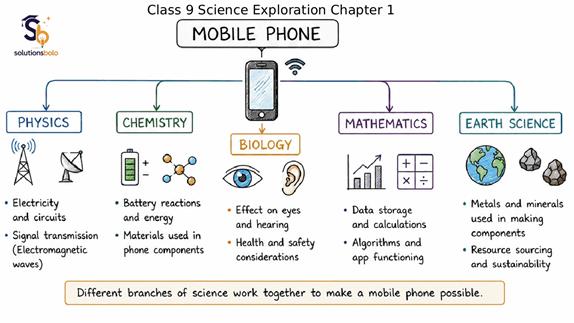
1. Physics: Physics helps us understand how electricity flows through circuits inside the phone. It also explains sound, light from the screen, radio signals, charging and wireless communication.
2. Chemistry: The battery inside the phone works because of chemical reactions. Chemistry is also involved in making the materials used in screens, batteries and electronic components.
3. Biology: Biology helps us study how mobile phones affect living organisms. Scientists investigate the effects of screen time on eyes, sleep patterns, hearing and overall health.
4. Earth Science: Many minerals and metals such as lithium, copper, silicon and gold are obtained from the Earth. Earth science helps us understand where these resources come from and how they are extracted.
5. Mathematics: Mathematics is used in calculations, data processing, coding, signal transmission, internet communication and storing information accurately.
Connection Between Branches
A mobile phone cannot work using only one branch of science.
• Physics and Chemistry work together in the battery. Chemistry produces electrical energy, while Physics explains how that energy powers the phone.
• Physics and Mathematics work together to transmit signals and process information.
• Earth Science and Chemistry work together because minerals from the Earth are transformed into useful electronic materials.
• Biology and Technology are connected when scientists study the impact of phone usage on human health.
Conclusion
A mobile phone is an excellent example of how different branches of science are connected in real life. Physics, Chemistry, Biology, Earth Science and Mathematics all contribute to its design and functioning. This shows that science is not divided in nature; different branches work together to solve real-world problems and create useful technologies.
5. Daily Life-Based Questions and Answers:
1. In what ways does science help us understand and use modern technology effectively?
Answer: Science explains the principles behind modern technologies such as mobile phones, computers, medicines and vehicles. Understanding science helps people use technology safely, solve technical problems and appreciate how these inventions improve life.
Explanation: Science provides the knowledge needed to understand how modern technologies work. Concepts from physics, chemistry, biology and mathematics are used in devices such as smartphones, computers, medical equipment and transportation systems. By learning science, people can use technology more effectively, troubleshoot simple problems and make informed choices about its use. Scientific knowledge also helps society develop new technologies that improve communication, healthcare, transportation and many other aspects of everyday life.
2. Why is it important to use standard units such as kilograms while buying and selling goods?
Answer: Standard units like kilograms ensure fairness and accuracy in buying and selling goods. They allow everyone to measure products in the same way, prevent confusion and make trade reliable and trustworthy everywhere.
Explanation: Standard units such as kilograms are important because they provide a common system of measurement for everyone. When buyers and sellers use the same unit, transactions become fair and accurate. Standard units prevent misunderstandings, reduce the chances of cheating and make it easier to compare products. They are also essential for scientific work, industry and international trade. Using standard measurements helps people trust the quantities they buy and ensures consistency across different places and countries.
3. How does estimation help us make decisions in everyday life?
Answer: Estimation helps us make quick and practical decisions by providing approximate answers. It helps in planning expenses, managing time, estimating quantities and checking whether an exact answer or calculation is reasonable.
Explanation: Estimation is useful in daily life because it helps us make decisions without needing exact calculations every time. We use estimation while shopping, planning journeys, budgeting money, cooking food or managing time. It helps us judge whether an answer is sensible and avoid obvious mistakes. Estimation saves time and develops practical thinking skills. By making reasonable approximations, we can solve everyday problems efficiently and make better decisions even when complete information is not available.
4. Why should people verify viral social media claims using scientific thinking before believing them?
Answer: People should verify viral social media claims because not all information online is true. Scientific thinking encourages checking evidence, facts and reliable sources before accepting a claim, helping prevent the spread of misinformation.
Explanation: Viral social media claims can spread quickly, but many may be inaccurate or misleading. Scientific thinking helps people examine evidence, ask questions and look for reliable sources before believing or sharing information. This approach reduces the chances of being misled by rumours, superstitions or false claims. By verifying facts through observation, data and trusted sources, people can make informed decisions and contribute to a better-informed society. Scientific thinking promotes critical analysis rather than blind acceptance.
6. Activity-Based Questions and Answers:
1. While modelling a bicycle ride from school to home, which details would you keep and which would you ignore? Give reasons.
Answer: While modelling a bicycle ride home, I would keep distance, speed, road condition and traffic because they affect travel time. I would ignore bicycle colour, rider’s clothing and nearby buildings because they do not significantly affect the journey.
Explanation: To model a bicycle ride from school to home, I would include factors such as distance travelled, average speed, traffic conditions, road quality and traffic signals because they influence the time taken to reach home. I would ignore details like the colour of the bicycle, the rider’s hairstyle, clothing or the colour of nearby houses because these factors do not affect travel time. Ignoring unnecessary details makes the model simpler, easier to study and still useful for making predictions.
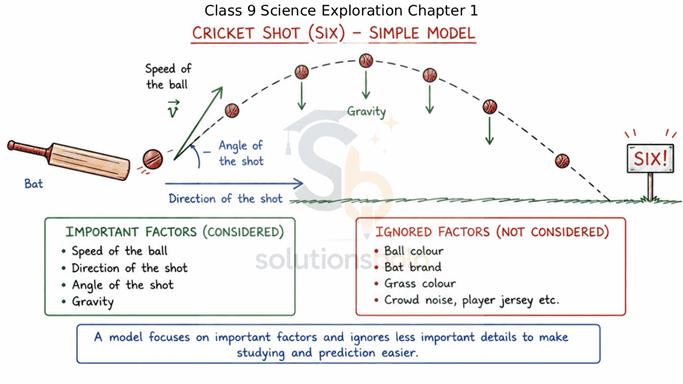
2. Create a simple model for a cricket ball being hit for a six. Explain the assumptions you would make.
Answer: To model a six, I would consider the ball’s speed, direction and angle after being hit. I would assume no strong wind and ignore the ball’s colour, seam and brand to simplify calculations.
Explanation: A simple model for a cricket ball being hit for a six would focus on the ball’s speed, direction, launch angle and gravity. I would assume that weather conditions remain normal and that strong wind does not affect the ball’s flight. I would also ignore the colour of the ball, the brand of the bat and the stitching on the ball because they have very little effect on whether the ball crosses the boundary. These assumptions help create a simple and useful model.
3. Estimate the amount of air you breathe in one day and describe the steps used to make your estimate.
Answer: I estimate that a person breathes about 10,000 litres of air daily. I used the average number of breaths per minute and the approximate volume of one breath to make this estimate.
Explanation: To estimate the amount of air breathed in one day, I first assume that a person takes about 14 breaths per minute. There are 1,440 minutes in a day, giving approximately 20,000 breaths daily. Next, I estimate that each breath contains about 0.5 litre of air. Multiplying 20,000 by 0.5 gives about 10,000 litres of air per day. This estimate may not be exact, but it helps us understand the large amount of air our body uses daily.
Steps of Estimation
1. Average breaths per minute ≈ 14
2. Minutes in one day = 24 × 60 = 1,440
3. Total breaths per day ≈ 14 × 1,440 = 20,160
4. Air in one breath ≈ 0.5 litre
5. Total air per day ≈ 20,160 × 0.5
6. Estimated air breathed ≈ 10,000 litres per day
Conclusion:
Scientific estimation does not always give an exact answer, but it helps us judge whether a result is reasonable and understand real-world situations.
7. Hypothetical-Based Questions and Answers:
1. What might happen if scientists refused to change their theories even when new evidence was discovered?
Answer: If scientists refused to change their theories, scientific progress would slow down. Incorrect ideas would continue to be accepted, new discoveries would be ignored and our understanding of nature would become less accurate over time.
Explanation: If scientists refused to modify their theories when new evidence appeared, science would stop progressing effectively. Many important discoveries, such as modern atomic theory or advances in medicine, might never have been accepted. Scientific theories remain reliable because they can be improved when better evidence becomes available. Ignoring new evidence would lead to inaccurate explanations, poor predictions and slower technological development. The willingness to revise ideas based on evidence is one of the greatest strengths of science.
2. If weather forecasts could predict conditions perfectly for an entire year, how might society change?
Answer: Perfect weather forecasts would help people plan farming, travel, construction and disaster management more effectively. Losses from storms, floods and droughts could be reduced, improving safety and economic productivity.
Explanation: If weather forecasts were perfectly accurate for an entire year, many aspects of society would improve. Farmers could plan planting and harvesting more efficiently. Governments could prepare better for floods, droughts and storms. Airlines, transport services and construction projects could avoid weather-related disruptions. People could plan events and travel with confidence. However, scientists would still need to study weather because understanding the reasons behind weather patterns would remain important for long-term environmental planning.
3. What problems could arise if people relied only on guesswork instead of scientific reasoning?
Answer: Relying only on guesswork could lead to poor decisions, inaccurate conclusions and avoidable mistakes. Without scientific reasoning, people might believe false information and struggle to solve problems effectively.
Explanation: If people depended only on guesswork, many decisions would become unreliable. Medical treatments, engineering projects, weather forecasts and daily problem-solving could result in serious errors. Scientific reasoning uses evidence, observations and logical analysis to reach dependable conclusions. Without it, misinformation and superstitions could spread more easily. Society would find it difficult to develop new technologies or improve living conditions. Scientific thinking helps ensure that decisions are based on facts rather than assumptions.
8. Discussion-Based Questions and Answers:
1. Discuss the importance of evidence in developing and improving scientific knowledge.
Answer: Evidence is the foundation of scientific knowledge. Scientists use observations, measurements and experiments to support ideas. Reliable evidence helps develop accurate explanations, test predictions, correct mistakes and improve our understanding of the natural world.
Explanation: Evidence plays a crucial role in science because scientific knowledge must be based on facts rather than opinions or beliefs. Scientists collect evidence through observations, measurements and experiments. This evidence helps them test hypotheses, develop theories and make reliable predictions. When new evidence is discovered, scientific explanations may be improved or revised. As a result, scientific knowledge becomes more accurate over time. Evidence ensures that science remains trustworthy, objective and capable of explaining natural phenomena effectively.
2. Discuss why scientific theories are considered reliable even though they can change over time.
Answer: Scientific theories are reliable because they are supported by extensive evidence and repeated testing. They may change when new evidence appears, making scientific explanations more accurate rather than proving previous scientific work useless.
Explanation: Scientific theories are considered reliable because they are based on observations, experiments and evidence collected over many years. They explain natural phenomena and successfully make predictions. Although theories can change, these changes usually improve their accuracy rather than replace them completely. Science welcomes new evidence and adjusts explanations when necessary. This ability to improve is a strength, not a weakness. Scientific theories remain trustworthy because they are continuously tested and refined using reliable evidence.
3. Discuss how different branches of science work together to solve real-world problems.
Answer: Different branches of science work together because real-world problems are complex. Physics, chemistry, biology, earth science and mathematics contribute different ideas, helping scientists understand situations completely and develop effective solutions.
Explanation: Real-world problems often involve multiple scientific disciplines working together. For example, developing a mobile phone requires physics for electricity, chemistry for batteries, earth science for minerals and mathematics for calculations. Environmental issues, healthcare and technology also depend on knowledge from several branches of science. By combining different perspectives and methods, scientists gain a more complete understanding of problems and create better solutions. This cooperation makes scientific progress more effective and beneficial for society.
9. Assertion–Reason Questions and Answers
(a) Both A and R are true, and R is the correct explanation of A.
(b) Both A and R are true, but R is not the correct explanation of A.
(c) A is true, but R is false.
(d) A is false, but R is true.
1. Assertion (A): Scientists often ignore some details while building models.
Reason (R): Ignoring less important details helps simplify complex systems and focus on key factors.
Correct Option: Both A and R are true and R is the correct explanation of A.
Answer: Scientists often ignore less important details while building models because real-world systems can be very complex. Focusing on key factors makes models simpler, easier to study and more useful for understanding and predicting phenomena.
Explanation: Both the Assertion and Reason are true and the Reason correctly explains the Assertion. Scientists use models to simplify complex situations by concentrating on the most important factors. Including every detail would make a model difficult to analyse and understand. For example, when studying the motion of a cricket ball, scientists focus on speed, direction and gravity rather than the ball’s colour or brand. Ignoring less important details helps create useful and practical scientific models.
2. Assertion (A): Scientific theories can change when new evidence becomes available.
Reason (R): Science is based on evidence rather than personal beliefs or opinions.
Correct Option: Both A and R are true and R is the correct explanation of A.
Answer: Scientific theories can change when new evidence is discovered because science depends on facts and observations. Scientists revise explanations when better evidence becomes available, ensuring that scientific knowledge remains accurate and reliable.
Explanation: Both the Assertion and Reason are true and the Reason correctly explains the Assertion. Science is based on evidence collected through observation and experimentation, not on personal beliefs. When new evidence contradicts existing explanations, scientists carefully examine it and may improve or modify their theories. This process helps science become more accurate over time. The ability to change in response to evidence is one of the strengths of scientific knowledge and contributes to scientific progress.
3. Assertion (A): Estimation is an important scientific skill.
Reason (R): Estimation helps determine whether an answer is reasonable before accepting it.
Correct Option: Both A and R are true and R is the correct explanation of A.
Answer: Estimation is an important scientific skill because it helps scientists judge whether results are reasonable. It allows quick checks, identifies possible mistakes and provides useful approximate answers when exact values are unnecessary.
Explanation: Both the Assertion and Reason are true and the Reason correctly explains the Assertion. Scientists frequently use estimation to check whether calculations and measurements make sense before accepting them. Estimation helps identify errors, develop scientific intuition and make quick judgments when exact values are not required. It is especially useful in planning, problem-solving and evaluating results. By comparing estimates with actual values, scientists can assess whether their conclusions are realistic and logically sound.
10. Imagination-Based Questions and Answers (Think Like a Scientist)
You are not studying science merely to pass an exam. You are learning how scientists think.
1. Imagine a world where scientists never used models. What difficulties would they face while studying nature?
Answer: If scientists never used models, studying nature would become extremely difficult. They would have to consider every detail of complex systems, making observations, explanations, predictions and experiments much harder, slower and less accurate.
Explanation: If scientists never used models, understanding the natural world would be very challenging. Real systems such as weather, the human body, stars and ecosystems are extremely complex. Scientists would need to examine every detail at once, which would make studying, predicting and explaining phenomena difficult. Models simplify reality by focusing on important factors while ignoring less important ones. Without models, scientific investigations would take much longer, predictions would be harder to make and many discoveries might never occur.
| Think Like a Scientist: |
Imagine trying to study the motion of a cricket ball by considering every blade of grass, every air particle, the ball’s stitching, wind direction, temperature and even tiny vibrations of the ground. The problem would become so complicated that finding useful answers would be nearly impossible. Models allow scientists to focus on what matters most. Without them, science would lose one of its most powerful tools for understanding nature.
2. Suppose scientific units were different in every country. How would this affect daily life and scientific work?
Answer: If every country used different scientific units, confusion and mistakes would increase. Trade, travel, communication and scientific research would become difficult because measurements could not be easily compared or understood worldwide.
Explanation: If scientific units were different in every country, people would face many problems in daily life and scientific work. Buying products, travelling, constructing buildings and conducting experiments would require constant conversions. Misunderstandings and calculation errors would become common. Scientists from different countries would struggle to compare results and share knowledge accurately. Standard units such as kilograms, metres and seconds provide a common language that allows science, trade and communication to function smoothly across the world.
| Think Like a Scientist: |
Imagine buying 1 kilogram of rice in one country and discovering that their “kilogram” is different from the kilogram used elsewhere. Medicines could be given in wrong amounts, engineering projects could fail and international trade could become confusing. Scientific progress depends on people being able to compare measurements accurately. That is why international standard units are so important.
3. Imagine you are a scientist studying a newly discovered planet. What observations and measurements would you make first?
Answer: As a scientist, I would first observe the planet’s size, temperature, atmosphere, gravity and distance from its star. These measurements would help determine whether the planet could support life or future exploration.
Explanation: If I discovered a new planet, I would begin by measuring its size, mass, temperature, gravity and distance from its star. I would also study its atmosphere, surface features, water availability and rotation period. These observations would help me understand the planet’s environment and determine whether it could support life. Collecting accurate data is important because scientific conclusions must be based on evidence rather than assumptions or imagination alone.
| Think Like a Scientist: |
As a scientist, I would ask several important questions:
• How large is the planet?
• What is its average temperature?
• Does it have an atmosphere?
• Is water present?
• How strong is its gravity?
• How long is one day and one year there?
• Does it have mountains, oceans or ice caps?
• Could living organisms survive there?
I would use telescopes, satellites, probes and scientific instruments to collect data. After gathering evidence, I would build models to explain the planet’s characteristics and predict what conditions might exist there.
11. Important Keywords and Definitions (As Quick Revision):
Science: A systematic way of understanding the natural world through observation, experimentation and reasoning.
Observation: Careful noticing and recording of events, objects or phenomena.
Model: A simplified representation of a real system used to understand or study it.
Assumption: A condition accepted as true while building a model or explanation.
Measurement: The process of determining the value of a quantity using standard units.
Scientific Language: Precise terms, symbols and units used to communicate scientific ideas clearly.
Symbol: A letter or sign used to represent a scientific quantity (e.g., m, v, F).
Unit: A standard quantity used for measurement, such as metre, kilogram or second.
SI Units: Internationally accepted standard units used in science and everyday life.
Quantity: A measurable property such as mass, length, time or temperature.
Mass: The amount of matter present in an object.
Velocity: The speed of an object in a particular direction.
Force: A push or pull that can change the motion of an object.
Electric Current: The flow of electric charge through a conductor.
Mathematics in Science: A language used to describe relationships between scientific quantities.
Equation: A mathematical statement showing the relationship between quantities.
Law: A statement describing a consistent pattern or relationship observed in nature.
Scientific Theory: A well-tested explanation of natural phenomena based on evidence.
Principle: A fundamental idea used to explain or understand scientific situations.
Evidence: Facts, observations or experimental results that support a scientific idea.
Prediction: A reasoned expectation about what may happen under certain conditions.
Experiment: A planned investigation used to test ideas or predictions.
Scientific Thinking: Using evidence, logic and reasoning to understand the world.
Hypothesis: A testable explanation or possible answer to a scientific question.
Data: Information collected through observations, measurements or experiments.
Pattern: A repeated trend or relationship found in observations or data.
Scientific Model: A simplified system used to explain, predict or study real-world phenomena.
Approximation: A value that is close to, but not exactly equal to, the actual value.
Estimation: Making a reasonable calculation or judgment without exact measurements.
Reasoning: The process of drawing conclusions using logic and evidence.
Accuracy: The closeness of a measurement to the true value.
Precision: The consistency of repeated measurements.
Standard Unit: A universally accepted unit used for fair and consistent measurement.
Scientific Evidence: Reliable information obtained through observation and experimentation.
Scientific Inquiry: The process of asking questions and investigating them scientifically.
Interdisciplinary Science: The use of ideas from multiple branches of science to solve problems.
Physics: The branch of science that studies matter, energy, motion and forces.
Chemistry: The branch of science that studies substances and their changes.
Biology: The branch of science that studies living organisms and life processes.
Earth Science: The study of Earth, its atmosphere, oceans and geological processes.
Critical Thinking: Carefully analysing information before forming conclusions.
Scientific Method: A systematic process of observation, hypothesis, experimentation and conclusion.
Conservation of Energy: The principle that energy cannot be created or destroyed, only transformed.
Evidence-Based Conclusion: A conclusion reached using observations and reliable data.
Scientific Exploration: The process of investigating and understanding the natural world through curiosity and evidence.
Science is not just about finding answers. It is about learning how to ask better questions.