NCERT Class 9 Maths Ganita Manjari Chapter 5 I’m Up and Down and Round and Round Solutions include Exercise Set 5.1, Exercise Set 5.2, Exercise Set 5.3, Exercise Set 5.4, Exercise Set 5.5 and End of Chapter Exercises for the academic session 2026–27. This chapter introduces students to the properties of circles, including chords, diameters, arcs, angles and cyclic quadrilaterals. Students learn to apply important circle theorems, identify the positions of the centre and circumcentre, solve problems involving chords and parallel chords and use geometrical reasoning to prove results. The chapter also develops logical thinking through theorem-based questions and practical applications of circle geometry. These Solutions provide clear step-by-step explanations and are useful for CBSE students preparing for school examinations based on the New Syllabus 2026–27.
Table of Contents (Quick Links):
Common Mistakes Students Make in Chapter
Quick Reference: Theorems & Formulas
Page – 98
Exercise Set 5.1
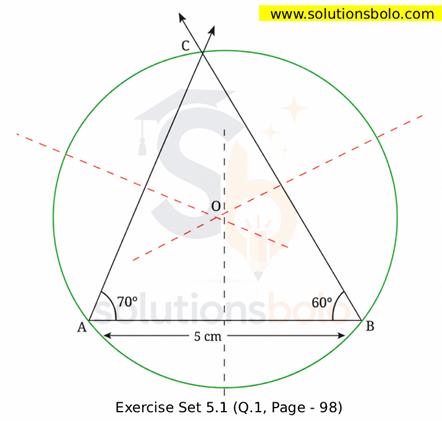
1. Draw ΔABC with AB = 5 cm, ∠A = 70° and ∠B = 60°. Draw the circumcircle of ΔABC. Is the centre inside or outside the triangle?
[Concept: The circumcentre of a triangle is the point where the perpendicular bisectors of its three sides intersect. A circle drawn with the circumcentre as the centre and passing through all the three vertices of the triangle is called the circumcircle.]
Solution:
Given
AB = 5 cm
∠A = 70°
∠B = 60°
Construction
Draw a line segment AB = 5 cm.
At point A, construct an angle of 70°.
At point B, construct an angle of 60°.
Let the two rays intersect at point C. Join AC and BC to obtain ΔABC.
Draw the perpendicular bisector of AB.
Draw the perpendicular bisector of BC.
Let the two perpendicular bisectors intersect at point O. Point O is the circumcentre of ΔABC.
With O as the centre and OA as the radius, draw a circle passing through A, B and C. This is the circumcircle of ΔABC.
Explanation
Now,
∠C = 180° − (70° + 60°)
= 50°
Since
∠A = 70°
∠B = 60°
∠C = 50°
all the angles of the triangle are less than 90°.
Therefore, ΔABC is an acute-angled triangle.
The circumcentre of an acute-angled triangle always lies inside the triangle.
Hence, the centre of the circumcircle lies inside the triangle.
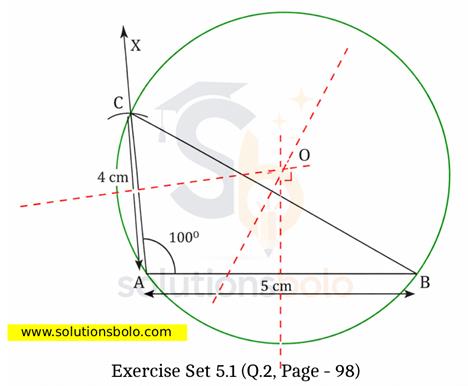
2. Draw ΔABC with AB = 5 cm, ∠A = 100° and AC = 4 cm. Draw the circumcircle of ΔABC. Is the centre inside or outside the triangle?
[Concept: Construct the given triangle and draw the perpendicular bisectors of any two sides. Their point of intersection is the circumcentre. Using this point as the centre and a vertex as the radius, draw the circumcircle.]
Solution:
Given
AB = 5 cm
AC = 4 cm
∠A = 100°
Construction
Draw a line segment AB = 5 cm.
At point A, construct an angle of 100°.
On one arm of the angle, mark a point C such that AC = 4 cm.
Join BC to obtain ΔABC.
Draw the perpendicular bisector of AB.
Draw the perpendicular bisector of BC.
Let the two perpendicular bisectors intersect at point O. Point O is the circumcentre of ΔABC.
With O as the centre and OA as the radius, draw a circle passing through A, B and C. This is the circumcircle of ΔABC.
Explanation
Now,
∠A = 100°
Since ∠A is greater than 90°, ΔABC is an obtuse-angled triangle.
The circumcentre of an obtuse-angled triangle always lies outside the triangle.
Hence, the centre of the circumcircle lies outside the triangle.
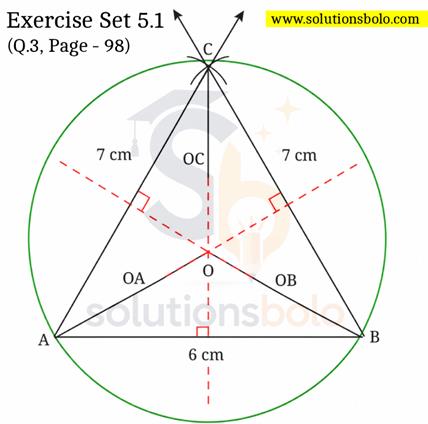
3. Draw ΔABC with AB = 6 cm, BC = 7 cm and CA = 7 cm. Draw the circumcircle of ΔABC. Let the circumcentre be O. Measure OA, OB and OC.
[Concept: Construct the triangle using the given side lengths. Draw the perpendicular bisectors of any two sides to locate the circumcentre. Since the circumcentre is the centre of the circumcircle, it is equidistant from all the vertices of the triangle.]
Solution:
Given
AB = 6 cm
BC = 7 cm
CA = 7 cm
Construction
Draw a line segment AB = 6 cm.
With A as the centre and radius 7 cm, draw an arc.
With B as the centre and radius 7 cm, draw another arc intersecting the first at C.
Join AC and BC to obtain ΔABC.
Draw the perpendicular bisector of AB.
Draw the perpendicular bisector of BC.
Let the two perpendicular bisectors intersect at point O. Point O is the circumcentre of ΔABC.
With O as the centre and OA as the radius, draw a circle passing through A, B and C. This is the circumcircle of ΔABC.
Explanation
Since O is the circumcentre of ΔABC,
OA = OB = OC
because all three are radii of the circumcircle.
By measuring the figure, the lengths of OA, OB and OC are found to be equal.
Hence,
OA = OB = OC.
4. What is the least possible radius of a circle through two points A and B?
[Concept: The centre of every circle passing through two fixed points A and B lies on the perpendicular bisector of AB. Among all such circles, the smallest circle is obtained when the centre is at the midpoint of AB. In this case, AB becomes the diameter of the circle.]
Solution:
Let the distance between the two points A and B be AB.
The least possible circle passing through A and B is obtained when AB is the diameter of the circle.
Therefore,
Radius = Diameter/2
Hence,
Least possible radius = AB/2
| Observation If the centre is moved anywhere else on the perpendicular bisector of AB, the radius becomes larger. Therefore, the minimum radius is obtained only when the centre is the midpoint of AB. Hence, the least possible radius of the circle is = AB/2. |
Page – 100
Exercise Set 5.2
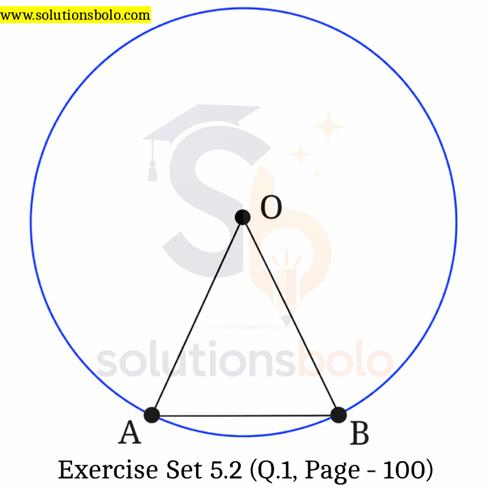
1. Show that the triangle formed by a chord and the centre of the circle is isosceles.
[Concept: If the endpoints of a chord are joined to the centre of the circle, the two sides formed are radii of the same circle. Since all radii are equal, the triangle formed is isosceles.]
Solution:
Given
Let AB be a chord of a circle with centre O.
Join OA and OB.
Proof
Since OA and OB are radii of the same circle,
OA = OB
Therefore, in triangle ΔOAB,
OA = OB
Hence, ΔOAB is an isosceles triangle.
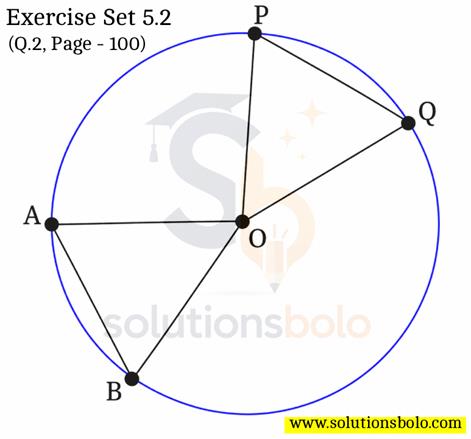
2. Show that if two such isosceles triangles (occurring in the previous question) have equal base length, they are congruent to each other.
[Concept: If two chords of the same circle are equal, then the triangles formed by joining the endpoints of each chord to the centre have three equal corresponding sides. Therefore, the triangles are congruent by the SSS Congruence Criterion.]
Solution:
Given
Let AB and CD be two equal chords of the same circle with centre O.
AB = CD
Join OA, OB, OC and OD.
Proof
Since OA, OB, OC and OD are radii of the same circle,
OA = OC
OB = OD
Also,
AB = CD (Given)
Now, in triangles ΔOAB and ΔOCD,
OA = OC
OB = OD
AB = CD
Therefore,
ΔOAB ≅ ΔOCD (by the SSS Congruence Criterion).
Hence, if two such isosceles triangles have equal base lengths, they are congruent.
Page – 101
Exercise Set 5.3
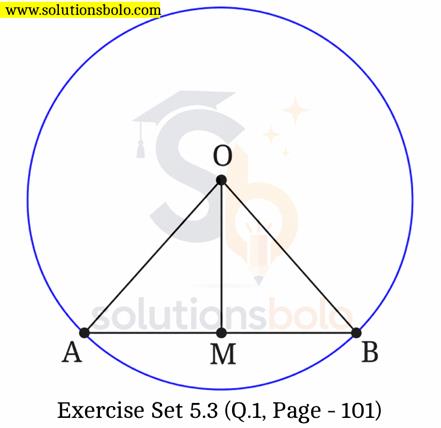
1. Can you explain why the converse to Theorem 4 is true, i.e., why does the perpendicular from the centre of a circle to a chord of the circle bisect the chord?
Hint: Use Fig. 5.12. You are told that ∠CMA = ∠CMB = 90°. You need to show that AM = BM.
[Concept: If a perpendicular is drawn from the centre of a circle to a chord, then the two right triangles formed have equal hypotenuses (radii) and a common side. Therefore, they are congruent by the RHS Congruence Criterion, implying that the chord is bisected.]
Solution:
Given
AB is a chord of a circle with centre C.
CM is perpendicular to AB.
Therefore,
∠CMA = ∠CMB = 90°.
Join CA and CB.
Proof
Since CA and CB are radii of the same circle,
CA = CB
Also,
CM = CM (Common side)
Now, in triangles ΔCMA and ΔCMB,
CA = CB
CM = CM
∠CMA = ∠CMB = 90°
Therefore,
ΔCMA ≅ ΔCMB (by the RHS Congruence Criterion)
Hence,
AM = BM (CPCT)
Therefore, M is the midpoint of AB.
Hence proved that the perpendicular from the centre of a circle to a chord bisects the chord.
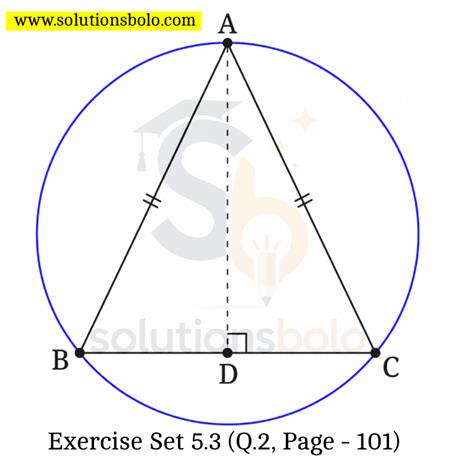
2. An isosceles triangle ABC is inscribed in a circle, with AB = AC. Show that the altitude from A to BC passes through the centre of the circle.
[Concept: In an isosceles triangle, the altitude drawn from the vertex to the base also bisects the base. Therefore, it becomes the perpendicular bisector of the base. Since the perpendicular bisector of a chord passes through the centre of the circle, the altitude must pass through the centre.]
Solution:
Given
△ABC is inscribed in a circle.
AB = AC.
Let AD be the altitude from A to BC.
Therefore,
AD ⊥ BC.
Proof
In triangles △ABD and △ACD,
AB = AC (Given)
AD = AD (Common side)
∠ADB = ∠ADC = 90° (Since AD ⊥ BC)
Therefore,
△ABD ≅ △ACD (by the RHS Congruence Criterion)
Hence,
BD = DC (CPCT)
Therefore, AD bisects BC.
Since AD is perpendicular to BC and also bisects BC, AD is the perpendicular bisector of chord BC.
The perpendicular bisector of a chord always passes through the centre of the circle.
Hence, AD passes through the centre of the circle.
3. Two parallel chords of lengths 6 cm and 8 cm are on opposite sides of the centre of a circle. If the radius of the circle is 5 cm, find the distance between the midpoints of the chords.
[Concept: The perpendicular drawn from the centre of a circle to a chord bisects the chord. If the radius of the circle and half the length of the chord are known, the perpendicular distance of the chord from the centre can be found using the Pythagoras Theorem.]
Solution:
Given
Radius of the circle = 5 cm
Length of first chord = 6 cm
Length of second chord = 8 cm
Calculation:
Let O be the centre of the circle.
Let M and N be the midpoints of the chords of lengths 6 cm and 8 cm, respectively.
Since the perpendicular from the centre bisects the chord,
Half of the first chord = 6 ÷ 2 = 3 cm
Applying Pythagoras Theorem,
OM² + 3² = 5²
OM² + 9 = 25
OM² = 16
OM = 4 cm
Similarly,
Half of the second chord = 8 ÷ 2 = 4 cm
Again,
ON² + 4² = 5²
ON² + 16 = 25
ON² = 9
ON = 3 cm
Since the two chords lie on opposite sides of the centre,
MN = OM + ON
MN = 4 + 3
MN = 7 cm
Distance between the midpoints of the two chords = 7 cm.
Page – 104
Exercise Set 5.4
1. Use the Baudhayana–Pythagoras theorem to show why Theorem 6 must be true.
[Concept: According to the Baudhayana–Pythagoras Theorem, in a right-angled triangle,
(Hypotenuse)² = (Perpendicular)² + (Base)²
Theorem 6 states that equal chords of a circle are equidistant from the centre. This can be proved by applying the Baudhayana–Pythagoras Theorem to the right triangles formed by drawing perpendiculars from the centre to the equal chords.]
Solution:
Given
AB and CD are two equal chords of a circle.
O is the centre of the circle.
OM ⟂ AB and ON ⟂ CD.
AB = CD.
Proof:
Since the perpendicular drawn from the centre of a circle bisects the chord,
AM = AB ÷ 2
CN = CD ÷ 2
As AB = CD,
AM = CN
Also,
OA = OC
(Radii of the same circle)
Applying the Baudhayana–Pythagoras Theorem in right triangles OMA and ONC,
OA² = OM² + AM²
OC² = ON² + CN²
Since
OA = OC
and
AM = CN,
therefore,
OM² = ON²
Hence,
OM = ON
Therefore, the equal chords are at equal distances from the centre.
Thus, Theorem 6 is proved.
Answer
Hence proved that equal chords of a circle are equidistant from the centre.
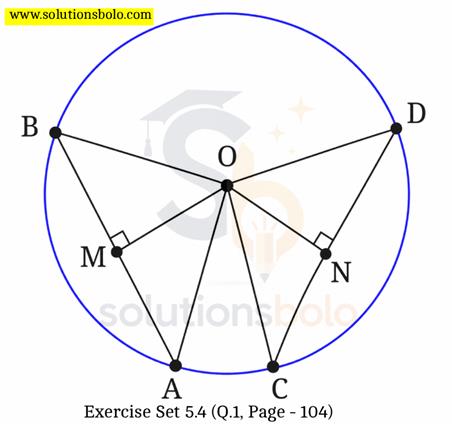
| Observation: Equal chords form equal right triangles with the radii. Hence, their perpendicular distances from the centre are equal. |
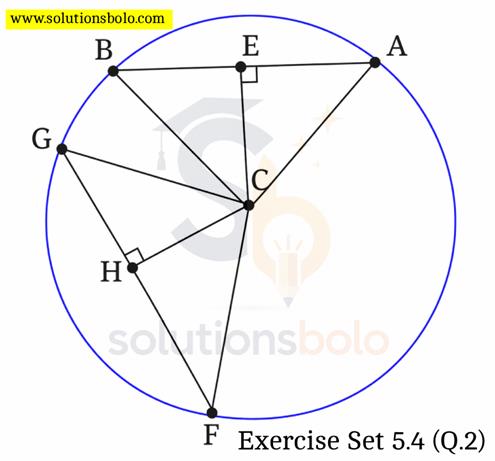
2. Consider Fig. 5.15. If CE is perpendicular to AB, CH is perpendicular to GF and CE = CH, show that AB = GF.
[Concept: The perpendicular drawn from the centre of a circle to a chord bisects the chord. If two chords are at the same perpendicular distance from the centre, then they are equal in length.]
Solution:
Given
CE ⟂ AB
CH ⟂ GF
CE = CH
To Prove
AB = GF
Proof
Since CE ⟂ AB,
the perpendicular from the centre to chord AB bisects the chord.
Therefore,
AE = EB
Similarly,
since CH ⟂ GF,
the perpendicular from the centre to chord GF bisects the chord.
Therefore,
GH = HF
Now, in triangles △CEA and △CHG,
CA = CG (Radii of the same circle)
CE = CH (Given)
∠CEA = ∠CHG = 90° (Since CE ⟂ AB and CH ⟂ GF)
Therefore,
△CEA ≅ △CHG (by the RHS Congruence Criterion)
Hence,
AE = GH (CPCT)
Multiplying both sides by 2,
2AE = 2GH
But,
AB = 2AE
GF = 2GH
Therefore,
AB = GF
3. Solve the previous question using the Baudhayana–Pythagoras theorem.
[Concept: According to the Baudhayana–Pythagoras Theorem, in a right-angled triangle,
(Hypotenuse)² = (Perpendicular)² + (Base)².
If two chords are at equal distances from the centre, then the corresponding half-chords are equal. Hence, the complete chords are also equal.]
Solution:
Given
CE ⟂ AB
CH ⟂ GF
CE = CH
To Prove
AB = GF
Proof
Since CE is perpendicular to chord AB,
it bisects chord AB.
Therefore,
E is the midpoint of AB.
AE = AB/2
Similarly,
since CH is perpendicular to chord GF,
it bisects chord GF.
Therefore,
H is the midpoint of GF.
GH = GF/2
Now apply the Baudhayana–Pythagoras Theorem.
In right triangle △CEA,
CA² = CE² + AE² ………. (1)
In right triangle △CHG,
CG² = CH² + GH² ………. (2)
Since,
CA = CG (Radii of the same circle)
CE = CH (Given)
From (1) and (2),
CE² + AE² = CH² + GH²
Since CE = CH,
AE² = GH²
Therefore,
AE = GH
But,
AE = AB/2
GH = GF/2
Therefore,
AB/2 = GF/2
Hence,
AB = GF
Page – 105
Exercise Set 5.5
1. Find the length of the chord of a circle where the radius is 7 cm and perpendicular distance is 6 cm.
[Concept: The perpendicular drawn from the centre of a circle to a chord bisects the chord. Using the Baudhayana–Pythagoras Theorem, we first find half of the chord and then multiply it by 2 to obtain the complete chord length.]
Solution:
Given
Radius of the circle (r) = 7 cm
Perpendicular distance from the centre to the chord (d) = 6 cm
Calculation
Let AB be the chord and O be the centre of the circle.
Let M be the midpoint of chord AB.
Since OM is perpendicular to AB,
AM = AB ÷ 2
Applying the Baudhayana–Pythagoras Theorem,
OA² = OM² + AM²
7² = 6² + AM²
49 = 36 + AM²
AM² = 13
AM = √13 cm
Therefore,
AB = 2 × AM
AB = 2√13 cm
Answer
Length of the chord = 2√13 cm
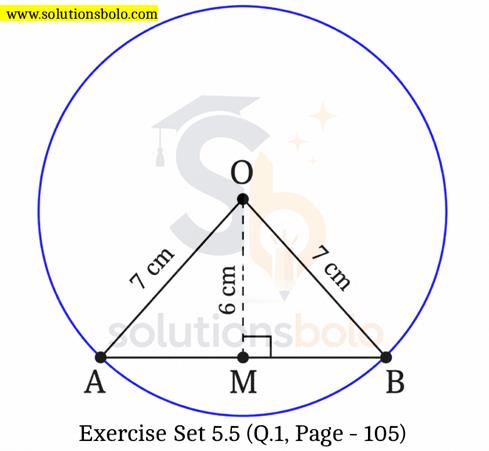
| Observation: The perpendicular from the centre divides the chord into two equal parts. Hence, after finding half of the chord, multiplying it by 2 gives the complete chord length. |
2. Explain why the following statement is true: If the perpendicular distance of a chord from the centre is d and the radius is r, then the chord length is 2√(r² − d²).
[Concept: The perpendicular drawn from the centre of a circle to a chord bisects the chord.
By applying the Baudhayana–Pythagoras Theorem to the right triangle formed, we can derive the general formula for the length of a chord.]
Solution:
Given
Radius of the circle = r
Perpendicular distance of the chord from the centre = d
Proof
Let AB be a chord of the circle and O be its centre.
Let OM be perpendicular to chord AB.
Then,
OM = d
OA = r
Since the perpendicular from the centre bisects the chord,
AM = AB ÷ 2
Applying the Baudhayana–Pythagoras Theorem in right triangle OMA,
OA² = OM² + AM²
r² = d² + AM²
AM² = r² − d²
AM = √(r² − d²)
But,
AB = 2 × AM
Therefore,
AB = 2√(r² − d²)
Hence, the length of the chord is
AB = 2√(r² − d²).
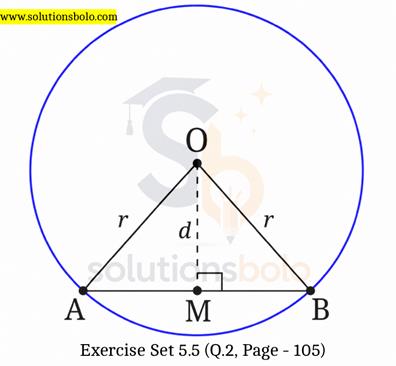
| Observation: The perpendicular from the centre divides the chord into two equal halves. Using the Baudhayana–Pythagoras Theorem, half of the chord is found to be √(r² − d²). Therefore, the complete chord length is 2√(r² − d²). |
3. In a circle, if the distance of chord AB from the centre is twice the distance of another chord CD from the centre, then can we conclude that CD = 2AB? Give reasons for your answer.
[Concept: The length of a chord depends on both the radius of the circle and its perpendicular distance from the centre. Since the relationship is not directly proportional, comparing the distances from the centre does not imply a similar comparison of the chord lengths.]
Solution:
Given
Distance of chord AB from the centre = 2 × (distance of chord CD from the centre)
Explanation
The length of a chord is given by
Chord length = 2√(r² − d²)
where,
r = radius of the circle
d = perpendicular distance of the chord from the centre.
Let the distance of chord CD from the centre be d.
Then the distance of chord AB from the centre is 2d.
Therefore,
CD = 2√(r² − d²)
AB = 2√(r² − (2d)²)
= 2√(r² − 4d²)
Since the relationship between the chord length and the distance from the centre is not directly proportional,
CD is not equal to 2AB in general.
Hence, we cannot conclude that CD = 2AB.
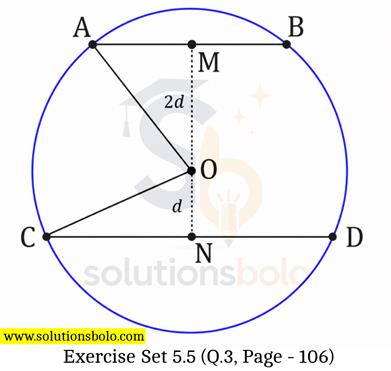
Page – 110
Exercise Set 5.6
1. In a circle with centre O, the central angle AOB is 60°. If the radius of the circle is 12 cm, what is the length of the chord AB?
[Concept: If the central angle of a circle is 60°, then the triangle formed by the two radii and the chord can be shown to be an equilateral triangle. Hence, the chord is equal to the radius.]
Solution
Given
Radius OA = OB = 12 cm
∠AOB = 60°
Calculation
In triangle AOB,
OA = OB
Therefore,
∠OAB = ∠OBA
(Angles opposite to equal sides are equal.)
Let
∠OAB = ∠OBA = x
Now, in triangle AOB,
∠AOB + ∠OAB + ∠OBA = 180°
60° + x + x = 180°
2x = 120°
x = 60°
Therefore,
∠OAB = ∠OBA = 60°
Thus, all three angles of triangle AOB are 60°.
Hence, triangle AOB is an equilateral triangle.
Therefore,
AB = OA
AB = 12 cm
Answer
Length of chord AB = 12 cm.
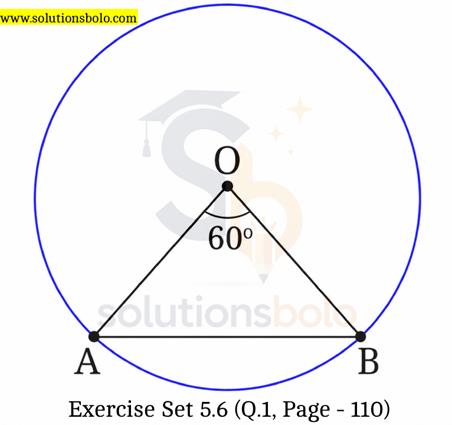
| Observation: When the central angle is 60°, the triangle formed by the two radii and the chord is an equilateral triangle. Therefore, the chord is equal to the radius. |
2.(i). Let A and B be two points on a circle with centre O. Are there points X, Y on the circle, on the same side of AB, such that ∠AXB is different from ∠AYB?
[Concept: Angles subtended by the same chord at points (एक ही जीवा द्वारा बिंदुओं पर बनाए गए कोण) on the same segment of a circle are always equal (एक ही वृत्त-खंड के कोण हमेशा बराबर होते हैं). This is a direct application of the theorem: (प्रमेय का सीधा अनुप्रयोग) “Angles in the same segment of a circle are equal.”]
Solution:
Given
A and B are two points on a circle.
X and Y are points on the same side of chord AB.
Explanation
Since X and Y lie on the same segment (एक ही खंड पर स्थित होना) of the circle,
both angles ∠AXB and ∠AYB are subtended by the same chord AB.
According to the theorem,
Angles in the same segment of a circle are equal.
Therefore,
∠AXB = ∠AYB
Hence, the two angles cannot be different.
| Observation: A chord subtends equal angles at every point (जीवा हर बिंदु पर समान कोण बनाती है) on the same segment of the circle. Therefore, all such angles are equal. |
2. (ii). Is it true that if ∠AXB = ∠AYB, then X and Y lie on the same side (X और Y एक ही तरफ़ स्थित हैं) of the circle?
[Concept: If two angles subtended by the same chord are equal (अगर एक ही जीवा (chord) द्वारा बनाए गए दो कोण बराबर हों), then the points at which these angles are formed lie on the same segment (बनने वाले कोण एक ही रेखाखंड पर स्थित होते हैं) of the circle. This is the converse of the theorem (प्रमेय का विलोम): “Angles in the same segment of a circle are equal.“]
Solution:
Given
A and B are two points on a circle.
∠AXB = ∠AYB.
Explanation
Both angles are subtended (कोण बनते हैं) by the same chord AB.
According to the converse of the theorem (प्रमेय का विलोम),
If two angles subtended by the same chord are equal (एक ही जीवा द्वारा बनाए गए दो कोण बराबर होते हैं), then the points lie on the same segment of the circle.
Therefore,
X and Y lie on the same side of chord AB (जीवा AB के एक ही ओर) (that is, in the same segment of the circle (वृत्त का वही खंड).
Hence, the given statement is true.
If ∠AXB = ∠AYB, then X and Y lie on the same segment (same side of chord AB) of the circle.
| Observation: Equal angles standing on the same chord (एक ही जीवा पर बने समान कोण) always belong to the same segment of the circle. Therefore, the corresponding points lie on the same side (संगत बिंदु एक ही तरफ स्थित होते हैं) of the chord. |
2. (iii). If ∠AXB = ∠AYB and X and Y do not lie on the circle (वृत्त पर स्थित नहीं हैं), does the circle through A, B and X also pass through Y?
[Concept: Three non-collinear points determine (असंरेखीय बिंदु निर्धारित करते हैं) a unique circle. If two points X and Y subtend equal angles at the same chord (एक ही जीवा पर समान कोण) AB, then A, B, X and Y are concyclic (lie on the same circle)]
Solution:
Given
∠AXB = ∠AYB.
X and Y do not lie on the given circle.
Explanation
A unique circle can always be drawn (वृत्त हमेशा खींचा जा सकता है) through three non-collinear points A, B and X.
Since
∠AXB = ∠AYB,
both angles subtend the same chord AB.
By the Converse of the Angle in the Same Segment Theorem (‘एक ही वृत्तखंड में बने कोण’ प्रमेय का विलोम), the four points A, B, X and Y lie (चार बिंदु A, B, X और Y स्थित हैं) on the same circle.
Therefore, the circle passing through A, B and X must also pass through Y.
If ∠AXB = ∠AYB, then the circle passing through A, B and X also passes through Y because the four points A, B, X and Y are concyclic.
| Observation: Equal angles standing on the same chord imply (एक ही जीवा पर स्थित होने का अर्थ है) that the corresponding points are concyclic. Hence, one unique circle passes through all four points. |
3. Find x in Fig. 5.26.
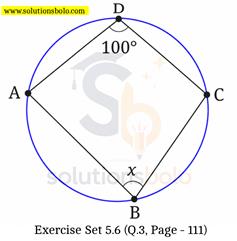
[Concept: In a cyclic quadrilateral, the opposite angles are supplementary. That is, Opposite Angle 1 + Opposite Angle 2 = 180°]
Solution:
Given
ABCD is a cyclic quadrilateral.
∠D = 100°
∠B = x
Calculation
Since ABCD is a cyclic quadrilateral,
Opposite angles are supplementary.
Therefore,
∠B + ∠D = 180°
Substituting the given values,
x + 100° = 180°
x = 180° − 100°
x = 80°
| Observation: In every cyclic quadrilateral, the sum of a pair of opposite angles is always 180°. Therefore, knowing one opposite angle is sufficient to find the other. |
Page – 114
End-of-Chapter Exercises
1. In a circle, a chord is 5 cm away from the centre (एक जीवा केंद्र से 5 cm की दूरी पर है). If the radius of the circle is 13 cm (अगर वृत्त की त्रिज्या 13 cm है), what is the length of the chord?
[Concept: The perpendicular drawn from the centre of a circle to a chord bisects the chord (वृत्त के केंद्र से जीवा पर डाला गया लंब जीवा को समद्विभाजित करता है). Using the Baudhayana–Pythagoras Theorem, we first find half of the chord (हम सबसे पहले जीवा का आधा भाग ज्ञात करते हैं) and then multiply it by 2 to obtain the complete chord length (पूरी कॉर्ड की लंबाई पाने के लिए इसे 2 से गुणा करें.]
Solution:
Given
Radius of the circle (r) = 13 cm
Perpendicular distance from the centre to the chord (d) = 5 cm
Calculation
Let AB be the chord and O be the centre of the circle.
Let M be the midpoint of chord AB.
Since OM is perpendicular to AB,
AM = AB ÷ 2
Applying the Baudhayana–Pythagoras Theorem,
OA² = OM² + AM²
13² = 5² + AM²
169 = 25 + AM²
AM² = 144
AM = 12 cm
Therefore,
AB = 2 × AM
AB = 2 × 12
AB = 24 cm
Length of the chord = 24 cm.
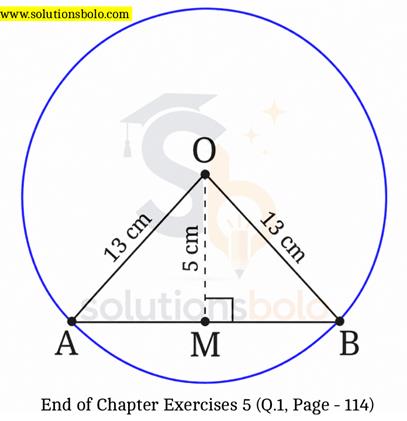
| Observation: The perpendicular from the centre divides the chord (केंद्र से डाला गया लंब जीवा को विभाजित करता है) into two equal parts. After finding half of the chord जीवा का आधा भाग ज्ञात करना), multiplying it by 2 gives the complete chord length (इसे 2 से गुणा करने पर कॉर्ड की पूरी लंबाई मिलती है). |
2. An arc of a circle subtends an angle of 70° at the centre. What is the measure of the angle subtended by the arc at a point on the circle?
[Concept: According to the Angle at the Centre Theorem, The angle subtended by an arc at the centre is twice the angle subtended by the same arc at any point on the remaining part of the circle.]
Solution:
Given
Angle subtended by the arc at the centre = 70°
Calculation
Let the angle subtended by the same arc at a point on the circle be x.
According to the Angle at the Centre Theorem,
Central Angle = 2 × Angle at the Circle
Therefore,
70° = 2 × x
x = 70° ÷ 2
x = 35°
The angle subtended by the arc at a point on the circle is 35°.
| Observation: The angle subtended by an arc at the centre is always twice the angle subtended by the same arc at any point on the circle. |
3. The diameter of a circle is 26 cm. A chord of length 24 cm is drawn in the circle. Find the distance from the centre of the circle to the chord.
[Concept: The perpendicular drawn from the centre of a circle to a chord bisects the chord. Using the Baudhayana–Pythagoras Theorem, the perpendicular distance from the centre to the chord can be calculated.]
Solution:
Given
Diameter of the circle = 26 cm
Radius of the circle = 26 ÷ 2 = 13 cm
Length of the chord = 24 cm
Calculation:
Half of the chord = 24 ÷ 2 = 12 cm
Let O be the centre of the circle.
Let M be the midpoint of chord AB.
Since OM is perpendicular to AB,
AM = 12 cm
Applying the Baudhayana–Pythagoras Theorem,
OA² = OM² + AM²
13² = OM² + 12²
169 = OM² + 144
OM² = 25
OM = 5 cm
Distance from the centre of the circle to the chord = 5 cm.
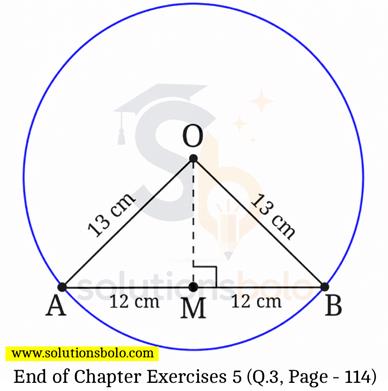
| Observation: The perpendicular from the centre divides the chord into two equal parts. Using one half of the chord and the radius, the perpendicular distance can be found by applying the Baudhayana–Pythagoras Theorem. |
4. A circle has a radius of 15 cm. A chord is drawn. The distance from the centre of the circle to the chord is 9 cm. What is the length of the chord?
[Concept: The perpendicular drawn from the centre of a circle to a chord bisects the chord. Using the Baudhayana–Pythagoras Theorem, we first find half of the chord and then multiply it by 2 to obtain the complete chord length.]
Solution:
Given
Radius of the circle = 15 cm
Distance of the chord from the centre = 9 cm
Calculation
Let AB be the chord and O be the centre of the circle.
Let M be the midpoint of chord AB.
Since OM is perpendicular to AB,
AM = AB/2
Applying the Baudhayana–Pythagoras Theorem,
OA² = OM² + AM²
15² = 9² + AM²
225 = 81 + AM²
AM² = 144
AM = 12 cm
Therefore,
AB = 2 × AM
AB = 2 × 12
AB = 24 cm
Length of the chord = 24 cm.
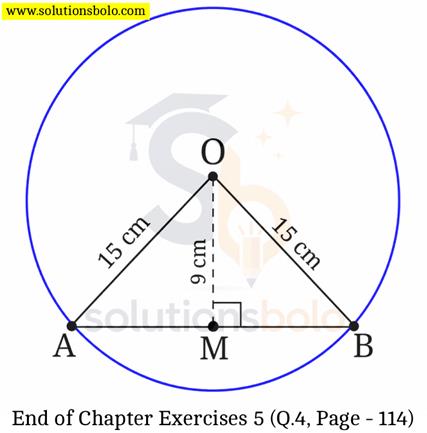
| Observation: The perpendicular from the centre bisects the chord into two equal parts. After finding half of the chord using the Baudhayana–Pythagoras Theorem, doubling it gives the complete chord length. |
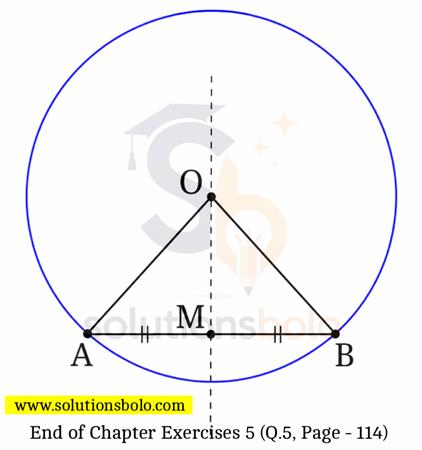
5. Prove that the perpendicular bisector of a chord passes through the centre of the circle.
[Concept: The centre of a circle is equidistant from the endpoints of every chord. Hence, it lies on the perpendicular bisector of the chord.]
Solution:
Given
AB is a chord of a circle with centre O.
Let M be the midpoint of AB.
Let OM ⟂ AB.
To Prove
The perpendicular bisector of chord AB passes through the centre O.
Proof
Since OA and OB are radii of the same circle,
OA = OB
Also,
AM = MB
(Since M is the midpoint of AB)
And,
OM = OM
(Common side)
Therefore, in triangles △OMA and △OMB,
OA = OB
AM = MB
OM = OM
Hence,
△OMA ≅ △OMB
(by the SSS Congruence Criterion)
Therefore,
∠OMA = ∠OMB
(CPCT)
But,
∠OMA + ∠OMB = 180°
(Angles on a straight line)
Since the two angles are equal,
∠OMA = ∠OMB = 90°
Hence,
OM is perpendicular to AB.
Since M is the midpoint of AB and OM ⟂ AB,
OM is the perpendicular bisector of chord AB.
Therefore, the perpendicular bisector of a chord passes through the centre of the circle.
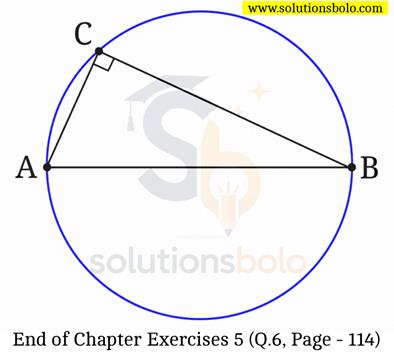
6. The diameter of a circle is AB. Point C is on the circumference. What is the measure of ∠ACB? Explain your reasoning.
[Concept: According to the Angle in a Semicircle Theorem, the angle subtended by a diameter at any point on the remaining part of the circle is always a right angle (90°).]
Solution:
Given
AB is the diameter of a circle.
C is a point on the circumference.
Explanation:
Since AB is the diameter of the circle,
the angle subtended by diameter AB at point C is a right angle.
According to the Angle in a Semicircle Theorem,
Angle subtended by a diameter = 90°
Therefore,
∠ACB = 90°
| Observation: A diameter always subtends a right angle at any point on the circumference. This property is true for every circle. |
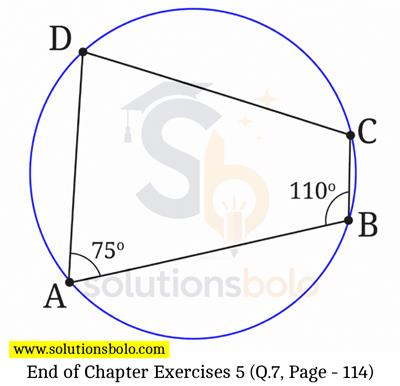
7. ABCD is a cyclic quadrilateral inscribed in a circle. If ∠A measures 75°, what is the measure of ∠C? If ∠B measures 110°, what is the measure of ∠D?
[Concept: In a cyclic quadrilateral, the sum of each pair of opposite angles is 180°. That is, ∠A + ∠C = 180° ∠B + ∠D = 180°]
Solution:
Given
∠A = 75°
∠B = 110°
Reason:
Since ABCD is a cyclic quadrilateral,
Opposite angles are supplementary.
Finding ∠C
∠A + ∠C = 180°
75° + ∠C = 180°
∠C = 180° − 75°
∠C = 105°
Finding ∠D
∠B + ∠D = 180°
110° + ∠D = 180°
∠D = 180° − 110°
∠D = 70°
Answer
∠C = 105°
∠D = 70°
| Observation: In every cyclic quadrilateral, opposite angles always add up to 180°. Knowing one opposite angle is sufficient to determine the other. |
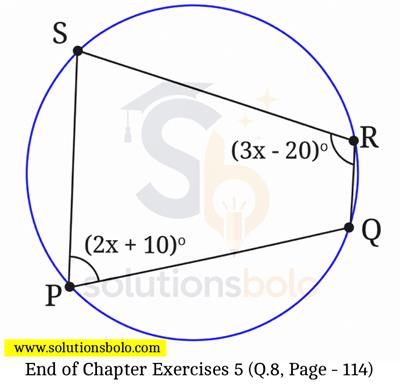
8. Quadrilateral PQRS is inscribed in a circle. If ∠P = (2x + 10)° and ∠R = (3x − 20)°, find the value of x and the measures of ∠P and ∠R.
[Concept: In a cyclic quadrilateral, the sum of opposite angles is 180°. That is, ∠P + ∠R = 180°]
Solution:
Given
∠P = (2x + 10)°
∠R = (3x − 20)°
Explanation:
Since PQRS is a cyclic quadrilateral,
Opposite angles are supplementary.
Therefore,
(2x + 10)° + (3x − 20)° = 180°
5x − 10 = 180
5x = 190
x = 38
Now,
∠P = 2 × 38 + 10
= 76 + 10
= 86°
Similarly,
∠R = 3 × 38 − 20
= 114 − 20
= 94°
Verification:
86° + 94° = 180° ✔
Answer
x = 38
∠P = 86°
∠R = 94°
| Observation: In every cyclic quadrilateral, opposite angles are supplementary. After finding the value of x, substitute it into the given expressions to obtain the required angles. |
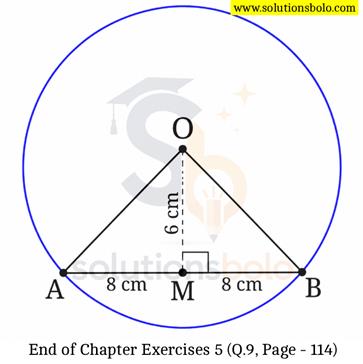
9. The distance of a chord of length 16 cm from the centre of a circle is 6 cm. Find the radius of the circle.
[Concept: The perpendicular drawn from the centre of a circle to a chord bisects the chord. Using the Baudhayana–Pythagoras Theorem, we can find the radius of the circle.]
Solution:
Given
Length of the chord = 16 cm
Distance of the chord from the centre = 6 cm
Explanation:
Half of the chord
= 16 ÷ 2
= 8 cm
Let O be the centre of the circle.
Let M be the midpoint of chord AB.
Since OM is perpendicular to AB,
AM = 8 cm
Applying the Baudhayana–Pythagoras Theorem,
OA² = OM² + AM²
OA² = 6² + 8²
OA² = 36 + 64
OA² = 100
OA = √100
OA = 10 cm
Since OA is the radius of the circle,
Radius = 10 cm
| Observation: The perpendicular from the centre divides the chord into two equal parts. Knowing the half-chord and the perpendicular distance, the radius can be found using the Baudhayana–Pythagoras Theorem. |
10. A cyclic quadrilateral has sides 5, 5, 12, 12 units. Find its area.
[Concept: The area of a cyclic quadrilateral is calculated using Brahmagupta’s Formula.
Area = √[(s − a)(s − b)(s − c)(s − d)]
Where a, b, c, d are the sides of the quadrilateral. s is the semi-perimeter.
Semi-perimeter (s) = (a + b + c + d) ÷ 2]
Solution:
Given
Sides of the cyclic quadrilateral:
a = 5 units
b = 5 units
c = 12 units
d = 12 units
Explanation:
First, find the semi-perimeter.
s = (5 + 5 + 12 + 12) ÷ 2
= 34 ÷ 2
= 17 units
Now, apply Brahmagupta’s Formula.
Area
= √[(17 − 5)(17 − 5)(17 − 12)(17 − 12)]
= √(12 × 12 × 5 × 5)
= √(144 × 25)
= √3600
= 60 square units
Area of the cyclic quadrilateral = 60 square units.
| Observation: For a cyclic quadrilateral, only the lengths of the four sides are required to find the area using Brahmagupta’s Formula. |
11. Consider a cyclic quadrilateral. Without drawing its circumcircle, how can we find out whether the centre of the circumcircle lies inside the quadrilateral or outside? What is the best way of finding out?
[Concept: The position of the circumcentre depends on the type of triangles formed by the diagonals of the cyclic quadrilateral.
Acute triangle → Circumcentre lies inside the triangle.
Right triangle → Circumcentre lies at the midpoint of the hypotenuse.
Obtuse triangle → Circumcentre lies outside the triangle. ]
Solution:
Given
A cyclic quadrilateral is given.
The circumcircle is not drawn.
Explanation
Observe the nature of the triangles formed by the diagonals of the cyclic quadrilateral.
If the triangles are acute-angled, the circumcentre lies inside.
If a triangle is right-angled, the circumcentre lies at the midpoint of the hypotenuse.
If a triangle is obtuse-angled, the circumcentre lies outside.
Thus, the position of the circumcentre can be determined without drawing the circumcircle.
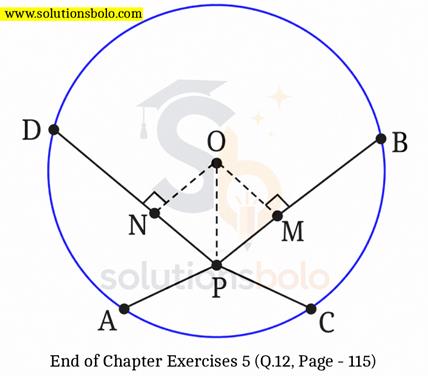
12. When two chords intersect (जब दो जीवाएँ एक-दूसरे को काटती हैं), each of them is divided into two line segments. Show that if the intersecting chords are of equal length (अगर एक-दूसरे को काटने वाली जीवाएँ बराबर लंबाई की हों), then the line segments of one chord are equal to the corresponding line segments (एक जीवा के रेखाखंड संगत रेखाखंडों के बराबर होते हैं) of the other chord.
[Concept: According to the Intersecting Chords Theorem, if two chords intersect inside a circle (अगर किसी वृत्त के अंदर दो जीवाएँ एक-दूसरे को काटती हैं), the product of the segments of one chord is equal to the product of the segments of the other chord. Since the two chords are equal in length (चूंकि दोनों जीवाओं की लंबाई बराबर है), we use the properties of equal chords and congruent triangles (हम बराबर जीवाओं और सर्वांगसम त्रिभुजों के गुणों का उपयोग करते हैं) to prove that the corresponding line segments are equal (यह साबित करने के लिए कि संगत रेखाखंड बराबर हैं)]
Solution:
Given
Chords AB and CD intersect at point P inside the circle.
Let O be the centre of the circle.
AB = CD ………. (1)
To Prove
PB = PD and AP = CP
Explanation
Draw OM ⟂ AB and ON ⟂ CD.
Since equal chords are equidistant from the centre,
OM = ON ………. (2)
In ΔOPM and ΔOPN,
OP = OP (Common side)
OM = ON (From (2))
∠OMP = ∠ONP = 90°
Therefore,
ΔOPM ≅ ΔOPN (RHS Congruency)
Hence,
PM = PN (CPCT) ………. (3)
Also,
Since OM ⟂ AB,
AM = MB
(Perpendicular drawn from the centre bisects the chord.)
Similarly,
Since ON ⟂ CD,
CN = ND
Now,
AB = CD (From (1))
Therefore,
BM = DN
(As BM = ½AB and DN = ½CD) ………. (4)
Adding (3) and (4),
PM + BM = PN + DN
PB = PD ………. (5)
Again,
From (1),
AB = CD
Subtracting (5) from both sides,
AB − PB = CD − PD
AP = CP
Hence, the corresponding line segments of one chord are equal to the corresponding line segments of the other chord.
| Observation: Equal chords are equidistant from the centre. Using the properties of congruent triangles and equal chords, the corresponding line segments are found to be equal. |
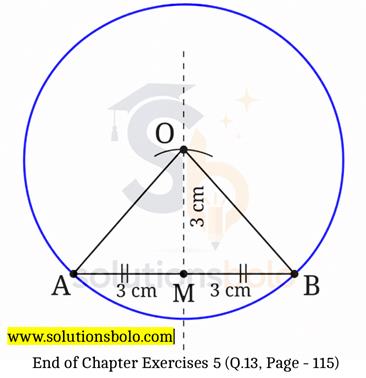
13. Draw a circle in which a chord of 6 cm length stands (एक वृत्त जिसमें 6 cm लंबाई की एक जीवा है) at a distance of 3 cm from the centre (केंद्र से 3 cm की दूरी है).
[Concept: The perpendicular drawn from the centre of a circle (वृत्त के केंद्र से खींचा गया लंब) to a chord bisects the chord (जीवा जीवा को समद्विभाजित करती है). Draw the given chord, locate its midpoint, mark the centre at the given distance from the chord and then draw the required circle using the obtained radius.]
Solution:
Given
Chord length = 6 cm
Distance from the centre to the chord = 3 cm
Construction
Draw a line segment AB = 6 cm.
Find the midpoint M of AB.
Draw a perpendicular to AB at M.
On this perpendicular, mark a point O such that
OM = 3 cm.
Join OA (or OB).
With centre O and radius OA, draw a circle.
Explanation
Since OM ⟂ AB and M is the midpoint of AB,
AM = MB = 3 cm
Also,
OM = 3 cm
Applying the Baudhayana–Pythagoras Theorem in ΔOMA,
OA² = OM² + AM²
OA² = 3² + 3²
OA² = 18
OA = 3√2 cm
Therefore, the required circle has centre O and radius 3√2 cm.
Hence, the required circle has been constructed successfully.
| Observation: The perpendicular drawn from the centre bisects the chord (केंद्र से खींचा गया लंब जीवा को समद्विभाजित करता है). Using the perpendicular distance and half of the chord (लंबवत दूरी और जीवा का आधा भाग), the radius of the required circle (ज़रूरी वृत्त की त्रिज्या) can be determined. |
14. Show that rectangle is the only parallelogram (आयत ही एकमात्र समांतर चतुर्भुज है) that can be inscribed in a circle.
[Concept: According to the property of a cyclic quadrilateral, the sum of opposite angles is 180°, whereas in a parallelogram, opposite angles are equal. Using these two properties together, we show that each angle becomes 90°, proving that the parallelogram is a rectangle.]
Solution:
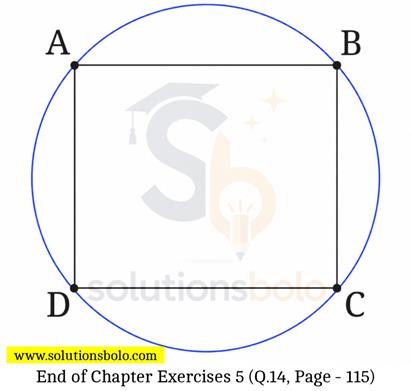
Given
A parallelogram ABCD is inscribed in a circle.
Reason
Since ABCD is a cyclic quadrilateral,
∠A + ∠C = 180°
Also, in a parallelogram,
∠A = ∠C
Therefore,
∠A + ∠A = 180°
2∠A = 180°
∠A = 90°
Similarly,
∠B = 90°
Hence, all four angles are 90°.
Therefore, the parallelogram is a rectangle.
Hence proved that a rectangle is the only parallelogram that can be inscribed in a circle.
| Observation: A cyclic parallelogram must have all its angles equal to 90°. |
15. Show that if a rectangle is inscribed in a circle (यदि किसी वृत्त के भीतर एक आयत बना हो), then the point of intersection of its diagonals (इसके विकर्णों के प्रतिच्छेदन का बिंदु) must lie at the centre of the circle.
[Concept: In a rectangle, the diagonals are equal and bisect each other. Using these properties, we show that the point of intersection of the diagonals is equidistant from all four vertices, proving that it is the centre of the circle.]
Solution:
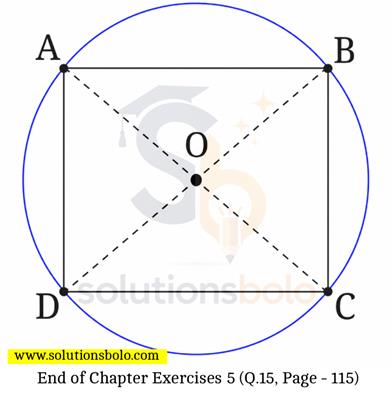
Given
Rectangle ABCD is inscribed in a circle.
Let diagonals AC and BD intersect at O.
Explanation
In a rectangle, the diagonals bisect each other.
Therefore,
OA = OC
and
OB = OD ………. (1)
Also, the diagonals of a rectangle are equal.
AC = BD ………. (2)
Since
OA = ½ AC
and
OB = ½ BD
From (2),
OA = OB ………. (3)
Using (1) and (3),
OA = OB = OC = OD
Therefore, point O is equidistant from the four vertices A, B, C and D.
A point equidistant from all the points on a circle is the centre of the circle.
Hence, O is the centre of the circle.
| Observation: The diagonals of a rectangle are equal and bisect each other. Therefore, their point of intersection is equidistant from all four vertices. |
16. Consider all chords of a circle of a fixed length. What is the shape formed by the midpoints of all these chords?
[Concept: The perpendicular drawn from the centre of a circle to a chord bisects the chord. Since all the chords have the same length, their midpoints remain at a fixed distance from the centre. Using the Baudhayana–Pythagoras Theorem, we can determine the locus of these midpoints.]
Solution:
Given
Let the radius of the circle be r.
Let each chord have a fixed length x.
Explanation
The perpendicular drawn from the centre of a circle to a chord bisects the chord.
Therefore,
Half of the chord = x/2
Let d be the perpendicular distance of the midpoint of the chord from the centre.
Applying the Baudhayana–Pythagoras Theorem,
r² = d² + (x/2)²
Therefore,
d² = r² − (x/2)²
Since r and x are fixed,
d is also fixed.
Thus, every midpoint is at the same distance d from the centre.
The locus of all points at a fixed distance from a fixed point is a circle.
Hence, the midpoints of all the chords lie on a circle having the same centre as the original circle.
| Observation: All the midpoints remain at a constant distance from the centre. Therefore, they form the locus of a circle concentric with the given circle. |
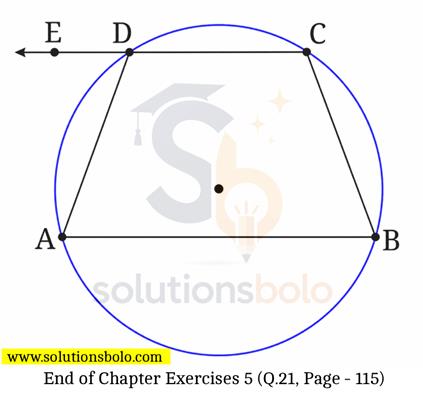
17. In a circle with centre O, chords AB and AC are congruent. Explain why this statement is true: “The centre of the circle lies on the angle bisector of ∠BAC.”
[Concept: Equal chords are equidistant from the centre of the circle. By joining the centre to the endpoints of the equal chords, we can use congruent triangles to show that the centre lies on the angle bisector of ∠BAC.]
Solution:
Given
In a circle with centre O,
AB = AC ………. (1)
To Prove
O lies on the angle bisector of ∠BAC.
Explanation:
Join OA, OB and OC.
Since OA, OB and OC are radii of the same circle,
OA = OB = OC ………. (2)
From (1),
AB = AC
Now, in ΔOAB and ΔOAC,
OA = OA (Common side)
OB = OC (Radii of the same circle)
AB = AC (Given)
Therefore,
ΔOAB ≅ ΔOAC (SSS Congruency)
Hence,
∠BAO = ∠OAC (CPCT)
Therefore, AO bisects ∠BAC.
Hence, the centre O lies on the angle bisector of ∠BAC.
| Observation: Equal chords subtend equal triangles with the centre. Hence, the line joining the centre to the common vertex bisects the angle formed by the equal chords. |
18. Two parallel chords of lengths 10 cm and 24 cm are on the same side of the centre of a circle. The distance between the chords is 7 cm. Find the radius of the circle.
[Concept: The perpendicular drawn from the centre of a circle to a chord bisects the chord. Using the Baudhayana–Pythagoras Theorem, we first find the perpendicular distances of the two chords from the centre and then determine the radius.]
Solution:
Given
Length of the first chord = 10 cm
Length of the second chord = 24 cm
Distance between the chords = 7 cm
Explanation:
Let OM and ON be the perpendiculars drawn from the centre O to the two parallel chords.
Since the chords are on the same side of the centre,
OM − ON = 7 ………. (1)
Also,
Half of the first chord
AM = 10 ÷ 2 = 5 cm
Half of the second chord
BN = 24 ÷ 2 = 12 cm
Let the radius of the circle be r.
Applying the Baudhayana–Pythagoras Theorem,
r² = OM² + 5²
r² = OM² + 25 ………. (2)
Again,
r² = ON² + 12²
r² = ON² + 144 ………. (3)
From (2) and (3),
OM² + 25 = ON² + 144
OM² − ON² = 119
Using the identity,
(OM − ON)(OM + ON) = 119
From (1),
7(OM + ON) = 119
OM + ON = 17 ………. (4)
Solving (1) and (4),
OM = 12 cm
ON = 5 cm
Substituting OM = 12 cm in (2),
r² = 12² + 5²
r² = 144 + 25
r² = 169
r = 13 cm
Radius of the circle = 13 cm.
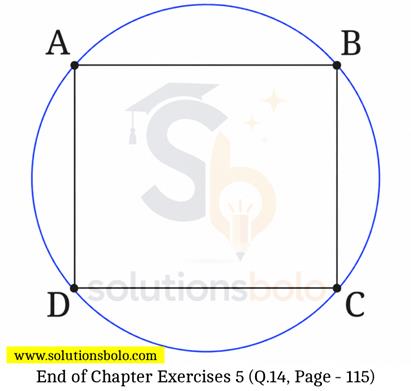
| Observation: The longer chord is nearer to the centre. Using the distances of the two chords from the centre and the Baudhayana–Pythagoras Theorem, the radius of the circle can be determined. |
19. A regular hexagon is inscribed in a circle of radius r. Find the length of the sides of the hexagon and the distance of each side from the centre of the circle.
[Concept: In a regular hexagon inscribed in a circle, each central angle is 60°. The triangle formed by joining the centre to two adjacent vertices is equilateral. Using this fact and the Baudhayana–Pythagoras Theorem, we can find the side length and the perpendicular distance of each side from the centre.]
Solution:
Given
A regular hexagon is inscribed in a circle.
Radius of the circle = r
Explanation
Let O be the centre of the circle and AB be one side of the regular hexagon.
Since the hexagon is regular,
∠AOB = 360° ÷ 6 = 60°
Also,
OA = OB = r (Radii of the circle)
Therefore,
ΔOAB is an equilateral triangle.
Hence,
AB = OA = OB = r
Therefore,
Side of the regular hexagon = r ………. (1)
Let OM ⟂ AB.
Since the perpendicular from the centre to a chord bisects the chord,
AM = MB = AB ÷ 2 = r/2
Applying the Baudhayana–Pythagoras Theorem in ΔOMA,
OA² = OM² + AM²
r² = OM² + (r/2)²
r² = OM² + r²/4
OM² = 3r²/4
OM = (√3/2) r
Therefore,
Side of the regular hexagon = r
Distance of each side from the centre = (√3/2) r
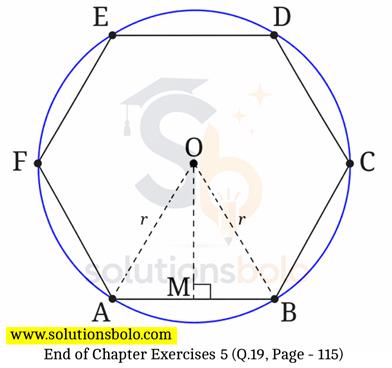
| Observation: Each side of a regular hexagon subtends a 60° angle at the centre, forming an equilateral triangle. The perpendicular distance from the centre to every side is the same. |
20. A quadrilateral MNOP is inscribed in a circle. If MN is a diameter, what can you say about ∠MOP and ∠MNP? Explain your reasoning.
[Concept: According to the Angle in a Semicircle Theorem, the angle subtended by a diameter at the circumference is always 90°. Also, angles subtended by the same chord are equal.]
Solution:
Given
Quadrilateral MNOP is inscribed in a circle.
MN is the diameter of the circle.
Explanation
Since MN is the diameter,
the angle subtended by MN at any point on the circumference is a right angle.
Therefore,
∠MOP = 90° ………. (Angle in a Semicircle Theorem)
Similarly,
Point P and O lie on the circumference and both angles subtend the same diameter MN.
Therefore,
∠MNP = 90° ………. (Angle in a Semicircle Theorem)
Hence,
∠MOP = ∠MNP = 90°
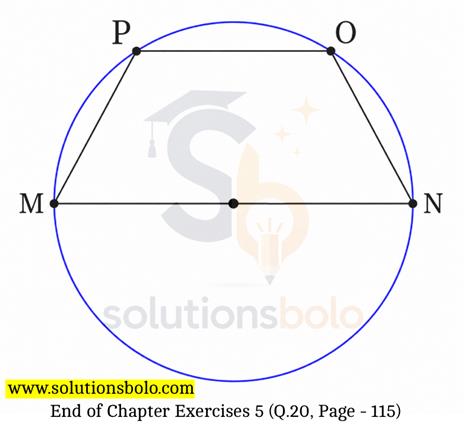
| Observation: A diameter always subtends a right angle at every point on the circumference. Therefore, all angles standing on the same diameter are equal. |
21. In a cyclic quadrilateral ABCD, ∠A = 85° and ∠C = (3x − 10)°. Find the value of x.
[Concept: In a cyclic quadrilateral, the sum of each pair of opposite angles is 180°. Using this property, we can form an equation and determine the value of the unknown.]
Solution:
Given
∠A = 85°
∠C = (3x − 10)°
Explanation
In a cyclic quadrilateral,
∠A + ∠C = 180°
Substituting the given values,
85° + (3x − 10)° = 180°
3x + 75 = 180
3x = 180 − 75
3x = 105
x = 105 ÷ 3
x = 35
| Observation: The opposite angles of a cyclic quadrilateral are supplementary. This property helps in finding unknown angles or variables. |
22. “There is no chord of a circle that is longer than its diameter.” How do you justify this statement?
[Concept: The diameter is the longest chord of a circle. As the perpendicular distance of a chord from the centre increases, its length decreases. Since the diameter passes through the centre, it has the maximum possible length.]
Solution
Given
A circle with centre O.
Let AB be any chord and CD be the diameter of the circle.
Explanation
Let OM ⟂ AB.
Since the perpendicular from the centre to a chord bisects the chord,
AM = MB
Applying the Baudhayana–Pythagoras Theorem in ΔOMA,
OA² = OM² + AM²
Since OM² ≥ 0,
AM² ≤ OA²
Therefore,
AM ≤ OA = r
Hence,
AB = 2AM ≤ 2r
Also,
CD = 2r (Diameter of the circle)
Therefore,
AB ≤ CD
Thus, no chord can be longer than the diameter.
| Observation: The diameter passes through the centre, so its perpendicular distance from the centre is zero. Every other chord is at a positive distance from the centre and is therefore shorter than the diameter. |
23. Let A be any point within a given circle with centre O. Show that the shortest chord of the circle that passes through point A is the one that is perpendicular to OA.
[Concept: Among all chords passing through a fixed point inside a circle, the chord perpendicular to the line joining the centre and the point is the shortest. This follows from the property that a chord nearer to the centre is longer, while a chord farther from the centre is shorter.]
Solution
Given
A circle with centre O.
A is any point inside the circle.
Let BC be the chord passing through A such that
OA ⟂ BC.
Explanation
Since OA ⟂ BC,
the perpendicular distance of chord BC from the centre is OA.
Now consider any other chord DE passing through A.
Since DE is not perpendicular to OA, its perpendicular distance from the centre is less than OA.
We know that:
A chord nearer to the centre is longer.
A chord farther from the centre is shorter.
Therefore,
BC < DE
Hence, the chord through A that is perpendicular to OA is the shortest chord passing through A.
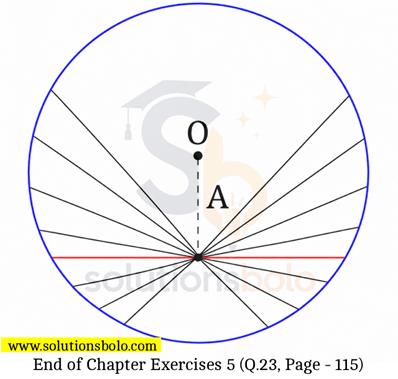
| Observation: The perpendicular from the centre gives the maximum possible distance of a chord passing through the fixed point A. Therefore, that chord has the minimum length. |
24. How would you use the following figure to justify the statement that the angle in a semicircle is 90°?
[Concept: The angle subtended by a diameter of a circle at any point on the semicircle is always a right angle. This can be proved by joining the centre of the circle to the point on the semicircle and using the properties of isosceles triangles.]
Solution:
Given
A circle with centre O.
BC is the diameter of the circle.
A is any point on the semicircle.
Join OA.
Explanation
Since O is the centre of the circle:
OA = OB = OC
because all are radii of the same circle.
Therefore,
△AOB and △AOC are isosceles triangles.
Let:
∠ABO = a and ∠ACO = b
In △AOB,
∠BAO = ∠ABO = a
In △AOC,
∠OAC = ∠ACO = b
Therefore,
∠BAC = ∠BAO + ∠OAC
∠BAC = a + b
Now, in △ABC:
∠ABC + ∠BAC + ∠ACB = 180°
Substituting the angles:
a + (a + b) + b = 180°
2a + 2b = 180°
2(a + b) = 180°
a + b = 90°
But,
∠BAC = a + b
Therefore,
∠BAC = 90°
Hence proved that the angle in a semicircle is 90°.
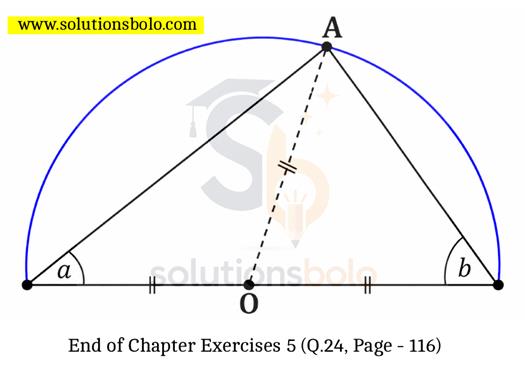
| Observation: The diameter divides the circle into a semicircle and the angle made by the diameter at any point on the semicircle is always a right angle because the two radii form two isosceles triangles. |
25. In a circle, two chords CC’ and DD’ are drawn perpendicular to a diameter AB. Prove that the segment MM’ joining the midpoints of the chords CD and C’D is perpendicular to AB.
[Concept: The perpendicular drawn from the centre of a circle to a chord bisects the chord. Therefore, if two chords are perpendicular to the same diameter, their midpoints lie on that diameter. Hence, the line joining the midpoints of the chords is perpendicular to the chords and parallel to the diameter.]
Solution:
Given
A circle with centre O.
AB is a diameter of the circle.
Chords CC’ and DD’ are perpendicular to AB.
M and M’ are the midpoints of chords CD and C’D respectively.
Explanation
Since AB is a diameter, it passes through the centre O.
The chords CC’ and DD’ are perpendicular to AB.
We know that:
The perpendicular from the centre of a circle to a chord bisects the chord.
Therefore,
The midpoint of chord CC’ lies on AB.
The midpoint of chord DD’ lies on AB.
Let these midpoints be M and M’.
Therefore,
M and M’ both lie on the diameter AB.
Hence, the segment MM’ lies along the diameter AB.
Since the chords are perpendicular to AB, the line joining their midpoints is perpendicular to the chords and coincides with AB.
Therefore,
MM’ ⟂ AB.
Hence proved that the segment MM’ joining the midpoints of the chords CD and C’D is perpendicular to AB.
| Observation: The centre of the circle lies on the diameter AB and the perpendicular from the centre always bisects the chords. Hence, the midpoints of the chords lie on AB, making the segment joining them perpendicular to the chords. |
26. How would you use the following figure to justify the statement that the sum of the opposite angles of a cyclic quadrilateral is 180°?
[Concept: In a cyclic quadrilateral, the sum of each pair of opposite angles is 180°. This happens because the angle at the centre of a circle is twice the angle at the circumference standing on the same arc.]
Solution
Given
A cyclic quadrilateral ABCD is inscribed in a circle with centre O.
OA, OB, OC and OD are joined.
Let:
∠BAO = p, ∠ABO = q
∠ADO = v, ∠DCO = u
Explanation
Since OA = OB = OC = OD,
because all are radii of the same circle.
Therefore,
△AOB and △COD are isosceles triangles.
In △AOB,
∠BAO = ∠ABO
Therefore,
∠BAO = ∠ABO = p and q
In △COD,
∠CDO = ∠DCO
Therefore,
∠CDO = ∠DCO = v and u
Now,
∠AOB = 180° – (p + q)
and
∠COD = 180° – (u + v)
The angles at the centre are related to the arcs:
∠AOB + ∠COD = 360° – ∠BOC – ∠AOD
But the complete angle at the centre of the circle is 360°.
For quadrilateral ABCD,
∠A + ∠C = 180°
and
∠B + ∠D = 180°
Therefore,
∠A + ∠C = 180°
Hence,
∠BAD + ∠BCD = 180°
Similarly,
∠ABC + ∠ADC = 180°
Hence proved that the sum of the opposite angles of a cyclic quadrilateral is 180°.
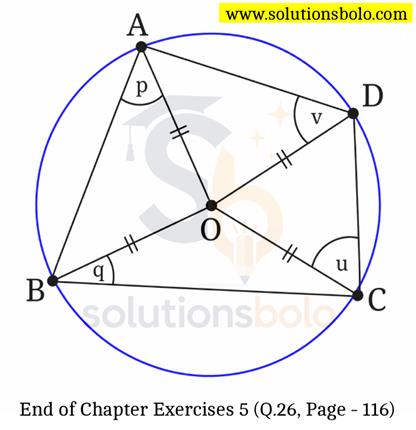
| Observation: The opposite angles of a cyclic quadrilateral stand on the opposite arcs of a circle. The measures of these arcs together make a complete circle of 360°, which makes the opposite angles supplementary. |
Common Mistakes & Exam Tips
1. Mistake: Misidentifying the position of the circumcentre based on the type of triangle.
Exam Tip: Remember: Circumcentre lies inside an acute triangle, outside an obtuse triangle and at the midpoint of the hypotenuse in a right-angled triangle.
2. Mistake: Using the full chord length directly in the Baudhayana–Pythagoras Theorem.
Exam Tip: The perpendicular from the centre bisects the chord. Always divide the chord by 2 (AM = AB/2) before starting calculations.
3. Mistake: Confusing the diameter given in the question for the radius.
Exam Tip: Write down r = Diameter/2 as your first line of calculation to avoid plugging the diameter into formulas.
4. Mistake: Assuming chord length is directly proportional to its distance from the centre.
Exam Tip: Doubling the distance does NOT halve the chord length. Always calculate using Chord Length = 2√(r² − d²).
5. Mistake: Reversing the multiplier between the central angle and the boundary angle (Theorem 9).
Exam Tip: The central angle is always the larger one: Angle at Centre = 2 × Angle at Circle.
6. Mistake: Assuming angles on opposite sides of a chord are equal.
Exam Tip: “Angles in the same segment are equal” applies only when both angles lie on the same side of the chord.
7. Mistake: Incorrectly adding or subtracting distances between two parallel chords.
Exam Tip: Subtract distances (OM − ON) if chords are on the same side of the centre; add them (OM + ON) if they lie on opposite sides.
8. Mistake: Failing to spot a 90° right angle when a diameter is present.
Exam Tip: Whenever you see a diameter forming an angle on the circle boundary, mark it immediately as 90° (angle in a semicircle).
9. Mistake: Treating every four-sided figure as a cyclic quadrilateral.
Exam Tip: A quadrilateral is cyclic only if all 4 vertices touch the circle and its opposite angles sum to 180°.
10. Mistake: Omitting the supporting theorem statement during proofs.
Exam Tip: Always write the supporting theorem in brackets next to your step, e.g., [Since perpendicular from centre bisects the chord], to secure full reasoning marks.
Quick Reference: Theorems & Formulas
Theorem 1: There is a unique circle passing through three non-collinear points.
(तीन असरेखीय (non-collinear) बिंदुओं से होकर जाने वाला केवल एक ही अद्वितीय वृत्त (unique circle) खींचा जा सकता है।)
| Related Questions: Exercise Set 5.1 (Q1, Q2, Q3), Theorem 10 & 12 |
Theorem 2: Equal chords of a circle subtend equal angles at the centre of the circle.
(किसी वृत्त की समान लंबाई वाली जीवाएँ (chords) केंद्र पर समान कोण अंतरित (subtend) करती हैं।)
| Related Questions: Exercise Set 5.2 (Q2). |
Theorem 3: Chords of a circle that subtend equal angles at the centre are equal.
(यदि किसी वृत्त की जीवाएँ केंद्र पर समान कोण बनाएँ, तो वे जीवाएँ आपस में बराबर (समान लंबाई की) होती हैं।)
| Related Questions: Exercise Set 5.2 (Q2). |
Theorem 4: The line joining the centre of a circle and the midpoint of a chord of the circle is perpendicular to the chord.
(किसी वृत्त के केंद्र और जीवा के मध्य-बिंदु (midpoint) को मिलाने वाली रेखा जीवा पर लंब (perpendicular) होती है।)
| Related Questions: Exercise Set 5.3 (Q1, Q2). |
Theorem 5: The perpendicular from the centre of a circle to a chord of the circle bisects the chord.
(किसी वृत्त के केंद्र से जीवा पर डाला गया लंब जीवा को दो बराबर भागों में समद्विभाजित (bisect) करता है।)
| Related Questions: Exercise Set 5.3 (Q1, Q3), Exercise Set 5.4 (Q1, Q2, Q3), Exercise Set 5.5 (Q1, Q2), End-of-Chapter Exercises (Q1, Q3, Q4, Q5, Q9)। |
Theorem 6: Chords of a circle having the same length are all at the same distance from the centre of the circle.
(किसी वृत्त की समान लंबाई वाली जीवाएँ केंद्र से बराबर दूरी (समदूरस्थ) पर होती हैं।)
| Related Questions: Exercise Set 5.4 (Q1, Q2), End-of-Chapter Exercises (Q13, Q16, Q19)। |
Theorem 7: Chords of a circle that are equidistant from the centre have equal length.
(वृत्त के केंद्र से समान दूरी पर स्थित जीवाएँ आपस में बराबर (समान लंबाई की) होती हैं।)
| Related Questions: Exercise Set 5.4 (Q2, Q3). |
Theorem 8: Let AB and DE be two chords of a circle with centre C. Suppose AB>DE. Then the distance from C to AB is less than the distance from C to DE.
(यदि किसी वृत्त में एक जीवा दूसरी जीवा से बड़ी हो (AB>DE), तो बड़ी जीवा केंद्र के अधिक निकट होती है (अर्थात उसकी केंद्र से लंबवत दूरी कम होती है)
| Related Questions: Exercise Set 5.5 (Q3), End-of-Chapter Exercises (Q22, Q23)। |
Theorem 9: The angle subtended by an arc at the centre of the circle is double the angle subtended by the arc at any point on the circle outside the arc.
(किसी चाप (arc) द्वारा केंद्र पर बनाया गया कोण, उसी चाप द्वारा वृत्त के शेष भाग के किसी बिंदु पर बनाए गए कोण का दोगुना होता है।)
| Related Questions: Exercise Set 5.6 (Q2, Q3), Theorem 11 & 12, End-of-Chapter Exercises (Q2)। |
Corollary 1 to Theorem 9: Angles in the same segment of a circle are equal.
(एक ही वृत्तखंड (segment) के कोण आपस में बराबर होते हैं।)
| Related Questions: Exercise Set 5.6 (Q2), Theorem 10 |
Corollary 2 to Theorem 9: The angle subtended by a diameter at any point on the circle is 90∘ (Angle in a semicircle is 90∘).
(व्यास द्वारा वृत्त के किसी भी बिंदु पर बनाया गया कोण 90^∘ (समकोण) होता है (या अर्धवृत्त का कोण समकोण होता है)।
| Related Questions: End-of-Chapter Exercises (Q6, Q20, Q24)। |
Theorem 10: If a line segment AB joining two points A, B subtends equal angles at two other points C, D that lie on the same side of AB, then the four points lie on a circle (they are concyclic).
[यदि दो बिंदुओं को मिलाने वाला रेखाखंड अपने एक ही तरफ स्थित दो अन्य बिंदुओं पर समान कोण बनाए, तो वे चारों बिंदु एक ही वृत्त पर स्थित होते हैं (चक्रीय होते हैं]
| Related Questions: Exercise Set 5.6 (Q2 – part iii)। |
Theorem 11: The sum of two opposite angles of a cyclic quadrilateral is 180^∘.
(किसी चक्रीय चतुर्भुज (cyclic quadrilateral) के सम्मुख कोणों (opposite angles) का योग 180∘ होता है।)
| Related Questions: End-of-Chapter Exercises (Q7, Q8, Q21, Q26)। |
Theorem 12: If two opposite angles of a quadrilateral add up to 180^∘, then the vertices of the quadrilateral lie on a circle (it is a cyclic quadrilateral).
[यदि किसी चतुर्भुज के सम्मुख कोणों का योग 180^∘ हो, तो उसके चारों शीर्ष एक वृत्त पर स्थित होते हैं (अर्थात वह एक चक्रीय चतुर्भुज होता है)।]
| Related Questions: End-of-Chapter Exercises (Q7, Q11, Q14)। |
Real-Life Uses
Theorem 1:
(i) Finding your live location using GPS,
(ii) Reconstructing the complete shape of a broken circular object.
Theorems 2 & 3:
(i) Balancing a car’s steering wheel,
(ii) Cutting any rounded thing into equal slices.
Theorems 4 & 5:
(i) Ensuring that the circular pillars of a flyover are perfectly vertical (90°).
(ii) Finding the exact centre of a circular table in carpentry.
Theorems 6 & 7:
(i) Balancing a car’s alloy wheel for high-speed driving.
(ii) Positioning motors at the correct distance in a circular drone frame.
Theorem 8:
(i) Determining the maximum road width inside a circular metro tunnel.
(ii) Setting up a robotic arm to pick up objects within a circular working area.
Theorem 9:
(i) Setting the wide-angle coverage of cameras in stadiums or theatres.
(ii) Determining the correct coverage range of a CCTV camera.
Corollary 1 to Theorem 9:
(i) Ensuring that every seat in the same row of a cinema hall has the same viewing angle of the screen.
Corollary 2 to Theorem 9:
(i) Checking a perfect 90° right angle while constructing walls or corners.
(ii) Aligning the signal focus of a satellite dish.
Theorem 10:
(i) Designing curved objects in 3D gaming and animation.
Theorems 11 & 12:
(i) Designing a circular walking track passing through the four corners of a square park.
(ii) Enabling robotic joints to move accurately along a circular path.
Frequently Asked Questions (FAQs)
1. What is the circumcentre of a triangle?
Answer: The circumcentre is the point where the perpendicular bisectors of the three sides of a triangle intersect. It is the centre of the circle passing through all three vertices of the triangle.
2. How can we identify whether a quadrilateral is cyclic?
Answer: A quadrilateral is cyclic if all its four vertices lie on the same circle. A simple test is that the sum of each pair of opposite angles must be 180 degrees.
3. Why does the perpendicular from the centre bisect a chord?
Answer: The centre is equidistant from the endpoints of the chord. Therefore, the perpendicular drawn from the centre divides the chord into two equal parts, creating two congruent right triangles.
4. Why are equal chords equidistant from the centre?
Answer: Equal chords form congruent triangles with the radii of the circle. As a result, the perpendicular distances from the centre to both chords are equal.
5. How do we find the length of a chord?
Answer: First find half of the chord using the Baudhayana Pythagoras Theorem, then multiply it by two. Always use half of the chord in the right triangle.
6. Why is the angle in a semicircle always 90 degrees?
Answer: The angle subtended by a diameter at the centre is 180 degrees. According to the Angle at the Centre Theorem, the angle at the circumference is half of it, which is 90 degrees.
7. What is the relationship between the central angle and the angle at the circle?
Answer: The angle subtended by an arc at the centre is always twice the angle subtended by the same arc at any point on the remaining part of the circle.
8. Does a longer chord lie nearer to the centre?
Answer: Yes. Among two chords of the same circle, the longer chord is always nearer to the centre, while the shorter chord is farther from the centre.
9. How can we locate the centre of a given circle?
Answer: Draw the perpendicular bisectors of any two chords of the circle. Their point of intersection is the centre of the circle.
10. What is the easiest way to remember the theorems of circles?
Answer: Group the theorems by topic such as chords, centre, angles and cyclic quadrilaterals. Understanding their connections is much easier than memorising each theorem separately.