NCERT Class 9 Science Exploration Chapter 8 “Journey Inside the Atom” explains the structure of the atom and the development of atomic models. The chapter discusses the ideas of Dalton, Thomson, Rutherford and Bohr, along with the discovery of electrons, protons and neutrons. It also explains atomic number, mass number, electronic configuration, valency, isotopes, isobars and average atomic mass. These solutions help students understand important concepts through clear explanations and diagrams according to the latest CBSE syllabus (2026-27).
Table of Contents (Quick Links):
1. NCERT Intext Questions (with Pause & Ponder)
2. Exercise Questions and Answers
3. Common Mistakes Students Make
4. How to Score Full Marks in this Chapter
5. Important Formulae and Key Terms
For Competency-Based Questions from Journey Inside the Atom
Intext Questions and Answers:
1. Are atoms the smallest indivisible particles?
Answer:
No, atoms are not indivisible particles.
Although early theories, such as Dalton’s atomic theory, viewed the atom as indivisible, 19th and 20th-century discoveries proved that atoms are composed of even smaller subatomic particles. An atom is made up of three primary subatomic components: negatively charged electrons (e⁻), positively charged protons (p⁺) and neutral neutrons (n⁰).
2. Why do electrons not fall into the nucleus even though they are attracted to protons in it?
Answer:
Electrons do not fall into the nucleus because they revolve in fixed, non-radiating orbits known as stationary states or energy levels.
In Rutherford’s classical model, revolving electrons were expected to constantly radiate energy, spiral inward and collapse into the nucleus. Niels Bohr resolved this by postulating that electrons can revolve only in specific allowed circular paths called stationary states or energy shells (K, L, M, N shells). While moving within a fixed energy level, an electron maintains a constant amount of energy and does not lose energy. Because there is no energy loss, the electron remains in a stable orbit around the positively charged nucleus without collapsing into it.
3. Why did scientists keep modifying atomic models?
[Concept: Science advances through continuous experimentation and observation. As experimental techniques improved, new evidence emerged about subatomic particles and atomic structure that previous models could not account for.]
Answer:
Scientists kept modifying atomic models because new experimental evidence constantly revealed limitations in existing theories, requiring refined models to explain atomic behavior accurately.
4. What if an atom had no empty space? How would this have affected the size of various objects?
[Concept: Rutherford discovered that an atom is mostly empty space, with a dense nucleus that is about 10⁵ (one lakh) times smaller than the total atom. Eliminating this vast empty space would collapse the overall volume of matter without changing its mass.]
Answer:
If an atom had no empty space, all physical objects would shrink into an extraordinarily tiny volume while retaining their original mass, making matter extremely dense.
The diameter of an atom is about 10⁻¹⁰ m, whereas the diameter of its nucleus is only about 10⁻¹⁵. This means that more than 99.999% of an atom’s volume consists of empty space through which electrons revolve. If all the empty space inside atoms were removed and subatomic particles were packed tightly together, the volume of every object would collapse by a factor of nearly 10¹⁵. As a result, huge objects like mountains, buildings or the human body would shrink down to the size of a tiny speck of dust or a grain of sand, even though their weight and mass would remain exactly the same.
5. Can you now say that elements with different atomic numbers are distinct from each other and the atomic number uniquely identifies an element? Observe Fig. 8.10. How many neutrons and protons are present in a lithium atom and what is its atomic number?
[Concept: The atomic number (Z) is defined as the total number of protons in the nucleus of an atom. Because every chemical element has a unique number of protons, the atomic number defines the fundamental identity and chemical behavior of that element.]
Answer:
Yes, elements with different atomic numbers are distinct from each other and the atomic number uniquely identifies an element. For a lithium atom, there are 3 protons and 4 neutrons and its atomic number is 3.
The atomic number (Z) determines the number of positive charges (protons) in an atom’s nucleus. Since no two different elements possess the same number of protons, an element’s atomic number serves as its unique chemical signature.
Looking at a lithium atom:
Number of protons = 3
Number of neutrons = 4
Atomic number (Z) = 3 (since atomic number equals the number of protons)
Pause and Ponder (page – 143)
1. Suppose you made up your own ‘atom’, as Thomson described, using clay for the positive charge and small beads for the electrons spread through it. What will happen if:
(i) the positive charge on the clay is lesser than the total negative charge of the beads?
(ii) by mistake, the clay itself carries a bit of negative charge? Would your model still represent a neutral atom?
[Concept: In Thomson’s model of an atom, the total magnitude of positive charge in the sphere must be exactly equal to the total magnitude of negative charge from the embedded electrons, ensuring that the atom remains electrically neutral overall.]
Answer:
(i) The model will fail to represent a neutral atom and will instead carry a net negative charge (becoming a negatively charged ion). (ii) No, the model would not represent a neutral atom.
(i) Thomson’s atomic model relies on electrostatic balance where total positive charge equals total negative charge. If the positive charge on the clay is less than the total negative charge of the beads, the charges do not cancel out, resulting in an overall net negative charge.
(ii) For an atom to be neutral, the sphere representing the atom’s body must be purely positively charged. If the clay carries a negative charge, it adds to the negative charge of the beads, making the entire model negatively charged overall.
2. Could an orange or a lemon, which also contain seeds inside soft pulp, be a good comparison? In what ways does it match Thomson’s idea and where does it fall short?
[Concept: Thomson compared his atomic model to a watermelon, where the positively charged sphere is spread out like the red edible pulp and negatively charged electrons are embedded throughout it like seeds.]
Answer:
Yes, an orange or a lemon can serve as an everyday visual comparison to Thomson’s model, much like the plum pudding or watermelon model.
Ways it matches Thomson’s idea:
The soft inner pulp represents the continuous sphere of positive charge.
The seeds scattered inside the pulp represent the negatively charged electrons distributed throughout the atom.
Where it falls short:
Physical matter like fruit pulp and seeds carries no inherent electrical charges, so it cannot demonstrate electrical neutrality or electrostatic attraction.
Fruit seeds are often concentrated near the center rather than uniformly distributed to maintain electrostatic equilibrium as real charges would.
3. Why did Thomson conclude that electrons are present in all atoms?
[Concept: Cathode rays consist of streams of negatively charged subatomic particles called electrons. Since these particles were emitted under high voltage irrespective of the chemical identity of the cathode or the gas, they were recognized as a universal fundamental constituent of all matter.]
Answer:
Thomson concluded that electrons are present in all atoms because the properties and nature of cathode rays remained identical regardless of the material used for the cathode or the gas filled inside the cathode ray tube.
During his experiments with cathode ray tubes, J. J. Thomson tested electrodes made of various metals and filled the tube with different gases at low pressure. In every single trial, the charge-to-mass ratio (e/m) and behavior of the cathode rays remained exactly the same. Because the emitted negatively charged particles did not depend on the specific element being tested, Thomson concluded that electrons are not unique to certain materials but are a fundamental building block present inside the atoms of every element.
Pause and Ponder (Page – 144)
4. What do you think would happen if α-particles were replaced with negatively charged particles in Rutherford’s gold foil experiment?
[Concept: Rutherford established that an atom consists mostly of empty space with a tiny, extremely dense, positively charged nucleus at its center. Opposite electrical charges attract each other, whereas like charges repel each other.]
Answer:
Most negatively charged particles would still pass straight through undeflected due to the vast empty space, but those passing close to the dense positive nucleus would be attracted toward it and deflected inward rather than repelled away.
In Rutherford’s original experiment, positively charged alpha particles experienced electrostatic repulsion when approaching the positively charged nucleus, causing them to deflect away or bounce backward. If negatively charged particles were used instead, the electrostatic interaction with the positive nucleus would be attractive rather than repulsive. Most particles would pass straight through without deflection because most of the atom is empty space. However, particles passing close to the nucleus would be pulled toward it by electrostatic attraction, bending their paths inward toward the center instead of being pushed away.
5. Rutherford found that a few α-particles bounced back sharply. How does this single surprising result completely rule out Thomson’s ʻplum pudding modelʼ of the atom?
[Concept: Thomson’s plum pudding model proposed that positive charge and mass were spread uniformly throughout the atom’s volume. In a uniform charge distribution, the electric field is too weak to cause large-angle deflections.]
Answer:
This result ruled out Thomson’s model because a diffuse, weak sphere of positive charge could never exert enough electrostatic force to deflect heavy, fast-moving alpha particles backward.
Alpha particles are fast-moving, heavy, positively charged helium nuclei. According to Thomson’s model, the positive charge was spread out so thin that alpha particles should have passed straight through the gold foil with only minor deflections. However, observing a few particles bounce straight back (deflected by nearly 180°) proved that the positive charge and almost the entire mass of the atom are concentrated in an extraordinarily small, dense core called the nucleus.
6. If you could ask Rutherford one question about his work, what would it be?
[Concept: Scientific inquiry relies on observing unexpected experimental outcomes and using logical reasoning to revise existing theoretical models.]
Answer:
“What was your immediate reaction when you observed alpha particles bouncing straight back and how did you deduce that the positive charge must be concentrated in an extremely tiny nucleus?”
Seeing alpha particles bounce back from an extremely thin gold foil was an unexpected result that contradicted the established physics of the time. Asking this question focuses on the thought process of a scientist when faced with unexpected experimental data, highlighting how surprising evidence leads to major breakthroughs like the discovery of the atomic nucleus.
Pause and Ponder (Page – 145)
7. Assertion (A): Rutherford concluded that most of the mass of an atom is concentrated in a small region at the centre called the nucleus.
Reason (R): According to Thomson’s model, electrons are embedded in a uniformly distributed positive charge sphere.
Choose the correct option:
(i) Both A and R are true and R is the correct explanation of A.
(ii) Both A and R are true, but R is not the correct explanation of A.
(iii) A is true, but R is false.
(iv) A is false, but R is true.
[Concept: An assertion and a reason are both evaluated for their factual scientific accuracy first. For the reason to be the correct explanation of the assertion, it must state the actual cause or evidence that led to the assertion’s conclusion.]
Answer:
(ii) Both A and R are true, but R is not the correct explanation of A.
Assertion (A) is true: Based on the gold foil (alpha-particle scattering) experiment, Rutherford observed that a few alpha particles bounced back, leading him to conclude that almost all the mass and positive charge of an atom are concentrated in a tiny central core called the nucleus.
Reason (R) is true: J. J. Thomson’s plum pudding model indeed proposed that electrons are embedded throughout a uniformly distributed sphere of positive charge.
Relation: Although both statements are individually correct facts, Thomson’s model is not the explanation for Rutherford’s conclusion. Rutherford reached his conclusion because of the results of his own gold foil experiment, which disproved Thomson’s model.
Pause and Ponder (Page – 149)
8. Imagine you are a scientist who has discovered a new element. Name this element after yourself and justify that the symbol you have chosen follows the IUPAC rules.
[Concept: According to the International Union of Pure and Applied Chemistry (IUPAC) naming conventions: 1. The symbol consists of one or two letters derived from the element’s name. 2. The first letter is always written in uppercase (capital). 3. The second letter (if present) is always written in lowercase.]
Answer:
Element Name: Sushantium
Chemical Symbol: “Su”
Justification: The symbol begins with an uppercase letter ‘S’ followed by a lowercase letter ‘u’, directly following IUPAC symbol rules.
9. What problems could arise if every scientist used different symbols for the same element?
[Concept: Chemical symbols provide an internationally recognized language that allows scientists across different countries and languages to share research seamlessly.]
Answer: Lack of standardized symbols would cause global confusion, miscommunication among scientists and errors in writing chemical formulas and scientific data.
Communication Failure: Research papers, medical studies and industrial reports would become unreadable across different regions.
Confusion in Chemical Formulas: Universal formulas (like H₂O or NaCl) would vary, causing dangerous mistakes in chemical manufacturing and medicine formulation.
Educational Chaos: Teaching science would become inconsistent, as students in different schools or countries would learn different representations for the exact same substance.
Pause and Ponder (Page – 150)
10. An atom with an atomic number of 26 has 56 nucleons. Find out its number of electrons, protons and neutrons.
[Concept: 1. Atomic Number (Z): Equals the total number of protons in an atom’s nucleus. For an electrically neutral atom, the number of electrons equals the number of protons. 2. Nucleons: Protons and neutrons present in the nucleus together are called nucleons. The total number of nucleons is equal to the mass number (A). Formula: A = Number of protons (p⁺) + Number of neutrons (n⁰)]
Answer:
The atom has 26 protons, 26 electrons and 30 neutrons.
Number of Protons: Since the atomic number Z = 26, the number of protons is 26.
Number of Electrons: Since the atom is neutral, the number of electrons equals the number of protons = 26.
Number of Neutrons:
Number of neutrons (n⁰) = Mass number (A) – Atomic number (Z)
Number of neutrons = 56 – 20 = 30
11. The nucleus of an atom contains 20 protons. If its mass number is 41, find the number of neutrons in it.
[Concept: The mass number (A) of an atom is the sum of the total number of protons (p⁺) and neutrons (n⁰) in its nucleus: A = p⁺ + n⁰]
Answer:
The number of neutrons in the nucleus is 21.
Given:
Number of protons (p⁺) = 20
Mass number (A) = 41
Calculation:
Number of neutrons (n⁰) = A – p⁺
Number of neutrons = 41 – 20 = 21
12. An atom has 18 neutrons and an atomic number of 17. What is its mass number?
[Concept: 1. The atomic number (Z) determines the number of protons in the nucleus (Z = p⁺). 2. The mass number (A) is calculated by adding the number of protons and neutrons together:
A= Atomic number (Z) + Number of neutrons (n⁰)]
Answer:
The mass number of the atom is 35.
Given:
Atomic number (Z) = 17 → Number of protons (p⁺) = 17
Number of neutrons (n⁰) = 18
Calculation:
Mass number (A) = 17 + 18 = 35
13. An atom ²³A has 11 electrons. Find the number of neutrons in it.
[Concept: Neutral Atom: In an electrically neutral atom, the number of protons equals the number of electrons (p⁺ = e⁻).Mass Number (A): The total number of protons and neutrons in the nucleus. Formula:Mass (A) = Number (p⁺) + Number of neutrons (n⁰)]
Answer:
The number of neutrons in the atom is 12.
Given Data:
Mass number (A) = 23
Number of electrons (e⁻) = 11
Determining Protons: Since the atom is electrically neutral, the number of protons (p⁺) is equal to the number of electrons:
Number of protons (p⁺) = 11
Calculating Neutrons:
Number of neutrons (n⁰) = Mass number (A) – Number of protons (p⁺)
Number of neutrons = 23 – 11 = 12
Pause and Ponder (Page – 152)
14. Identify the number of electrons in the outermost shell of the following elements:
(i) ¹²₆C
(ii) ¹⁹₉F
(iii) ²⁸₁₄Si
[Concept: 1. Atomic Number (Z): Represented by the subscript in notation, which gives the total number of protons and equal number of electrons in a neutral atom. 2. Bohr-Bury Rule: Electrons fill energy shells step-by-step up to maximum capacities given by 2n² (K = 2, L = 8, M= 18).3. Outermost (Valence) Shell: The highest occupied energy shell containing valence electrons.]
Answer:
(i) ¹²₆C has 4 electrons in its outermost shell.
(ii) ¹⁹₉F has 7 electrons in its outermost shell.
(iii) ²⁸₁₄Si has 4 electrons in its outermost shell.
(i) Carbon (¹²₆C) Atomic number Z = 6.
Electronic distribution: K = 2, L = 4
Outermost shell (L – shell) electrons = 4.
(ii) Fluorine (¹⁹₉F) Atomic number Z = 9.
Electronic distribution: K = 2, L = 7
Outermost shell (L-shell) electrons = 7.
(iii) Silicon (²⁸₁₄Si) Atomic number Z = 14
Electronic distribution: K = 2, L = 8, M = 4.
Outermost shell (M – shell) electrons = 4.
15. Write the electronic configuration of the elements having atomic numbers 12, 16 and 18.
[Concept: Electrons are distributed in shells starting from the shell closest to the nucleus (K) moving outward (K → L → M → …). A shell is filled to its maximum capacity before filling the next higher shell.]
Answer:
Atomic number 12 (Magnesium, Mg): 2, 8, 2 (K = 2, L = 8, M = 2)
Atomic number 16 (Sulfur, S): 2, 8, 6 (K = 2, L = 8, M = 6)
Atomic number 18 (Argon, Ar): 2, 8, 8 (K = 2, L = 8, M = 8)
For Z = 12 (Magnesium):
K -shell holds 2 electrons.
L – shell holds 8 electrons.
Remaining 12 – (2 +8) = 2 electrons go to the M – shell.
Electronic configuration = 2, 8, 2
For Z = 16 (Sulfur):
K -shell holds 2 electrons.
L – shell holds 8 electrons.
Remaining 16 – (2 + 8) = 6 electrons go to the M -shell.
Electronic configuration = 2, 8, 6
For Z = 18 (Argon):
K -shell holds 2 electrons.
L – shell holds 8 electrons.
Remaining 18 – (2 + 8) = 8 electrons go to the M-shell.
Electronic configuration = 2, 8, 8
16. Solve this riddle: I am an atom with a mass number of 23 and 11 protons. I am a soft metal and react vigorously with water. Who am I and how many neutrons do I have? You can also create one such riddle.
[Concept: 1. The number of protons determines the atomic number (Z) and chemical identity of the element. 2. Number of neutrons (n⁰) = Mass number (A) − Number of protons (p⁺).]
Answer:
Identity: Sodium (Na)
Number of Neutrons: 12
Identity: Since the atom has 11 protons, its atomic number Z = 11, which uniquely identifies it as Sodium (Na).
Calculation of Neutrons:
Number of neutrons (n⁰) = Mass number (A) − Number of protons (p⁺)
Number of neutrons = 23 − 11 = 12
Therefore, the element is Sodium (Na) and it has 12 neutrons.
Riddle:
“I am an atom with an atomic number of 6 and a mass number of 12. I am the fundamental building block of all living beings and my valence shell has 4 electrons. Who am I and how many neutrons do I have in my nucleus?”
Answer:
Identity: Carbon (C)
Number of Neutrons: 12 – 6 = 6 neutrons
Pause and Ponder (Page – 156)
17. Two different atoms have 11 protons each, but one has 12 neutrons and the other has 13 neutrons. How do their atomic numbers and mass numbers compare? Are they the same element or different elements?
[Concept: Atomic Number (Z): It equals the total number of protons in an atom’s nucleus (Z = p⁺). Since the atomic number uniquely defines an element’s identity, atoms with the same number of protons belong to the same element. Mass Number (A): It is calculated as the sum of protons (p⁺) and neutrons (n⁰): A = p⁺ + n⁰ Isotopes: Isotopes are atoms of the same element having the same atomic number but different mass numbers due to a different number of neutrons.]
Answer:
Their atomic numbers are the same (Z = 11), but their mass numbers are different (A₁ = 23 and A₂ = 24). They belong to the same element, Sodium (Na) and are isotopes of each other.
Atomic Number Comparison: Both atoms have 11 protons, so both have an atomic number Z = 11.
Mass Number Comparison:
First atom (A₁):
A₁ = 11 protons + 12 neutrons = 23
Second atom (A₂):
A₂ = 11 protons + 13 neutrons = 24
Identity: Because both atoms have Z = 11, they represent the same element, Sodium (Na). Specifically, ²³₁₁Na and ²⁴₁₁Na are isotopes of sodium.
18. If a bromine atom is available in the form of, say two isotopes, ⁷⁹₃₅Br (49.7%) and ⁸¹₃₅Br (50.3%), calculate the average atomic mass of the bromine atom.
[Concept: The average atomic mass of a naturally occurring element with multiple isotopes is calculated as a weighted average based on the relative percentage abundance of each isotope:Average Atomic Mass = (Mass₁ × %₁/100) + (Mass₂ × %₂/100)
Answer:
The average atomic mass of the bromine atom is 80.006 u (or approximately 80 u).
Given Data:
Isotope 1 (⁷⁹₃₅Br): Mass = 79 u, Abundance = 49.7%
Isotope 2 (⁸¹₃₅Br): Mass = 81 u, Abundance = 50.3%
Calculation:
Average Atomic Mass = (79 × 49.7/100) + (81 × 50.3/100)
Average Atomic Mass = (3926.3/100) + (4074.3/100)
Average Atomic Mass = 39.263 + 40.743 = 80.006 u
Thus, the weighted average atomic mass of bromine is 80.006 u.
Exercise Questions and Answers:
1. Choose the correct options and explain the reason for the correct and incorrect options in the context of Ernest Rutherford’s gold foil experiment:
(i) The experiment clearly showed the existence of neutrons in the nucleus.
(ii) The results disproved the plum pudding model and led to the idea of a nucleus at the centre of the atom.
(iii) The large deflection of a few alpha particles indicated that most of the mass of the atom and positive charge are packed into a tiny centre.
(iv) The way alpha particles were deflected showed that electrons move around the nucleus.
Answer:
(i) Incorrect
Reason: Rutherford’s gold foil experiment only proved the existence of a dense, positively charged nucleus at the center of the atom. Neutrons were neutral subatomic particles discovered much later in 1932 by James Chadwick
(ii) Correct
Reason: The sharp deflections and bouncing back of a few alpha particles showed that the positive charge was not uniformly spread out throughout the atom as proposed in Thomson’s plum pudding model, but concentrated in an extremely small central core called the nucleus.
(iii) Correct
Reason: Alpha particles are fast-moving, heavy, positively charged particles. Only a very small, dense and concentrated positive center (the nucleus) could exert a strong repulsive electrostatic force necessary to deflect them at large angles or cause them to bounce straight back.
(iv) Incorrect
Reason: The deflection of alpha particles was caused by the electrostatic repulsion between the positive alpha particles and the concentrated positive charge of the nucleus, not by electrons. The arrangement and movement of electrons were inferred to balance the central charge and maintain atomic structure, not directly demonstrated by the deflection trajectories.
2. Which of the following statements are correct or incorrect according to the Bohr’s atomic model? Give a reason for each statement.
(i) Electrons lose energy while moving in fixed orbits and slowly fall into the nucleus.
(ii) Electrons can exist anywhere around the nucleus with no fixed energy.
(iii) Electrons revolve around the nucleus in orbits of fixed energy without losing energy.
(iv) Electrons can be found between energy levels as they move around the nucleus.
Answer:
(i) Incorrect
Reason: According to Niels Bohr, electrons revolve in specific allowed paths called stationary states or fixed orbits (K, L, M, N shells). While moving within a fixed energy level, an electron maintains a constant amount of energy and does not lose energy.
(ii) Incorrect
Reason: Bohr’s model postulates that electrons are restricted to specific circular orbits (energy levels) with quantized, definite energies and cannot revolve in random spaces between these allowed orbits.
(iii) Correct
Reason: This is a fundamental postulate of Bohr’s model introduced to explain the stability of the atom. Because electrons do not radiate energy while moving within an allowed orbit, they do not spiral inward or collapse into the nucleus.
(iv) Incorrect
Reason: Electrons can only exist within the allowed energy levels (n = 1, 2, 3, 4 ….). They move between energy levels only by absorbing or releasing a fixed quantum of energy equal to the difference between the two energy states; they cannot reside in the space between shells
3. The composition of the nuclei of three atomic species X, Y and Z are given as follows.
| X | Y | Z | |
| Number of protons | 18 | 17 | 17 |
| Number of neutrons | 19 | 18 | 20 |
Explain the relation between the following:
(i) Y and Z
(ii) Z and X
Answer:
(i) Between Y and Z:
Relation: Isotopes
Reason: Both species Y and Z have the same atomic number / number of protons (Z = 17), but different mass numbers [A(Y) = 35 and A(Z) = 37] due to different numbers of neutrons (18 and 20). Atoms of the same element having the same atomic number but different mass numbers are defined as isotopes.
(ii) Between Z and X:
Relation: Isobars
Reason: Species Z and X have different atomic numbers [Z(Z) = 17 and Z(X) = 18], but have the exact same mass number (A = 37, since 17 + 20 = 37 and 18 + 19 = 37). Atoms of different elements having different atomic numbers but the same mass number are defined as isobars.
4. What conclusion did Rutherford draw about the position and characteristics of the atom’s positively charged part based on the few alpha particles that bounced back or were deflected at large angles in the gold foil experiment?
Answer: Based on the gold foil experiment, Rutherford concluded that the positive charge of an atom is concentrated in a tiny, dense region at the center rather than being spread out uniformly.
The specific characteristics and position concluded by Rutherford include:
Position: The positive charge is located entirely in an extremely small region at the exact center of the atom, known as the nucleus.
Concentration of Mass and Charge: The nucleus is dense and contains all of the atom’s positive charge along with most of its mass.
Extremely Small Size: The nucleus is about 10⁵ (one lakh) times smaller than the overall atom, possessing a diameter of roughly 10⁻¹⁵ m compared to the atom’s diameter of ≈ 10⁻¹⁰
Strong Repulsive Force: The dense positive charge packed into this tiny center exerts a powerful electrostatic repulsion, which is strong enough to deflect fast-moving positive alpha particles at large angles or cause them to bounce straight back.
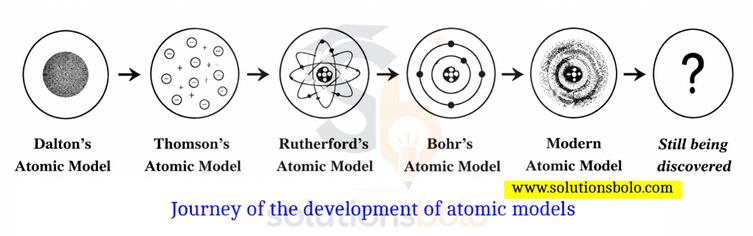
5. Explain and arrange the following statements in the correct chronological order to show how atomic models have evolved over time.
(i) Bohr’s model proposed that electrons move in fixed orbits around the nucleus, each with a definite energy.
(ii) Thomson’s model depicted the atom as a ʻplum puddingʼ with electrons embedded in a sphere of positive charge.
(iii) Rutherford’s model proposed that atoms have a dense central nucleus.
(iv) Dalton’s model described atoms as indivisible particles.
Answer: The correct chronological order is (iv) → (ii) → (iii) → (i).
(iv) Dalton’s Atomic Theory (1808): John Dalton proposed the first scientific atomic theory, describing atoms as indivisible building blocks of matter.
(ii) Thomson’s Atomic Model (1897): Following his discovery of the electron, J. J. Thomson proposed the ‘plum pudding’ model, depicting the atom as a positively charged sphere with embedded negative electrons.
(iii) Rutherford’s Atomic Model (1911): Based on the alpha-particle gold foil experiment, Ernest Rutherford disproved Thomson’s model and proposed that atoms have a dense, tiny, positively charged central nucleus surrounded by orbiting electrons.
(i) Bohr’s Atomic Model (1913): Niels Bohr resolved the limitation of Rutherford’s model regarding atomic stability by proposing that electrons revolve around the nucleus in fixed orbits (stationary energy levels) without radiating energy.
6. Electrons move around the nucleus in orbits. Why do they not fly away from the atom? Explain what keeps them attracted to the nucleus.
Answer: Electrons do not fly away because they are attracted towards the positively charged nucleus. According to the laws of electrostatics, opposite charges exert an attractive force on each other. This force keeps the negatively charged electrons attracted to the positively charged nucleus.
7. Assertion (A): The discovery of subatomic particles helped in understanding the atomic structure.
Reason (R): The number of electrons is equal to the number of protons in an atom.
Choose the correct option:
(i) Both A and R are true and R is the correct explanation of A.
(ii) Both A and R are true, but R is not the correct explanation of A.
(iii) A is true, but R is false.
(iv) A is false, but R is true.
Answer: (ii) Both A and R are true, but R is not the correct explanation of A.
Assertion (A) is true because discovering subatomic particles like electrons, protons and neutrons disproved Dalton’s idea of indivisible atoms and allowed scientists to build models showing how these particles are arranged within the atom.
Reason (R) is also true because an atom is electrically neutral, meaning its total number of negatively charged electrons equals its total number of positively charged protons.
However, Reason (R) is not the correct explanation for Assertion (A); the discovery of subatomic particles helped understand atomic structure because it revealed the internal constituents and arrangement of the atom, not simply because electrons and protons exist in equal numbers.
8. Magnesium is essential for many biological processes, including muscle contraction. For an atom of magnesium with a mass number of 24 and atomic number 12, determine the number of (i) protons, (ii) neutrons, (iii) electrons and also illustrate the arrangement of electrons in a magnesium atom.
Answer:
(i) Number of Protons: 12
(ii) Number of Neutrons: 12
(iii) Number of Electrons: 12
Electronic Configuration: 2, 8, 2 (K = 2, L = 8, M = 2)
Calculation of Subatomic Particles:
Protons: Atomic number (Z) = 12, so the number of protons = 12.
Electrons: In a neutral magnesium atom, electrons = protons = 12.
Neutrons:
Number of neutrons (n⁰) = Mass number (A) – Atomic number (Z)
Number of neutrons = 24 – 12 = 12
Arrangement of Electrons (Electronic Configuration):
K-shell (n = 1): Takes 2 electrons.
L-shell (n = 2): Takes 8 electrons.
M-shell (n = 3): Takes the remaining 12 – (2 + 8) = 2 electrons.
Electronic Configuration = 2, 8, 2
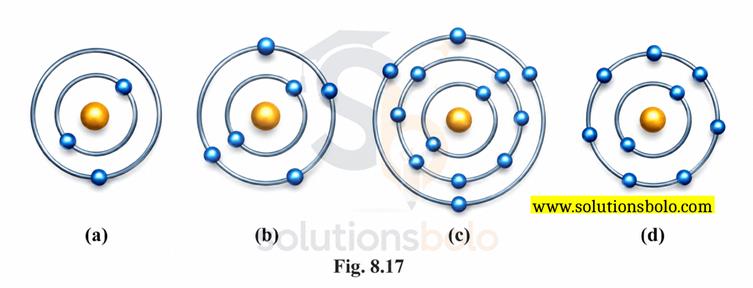
9. Find the following information for the elements shown in Fig. 8.17:
(i) Name of the element
(ii) Symbol
(iii) Total number of electrons
(iv) Number of valence electrons
(v) Valency of the element
(vi) Number of protons
(vii) Atomic number
Answer:
In diagram (a)
Electrons count: 2 in K-shell + 2 in L-shell = 4 electrons
(i) Name of the element: Beryllium
(ii) Symbol: Be
(iii) Total number of electrons: 4
(iv) Number of valence electrons: 2 (in L-shell)
(v) Valency of the element: 2
(vi) Number of protons: 4
(vii) Atomic number: 4
In diagram (b)
Electrons count: 2 in K-shell + 5 in L-shell = 7 electrons
(i) Name of the element: Nitrogen
(ii) Symbol: N
(iii) Total number of electrons: 7
(iv) Number of valence electrons: 5 (in L-shell)
(v) Valency of the element: 3 (8 – 5 = 3)
(vi) Number of protons: 7
(vii) Atomic number: 7
In diagram (c)
Electrons count: 2 in K-shell + 8 in L-shell + 3 in M-shell = 13 electrons
(i) Name of the element: Aluminium
(ii) Symbol: Al
(iii) Total number of electrons: 13
(iv) Number of valence electrons: 3 (in M-shell)
(v) Valency of the element: 3
(vi) Number of protons: 13
(vii) Atomic number: 13
In diagram (d)
Electrons count: 2 in K-shell + 8 in L-shell = 10 electrons
(i) Name of the element: Neon
(ii) Symbol: Ne
(iii) Total number of electrons: 10
(iv) Number of valence electrons: 8 (in L-shell)
(v) Valency of the element: 0 (complete octet)
(vi) Number of protons: 10
(vii) Atomic number: 10
10. Both Rutherford’s and Bohr’s models have electrons orbiting the nucleus. Why did Rutherford’s model fail to explain atomic stability, while Bohr’s model succeeded?
Answer: Rutherford’s model failed because classical physics predicted that revolving, accelerating electrons would continuously lose energy and collapse into the nucleus, while Bohr’s model succeeded by postulating that electrons move in fixed, non-radiating orbits (stationary states) where they maintain constant energy.
11. An atom ⁷⁰X has 31 electrons. How many neutrons are there in its nucleus?
[Concept: 1. Neutral Atom: In an electrically neutral atom, the number of protons equals the number of electrons (p⁺ = e⁻). 2. Mass Number (A): The mass number is represented as the superscript in the standard symbol notation (ᴬzX). It gives the total number of protons and neutrons in the nucleus. (A = p⁺ + n⁰) 3. Formula: Number of neutrons (n⁰) = Mass number (A) – Number of protons (p⁺)]
Answer: There are 39 neutrons in the nucleus of the atom.
Given Data:
Mass number (A) = 70
Number of electrons (e⁻) = 31
Determining Protons:
In a neutral atom, the number of protons is equal to the number of electrons.
Number of protons (p⁺) = 31
Calculating Neutrons:
Number of neutrons (n⁰) = Mass number (A) – Number of protons (p⁺)
Number of neutrons = 70 – 31 = 39
Therefore, the number of neutrons in the nucleus is 39.
12. An atom has 79 protons and a mass number of 197. Calculate (i) the number of neutrons and (ii) the number of electrons.
[Concept: Neutral Atom: In an electrically neutral atom, the number of electrons equals the number of protons (e⁻ = p⁺).
Mass Number (A): It is calculated as the total sum of protons (p⁺) and neutrons (n⁰) present in the nucleus. A = p⁺ + n⁰]
Answer:
(i) The number of neutrons is 118.
(ii) The number of electrons is 79.
Given Data:
Number of protons (p⁺) = 79
Mass number (A) = 197
(i) Calculation of Neutrons:
Number of neutrons (n⁰) = Mass number (A) – Number of protons (p⁺)
Number of neutrons = 197 – 79 = 118
(ii) Calculation of Electrons:
In an electrically neutral atom, the number of electrons is equal to the number of protons.
Number of electrons (e⁻) = Number of protons (p⁺) = 79
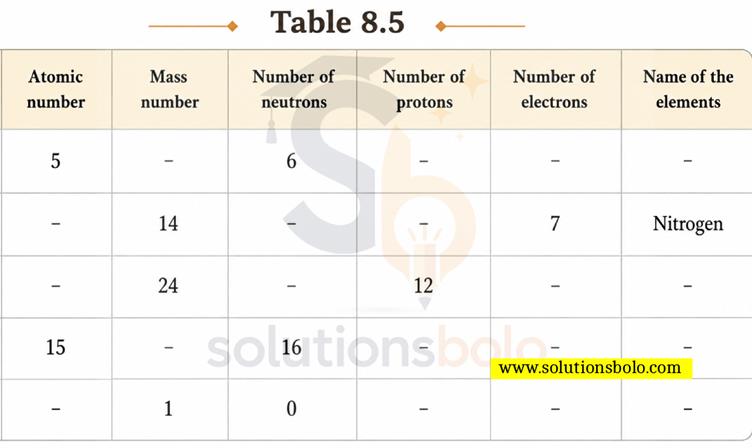
13. Complete the Table 8.5:
Answer:
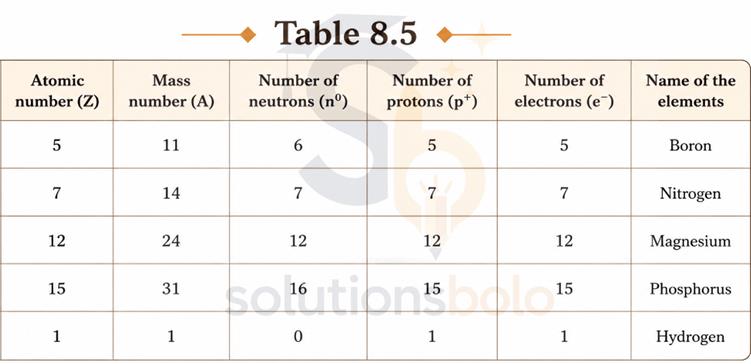
In Row 1:
Given: Atomic number (Z) = 5, Neutrons (n⁰) = 6
Protons (p⁺) = Atomic number (Z) = 5
Electrons (e⁻) = Protons (p⁺) = 5
Mass number (A) = p⁺ + n⁰ = 5 + 6 = 11
Element with Z = 5 is Boron.
In Row 2:
Given: Mass number (A) = 14, Electrons (e⁻) = 7, Element = Nitrogen
Protons (p⁺) = Electrons (e⁻) = 7
Atomic number (Z) = Protons (p⁺) = 7
Neutrons (n⁰) = A – p⁺ = 14 – 7 = 7
In Row 3:
Given: Mass number (A) = 24, Protons (p⁺) = 12
Atomic number (Z) = Protons (p⁺) = 12
Electrons (e⁻) = Protons (p⁺) = 12
Neutrons (n⁰) = A – p⁺ = 24 – 12 = 12
Element with Z = 12 is Magnesium.
In Row 4:
Given: Atomic number (Z) = 15, Neutrons (n⁰) = 16
Protons (p⁺) = Atomic number (Z) = 15
Electrons (e⁻) = Protons (p⁺) = 15
Mass number (A) = p⁺ + n⁰ = 15 + 16 = 31
Element with Z = 15 is Phosphorus.
In Row 5:
Given: Mass number (A) = 1, Neutrons (n⁰) = 0
Protons (p⁺) = A – n⁰ = 1 – 0 = 1
Atomic number (Z) = Protons (p⁺) = 1
Electrons (e⁻) = Protons (p⁺) = 1
Element with Z = 1 is Hydrogen.
14. Aman was discussing the structure of atom with his classmates. During the discussion, he learnt that an element X has a mass number of 35 and contains 18 neutrons. Based on this information, answer the following questions:
(i) How many electrons and protons does element X have?
(ii) What is its atomic number?
(iii) Identify the element X.
(iv) Write its electronic configuration.
(v) How many valence electrons does it have?
(vi) What will be the mass number if two neutrons are added to its nucleus?
(vii) What will be the relation of X with the new atom?
Answers:
(i) Protons = 17, Electrons = 17
(ii) Atomic number = 17
(iii) Element X is Chlorine (Cl)
(iv) Electronic configuration = 2, 8, 7 (K = 2, L = 8, M = 7)
(v) Valence electrons = 7
(vi) New mass number = 37
(vii) X and the new atom are Isotopes.
Explanation:
(i) Number of protons and electrons:
Number of protons (p⁺) = Mass number (A) – Number of neutrons (n⁰)
Number of protons = 35 – 18 = 17
Since an atom is electrically neutral, the number of electrons equals the number of protons:
Number of electrons (e⁻) = 17
(ii) Atomic number (Z):
The atomic number is equal to the total number of protons in the nucleus:
Z = p⁺ = 17
(iii) Identity of element X:
The element with atomic number 17 is Chlorine (Cl).
(iv) Electronic configuration:
Distributing the 17 electrons across the Bohr shells:
K-shell = 2
L-shell = 8
M-shell = 7
Electronic configuration = 2, 8, 7
(v) Number of valence electrons:
Valence electrons are the electrons present in the outermost shell (M-shell), which is 7.
(vi) Mass number after adding two neutrons:
New number of neutrons = 18 + 2 = 20
New Mass Number (Aₙₑw) = Protons + New neutrons
New Mass Number = 17 + 20 = 37
(vii) Relation between X and the new atom:
Both atoms have the same atomic number (17) but different mass numbers (35 and 37). Therefore, they are isotopes of each other.
³⁵₁₇Cl and ³⁷₁₇Cl.
15. In an atom, there are 12 protons and 12 neutrons in the nucleus. Now, imagine that all the electrons are replaced with some hypothetical particles that have the same charge as electrons but are 500 times heavier. What effect will this replacement have on the atom’s:
(i) Atomic number
(ii) Atomic mass
(iii) Mass number
(iv) Overall charge
Answers:
(i) Atomic number:
Effect: No effect / Remains unchanged (12).
Reason: The atomic number (Z) is defined strictly by the number of protons inside the nucleus (Z = p⁺). Changing the mass of the orbiting negative particles does not affect the proton count.
(ii) Atomic mass:
Effect: Increases.
Reason: The replacement particles have the same charge as electrons but are 500 times heavier. Therefore, their increased mass contributes significantly to the total mass of the atom.
(iii) Mass number:
Effect: No effect / Remains unchanged (24).
Reason: The mass number (A) is defined solely as the total number of nucleons (protons + neutrons) inside the nucleus.
A = 12 + 12 = 24
The mass or nature of extranuclear particles does not change the nucleon count.
(iv) Overall charge:
Effect: No effect / Remains neutral (Charge = 0).
Reason: The hypothetical particles carry the exact same electrical charge as electrons (-1 unit each). Because there are still 12 negatively charged particles balancing the 12 positively charged protons in the nucleus, the net electric charge remains zero.
Net charge = +12 – 12 = 0
Common Mistakes Students Make (With Exam Tips):
1. Confusion Between Valency and Valence Electrons
Common Mistake: Writing the valence electrons directly as valency for non-metals (e.g., writing valency of Chlorine as 7 or Oxygen as 6).
Exam Tip: Double-check if the question asks for “number of valence electrons” or “valency”. They are two completely different terms.
2. Incorrect Electronic Configuration of Potassium (Z = 19) and Calcium (Z = 20)
Common Mistake: Applying only the 2n² formula (M-shell capacity = 18) and writing Potassium as 2,8,9 and Calcium as 2,8,10.
Exam Tip: Always write Potassium (Z = 19) as 2,8,8,1 and Calcium (Z = 20) as 2,8,8,2. The N-shell starts filling once the M-shell reaches 8 electrons.
3. Mixing Up Atomic Number (Z) and Mass Number (A) in Notation
Common Mistake: Swapping the positions of Z and A or writing subatomic counts incorrectly for ions.
Exam Tip: Remember the mnemonic: A is on top (like the roof/Attic) and Z is at the base (Zero/Ground).
4. Miscalculating Subatomic Particles in Ions (Na⁺, Cl⁻, O²⁻)
Common Mistake: Changing the number of protons or neutrons when calculating particles for an ion.
Exam Tip: Never subtract or add numbers to protons when dealing with ionic charges; only adjust the electron count.
5. Forgetting that Protium (¹₁H) Contains Zero Neutrons
Common Mistake: Assuming every atom must contain at least one neutron.
Exam Tip: In “True/False” or Assertion-Reason questions, remember the statement “All atoms contain protons, neutrons and electrons” is False because of Protium.
6. Confusing Isotopes with Isobars
Common Mistake: Interchanging definitions or claiming isotopes have different chemical properties.
Exam Tip: Look at the suffix: Isotope → same protons (Z); Isobar → same mass number (A).
7. Stating Thomson’s Model in Rutherford’s Observations
Common Mistake: Writing that Rutherford discovered electrons or that Thomson discovered the nucleus.
Exam Tip: Clearly attribute the discovery of the dense central nucleus and the planetary model strictly to Rutherford’s scattering experiment.
8. Forgetting Units in Average Atomic Mass Calculations
Common Mistake: Writing fractional atomic mass without the unified mass unit (u) or forgetting to divide isotopic abundance by 100.
Exam Tip: Ensure the final answer has the unit u (e.g., Chlorine = 35.5 u, Bromine = 80 u). Never leave the final value dimensionless.
How to Score Full Marks in Journey Inside the Atom
1. Master Electronic Configurations Up to Z = 20: Memorize atomic numbers 1 to 20 sequentially (Hydrogen to Calcium). Practice drawing Bohr orbital diagrams with the correct electron count per shell (K, L, M, N) and never violate the octet rule for Potassium (2, 8, 8, 1) and Calcium (2, 8, 8, 2).
2. Format Average Atomic Mass Calculations Step-by-Step: Always write the full formula first, substitute the fractional abundance, show arithmetic clearly and state the final answer with the unit u (e.g., Chlorine = 35.5 u). Examiners deduct marks for missing steps or missing units.
3. Memorize Exact Observations vs. Conclusions for Experiments: Do not mix observations with inferences in Rutherford’s alpha-particle scattering experiment. Clearly state what was observed (e.g., most α-particles passed straight through) alongside its corresponding scientific deduction (e.g., most of the atom’s volume is empty space).
4. Write Precise Definitions with Standard Notation: Learn exact textbook definitions for Isotopes, Isobars, Valency and Valence Electrons. Whenever an example is required, always write it in standard isotopic notation (such as ³⁵₁₇Cl and ³⁷₁₇Cl for isotopes or ⁴⁰₁₈Ar and ⁴⁰₂₀Ca for isobars).
5. Handle Ionic Species with Nucleon Invariance: When finding subatomic counts in ions like Al³⁺ or O²⁻, keep the proton and neutron counts strictly constant and adjust only the electron count. Explicitly state this step in your answers to secure full method marks.
6. Learn Specific Uses of Radioisotopes: Directly memorize the standard applications frequently tested in 1-mark and case-based questions: Cobalt-60 for cancer therapy, Iodine-131 for goitre treatment, Uranium-235 for nuclear reactor fuel and Carbon-14 for carbon dating.
Important Formulae and Key Terms
1. Maximum electrons in shell: 2n² (n = shell number)
2. Mass Number: A = Z + number of neutrons
3. Atomic Number (Z): Number of protons = number of electrons (neutral atom)
4. Number of neutrons: A − Z
5. Weighted Average Atomic Mass: Sum of (mass × % abundance/100) for each isotope
6. Charge of neutron: 0
7. Nucleus is smaller than atom by: 10⁵ times (one lakh times)
8. Diameter of atom: ≈ 10⁻¹⁰ m
9. Diameter of nucleus: ≈ 10⁻¹⁵ m
10. Charge of electron: −1.602 × 10⁻¹⁹ C (relative charge = −1)
11. Charge of proton: +1.602 × 10⁻¹⁹ C (relative charge = +1)
Frequently Asked Questions (FAQs):
1. Why is an atom electrically neutral despite containing charged subatomic particles?
Answer: An atom contains positively charged protons inside the nucleus and negatively charged electrons revolving around it. Because the number of protons is exactly equal to the number of electrons, their charges of equal magnitude (+1.6 × 10⁻¹⁹ C and −1.6 × 10⁻¹⁹ C) cancel each other out completely, resulting in zero net charge.
2. Why is the atomic mass of chlorine written as a fraction (35.5 u)?
Answer: Chlorine exists in nature as a mixture of two isotopes: ³⁵Cl (75%) and ³⁷Cl (25%). The atomic mass of an element is taken as the weighted average of its naturally occurring isotopic masses:
Average Mass = (35 × 75/100) + (37 × 25/100) = 26.25 + 9.25 = 35.5 u
3. What was the main drawback of Rutherford’s nuclear model of the atom?
Answer: According to Maxwell’s electromagnetic theory, any charged particle moving in a circular path undergoes continuous acceleration and must radiate energy. An electron revolving around the nucleus would constantly lose kinetic energy, spiral inward and collapse into the nucleus within 10⁻⁸ seconds, making stable matter impossible.
4. Why is the electronic configuration of Potassium (Z = 19) written as 2, 8, 8, 1 and not 2, 8, 9?
Answer: According to the Bohr-Bury rules, the maximum number of electrons that can be accommodated in the outermost valence shell is strictly 8. If written as 2, 8, 9, the M-shell would become the outermost shell with 9 electrons, violating the octet rule. Therefore, the 19th electron enters the N-shell (2, 8, 8, 1).
5. Why do isotopes have identical chemical properties but different physical properties?
Answer: Chemical properties are determined exclusively by the number and arrangement of valence electrons, which is identical for all isotopes of an element. Physical properties (such as density, boiling point and mass) depend directly on the mass of the nucleus, which differs due to varying numbers of neutrons.
6. What are the mass and charge of the three fundamental subatomic particles?
Answer: Proton (p⁺): Relative charge = +1 (+1.6 × 10⁻¹⁹ C), Mass ≈ 1 u (1.672 × 10⁻²⁷ kg)
Neutron (n⁰): Relative charge = 0 (Neutral), Mass ≈ 1 u (1.675 × 10⁻²⁷ kg)
Electron (e⁻): Relative charge = −1 (−1.6 × 10⁻¹⁹ C), Mass ≈ 1/1840 u (9.1 × 10⁻³¹ kg)
7. How does Bohr’s atomic model explain the stability of an atom?
Answer: Niels Bohr proposed that electrons revolve around the nucleus only in certain discrete, stationary orbits (K, L, M, N). While confined to these specific quantized paths, electrons do not radiate electromagnetic energy, ensuring the atom maintains permanent structural stability.
8. What is the difference between atomic number (Z) and mass number (A)?
Answer: Atomic Number (Z): The total number of protons present inside the nucleus of an atom. It uniquely identifies the element (Z = p⁺).
Mass Number (A): The total number of nucleons (protons + neutrons) inside the nucleus (A = p⁺ + n⁰).
9. Why was gold foil chosen by Rutherford for his alpha-particle scattering experiment?
Answer: Gold has exceptionally high malleability, allowing it to be hammered into an ultra-thin foil approximately 1000 atoms thick (around 100 nm). This ensured that alpha particles interacted with a minimal number of atomic layers without multiple scattering interference.
10. What is an alpha (α) particle and what are its charge and mass?
Answer: An alpha particle is a doubly charged helium ion (He²⁺), consisting of 2 protons and 2 neutrons without any electrons. It carries a net positive charge of +2 (+3.2 × 10⁻¹⁹ C) and a mass of 4 u (6.64 × 10⁻²⁷ kg).