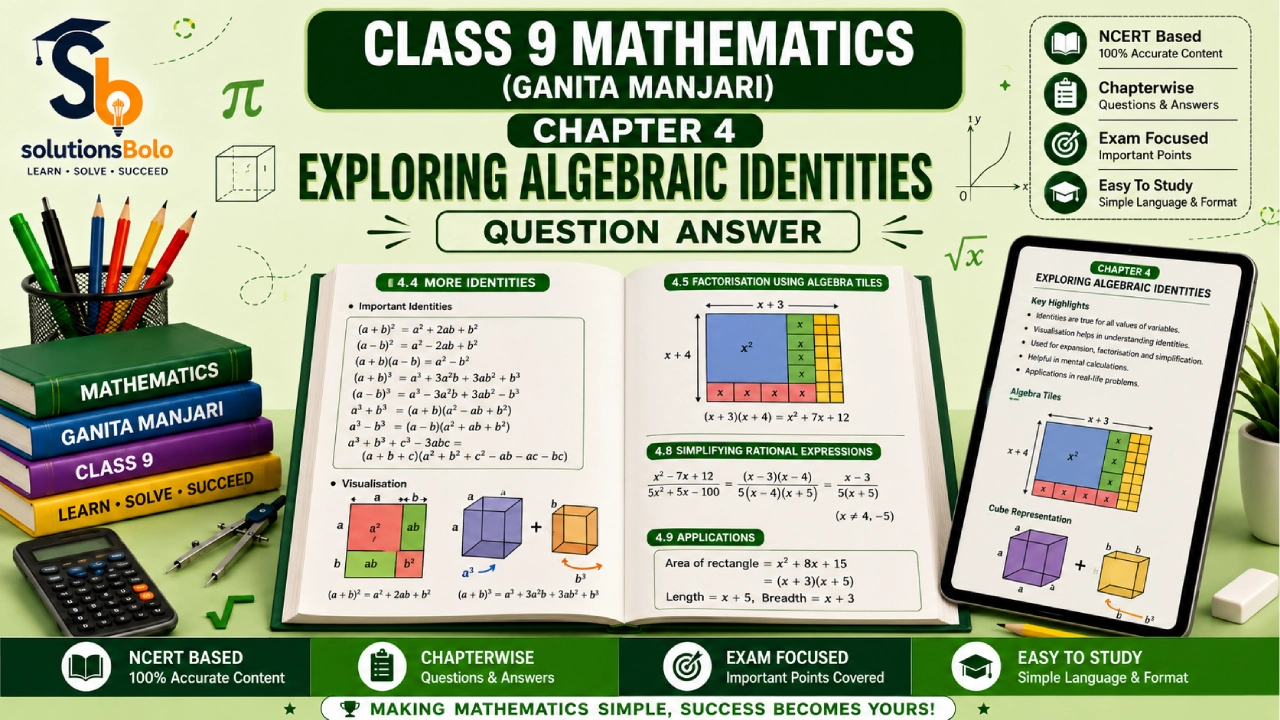
NCERT Class 9 Maths Ganita Manjari Chapter 4 Exploring Algebraic Identities Solutions include Exercise Set 4.1, Exercise Set 4.2, Exercise Set 4.3, Exercise Set 4.4, Exercise Set 4.5 and End of Chapter Exercises for the academic session 2026–27. This chapter helps students understand and apply standard algebraic identities through expansion, factorisation and simplification of algebraic expressions. Students learn to use identities for finding squares, cubes and products, factorising polynomials, simplifying rational algebraic expressions and solving application-based problems. The chapter also explores the geometrical interpretation of algebraic identities and their use in mental calculations and mathematical proofs. These NCERT Solutions provide clear step-by-step explanations and are useful for CBSE students preparing for school examinations based on the New Syllabus 2026–27.
Table of Contents (Quick Links):
Common Mistakes Students Make in Chapter
(Page – 71)
Exercise Set 4.1
1. Using the identity (a + b)² = a² + 2ab + b², expand the following:
(i) (7x + 4y)² (ii) (7/5 x+3/2 y)² (iii) (2.5p + 1.5q)²
(iv) ((3/4)s + 8t)² (v) (x + 1/(2y))² (vi) (1/x + 1/y)²
Concept: The identity (a + b)² = a² + 2ab + b² is used to expand the square of a binomial.
How to Solve: Identify the two terms as a and b. Then substitute them into the identity and simplify the expression.
(i) (7x + 4y)²
Solution:
Here,
a = 7x, b = 4y
Using the identity,
(a + b)² = a² + 2ab + b²
= (7x)² + 2(7x)(4y) + (4y)²
= 49x² + 56xy + 16y²
(ii) (7/5 x+3/2 y)²
Solution:
Here,
a = (7/5)x, b = (3/2)y
Using the identity,
(a + b)² = a² + 2ab + b²
= ((7/5)x)² + 2((7/5)x)((3/2)y) + ((3/2)y)²
= (49/25)x² + (21/5)xy + (9/4)y²
(iii) (2.5p + 1.5q)²
Solution:
Here,
a = 2.5p, b = 1.5q
Using the identity,
(a + b)² = a² + 2ab + b²
= (2.5p)² + 2(2.5p)(1.5q) + (1.5q)²
= 6.25p² + 7.5pq + 2.25q²
(iv) ((3/4)s + 8t)²
Solution:
Here,
a = (3/4)s, b = 8t
Using the identity,
(a + b)² = a² + 2ab + b²
= ((3/4)s)² + 2((3/4)s)(8t) + (8t)²
= (9/16)s² + 12st + 64t²
(v) (x + 1/(2y))²
Solution:
Here,
a = x, b = 1/(2y)
Using the identity,
(a + b)² = a² + 2ab + b²
= x² + 2(x)(1/(2y)) + (1/(2y))²
= x² + x/y + 1/(4y²)
(vi) (1/x + 1/y)²
Solution:
Here,
a = 1/x, b = 1/y
Using the identity,
(a + b)² = a² + 2ab + b²
= (1/x)² + 2(1/x)(1/y) + (1/y)²
= 1/x² + 2/(xy) + 1/y²
2. Using the same identity, find the values of the following:
(i) (64)² (ii) (105)² (iii) (205)²
Concept: Use the identity (a + b)² = a² + 2ab + b² Choose a and b so that the given number becomes easy to square mentally.
How to Solve: Express the given number as the sum of two convenient numbers, apply the identity and simplify.
(i) (64)²
Solution:
64 = 60 + 4
Using the identity,
(60 + 4)²
= 60² + 2(60)(4) + 4²
= 3600 + 480 + 16
= 4096
(ii) (105)²
Solution:
105 = 100 + 5
Using the identity,
(100 + 5)²
= 100² + 2(100)(5) + 5²
= 10000 + 1000 + 25
= 11025
(iii) (205)²
Solution:
205 = 200 + 5
Using the identity,
(200 + 5)²
= 200² + 2(200)(5) + 5²
= 40000 + 2000 + 25
= 42025
Page – 74
Exercise Set 4.2
Q.1 Factor completely.
(i) 9x² + 24xy + 16y² (ii) 4s² + 20st + 25t²
(iii) 49x² + 28xy + 4y² (iv) 64p² + (32/3)pq + (4/9)q²
(v) 3a² + 4ab + (4/3)b² (vi) (9/5)s² + 6sv + 5v²
Concept: A perfect square trinomial can be factorised using the identities:
(a + b)² = a² + 2ab + b²
(a – b)² = a² – 2ab + b²
How to Solve: Identify the first and last terms as perfect squares. Then check whether the middle term is equal to ±2ab and apply the appropriate identity.
(i) 9x² + 24xy + 16y²
Solution:
Here,
9x² = (3x)²
16y² = (4y)²
Also,
2(3x)(4y) = 24xy
Using the identity,
a² + 2ab + b² = (a + b)²
= (3x + 4y)²
(ii) 4s² + 20st + 25t²
Solution:
Here,
4s² = (2s)²
25t² = (5t)²
Also,
2(2s)(5t) = 20st
Using the identity,
a² + 2ab + b² = (a + b)²
= (2s + 5t)²
(iii) 49x² + 28xy + 4y²
Solution:
Here,
49x² = (7x)²
4y² = (2y)²
Also,
2(7x)(2y) = 28xy
Using the identity,
a² + 2ab + b² = (a + b)²
= (7x + 2y)²
(iv) 64p² + (32/3)pq + (4/9)q²
Solution:
Here,
64p² = (8p)²
(4/9)q² = ((2/3)q)²
Also,
2(8p)((2/3)q) = (32/3)pq
Using the identity,
a² + 2ab + b² = (a + b)²
= (8p + (2/3)q)²
(v) 3a² + 4ab + (4/3)b²
Solution:
Taking 1/3 as a common factor,
= (1/3)(9a² + 12ab + 4b²)
Now,
9a² = (3a)²
4b² = (2b)²
Also,
2(3a)(2b) = 12ab
Using the identity,
a² + 2ab + b² = (a + b)²
= (1/3)(3a + 2b)²
(vi) (9/5)s² + 6sv + 5v²
Solution:
Taking 1/5 as a common factor,
= (1/5)(9s² + 30sv + 25v²)
Now,
9s² = (3s)²
25v² = (5v)²
Also,
2(3s)(5v) = 30sv
Using the identity,
a² + 2ab + b² = (a + b)²
= (1/5)(3s + 5v)²
2. Find the values of the following using the identity (a – b)² = a² – 2ab + b².
(i) (79)² (ii) (193)² (iii) (299)²
(i) (79)²
Solution:
79 = 80 – 1
Using the identity,
(a – b)² = a² – 2ab + b²
= (80 – 1)²
= 80² – 2(80)(1) + 1²
= 6400 – 160 + 1
= 6241
(ii) (193)²
Solution:
193 = 200 – 7
Using the identity,
(a – b)² = a² – 2ab + b²
= (200 – 7)²
= 200² – 2(200)(7) + 7²
= 40000 – 2800 + 49
= 37249
(iii) (299)²
Solution:
299 = 300 – 1
Using the identity,
(a – b)² = a² – 2ab + b²
= (300 – 1)²
= 300² – 2(300)(1) + 1²
= 90000 – 600 + 1
= 89401
Page – 76
Exercise Set 4.3
1. Find the following squares using one of the above identities. Determine which of these identities will make these calculations easier.
(i) 117² (ii) 78² (iii) 198²
(iv) 214² (v) 1104² (vi) 1120²
Concept: Algebraic identities help us calculate the squares of numbers quickly without actual multiplication.
How to Solve: Express the given number as (a + b) or (a – b), apply the appropriate identity and simplify the expression.
(i) 117²
Solution:
117 = 100 + 17
Using the identity,
(a + b)² = a² + 2ab + b²
= (100 + 17)²
= 100² + 2(100)(17) + 17²
= 10000 + 3400 + 289
= 13689
(ii) 78²
Solution:
78 = 80 – 2
Using the identity,
(a – b)² = a² – 2ab + b²
= (80 – 2)²
= 80² – 2(80)(2) + 2²
= 6400 – 320 + 4
= 6084
(iii) 198²
Solution:
198 = 200 – 2
Using the identity,
(a – b)² = a² – 2ab + b²
= (200 – 2)²
= 200² – 2(200)(2) + 2²
= 40000 – 800 + 4
= 39204
(iv) 214²
Solution:
214 = 200 + 14
Using the identity,
(a + b)² = a² + 2ab + b²
= (200 + 14)²
= 200² + 2(200)(14) + 14²
= 40000 + 5600 + 196
= 45796
(v) 1104²
Solution:
1104 = 1100 + 4
Using the identity,
(a + b)² = a² + 2ab + b²
= (1100 + 4)²
= 1100² + 2(1100)(4) + 4²
= 1210000 + 8800 + 16
= 1218816
(vi) 1120²
Solution:
1120 = 1100 + 20
Using the identity,
(a + b)² = a² + 2ab + b²
= (1100 + 20)²
= 1100² + 2(1100)(20) + 20²
= 1210000 + 44000 + 400
= 1254400
2. Factor using suitable identities.
(i) 16y² – 24y + 9 (ii) (9/4)s² + 6st + 4t²
(iii) m²/9 + mk/3 + k²/4 + 3nk + 2mn + 9n² (iv) p²/16 – 2 + 16/p²
(v) 9a² + 4b² + c² – 12ab + 6ac – 4bc
Concept: Suitable algebraic identities help factorise perfect square trinomials and expressions that can be written as the square of a binomial.
How to Solve: Identify the given expression as a perfect square trinomial. Rewrite it in the form a² ± 2ab + b² and apply the appropriate identity.
(i) 16y² – 24y + 9
Solution:
Here,
16y² = (4y)²
9 = 3²
Also,
2(4y)(3) = 24y
Using the identity,
a² – 2ab + b² = (a – b)²
= (4y – 3)²
(ii) (9/4)s² + 6st + 4t²
Solution:
Here,
(9/4)s² = ((3/2)s)²
4t² = (2t)²
Also,
2((3/2)s)(2t) = 6st
Using the identity,
a² + 2ab + b² = (a + b)²
= ((3/2)s + 2t)²
(iii) m²/9 + mk/3 + k²/4 + 3nk + 2mn + 9n²
Solution:
Rearranging the terms,
= (m²/9 + mk/3 + k²/4) + (2mn + 3nk + 9n²)
Observe that,
m²/9 + mk/3 + k²/4 = (m/3 + k/2)²
Also,
2(m/3 + k/2)(3n) = 2mn + 3nk
and
(3n)² = 9n²
Using the identity,
a² + 2ab + b² = (a + b)²
= (m/3 + k/2 + 3n)²
(iv) p²/16 – 2 + 16/p²
Solution:
Here,
p²/16 = (p/4)²
16/p² = (4/p)²
Also,
2(p/4)(4/p) = 2
Hence,
p²/16 – 2 + 16/p²
= (p/4)² – 2(p/4)(4/p) + (4/p)²
Using the identity,
a² – 2ab + b² = (a – b)²
= (p/4 – 4/p)²
(v) 9a² + 4b² + c² – 12ab + 6ac – 4bc
Solution:
Here,
9a² = (3a)²
4b² = (2b)²
c² = c²
Also,
-2(3a)(2b) = -12ab
2(3a)(c) = 6ac
-2(2b)(c) = -4bc
Using the identity,
x² + y² + z² – 2xy + 2xz – 2yz = (x – y + z)²
where,
x = 3a, y = 2b, z = c
Therefore,
9a² + 4b² + c² – 12ab + 6ac – 4bc
= (3a – 2b + c)²
3. Expand the following using the identity (a + b + c)² = a² + b² + c² + 2ab + 2bc + 2ca
(i) (p + 3q + 7r)² (ii) (3x – 2y + 4z)²
Concept: The identity (a + b + c)² is used to expand the square of a trinomial without actual multiplication.
How to Solve: Identify the three terms as a, b and c. Substitute them into the identity and simplify the expression.
(i) (p + 3q + 7r)²
Solution:
Here,
a = p, b = 3q, c = 7r
Using the identity,
(a + b + c)² = a² + b² + c² + 2ab + 2bc + 2ca
= p² + (3q)² + (7r)² + 2(p)(3q) + 2(3q)(7r) + 2(7r)(p)
= p² + 9q² + 49r² + 6pq + 42qr + 14pr
(ii) (3x – 2y + 4z)²
Solution:
Here,
a = 3x, b = –2y, c = 4z
Using the identity,
(a + b + c)² = a² + b² + c² + 2ab + 2bc + 2ca
= (3x)² + (–2y)² + (4z)² + 2(3x)(–2y) + 2(–2y)(4z) + 2(4z)(3x)
= 9x² + 4y² + 16z² – 12xy – 16yz + 24xz
4. Is this an identity?
(a + b – c)² + (a – b + c)² + (a – b – c)² = 2a² + 2b² + 2c²
Concept: An equation is an identity if its left-hand side (LHS) and right-hand side (RHS) are equal for all values of the variables.
How to Solve: Expand each expression on the LHS using the identity (a + b + c)², simplify the result and compare it with the RHS. If both sides are identical, the given statement is an identity.
(a + b – c)² + (a – b + c)² + (a – b – c)² = 2a² + 2b² + 2c²
Solution:
LHS
= (a + b – c)² + (a – b + c)² + (a – b – c)²
Using the identity,
(a + b + c)² = a² + b² + c² + 2ab + 2bc + 2ca
= (a² + b² + c² + 2ab – 2ac – 2bc)
(a² + b² + c² – 2ab + 2ac – 2bc)
(a² + b² + c² – 2ab – 2ac + 2bc)
= 3a² + 3b² + 3c² – 2ab – 2ac – 2bc
RHS
= 2a² + 2b² + 2c²
Since,
LHS ≠ RHS
Therefore, the given statement is not an identity.
Page – 81
Exercise Set 4.4
1. Fill in the blanks to complete the following identities.
(i) s² − 11s + 24 = ( _____ )( _____ )
(ii) ( _____ )(x + 1) = (3x² − 4x − 7)
(iii) 10x² − 11x − 6 = (2x − )( + 2)
(iv) 6x² + 7x + 2 = ( _____ )( _____ )
Concept: Algebraic identities and factorisation are used to complete the missing terms in the given expressions.
How to Solve: Factorise the given polynomial or compare both sides of the identity. Then fill in the missing terms so that both sides become equal.
(i) s² − 11s + 24 = ( _____ )( _____ )
Solution:
We need two numbers whose product is 24 and whose sum is −11.
These numbers are −3 and −8.
Therefore,
s² − 11s + 24
= (s − 3)(s − 8)
(ii) ( _____ )(x + 1) = (3x² − 4x − 7)
Solution:
Factorising the RHS,
3x² − 4x − 7
= 3x² + 3x − 7x − 7
= 3x(x + 1) − 7(x + 1)
= (3x − 7)(x + 1)
Hence, the missing factor is 3x − 7
(iii) 10x² − 11x − 6 = (2x − )( + 2)
Solution:
Factorising,
10x² − 11x − 6
= 10x² + 4x − 15x − 6
= 2x(5x + 2) − 3(5x + 2)
= (2x − 3)(5x + 2)
(iv) 6x² + 7x + 2 = ( _____ )( _____ )
Solution:
Factorising,
6x² + 7x + 2
= 6x² + 3x + 4x + 2
= 3x(2x + 1) + 2(2x + 1)
= (3x + 2)(2x + 1)
2. Select and use the identity that will help you to find the following products without multiplying directly.
(i) (41)² (ii) (27)²
(iii) (23 × 17) (iv) (135)²
(v) (97)² (vi) (18 × 29)
(vii) (34 × 43) (vii) (34 × 43)
Concept: Algebraic identities help us calculate products and squares quickly by expressing the given numbers in a suitable form such as (a + b) or (a − b).
How to Solve: Express each number as the sum or difference of convenient numbers, apply the appropriate identity and simplify.
(i) (41)²
Solution:
41 = 40 + 1
Using the identity,
(a + b)² = a² + 2ab + b²
= (40 + 1)²
= 40² + 2(40)(1) + 1²
= 1600 + 80 + 1
= 1681
(ii) (27)²
Solution:
27 = 30 − 3
Using the identity,
(a − b)² = a² − 2ab + b²
= (30 − 3)²
= 30² − 2(30)(3) + 3²
= 900 − 180 + 9
= 729
(iii) (23 × 17)
Solution:
23 = 20 + 3
17 = 20 − 3
Using the identity,
(a + b)(a − b) = a² − b²
= (20 + 3)(20 − 3)
= 20² − 3²
= 400 − 9
= 391
(iv) (135)²
Solution:
135 = 100 + 35
Using the identity,
(a + b)² = a² + 2ab + b²
= (100 + 35)²
= 100² + 2(100)(35) + 35²
= 10000 + 7000 + 1225
= 18225
(v) (97)²
Solution:
97 = 100 − 3
Using the identity,
(a − b)² = a² − 2ab + b²
= (100 − 3)²
= 100² − 2(100)(3) + 3²
= 10000 − 600 + 9
= 9409
(vi) (18 × 29)
Solution:
18 = 20 − 2
29 = 20 + 9
Using the identity,
(a + b)(a + c) = a² + a(b + c) + bc
= (20 − 2)(20 + 9)
= 20² + 20(−2 + 9) + (−2)(9)
= 400 + 140 − 18
= 522
(vii) (34 × 43)
Solution:
34 = 40 − 6
43 = 40 + 3
Using the identity,
(a + b)(a + c) = a² + a(b + c) + bc
= (40 − 6)(40 + 3)
= 40² + 40(−6 + 3) + (−6)(3)
= 1600 − 120 − 18
= 1462
(viii) (205)²
Solution:
205 = 200 + 5
Using the identity,
(a + b)² = a² + 2ab + b²
= (200 + 5)²
= 200² + 2(200)(5) + 5²
= 40000 + 2000 + 25
= 42025
3. Factor the following:
(i) 9a² + b² + 4c² − 6ab + 12ac − 4bc
(ii) 16s² + 25t² − 40st
(iii) r² − r − 42
(iv) 49g² + 14gh + h²
(v) 64u² + 121v² + 4w² − 176uv − 32uw + 44vw
Concept: Algebraic identities and factorisation are used to express a polynomial as the product of two or more factors.
How to Solve: Identify whether the given expression is a perfect square trinomial or a quadratic expression. Then apply the suitable identity or factorisation method to obtain its factors.
(i) 9a² + b² + 4c² − 6ab + 12ac − 4bc
Solution:
Here,
9a² = (3a)²
b² = (b)²
4c² = (2c)²
Also,
−2(3a)(b) = −6ab
2(3a)(2c) = 12ac
−2(b)(2c) = −4bc
Using the identity,
x² + y² + z² − 2xy + 2xz − 2yz = (x − y + z)²
= (3a − b + 2c)²
(ii) 16s² + 25t² − 40st
Solution:
Here,
16s² = (4s)²
25t² = (5t)²
Also,
2(4s)(5t) = 40st
Using the identity,
a² − 2ab + b² = (a − b)²
= (4s − 5t)²
(iii) r² − r − 42
Solution:
We need two numbers whose product is −42 and whose sum is −1.
These numbers are −7 and 6.
Therefore,
r² − r − 42
= r² − 7r + 6r − 42
= r(r − 7) + 6(r − 7)
= (r − 7)(r + 6)
(iv) 49g² + 14gh + h²
Solution:
Here,
49g² = (7g)²
h² = (h)²
Also,
2(7g)(h) = 14gh
Using the identity,
a² + 2ab + b² = (a + b)²
= (7g + h)²
(v) 64u² + 121v² + 4w² − 176uv − 32uw + 44vw
Solution:
Here,
64u² = (8u)²
121v² = (11v)²
4w² = (2w)²
Also,
−2(8u)(11v) = −176uv
−2(8u)(2w) = −32uw
2(11v)(2w) = 44vw
Using the identity,
x² + y² + z² − 2xy − 2xz + 2yz = (x − y − z)²
where,
x = 8u, y = 11v, z = −2w
Therefore,
64u² + 121v² + 4w² − 176uv − 32uw + 44vw
= (8u − 11v − 2w)²
Page – 87
Exercise Set 4.5
1. Simplify the following rational expressions assuming that the expressions in the denominators are not equal to zero.
(i) (3p² − 3pq − 18q²) / (p² + 3pq − 10q²)
(ii) (n³ − 3n²m + 3nm² − m³) / (5m² − 10mn + 5n²)
(iii) (w³ − v³ + x³ + 3wvx) / (w² + v² + x² − 2wv − 2vx + 2wx)
(iv) (4y² − 20yz + 25z²) / (25z² − 4y²)
(v) ((x² + x − 6)(x² − 7x + 12)) / ((x² − 6x + 8)(x² − 9))
(vi) (p⁴ − 16) / (p² − 4p + 4)
Concept: A rational expression is simplified by factorising its numerator and denominator, then cancelling the common factors. The denominator must not be zero.
How to Solve: Factorise the numerator and denominator completely. Cancel the common factors and write the simplified expression, ensuring that the denominator is not equal to zero.
(i) (3p² − 3pq − 18q²) / (p² + 3pq − 10q²)
Solution:
Factorising the numerator,
3p² − 3pq − 18q²
= 3(p² − pq − 6q²)
= 3(p − 3q)(p + 2q)
Factorising the denominator,
p² + 3pq − 10q²
= (p + 5q)(p − 2q)
Therefore,
(3p² − 3pq − 18q²) / (p² + 3pq − 10q²)
= 3(p − 3q)(p + 2q) / ((p + 5q)(p − 2q))
No common factor can be cancelled.
(ii) (n³ − 3n²m + 3nm² − m³) / (5m² − 10mn + 5n²)
Solution:
Factorising the numerator,
n³ − 3n²m + 3nm² − m³
= (n − m)³
Factorising the denominator,
5m² − 10mn + 5n²
= 5(m² − 2mn + n²)
= 5(m − n)²
Since,
(m − n)² = (n − m)²
Therefore,
(n − m)³ / 5(m − n)²
= (n − m)³ / 5(n − m)²
= (n − m) / 5
(iii) (w³ − v³ + x³ + 3wvx) / (w² + v² + x² − 2wv − 2vx + 2wx)
Solution:
Using the identity,
a³ + b³ + c³ − 3abc
= (a + b + c)(a² + b² + c² − ab − bc − ca)
Let
a = w, b = x, c = −v
Then,
w³ + x³ + (−v)³ − 3(w)(x)(−v)
= w³ + x³ − v³ + 3wvx
So, the numerator becomes
= (w + x − v)(w² + x² + v² − wx + xv + vw)
Rearranging the denominator,
w² + v² + x² − 2wv − 2vx + 2wx
= (w − v + x)²
Since,
w − v + x = w + x − v
Therefore,
(w³ − v³ + x³ + 3wvx) / (w² + v² + x² − 2wv − 2vx + 2wx)
= (w + x − v)(w² + x² + v² − wx + xv + vw) / (w + x − v)²
= (w² + x² + v² − wx + xv + vw) / (w + x − v)
(iv) (4y² − 20yz + 25z²) / (25z² − 4y²)
Solution:
Factorising the numerator,
4y² − 20yz + 25z²
= (2y − 5z)²
Factorising the denominator,
25z² − 4y²
= (5z)² − (2y)²
= (5z − 2y)(5z + 2y)
Since,
2y − 5z = −(5z − 2y)
Therefore,
(2y − 5z)² = (5z − 2y)²
Hence,
(4y² − 20yz + 25z²) / (25z² − 4y²)
= (5z − 2y)² / ((5z − 2y)(5z + 2y))
= (5z − 2y) / (5z + 2y)
(v) ((x² + x − 6)(x² − 7x + 12)) / ((x² − 6x + 8)(x² − 9))
Solution:
Factorising each polynomial,
x² + x − 6
= (x + 3)(x − 2)
x² − 7x + 12
= (x − 3)(x − 4)
x² − 6x + 8
= (x − 2)(x − 4)
x² − 9
= (x − 3)(x + 3)
Therefore,
((x + 3)(x − 2)(x − 3)(x − 4)) / ((x − 2)(x − 4)(x − 3)(x + 3))
Cancelling the common factors,
= 1
(vi) (p⁴ − 16) / (p² − 4p + 4)
Solution:
Factorising the numerator,
p⁴ − 16
= (p² − 4)(p² + 4)
= (p − 2)(p + 2)(p² + 4)
Factorising the denominator,
p² − 4p + 4
= (p − 2)²
Cancelling the common factor (p − 2),
= (p + 2)(p² + 4) / (p − 2)
Page – 88
End of Chapter Exercises
1. Use suitable identities to find the following products.
(i) (−3x + 4)² (ii) (2s + 7)(2s − 7)
(iii) (p² + 1/2)(p² − 1/2) (iv) (2n + 7)(2n − 7)
(v) (s − 2t)(s² + 2st + 4t²) (vi) (1/(2r) − 4r)²
(vii) (−3m + 4k − l)² (viii) (x − 1/3 y)³
(ix) (7/2 k − 2/3 m)³
Concept: Algebraic identities simplify the multiplication of binomials, trinomials and cubes without lengthy calculations.
How to Solve: Identify the suitable algebraic identity for the given expression, substitute the terms into the identity and simplify the result.
(i) (−3x + 4)²
Solution:
Here,
a = −3x, b = 4
Using the identity,
(a + b)² = a² + 2ab + b²
= (−3x)² + 2(−3x)(4) + 4²
= 9x² − 24x + 16
(ii) (2s + 7)(2s − 7)
Solution:
Using the identity,
(a + b)(a − b) = a² − b²
= (2s)² − 7²
= 4s² − 49
(iii) (p² + 1/2)(p² − 1/2)
Solution:
Using the identity,
(a + b)(a − b) = a² − b²
= (p²)² − (1/2)²
= p⁴ − 1/4
(iv) (2n + 7)(2n − 7)
Solution:
Using the identity,
(a + b)(a − b) = a² − b²
= (2n)² − 7²
= 4n² − 49
(v) (s − 2t)(s² + 2st + 4t²)
Solution:
Using the identity,
(a − b)(a² + ab + b²) = a³ − b³
Here,
a = s, b = 2t
= s³ − (2t)³
= s³ − 8t³
(vi) (1/(2r) − 4r)²
Solution:
Here,
a = 1/(2r), b = 4r
Using the identity,
(a − b)² = a² − 2ab + b²
= (1/(2r))² − 2(1/(2r))(4r) + (4r)²
= 1/(4r²) − 4 + 16r²
= 16r² − 4 + 1/(4r²)
(vii) (−3m + 4k − l)²
Solution:
Here,
a = −3m, b = 4k, c = −l
Using the identity,
(a + b + c)² = a² + b² + c² + 2ab + 2bc + 2ca
= (−3m)² + (4k)² + (−l)²
2(−3m)(4k)
2(4k)(−l)
2(−3m)(−l)
= 9m² + 16k² + l² − 24mk − 8kl + 6ml
(viii) (x − 1/3 y)³
Solution:
Using the identity,
(a − b)³ = a³ − 3a²b + 3ab² − b³
Here,
a = x, b = y/3
= x³ − 3x²(y/3) + 3x(y/3)² − (y/3)³
= x³ − x²y + xy²/3 − y³/27
(ix) (7/2 k − 2/3 m)³
Solution:
Using the identity,
(a − b)³ = a³ − 3a²b + 3ab² − b³
Here,
a = (7/2)k, b = (2/3)m
= ((7/2)k)³ − 3((7/2)k)²((2/3)m)
+ 3((7/2)k)((2/3)m)² − ((2/3)m)³
= 343k³/8 − 49k²m/2 + 14km²/3 − 8m³/27
2. Find the values using suitable identities.
(i) 17 × 21
Solution:
17 = 19 − 2
21 = 19 + 2
Using the identity,
(a − b)(a + b) = a² − b²
= (19 − 2)(19 + 2)
= 19² − 2²
= 361 − 4
= 357
(ii) 104 × 96
Solution:
104 = 100 + 4
96 = 100 − 4
Using the identity,
(a + b)(a − b) = a² − b²
= (100 + 4)(100 − 4)
= 100² − 4²
= 10000 − 16
= 9984
Answer:
9984
(iii) 24 × 16
Solution:
24 = 20 + 4
16 = 20 − 4
Using the identity,
(a + b)(a − b) = a² − b²
= (20 + 4)(20 − 4)
= 20² − 4²
= 400 − 16
= 384
Answer:
384
(iv) 147³
Solution:
147 = 150 − 3
Using the identity,
(a − b)³ = a³ − 3a²b + 3ab² − b³
= (150 − 3)³
= 150³ − 3(150²)(3) + 3(150)(3²) − 3³
= 3375000 − 202500 + 4050 − 27
= 3176523
(v) 199³
Solution:
199 = 200 − 1
Using the identity,
(a − b)³ = a³ − 3a²b + 3ab² − b³
= (200 − 1)³
= 200³ − 3(200²)(1) + 3(200)(1²) − 1³
= 8000000 − 120000 + 600 − 1
= 7880599
(vi) 127³
Solution:
127 = 120 + 7
Using the identity,
(a + b)³ = a³ + 3a²b + 3ab² + b³
= (120 + 7)³
= 120³ + 3(120²)(7) + 3(120)(7²) + 7³
= 1728000 + 302400 + 17640 + 343
= 2048383
(vii) (−107)³
Solution:
−107 = −(100 + 7)
Using the identity,
(a + b)³ = a³ + 3a²b + 3ab² + b³
= −(100 + 7)³
= −[100³ + 3(100²)(7) + 3(100)(7²) + 7³]
= −[1000000 + 210000 + 14700 + 343]
= −1225043
(viii) (−299)³
Solution:
−299 = −(300 − 1)
Using the identity,
(a − b)³ = a³ − 3a²b + 3ab² − b³
= −(300 − 1)³
= −[300³ − 3(300²)(1) + 3(300)(1²) − 1³]
= −[27000000 − 270000 + 900 − 1]
= −26730901
3. Factor the following algebraic expressions.
(i) 4y² + 1 + 1/(16y²)
(ii) 9m² − 1/(25n²)
(iii) 27b³ − 1/(64b³)
(iv) x² + 5x/6 + 1/6
(v) 27u³ − 1/125 − 27u²/5 + 9u/25
(vi) 64y³ + z³/125
(vii) p³ + 27q³ + r³ − 9pqr
(viii) 9m² − 12m + 4
(ix) 9x³ − 8y³/3 + z³/3 + 6xyz
(x) 4x² + 9y² + 36z² + 12xz + 36yz + 24xy
(xi) 27u³ − 1/216 − 9u²/2 + u/4
Concept: Factorisation is done by identifying suitable algebraic identities such as perfect square, difference of squares, sum or difference of cubes or by comparing the given expression with a standard identity.
How to Solve: Identify the suitable identity, rewrite the expression in the required form and express it as the product of its factors.
(i) 4y² + 1 + 1/(16y²)
Solution:
Here,
4y² = (2y)²
1/(16y²) = (1/(4y))²
Also,
2(2y)(1/(4y)) = 1
Using the identity,
a² + 2ab + b² = (a + b)²
= (2y + 1/(4y))²
(ii) 9m² − 1/(25n²)
Solution:
Here,
9m² = (3m)²
1/(25n²) = (1/(5n))²
Using the identity,
a² − b² = (a + b)(a − b)
= (3m + 1/(5n))(3m − 1/(5n))
(iii) 27b³ − 1/(64b³)
Solution:
Here,
27b³ = (3b)³
1/(64b³) = (1/(4b))³
Using the identity,
a³ − b³ = (a − b)(a² + ab + b²)
= (3b − 1/(4b)) (9b² + 3/4 + 1/(16b²))
(iv) x² + 5x/6 + 1/6
Solution:
We need two numbers whose product is 1/6 and whose sum is 5/6.
These numbers are 1/2 and 1/3.
Therefore,
x² + 5x/6 + 1/6
= (x + 1/2)(x + 1/3)
(v) 27u³ − 1/125 − 27u²/5 + 9u/25
Solution:
Rearranging the terms,
27u³ − 27u²/5 + 9u/25 − 1/125
Here,
27u³ = (3u)³
1/125 = (1/5)³
Also,
3(3u)²(1/5) = 27u²/5
3(3u)(1/5)² = 9u/25
Using the identity,
a³ − 3a²b + 3ab² − b³ = (a − b)³
= (3u − 1/5)³
(vi) 64y³ + z³/125
Solution:
Here,
64y³ = (4y)³
z³/125 = (z/5)³
Using the identity,
a³ + b³ = (a + b)(a² − ab + b²)
= (4y + z/5) (16y² − 4yz/5 + z²/25)
(vii) p³ + 27q³ + r³ − 9pqr
Solution:
Using the identity,
a³ + b³ + c³ − 3abc
= (a + b + c)(a² + b² + c² − ab − bc − ca)
Here,
a = p, b = 3q, c = r
Therefore,
= (p + 3q + r) (p² + 9q² + r² − 3pq − 3qr − pr)
(viii) 9m² − 12m + 4
Solution:
Here,
9m² = (3m)²
4 = 2²
Also,
2(3m)(2) = 12m
Using the identity,
a² − 2ab + b² = (a − b)²
= (3m − 2)²
(ix) 9x³ − 8y³/3 + z³/3 + 6xyz
Solution:
Here,
9x³ = (3x)³
−8y³/3 = (−2y/∛3)³
z³/3 = (z/∛3)³
Also,
3(3x)(−2y/∛3)(z/∛3)
= −6xyz
But the given expression contains +6xyz, so take
c = −z/∛3
Then,
c³ = −z³/3
which does not match the given expression.
Hence, the expression is not of the form
a³ + b³ + c³ − 3abc
or
a³ + b³ + c³ + 3abc.
Therefore, it cannot be factorised using the standard sum/difference of cubes identity.
(x) 4x² + 9y² + 36z² + 12xz + 36yz + 24xy
Solution:
Here,
4x² = (2x)²
9y² = (3y)²
36z² = (6z)²
Also,
2(2x)(3y) = 12xy
2(2x)(6z) = 24xz
2(3y)(6z) = 36yz
Using the identity,
(a + b + c)²
= a² + b² + c² + 2ab + 2bc + 2ca
Therefore,
4x² + 9y² + 36z² + 12xy + 24xz + 36yz
= (2x + 3y + 6z)²
(xi) 27u³ − 1/216 − 9u²/2 + u/4
Solution:
Rearranging the terms,
27u³ − 9u²/2 + u/4 − 1/216
Here,
27u³ = (3u)³
1/216 = (1/6)³
Also,
3(3u)²(1/6) = 9u²/2
3(3u)(1/6)² = u/4
Using the identity,
a³ − 3a²b + 3ab² − b³ = (a − b)³
Therefore,
27u³ − 1/216 − 9u²/2 + u/4
= (3u − 1/6)³
4. Simplify the following.
(i) (4x² + 4x + 1) / (4x² − 1)
(ii) 9(3a³ − 24b³) / (9a² − 36b²)
(iii) (s³ + 125t³) / (s² − 2st − 35t²)
Concept: Simplify rational expressions by factorising the numerator and denominator using suitable algebraic identities, then cancel the common factors.
How to Solve: Factorise both the numerator and denominator completely, cancel the common factors (if any) and write the simplified expression.
(i) (4x² + 4x + 1) / (4x² − 1)
Solution:
Factorising the numerator,
4x² + 4x + 1
= (2x + 1)²
Factorising the denominator,
4x² − 1
= (2x + 1)(2x − 1)
Cancelling the common factor,
= (2x + 1)² / ((2x + 1)(2x − 1))
= (2x + 1) / (2x − 1)
(ii) 9(3a³ − 24b³) / (9a² − 36b²)
Solution:
Factorising the numerator,
9(3a³ − 24b³)
= 27(a³ − 8b³)
= 27(a − 2b)(a² + 2ab + 4b²)
Factorising the denominator,
9a² − 36b²
= 9(a² − 4b²)
= 9(a − 2b)(a + 2b)
Cancelling the common factors 9 and (a − 2b),
= 3(a² + 2ab + 4b²) / (a + 2b)
(iii) (s³ + 125t³) / (s² − 2st − 35t²)
Solution:
Factorising the numerator,
s³ + 125t³
= s³ + (5t)³
= (s + 5t)(s² − 5st + 25t²)
Factorising the denominator,
s² − 2st − 35t²
= (s − 7t)(s + 5t)
Cancelling the common factor (s + 5t),
= (s² − 5st + 25t²) / (s − 7t)
5. Find possible expressions for the length and breadth of each of the following rectangles whose areas are given by the following expressions in square units.
(i) 25a² − 30ab + 9b² (ii) 36s² − 49t²
Concept: The area of a rectangle is the product of its length and breadth. Therefore, factorising the given algebraic expression gives the possible expressions for its dimensions.
How to Solve: Factorise the given expression completely. The two factors obtained represent the possible length and breadth of the rectangle.
(i) 25a² − 30ab + 9b²
Solution:
Recognise it as a perfect square.
25a² − 30ab + 9b²
= (5a)² − 2(5a)(3b) + (3b)²
Using the identity,
a² − 2ab + b² = (a − b)²
= (5a − 3b)²
Hence,
Possible length = 5a − 3b
Possible breadth = 5a − 3b
(ii) 36s² − 49t²
Solution:
Recognise it as a difference of squares.
36s² − 49t²
= (6s)² − (7t)²
Using the identity,
a² − b² = (a + b)(a − b)
= (6s + 7t)(6s − 7t)
Hence,
Possible length = 6s + 7t
Possible breadth = 6s − 7t
6. Find possible expressions for the length, breadth and heights of each of the following cuboids whose volumes are given by the following expressions in cubic units.
(i) 6a² − 24b²
(ii) 3ps² − 15ps + 12p
Concept: The volume of a cuboid is the product of its length, breadth and height. Therefore, factorising the given algebraic expression completely gives the possible expressions for its dimensions.
How to Solve: Take out the common factor (if any), then factorise the remaining expression completely. The three factors obtained represent the possible length, breadth and height of the cuboid.
(i) 6a² − 24b²
Solution:
Take the common factor 6.
6a² − 24b²
= 6(a² − 4b²)
Now, use the identity,
a² − b² = (a + b)(a − b)
= 6(a + 2b)(a − 2b)
Hence,
Possible length = 6
Possible breadth = a + 2b
Possible height = a − 2b
(ii) 3ps² − 15ps + 12p
Solution:
Take the common factor 3p.
3ps² − 15ps + 12p
= 3p(s² − 5s + 4)
Now factorise the quadratic expression.
s² − 5s + 4
= (s − 1)(s − 4)
Therefore,
3ps² − 15ps + 12p
= 3p(s − 1)(s − 4)
Hence,
Possible length = 3p
Possible breadth = s − 1
Possible height = s − 4
7. The village playground is shaped as a square of side 40 metres. A path of width s metres is created around the playground for people to walk. Find an expression for the area of the path in terms of s.
Concept: The area of the path is obtained by subtracting the area of the playground from the area of the larger square formed after adding the path.
How to Solve: Find the side of the larger square, calculate its area, subtract the area of the original playground and simplify the expression.
Solution:
Side of the playground = 40 m
Width of the path = s m
Therefore,
Side of the larger square
= 40 + 2s
Area of the larger square
= (40 + 2s)²
Using the identity,
(a + b)² = a² + 2ab + b²
= 40² + 2(40)(2s) + (2s)²
= 1600 + 160s + 4s²
Area of the playground
= 40²
= 1600
Area of the path
= (1600 + 160s + 4s²) − 1600
= 160s + 4s²
= 4s(s + 40)
Hence,
Area of the path = 160s + 4s² square metres
or
Area of the path = 4s(s + 40) square metres
8. If a number plus its reciprocal equals 10/3, find the number.
Concept: Let the required number be x. Form the equation using the given condition, simplify it into a quadratic equation and solve by factorisation.
How to Solve: Assume the number is x, replace its reciprocal by 1/x, eliminate the denominator, solve the quadratic equation and find the possible values of x.
Solution:
Let the required number be x.
Given,
x + 1/x = 10/3
Multiplying both sides by 3x,
3x² + 3 = 10x
3x² − 10x + 3 = 0
Factorising,
3x² − 9x − x + 3 = 0
3x(x − 3) − 1(x − 3) = 0
(3x − 1)(x − 3) = 0
Therefore,
3x − 1 = 0
or
x − 3 = 0
Hence,
x = 1/3 or x = 3
The required number is 3 or 1/3.
9. A rectangular pool has area 2x² + 7x + 3 square hastas. If its width is 2x + 1 hastas, find its length. Hasta was a unit used to measure length.
Concept: The length of a rectangle is obtained by dividing its area by its width. Factorising the area helps to determine the required expression easily.
How to Solve: Factorise the given area, identify the given width as one of the factors and divide the area by the width to find the length.
Solution:
Given,
Area of the pool
= 2x² + 7x + 3 square hastas
Width
= 2x + 1 hastas
Factorising the area,
2x² + 7x + 3
= 2x² + 6x + x + 3
= 2x(x + 3) + 1(x + 3)
= (2x + 1)(x + 3)
Therefore,
Length
= Area / Width
= ((2x + 1)(x + 3)) / (2x + 1)
= x + 3 hastas
The length of the rectangular pool is x + 3 hastas.
10. If both x − 2 and x − 1/2 are factors of px² + 5x + r, show that p = r.
Concept: If two linear factors of a quadratic polynomial are known, the polynomial can be written as the product of those factors. Comparing the coefficients of the resulting polynomial with the given polynomial helps to establish the required relation.
How to Solve: Express the polynomial as the product of its given factors, expand it, compare the coefficients with the given polynomial and obtain the required result.
Solution:
Since x − 2 and x − 1/2 are factors of the polynomial,
px² + 5x + r
there exists a constant k such that
px² + 5x + r
= k(x − 2)(x − 1/2)
Expanding,
= k(x² − 5x/2 + 1)
= kx² − 5k/2 x + k
Comparing the coefficients with
px² + 5x + r,
we get
p = k
−5k/2 = 5
and
r = k
From
−5k/2 = 5
k = −2
Therefore,
p = −2
and
r = −2
Hence,
p = r
11. If a + b + c = 5 and ab + bc + ca = 10, then prove that
a³ + b³ + c³ − 3abc = −25.
Concept: Use the identity, a³ + b³ + c³ − 3abc
= (a + b + c)(a² + b² + c² − ab − bc − ca)
Then express a² + b² + c² in terms of a + b + c and ab + bc + ca.
How to Solve: Use the given values to find a² + b² + c², substitute them into the identity and simplify.
Solution:
Given,
a + b + c = 5
ab + bc + ca = 10
Using the identity,
a² + b² + c²
= (a + b + c)² − 2(ab + bc + ca)
= 5² − 2(10)
= 25 − 20
= 5
Now,
a² + b² + c² − ab − bc − ca
= 5 − 10
= −5
Using the identity,
a³ + b³ + c³ − 3abc
= (a + b + c)(a² + b² + c² − ab − bc − ca)
= 5 × (−5)
= −25
Hence,
a³ + b³ + c³ − 3abc = −25
12. By factoring the expression, check that n³ − n is always divisible by 6 for all natural numbers n. Give reasons.
Concept: Factorise the given expression completely. Then show that the factors always contain one even number and one multiple of 3, proving that the expression is divisible by 6.
How to Solve: Factorise the expression, identify three consecutive integers and use their properties to prove divisibility by 6.
Solution:
Given,
n³ − n
Taking n as a common factor,
= n(n² − 1)
Using the identity,
a² − b² = (a + b)(a − b)
= n(n + 1)(n − 1)
The three factors
(n − 1), n and (n + 1) are three consecutive integers.
Among any three consecutive integers, one is always divisible by 3 and at least one is always even (divisible by 2).
Therefore, their product is divisible by
2 × 3 = 6.
Hence,
n³ − n is always divisible by 6 for every natural number n.
13. Find the value of:
(i) x³ + y³ − 12xy + 64, when x + y = −4
(ii) x³ − 8y³ − 36xy − 216, when x = 2y + 6
Concept: Use suitable algebraic identities to rewrite the given expression in factorised form. Then apply the given condition to evaluate its value directly.
How to Solve: Identify the appropriate identity, factorise the expression, substitute the given condition and simplify.
(i) x³ + y³ − 12xy + 64, when x + y = −4
Solution:
Using the identity,
a³ + b³ + c³ − 3abc
= (a + b + c)(a² + b² + c² − ab − bc − ca)
Let,
a = x, b = y, c = 4
Then,
x³ + y³ + 4³ − 3(x)(y)(4)
= x³ + y³ + 64 − 12xy
= (x + y + 4)(x² + y² + 16 − xy − 4x − 4y)
Given,
x + y = −4
Therefore,
x + y + 4 = 0
Hence,
x³ + y³ − 12xy + 64
= 0
(ii) x³ − 8y³ − 36xy − 216, when x = 2y + 6
Solution:
Rewrite the expression as
x³ − (2y)³ − 3(x)(2y)(6) − 6³
Using the identity,
a³ − b³ − c³ − 3abc
= (a − b − c)(a² + b² + c² + ab + ac − bc)
Let,
a = x, b = 2y, c = 6
Then,
x³ − 8y³ − 36xy − 216
= (x − 2y − 6)(x² + 4y² + 36 + 2xy + 6x − 12y)
Given,
x = 2y + 6
Therefore,
x − 2y − 6 = 0
Hence,
x³ − 8y³ − 36xy − 216
= 0
Common Mistakes Students Make in Chapter (with Exam Tips)
1. Using the wrong algebraic identity
Mistake: Applying an incorrect identity, such as using (a + b)² instead of (a − b)².
Exam Tip: Always identify whether the expression is a sum, difference, square or cube before choosing the identity.
2. Forgetting the middle term
Mistake: Writing (a + b)² = a² + b² and forgetting 2ab.
Exam Tip: Remember that every square of a binomial has three terms.
3. Sign errors while expanding
Mistake: Incorrectly handling positive and negative signs, especially in (a − b)² and (a − b)³.
Exam Tip: Pay extra attention to the signs while substituting values into the identity.
4. Incomplete factorisation
Mistake: Stopping after taking out only the common factor without factorising further.
Exam Tip: Keep factorising until no further standard identity or common factor can be applied.
5. Confusing sum and difference of cubes
Mistake: Mixing up the formulas for a³ + b³ and a³ − b³.
Exam Tip: Memorise both identities separately and practise them regularly.
6. Cancelling terms instead of factors
Mistake: Cancelling terms directly in rational expressions without factorising.
Exam Tip: Only factors can be cancelled, never individual terms.
7. Incorrect comparison of coefficients
Mistake: Comparing coefficients before expanding the polynomial completely.
Exam Tip: Expand and simplify the expression first, then compare corresponding coefficients.
8. Missing the given condition
Mistake: Solving identity-based questions without using the given condition (such as x + y = −4).
Exam Tip: Read the entire question carefully and use every given condition before simplifying.
9. Errors in factorising quadratic expressions
Mistake: Choosing incorrect numbers while splitting the middle term.
Exam Tip: Find two numbers whose product equals the constant term and sum equals the middle coefficient.
10. Not checking the final answer
Mistake: Leaving the solution without verifying the expansion or factorisation.
Exam Tip: Re-expand the factors (or refactor the expansion) to quickly verify your final answer during the exam.
Important Formula – (Memorise for examinations):
• (x + y)² = x² + 2xy + y²
• (x − y)² = x² − 2xy + y²
• (x + y + z)² = x² + y² + z² + 2xy + 2yz + 2zx
• (x + y)(x − y) = x² − y²
• (x + a)(x + b) = x² + (a + b)x + ab
• (ax + b)(cx + d) = acx² + (ad + bc)x + bd
• x³ − y³ = (x − y)(x² + xy + y²)
• x³ + y³ = (x + y)(x² − xy + y²)
• (x + y)³ = x³ + 3x²y + 3xy² + y³
• (x − y)³ = x³ − 3x²y + 3xy² − y³
• x³ + y³ + z³ − 3xyz = (x + y + z)(x² + y² + z² − xy − xz − yz)
Frequently Asked Questions (FAQs)
1. What are algebraic identities in Class 9 Maths?
Answer: Algebraic identities are equations that are true for every value of the variables. They help expand expressions, factorise polynomials, simplify calculations and solve algebraic problems quickly.
2. Why is this chapter called “Exploring Algebraic Identities”?
Answer: This chapter goes beyond memorising identities. Students discover identities using geometrical models, cubes, algebra tiles and factorisation, making the concepts easier to understand and remember.
3. Which algebraic identities are most important for Class 9 exams?
Answer: The most important identities are:
i. (a + b)² = a² + 2ab + b²
ii. (a − b)² = a² − 2ab + b²
iii. (a + b)(a − b) = a² − b²
iv. (a + b)³ = a³ + 3a²b + 3ab² + b³
v. (a − b)³ = a³ − 3a²b + 3ab² − b³
vi. a³ + b³ = (a + b)(a² − ab + b²)
vii. a³ − b³ = (a − b)(a² + ab + b²)
4. How do algebraic identities help in factorisation?
Answer: Many algebraic expressions can be factorised by recognising a standard identity. This makes simplification easier and helps solve equations and rational expressions quickly.
5. How are algebraic identities useful in real life?
Answer: Algebraic identities are useful for finding areas, volumes, simplifying calculations, estimating large numbers mentally and solving practical geometry and measurement problems. The chapter also includes applications involving rectangles, cuboids and playgrounds.
6. Why do we simplify rational algebraic expressions?
Answer: Simplifying rational expressions makes calculations easier. This is done by factorising the numerator and denominator and cancelling common factors, provided those factors are not equal to zero.
7. What is the biggest mistake students make while using algebraic identities?
Answer: The most common mistakes are selecting the wrong identity, making sign errors, forgetting the middle term and cancelling terms instead of common factors. Careful identification of the correct identity helps avoid these errors.
8. How can I identify the correct algebraic identity quickly?
Answer: Look carefully at the number of terms, their powers and the signs in the given expression.
(i) Two squared terms usually indicate a square identity.
(ii) A difference of two squares suggests (a + b)(a – b).
(iii) Cubic expressions often involve the sum or difference of cubes.
(iv) Three-variable expressions may involve the identity a³ + b³ + c³ – 3abc.
(v) If an expression resembles a perfect square or perfect cube, try matching it with the corresponding identity.
9. Is it necessary to memorise all algebraic identities?
Answer: Yes. Memorising the standard identities is important because they are repeatedly used in expansion, factorisation, simplification, proof-based questions and applications throughout the chapter.
10. What is the best strategy to prepare Chapter 4 for exams?
Answer: Learn every standard identity, understand how each identity is derived, practise expansion and factorisation regularly, solve all NCERT examples and exercises and always verify your final answer whenever possible.