NCERT Class 9 Maths Ganita Manjari Chapter 3 The World of Numbers Solutions include Exercise Set 3.1, Exercise Set 3.2, Exercise Set 3.3, Exercise Set 3.4, Exercise Set 3.5 and End of Chapter Exercises for the academic session 2026–27. This chapter introduces students to the concept of natural numbers, whole numbers, integers and rational numbers, along with their properties and operations. Students also learn about equivalent rational numbers, decimal expansions, recurring decimals, mixed fractions, rational numbers on the number line and expressing decimals in p/q form. These NCERT Solutions provide clear step-by-step explanations and are useful for CBSE students preparing for school examinations based on the New Syllabus 2026–27.
Table of Contents (Quick Links):
EXERCISE SET 3.1
1. A merchant in the port city of Lothal is exchanging bags of spices for copper ingots. He receives 15 ingots for every 2 bags of spices. If he brings 12 bags of spices to the market, how many copper ingots will he leave with?
[Concept: A ratio compares two quantities of the same kind. If the ratio between two quantities is known, we can use it to find the corresponding value of one quantity when the other quantity is given. How to Solve: Write the given ratio between the two quantities. Find the value corresponding to one unit, then multiply by the required number of units to obtain the answer.]
Solution:
According to the question,
2 bags of spices = 15 copper ingots
Therefore,
1 bag of spices = 15/2 copper ingots
For 12 bags of spices,
Number of copper ingots
= (15/2) × 12
= 15 × 6
= 90
Therefore, the merchant will leave with 90 copper ingots.
| Verification: 2 bags of spices = 15 copper ingots Therefore, 12 bags = 90 copper ingots Check: 90 ÷ 12 = 7.5 ingots per bag and 15 ÷ 2 = 7.5 ingots per bag Both ratios are equal. (Hence, the answer is verified.) |
2. Look at the sequence of numbers on one column of the Ishango bone: 11, 13, 17, 19. What do these numbers have in common? List the next three numbers that fit this pattern.
[Concept: Prime numbers are numbers greater than 1 that have exactly two factors: 1 and the number itself. By observing the given sequence, we can identify the common property and continue the pattern. How to Solve: Check whether each given number has only two factors. Identify the common pattern and write the next three numbers that satisfy the same property.]
Solution:
The given numbers are
11, 13, 17, 19
Each of these numbers has exactly two factors, namely 1 and the number itself.
Therefore, all the given numbers are prime numbers.
The next three prime numbers after 19 are
23, 29, and 31.
Therefore, the next three numbers in the pattern are 23, 29, and 31.
3. We know that Natural Numbers are closed under addition (the sum of any two natural numbers is always a natural number). Are they closed under subtraction? Provide a couple of examples to justify your answer.
[Concept: A set is said to be closed under an operation if performing that operation on any two numbers in the set always gives a result that also belongs to the same set. How to Solve: Subtract different pairs of natural numbers. If even one result is not a natural number, then the set is not closed under subtraction.]
Solution:
Natural numbers are not closed under subtraction because the difference of two natural numbers is not always a natural number.
For example,
7 − 3 = 4, which is a natural number.
But,
3 − 7 = −4, which is not a natural number.
Also,
5 − 5 = 0, and 0 is not a natural number
Therefore, natural numbers are not closed under subtraction.
4. Ancient Indians used the joints of their fingers to count, a practice still seen today. Each finger has 3 joints, and the thumb is used to count them. How many can you count on one hand? How does this relate to the ancient base-12 counting systems?
[Concept: Counting systems were developed using practical methods. One such method was counting the finger joints, which naturally led to counting in groups of twelve. How to Solve: Count the number of joints on the four fingers of one hand. Then explain how this total is connected with the ancient base-12 counting system.]
Solution:
Each of the four fingers (excluding the thumb) has 3 joints.
Therefore,
Total number of joints
= 4 × 3
= 12
Using the thumb to touch each joint, a person can count 12 on one hand.
Therefore, one can count up to 12 on one hand, which is why the ancient base-12 counting system developed.
EXERCISE SET 3.2
1. The temperature in the high-altitude desert of Ladakh is recorded as 4°C at noon. By midnight, it drops by 15°C. What is the midnight temperature?
[Concept: Integers are used to represent temperatures above and below 0°C. A decrease in temperature is represented by subtracting the given value from the initial temperature. How to Solve: Write the initial temperature. Since the temperature drops, subtract the given decrease from the initial temperature to find the final temperature.]
Solution:
According to the question,
Temperature at noon = 4°C
Drop in temperature = 15°C
Therefore,
Midnight temperature
= 4 − 15
= −11°C
Therefore, the temperature at midnight is −11°C.
2. A spice trader takes a loan (debt) of ₹850. The next day, he makes a profit (fortune) of ₹1,200. The following week, he incurs a loss of ₹450. Write this sequence as an equation using integers and calculate his final financial standing.
[Concept: A loan or loss is represented by a negative integer, while a profit or gain is represented by a positive integer. The final financial standing is obtained by adding all the integers. How to Solve: Represent each transaction using integers. Add the integers in the given order to find the final financial standing.]
Solution:
According to the question,
Loan = −₹850
Profit = +₹1200
Loss = −₹450
The required equation is
(−850) + 1200 + (−450)
= 350 − 450
= −100
Therefore, the trader’s final financial standing is −₹100.
This means the trader is still in debt of ₹100.
| Verification: Total gains = ₹1200 Total losses = ₹850 + ₹450 = ₹1300 Net amount = ₹1200 − ₹1300 = −₹100 Hence, the answer is verified. |
3. Calculate the following using Brahmagupta’s laws.
(i) (−12) × 5
(ii) (−8) × (−7)
(iii) 0 − (−14)
(iv) (−20) ÷ 4
[Concept: Brahmagupta’s laws describe the rules for performing arithmetic operations involving positive integers, negative integers, and zero. How to Solve: Apply the appropriate rule of signs for multiplication, division, subtraction, and operations involving zero to obtain the required result.]
Solution:
(i) (−12) × 5
A negative number multiplied by a positive number is negative.
(−12) × 5 = −60
(ii) (−8) × (−7)
The product of two negative numbers is positive.
(−8) × (−7) = 56
(iii) 0 − (−14)
Subtracting a negative number is the same as adding the corresponding positive number.
0 − (−14)
= 0 + 14
= 14
(iv) (−20) ÷ 4
A negative number divided by a positive number is negative.
(−20) ÷ 4 = −5
4. Explain, using a real-world example of debt, why subtracting a negative number is the same as adding a positive number (e.g., 10 − (−5) = 15).
[Concept: A negative number may represent a debt or loss. Removing a debt has the same effect as gaining the same amount. Therefore, subtracting a negative number is equivalent to adding a positive number. How to Solve: Take a real-life situation involving debt. Show what happens when the debt is cancelled or removed, and relate it to the given mathematical expression.]
Solution:
Suppose a person has ₹10.
He also has a debt of ₹5.
If the debt of ₹5 is cancelled, he is no longer required to pay that amount.
Mathematically,
10 − (−5)
= 10 + 5
= 15
Thus, removing a debt of ₹5 has the same effect as gaining ₹5.
Therefore, subtracting a negative number is the same as adding the corresponding positive number.
[Note: A negative number may represent a debt, while a positive number may represent a gain or fortune. Therefore, removing a debt increases a person’s financial position by the same amount.]
EXERCISE SET 3.3
1. Prove that the following rational numbers are equal.
(i) 2/3 and 4/6
(ii) 5/4 and 10/8
(iii) −3/5 and −6/10
(iv) 9/3 and 3
[Concept: Two rational numbers are equal if one can be obtained from the other by multiplying or dividing both the numerator and the denominator by the same non-zero integer. Such rational numbers are called equivalent rational numbers. How to Solve: Compare the given rational numbers by simplifying them or by multiplying/dividing the numerator and denominator by the same non-zero integer. If both fractions reduce to the same value, they are equal.]
Solution:
Given rational numbers are
2/3 and 4/6
Simplify 4/6 by dividing both the numerator and the denominator by 2.
4/6 = (4 ÷ 2)/(6 ÷ 2)
= 2/3
Therefore,
2/3 = 4/6
Hence, the given rational numbers are equal.
(ii) 5/4 and 10/8
Solution:
Given rational numbers are
5/4 and 10/8
Simplify 10/8 by dividing both the numerator and the denominator by 2.
10/8 = (10 ÷ 2)/(8 ÷ 2)
= 5/4
Therefore,
5/4 = 10/8
Hence, the given rational numbers are equal.
(iii) −3/5 and −6/10
Solution:
Given rational numbers are
−3/5 and −6/10
Simplify −6/10 by dividing both the numerator and the denominator by 2.
−6/10 = (−6 ÷ 2)/(10 ÷ 2)
= −3/5
Therefore,
−3/5 = −6/10
Hence, the given rational numbers are equal.
(iv) 9/3 and 3
Solution:
Given numbers are
9/3 and 3
Simplify 9/3.
9/3 = 3
Therefore,
9/3 = 3
Hence, the given rational numbers are equal.
2. Find the sum.
(i) 2/5 + 3/10
(ii) 7/12 + 5/8
(iii) −4/7 + 3/14
[Concept: To add two rational numbers, first make their denominators the same (if necessary) by finding the Least Common Multiple (LCM). Then add the numerators while keeping the denominator unchanged. Finally, simplify the answer, if possible. How to Solve: Find the LCM of the denominators. Convert the given rational numbers into equivalent fractions having the same denominator. Add the numerators, keep the denominator unchanged, and simplify the result if required.]
(i) 2/5 + 3/10
Solution:
The denominators are 5 and 10.
LCM of 5 and 10 = 10
Convert 2/5 into an equivalent fraction with denominator 10.
2/5 = 4/10
Therefore,
2/5 + 3/10
= 4/10 + 3/10
= (4 + 3)/10
= 7/10
Therefore, the required sum is 7/10.
(ii) 7/12 + 5/8
Solution:
The denominators are 12 and 8.
LCM of 12 and 8 = 24
Convert the fractions into equivalent fractions with denominator 24.
7/12 = 14/24
5/8 = 15/24
Therefore,
7/12 + 5/8
= 14/24 + 15/24
= (14 + 15)/24
= 29/24
= 1 5/24
Therefore, the required sum is 29/24 or 1 5/24.
(iii) −4/7 + 3/14
Solution:
The denominators are 7 and 14.
LCM of 7 and 14 = 14
Convert −4/7 into an equivalent fraction with denominator 14.
−4/7 = −8/14
Therefore,
−4/7 + 3/14
= −8/14 + 3/14
= (−8 + 3)/14
= −5/14
Therefore, the required sum is −5/14.
[Note: Before adding rational numbers, always check whether the denominators are the same. If they are different, first convert them into equivalent fractions with the same denominator by using the LCM. This makes addition simple and avoids mistakes.]
3. Find the difference.
(i) 5/6 − 1/4
(ii) 11/8 − 3/4
(iii) −7/9 − (−2/3)
[Concept: To subtract two rational numbers, first make their denominators the same (if necessary) by finding the Least Common Multiple (LCM). Then subtract the numerators while keeping the denominator unchanged. Finally, simplify the answer, if possible. How to Solve: Find the LCM of the denominators. Convert the given rational numbers into equivalent fractions having the same denominator. Subtract the numerators, keep the denominator unchanged, and simplify the result if required.]
(i) 5/6 − 1/4
Solution:
The denominators are 6 and 4.
LCM of 6 and 4 = 12
Convert the fractions into equivalent fractions with denominator 12.
5/6 = 10/12
1/4 = 3/12
Therefore,
5/6 − 1/4
= 10/12 − 3/12
= (10 − 3)/12
= 7/12
Therefore, the required difference is 7/12.
(ii) 11/8 − 3/4
Solution:
The denominators are 8 and 4.
LCM of 8 and 4 = 8
Convert 3/4 into an equivalent fraction with denominator 8.
3/4 = 6/8
Therefore,
11/8 − 3/4
= 11/8 − 6/8
= (11 − 6)/8
= 5/8
Therefore, the required difference is 5/8.
(iii) −7/9 − (−2/3)
Solution:
The denominators are 9 and 3.
LCM of 9 and 3 = 9
Convert −2/3 into an equivalent fraction with denominator 9.
−2/3 = −6/9
Therefore,
−7/9 − (−2/3)
= −7/9 − (−6/9)
= −7/9 + 6/9
= (−7 + 6)/9
= −1/9
Therefore, the required difference is −1/9.
4. Find the product.
(i) 2/3 × 3/10
(ii) 7/11 × 5/8
(iii) -4/7 × 5/14
[Concept: The product of two rational numbers is obtained by multiplying their numerators and denominators separately. Before multiplying, common factors may be cancelled to simplify the calculation. How to Solve: Cancel the common factors, if possible. Then multiply the remaining numerators and denominators separately. Finally, write the answer in its simplest form.]
(i) 2/3 × 3/10
Solution:
Given,
2/3 × 3/10
Cancel the common factor 3 from the numerator and denominator.
2/3 × 3/10
= (2 × 1)/(1 × 10)
= 2/10
= 1/5
Therefore, the required product is 1/5.
(ii) 7/11 × 5/8
Solution:
Given,
7/11 × 5/8
There is no common factor to cancel.
Multiply the numerators and denominators.
= (7 × 5)/(11 × 8)
= 35/88
Since 35 and 88 have no common factor other than 1, the fraction is already in its simplest form.
Therefore, the required product is 35/88.
(iii) -4/7 × 5/14
Solution:
Given,
−4/7 × 5/14
There is no common factor that can be cancelled between the numerators and denominators.
Multiply the numerators and denominators.
= (−4 × 5)/(7 × 14)
= −20/98
Divide the numerator and denominator by 2.
= −10/49
Therefore, the required product is −10/49.
5. Find the quotient.
(i) 2/3 ÷ 3/10
(ii) 7/11 ÷ 5/8
(iii) -4/7 ÷ 5/14
[Concept: To divide one rational number by another, multiply the first rational number by the reciprocal (multiplicative inverse) of the second rational number. Then simplify the result, if possible. How to Solve: Write the reciprocal of the second rational number. Change the division sign (÷) to multiplication (×). Multiply the numerators and denominators, and simplify the answer to its lowest form.]
(i) 2/3 ÷ 3/10
Solution:
Given,
2/3 ÷ 3/10
Take the reciprocal of 3/10.
= 2/3 × 10/3
Multiply the numerators and denominators.
= (2 × 10)/(3 × 3)
= 20/9
Therefore, the required quotient is 20/9.
(ii) 7/11 ÷ 5/8
Solution:
Given,
7/11 ÷ 5/8
Take the reciprocal of 5/8.
= 7/11 × 8/5
Multiply the numerators and denominators.
= (7 × 8)/(11 × 5)
= 56/55
Therefore, the required quotient is 56/55.
(iii) -4/7 ÷ 5/14
Solution:
Given,
−4/7 ÷ 5/14
Take the reciprocal of 5/14.
= −4/7 × 14/5
Cancel the common factor 7 and 14.
= −4/1 × 2/5
Multiply the numerators and denominators.
= −8/5
Therefore, the required quotient is −8/5.
[Note: Division of rational numbers is never performed directly. Always change the division into multiplication by taking the reciprocal of the second rational number, then simplify the result. This method is the standard procedure used in school and board examinations.]
6. Show that:
(1/2 + 3/4) × 8/3 = (1/2 × 8/3) + (3/4 × 8/3)
[Concept: The distributive property of multiplication over addition states that multiplying a sum by a number gives the same result as multiplying each addend separately and then adding the products. How to Solve: Find the value of the Left-Hand Side (LHS) and the Right-Hand Side (RHS) separately. If both sides are equal, the given statement is proved.]
Solution:
Left-Hand Side (LHS)
LHS = (1/2 + 3/4) × 8/3
First, add the fractions.
LCM of 2 and 4 = 4
1/2 = 2/4
Therefore,
1/2 + 3/4 = 2/4 + 3/4 = 5/4
Now multiply.
5/4 × 8/3
= (5 × 8) / (4 × 3)
= 40/12
= 10/3
Therefore,
LHS = 10/3
Right-Hand Side (RHS)
RHS = (1/2 × 8/3) + (3/4 × 8/3)
First term:
1/2 × 8/3
= (1 × 8) / (2 × 3)
= 8/6
= 4/3
Second term:
3/4 × 8/3
= (3 × 8) / (4 × 3)
= 24/12
= 2
Now add the two results.
4/3 + 2
= 4/3 + 6/3
= 10/3
Therefore,
RHS = 10/3
Since,
LHS = RHS = 10/3
Therefore, the given statement is proved.
7. Simplify the following using the distributive property:
7/9 (6/7 − 3/4)
[Concept: The distributive property of multiplication over subtraction states that a × (b − c) = ab − ac. Multiply the number outside the bracket by each term inside the bracket separately, then simplify the result. How to Solve: Apply the distributive property by multiplying 7/9 with each fraction inside the bracket. Simplify each product, then subtract the results.]
Solution:
Given,
7/9 (6/7 − 3/4)
Using the distributive property,
= (7/9 × 6/7) − (7/9 × 3/4)
First product:
7/9 × 6/7
Cancel the common factor 7.
= 6/9
= 2/3
Second product:
7/9 × 3/4
Cancel the common factor 3.
= (7 × 1)/(3 × 4)
= 7/12
Now subtract the fractions.
2/3 − 7/12
LCM of 3 and 12 = 12
2/3 = 8/12
Therefore,
8/12 − 7/12 = 1/12
Therefore, the required answer is 1/12.
8. Find the rational number x such that:
5/6 (x + 3/5) = (5/6)x + 1/2
[Concept: Use the distributive property to expand the left-hand side. Then compare both sides of the equation and solve for the unknown rational number. How to Solve: Expand the bracket using the distributive property. Simplify the expression. Compare both sides and find the value of x.]
Solution:
Given,
5/6 (x + 3/5) = (5/6)x + 1/2
Using the distributive property,
5/6 × x + 5/6 × 3/5 = (5/6)x + 1/2
Simplify the second product.
5/6 × 3/5
= (5 × 3)/(6 × 5)
= 3/6
= 1/2
Therefore,
(5/6)x + 1/2 = (5/6)x + 1/2
The left-hand side and the right-hand side are exactly the same.
Hence, the equation is true for every rational value of x.
Therefore,
x can be any rational number.
| Verification: Let x = 2. LHS = 5/6 (2 + 3/5) = 5/6 × 13/5 = 13/6 | RHS = (5/6 × 2) + 1/2 = 10/6 + 1/2 = 10/6 + 3/6 = 13/6 LHS = RHS Hence, the answer is verified. |
EXERCISE SET 3.4
1. Represent the rational numbers 2/3, -5/4 and 1 1/2 on a single number line.
[Concept: A rational number can be represented on a number line by locating its exact position according to its value. Negative rational numbers lie to the left of 0, while positive rational numbers lie to the right of 0. How to Solve: Convert the mixed number into an improper fraction if necessary. Compare the values of the given rational numbers and mark their positions correctly on a single number line.]
Solution:
The given rational numbers are:
2/3, -5/4 and 1 1/2
Convert the mixed number into an improper fraction.
1 1/2 = 3/2
Now compare the values.
-5/4 = -1.25
2/3 ≈ 0.67
3/2 = 1.5
Therefore, on the number line:
-5/4 lies between -2 and -1.
2/3 lies between 0 and 1.
3/2 (or 1 1/2) lies between 1 and 2.
Mark these three points on the same number line.
[Insert your IMAGE ………..Number Line here]
2. Find three distinct rational numbers that lie strictly between -1/2 and 1/4.
[Concept: There are infinitely many rational numbers between any two distinct rational numbers. To find them, convert the given fractions into equivalent fractions with a common denominator and choose any fractions lying between them. How to Solve: Convert the given rational numbers into equivalent fractions with the same denominator. Then select any three fractions that lie strictly between them and simplify them if possible.]
Solution:
The given rational numbers are
-1/2 and 1/4
First, convert them into equivalent fractions with the same denominator.
LCM of 2 and 4 = 4
-1/2 = -2/4
1/4 = 1/4
To obtain more rational numbers between them, multiply both numerator and denominator by 4.
-2/4 = -8/16
1/4 = 4/16
Now the fractions lying strictly between -8/16 and 4/16 include
-7/16, -3/16 and 1/16
Therefore, three rational numbers lying strictly between -1/2 and 1/4 are
-7/16, -3/16 and 1/16
3. Simplify the expression:
(-1/4) + (5/12)
[Concept: To add rational numbers having different denominators, first convert them into equivalent fractions with the same denominator. Then add their numerators and simplify the result if possible. How to Solve: Find the LCM of the denominators. Convert both fractions into equivalent fractions with the LCM as the denominator. Add the numerators and simplify the final answer.]
Solution:
The given expression is
(-1/4) + (5/12)
The denominators are 4 and 12.
LCM of 4 and 12 = 12
Convert the fractions into equivalent fractions with denominator 12.
-1/4 = -3/12
5/12 = 5/12
Now add the fractions.
(-3/12) + (5/12)
= (-3 + 5)/12
= 2/12
Simplify the fraction.
2/12 = 1/6
Therefore, the required answer is 1/6.
4. A tailor has 15 3/4 metres of fine silk. If making one kurta requires 2 1/4 metres of silk, exactly how many kurtas can he make?
[Concept: To find how many items can be made from a given quantity, divide the total quantity by the quantity required for one item. For mixed fractions, first convert them into improper fractions and then perform the division. How to Solve: Convert the mixed fractions into improper fractions. Divide the total silk by the silk required for one kurta by multiplying with the reciprocal. Simplify the result.]
Solution:
The tailor has = 15 3/4 metres of silk.
Silk required for one kurta is = 2 1/4 metres.
Convert the mixed fractions into improper fractions.
15 3/4 = 63/4
2 1/4 = 9/4
Now divide: 63/4 ÷ 9/4
Multiply by the reciprocal.
= 63/4 × 4/9
Cancel the common factor 4.
= 63/9
= 7
Therefore, the tailor can make exactly 7 kurtas.
5. Find three rational numbers between 3.1415 and 3.1416.
[Concept: There are infinitely many rational numbers between any two distinct rational numbers. By expressing the given decimals with more decimal places, we can easily find several rational numbers lying between them. How to Solve: Write the given decimal numbers with one more decimal place by adding a zero at the end. Then choose any three decimal numbers that lie strictly between them.]
Solution:
The given rational numbers are
3.1415 and 3.1416
Write them with one more decimal place.
3.1415 = 3.14150
3.1416 = 3.14160
Now choose any three numbers lying strictly between them.
Three such rational numbers are
3.14151, 3.14152 and 3.14153
Therefore, the required rational numbers are
3.14151, 3.14152 and 3.14153
6. Explain another method of finding rational numbers between two given rational numbers.
[Concept: There are infinitely many rational numbers between any two distinct rational numbers. One simple method is to convert the given rational numbers into equivalent fractions with larger denominators. Another method is to find their average (mean). Repeating this process gives infinitely many rational numbers.
How to Solve: Find the average (mean) of the two given rational numbers by adding them and dividing the sum by 2. The average always lies between the given numbers. This process can be repeated to obtain more rational numbers.]
Solution:
Suppose the two given rational numbers are a and b, where a < b.
A rational number between them can be found by taking their average.
Average = (a + b)/2
Since the average lies between a and b,
a < (a + b)/2 < b
Therefore, (a + b)/2 is a rational number lying between a and b.
This method can be repeated again by finding the averages of
a and (a + b)/2,
or
(a + b)/2 and b.
By repeating this process, we can obtain infinitely many rational numbers between the given rational numbers.
EXERCISE SET 3.5
1. Without performing long division, determine which of the following rational numbers will have terminating decimals and which will be repeating: 7/20, 4/15 and 13/250. Then check your answers by explicitly performing the long divisions and expressing these rational numbers as decimals.
[Concept: A rational number has a terminating decimal expansion if its denominator (in the lowest form) has only the prime factors 2 and/or 5. Otherwise, its decimal expansion is non-terminating repeating (recurring).
How to Solve: Simplify the fraction, if required, and check the prime factors of the denominator. If the denominator contains only 2 and/or 5, the decimal expansion is terminating. Otherwise, it is non-terminating repeating. Finally, perform long division to verify the result.]
Solution:
(i) 7/20
The denominator is
20 = 2² × 5
Since it contains only the prime factors 2 and 5, 7/20 is a terminating decimal.
By long division,
7 ÷ 20 = 0.35
Therefore,
7/20 = 0.35 (Terminating Decimal)
(ii) 4/15
The denominator is
15 = 3 × 5
Since it contains the prime factor 3, the decimal expansion is repeating.
By long division,
4 ÷ 15 = 0.26666…
Therefore,
4/15 = 0.26666… = 0.2̅6 (Repeating Decimal)
(iii) 13/250
The denominator is
250 = 2 × 5³
Since it contains only the prime factors 2 and 5, 13/250 is a terminating decimal.
By long division,
13 ÷ 250 = 0.052
Therefore,
13/250 = 0.052 (Terminating Decimal)
2. Perform the long division for 1/13. Identify the repeating block of digits. Does it show cyclic properties if you evaluate 2/13? Now compute 3/13, 4/13, etc. What do you notice?
[Concept: Some rational numbers have non-terminating repeating decimals. The repeating digits form a repeating block (repetend), which may show a cyclic pattern. How to Solve: Perform the long division for 1/13, then repeat it for 2/13, 3/13 and 4/13. Compare the repeating blocks and observe the pattern.]
Solution:
(i) Long division of 1/13
By performing the long division,
1 ÷ 13 = 0.076923076923…
The repeating block is
076923
Therefore,
1/13 = 0.076923076923…
(ii) Evaluate 2/13
By long division,
2 ÷ 13 = 0.153846153846…
The repeating block is
153846
(iii) Evaluate 3/13
3 ÷ 13 = 0.230769230769…
The repeating block is
230769
(iv) Evaluate 4/13
4 ÷ 13 = 0.307692307692…
The repeating block is
307692
Observation:
The decimal expansions are
1/13 = 0.076923076923…
2/13 = 0.153846153846…
3/13 = 0.230769230769…
4/13 = 0.307692307692…
The same six digits (076923) repeat in a cyclic order for different numerators.
3. Classify the following numbers as rational or irrational. Find the explicit fractions in case they are rational.
(i) √81
(ii) √12
(iii) 0.33333…
(iv) 0.123451234512345…
(v) 1.01001000100001…
(vi) 23.560185612239874790120
Find the explicit fractions in case they are rational.
[Concept: A rational number can be written as the ratio of two integers (p/q, where q ≠ 0). Its decimal expansion either terminates or repeats.An irrational number cannot be expressed as the ratio of two integers. Its decimal expansion is non-terminating and non-repeating.
How to Solve: • Check whether the number is a perfect square, a terminating decimal, or a repeating decimal. • If it is rational, write it as a fraction in simplest form. • If the decimal neither terminates nor repeats, classify it as irrational.]
Solution:
(i) √81
√81 = 9
Since 9 is an integer,
9 = 9/1
Therefore,
√81 is a rational number.
(ii) √12
12 is not a perfect square.
Therefore, √12 is a non-terminating, non-repeating decimal.
Hence,
√12 is an irrational number.
(iii) 0.33333…
The digit 3 repeats indefinitely.
Let
x = 0.33333…
Multiply both sides by 10.
10x = 3.33333…
Subtract the first equation from the second.
10x − x = 3.33333… − 0.33333…
9x = 3
x = 3/9
x = 1/3
Therefore,
0.33333… = 1/3
Hence, it is a rational number.
(iv) 0.123451234512345…
The block 12345 repeats continuously.
Let
x = 0.123451234512345…
Multiply both sides by 100000.
100000x = 12345.1234512345…
Subtract the first equation.
100000x − x = 12345
99999x = 12345
x = 12345/99999
Simplify the fraction.
12345/99999 = 4115/33333
Therefore,
0.123451234512345… = 4115/33333
Hence, it is a rational number.
(v) 1.01001000100001…
The number does not have a repeating block.
The number of zeros between successive ones keeps increasing.
Therefore, the decimal is non-terminating and non-repeating.
Hence,
1.01001000100001… is an irrational number.
(vi) 23.560185612239874790120
The decimal has a finite number of digits.
Therefore, it is a terminating decimal.
Write it as a fraction.
23.560185612239874790120
= 23560185612239874790120 / 1000000000000000000000
After simplification, it remains a rational number.
Therefore,
23.560185612239874790120 is a rational number.
| Remember: • Every terminating decimal is a rational number. • Every repeating decimal is also a rational number. • A decimal that is non-terminating and non-repeating is an irrational number. • The square root of a perfect square is rational, whereas the square root of a non-perfect square is irrational. |
4. The number 0.9̅ (which means 0.99999…) is a rational number. Using algebra (let x = 0.9̅, multiply by 10, and subtract), explain why 0.9̅ is exactly equal to 1.
[Concept: A repeating decimal is a rational number because it can be expressed as a fraction. One common algebraic method is to let the repeating decimal be x, multiply both sides by an appropriate power of 10, and subtract the equations to eliminate the repeating part.
How to Solve: Let the repeating decimal be x. Multiply both sides by 10 so that the repeating digits align. Subtract the original equation from the new equation and solve for x.]
Solution:
Let
x = 0.99999…
Multiply both sides by 10.
10x = 9.99999… ………. (i)
The original equation is
x = 0.99999… ………. (ii)
Subtract Equation (ii) from Equation (i).
10x − x = 9.99999… − 0.99999…
9x = 9 (Divide both sides by 9)
x = 1
But,
x = 0.99999…
Therefore,
0.99999… = 1
Hence, 0.9̅ is exactly equal to 1.
5. We have seen that the repeating block of 1/7 is a cyclic number. Try to find more numbers (n) whose reciprocals (1/n) produce decimals with repeating blocks that are cyclic.
[Concept: Some fractions have repeating decimal expansions whose repeating digits form a cyclic pattern. Such numbers are called cyclic numbers. The repeating block shifts cyclically when the numerator changes. How to Solve: Write the decimal expansion of reciprocals of different numbers and observe whether the repeating digits form a cyclic pattern.]
Solution:
Besides 1/7, there are several other reciprocals that produce cyclic repeating decimals.
Some examples are:
1/13 = 0.076923076923…
1/17 = 0.0588235294117647…
1/19 = 0.052631578947368421…
The repeating blocks of these decimals exhibit cyclic properties.
For example,
1/13 = 0.076923…
2/13 = 0.153846…
3/13 = 0.230769…
The same six digits appear repeatedly in a cyclic order.
Similarly,
1/7 = 0.142857142857…
2/7 = 0.285714285714…
3/7 = 0.428571428571…
Again, the same six digits repeat in a cyclic order.
Therefore, numbers such as 7, 13, 17, and 19 are examples whose reciprocals produce cyclic repeating decimals.
End-of-Chapter Exercises
1. Convert the following rational numbers into the form of a terminating decimal or a non-terminating and repeating decimal, whichever the case may be, by the process of long division.
(i) 3/50
(ii) 2/9
[Concept: A rational number can be expressed either as a terminating decimal or a non-terminating repeating decimal. This can be determined by dividing the numerator by the denominator using the long division method. How to Solve: Perform the long division of the numerator by the denominator.• If the remainder becomes zero, the decimal is terminating. •If the remainder starts repeating, the decimal is non-terminating and repeating.]
(i) 3/50
Solution:
Divide 3 by 50 using long division.
3 ÷ 50 = 0.06
The remainder becomes zero after the division is completed.
Therefore,
3/50 = 0.06
Hence, 3/50 is a terminating decimal.
(ii) 2/9
Solution:
Divide 2 by 9 using long division.
2 ÷ 9 = 0.22222…
The digit 2 repeats indefinitely.
Therefore,
2/9 = 0.2̅ (overline on 2)
Hence, 2/9 is a non-terminating repeating decimal.
2. Prove that √5 is an irrational number.
[Concept: A number is irrational if it cannot be expressed in the form p/q, where p and q are integers and q ≠ 0. To prove that √5 is irrational, we use the method of contradiction (proof by contradiction).
How to Solve: Assume that √5 is a rational number. Write it in the form p/q, where p and q have no common factor. Square both sides and simplify. If this assumption leads to a contradiction, then the assumption is false. Hence, √5 must be irrational.]
Solution:
Assume that √5 is a rational number.
Then it can be written in the form
√5 = p/q
where p and q are integers, q ≠ 0, and p and q have no common factor.
Squaring both sides,
5 = p²/q²
Multiplying both sides by q²,
p² = 5q² ………. (i)
Equation (i) shows that p² is divisible by 5.
Therefore, p is also divisible by 5.
Let
p = 5k, where k is an integer.
Substitute this value into Equation (i).
(5k)² = 5q²
25k² = 5q²
Divide both sides by 5.
5k² = q²
Thus, q² is also divisible by 5.
Therefore, q is divisible by 5.
Hence, both p and q are divisible by 5.
This contradicts our assumption that p and q have no common factor.
Therefore, our assumption is false.
Hence,
√5 is an irrational number.
3. Convert the following decimal numbers into p/q form.
(i) 12.6
(ii) 0.0120
(iii) 3.05̅2̅ (overline on 52)
(iv) 1.23̅5̅ (overline on 35)
(v) 0.2̅3̅ (overline on 23)
(vi) 2.05̅ (overline on 5)
(vii) 2.125̅ (overline on 5)
(viii) 3.125̅ (overline on 5)
(ix) 2.1̅6̅2̅5̅ (overline on 1625)
[Concept: A decimal number can be converted into p/q form by expressing it as an equation, removing the decimal part, and simplifying the resulting fraction. How to Solve: Identify whether the decimal is terminating, pure recurring, or mixed recurring. Apply the appropriate algebraic method to remove the decimal part and simplify the fraction to its lowest form.]
Solution:
Given,
12.6
Since there is one digit after the decimal point,
12.6 = 126/10
Simplify the fraction by dividing the numerator and denominator by 2.
126/10 = 63/5
Therefore,
12.6 = 63/5
(ii) 0.0120
Solution:
Given,
0.0120
Since there are four digits after the decimal point,
0.0120 = 120/10000
Divide the numerator and denominator by 40.
120/10000 = 3/250
Therefore,
0.0120 = 3/250
(iii) 3.05̅2̅
Solution:
Let
x = 3.05252525…
Multiply both sides by 10.
10x = 30.5252525… ………. (i)
Now multiply both sides by 1000.
1000x = 3052.5252525… ………. (ii)
Subtract Equation (i) from Equation (ii).
1000x − 10x = 3052.5252525… − 30.5252525…
990x = 3022
x = 3022/990
Divide the numerator and denominator by 2.
x = 1511/495
Therefore,
3.05̅2̅= 1511/495
(iv) 1.23̅5̅
Solution:
Let
x = 1.235353535…
Multiply both sides by 10.
10x = 12.35353535… ………. (i)
Now multiply both sides by 1000.
1000x = 1235.35353535… ………. (ii)
Subtract Equation (i) from Equation (ii).
1000x − 10x = 1235.35353535… − 12.35353535…
990x = 1223
x = 1223/990
Since 1223 and 990 have no common factor, the fraction is already in its simplest form.
Therefore,
1.23̅5̅ = 1223/990
(v) 0.2̅3̅
Solution:
Let
x = 0.23232323…
Multiply both sides by 100 (since two digits are repeating).
100x = 23.23232323… ………. (i)
The original equation is
x = 0.23232323… ………. (ii)
Subtract Equation (ii) from Equation (i).
100x − x = 23.23232323… − 0.23232323…
99x = 23
Divide both sides by 99.
x = 23/99
Therefore,
0.2̅3̅ = 23/99
(vi) 2.05̅
Solution:
Let
x = 2.05555555…
Multiply both sides by 10.
10x = 20.5555555… ………. (i)
Now multiply both sides by 100.
100x = 205.5555555… ………. (ii)
Subtract Equation (i) from Equation (ii).
100x − 10x = 205.5555555… − 20.5555555…
90x = 185
Divide both sides by 90.
x = 185/90
Simplify the fraction by dividing the numerator and denominator by 5.
x = 37/18
Therefore,
2.05̅ = 37/18
(vii) 2.125̅
Solution:
Let
x = 2.12555555…
Multiply both sides by 100.
100x = 212.5555555… ………. (i)
Now multiply both sides by 1000.
1000x = 2125.5555555… ………. (ii)
Subtract Equation (i) from Equation (ii).
1000x − 100x = 2125.5555555… − 212.5555555…
900x = 1913
Divide both sides by 900.
x = 1913/900
Since 1913 and 900 have no common factor, the fraction is already in its simplest form.
Therefore,
2.125̅ = 1913/900
(viii) 3.125̅
Solution:
Let
x = 3.12555555…
Multiply both sides by 100.
100x = 312.5555555… ………. (i)
Now multiply both sides by 1000.
1000x = 3125.5555555… ………. (ii)
Subtract Equation (i) from Equation (ii).
1000x − 100x = 3125.5555555… − 312.5555555…
900x = 2813
Divide both sides by 900.
x = 2813/900
Since 2813 and 900 have no common factor, the fraction is already in its simplest form.
Therefore,
3.125̅= 2813/900
(ix) 2.1̅6̅2̅5̅
Solution:
Let
x = 2.162516251625…
Multiply both sides by 10000.
10000x = 21625.162516251625… ………. (i)
The original equation is
x = 2.162516251625… ………. (ii)
Subtract Equation (ii) from Equation (i).
10000x − x = 21625.162516251625… − 2.162516251625…
9999x = 21623
Divide both sides by 9999.
x = 21623/9999
Since 21623 and 9999 have no common factor, the fraction is already in its simplest form.
Therefore,
2.1̅6̅2̅5̅ = 21623/9999
[Note: In a pure recurring decimal, the repeating digits begin immediately after the decimal point. If the repeating block contains n digits, multiply by 10ⁿ, subtract the original equation, and simplify the resulting fraction to obtain the required p/q form.]
4. Locate the following rational numbers on the number line.
(i) 0.532
(ii) 1.15̅ (overline on 5)
[Concept: A terminating decimal can be represented on the number line by locating its exact position according to its place value. How to Solve: Identify the two consecutive numbers (or tenths/hundredths) between which the given decimal lies. Then divide the interval into equal parts according to the decimal places and mark the required point.]
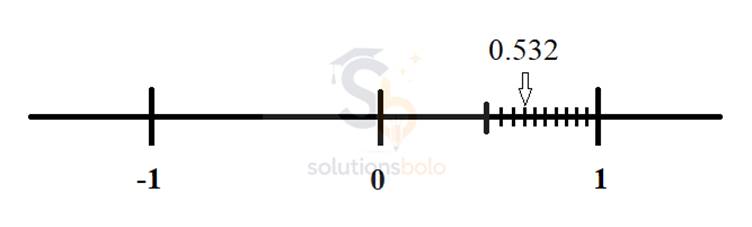
(i) 0.532
Solution:
The number 0.532 lies between 0 and 1.
More precisely,
0.532 lies between 0.53 and 0.54.
Divide the interval from 0.53 to 0.54 into 10 equal parts.
The second division after 0.53 represents 0.532.
Therefore, mark the point 0.532 on the number line.
(ii) 1.15̅ (overline on 5)
Solution:
The number
1.15̅ = 1.15555555…
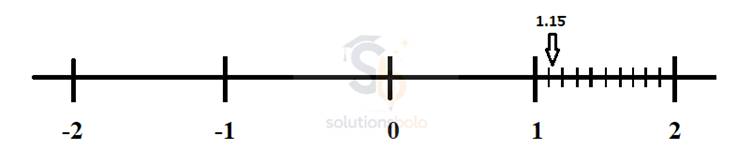
lies between 1 and 2.
More precisely,
1.15̅ lies between 1.15 and 1.16.
To locate it on the number line:
• First mark the interval from 1.1 to 1.2.
• Divide this interval into 10 equal parts to obtain 1.11, 1.12, …, 1.19.
• Now focus on the interval from 1.15 to 1.16.
• Since the digit 5 repeats indefinitely, the point lies just after 1.15, but before 1.16.
Therefore, mark the point 1.15̅ slightly to the right of 1.15 on the number line.
5. Find 6 rational numbers between 3 and 4.
Solution:
Given numbers are
3 and 4
Write them with denominator 10.
3 = 30/10
4 = 40/10
Now choose any six fractions between 30/10 and 40/10.
31/10, 32/10, 33/10, 34/10, 35/10, 36/10
Therefore, the required six rational numbers are
31/10, 32/10, 33/10, 34/10, 35/10, 36/10
6. Find 5 rational numbers between 2/5 and 3/5.
Solution:
Given fractions are
2/5 and 3/5
Multiply both the numerator and denominator of each fraction by 6.
2/5 = 12/30
3/5 = 18/30
Now choose any five fractions between 12/30 and 18/30.
13/30, 14/30, 15/30, 16/30, 17/30
Therefore, the required five rational numbers are
13/30, 14/30, 15/30, 16/30, 17/30
7. Find 5 rational numbers between 1/6 and 2/5.
Solution:
Given fractions are
1/6 and 2/5
The LCM of 6 and 5 is 30.
So,
1/6 = 5/30
2/5 = 12/30
There are only six integers (6 to 11) between 5 and 12. To make the selection easier, multiply both fractions by 2.
1/6 = 10/60
2/5 = 24/60
Now choose any five fractions between 10/60 and 24/60.
11/60, 12/60, 13/60, 14/60, 15/60
Therefore, the required five rational numbers are
11/60, 12/60, 13/60, 14/60, 15/60
8. If x/3 + x/5 = 16/15, find the rational number x.
[Concept: When solving a linear equation involving fractions, first take the LCM of the denominators to remove the fractions. Then simplify the equation and solve for the unknown variable.
How to Solve: Take the LCM of the denominators, multiply both sides of the equation by the LCM, combine like terms, and solve for x.]
Solution:
Given,
x/3 + x/5 = 16/15
The LCM of 3, 5 and 15 is 15.
Multiply both sides of the equation by 15.
15 × (x/3) + 15 × (x/5) = 15 × (16/15)
5x + 3x = 16
8x = 16
Divide both sides by 8.
x = 16/8
x = 2
Therefore,
The required rational number is x = 2.
9. Let a and b be two non-zero rational numbers such that a + 1/b = 0. Without assigning any numerical values, determine whether ab is positive or negative. Justify your answer.
[Concept: Use the given equation to express one variable in terms of the other. Then simplify the expression for the product and determine its sign without substituting any numerical values.
How to Solve: Rearrange the given equation to isolate one variable. Multiply both sides by the other variable, simplify the product, and determine whether it is positive or negative.]
Solution:
Given,
a + 1/b = 0
Subtract 1/b from both sides.
a = -1/b
Multiply both sides by b.
ab = (-1/b) × b
Since b ≠ 0,
ab = -1
Since -1 is a negative rational number,
ab is negative.
Therefore, the product ab is always negative.
10. A rational number has a terminating decimal expansion whose last non-zero digit occurs in the 4th decimal place. Show that such a number can be written in the form p/10⁴, where p is an integer not divisible by 10. Is it necessary that the denominator of this rational number, when written in the lowest form, is divisible by 2⁴ or 5⁴? Give reasons.
[Concept: A terminating decimal with its last non-zero digit in the 4th decimal place can always be expressed with denominator 10⁴. After reducing the fraction to its lowest form, the denominator need not contain 2⁴ or 5⁴ because common factors may cancel.
How to Solve: Express the decimal as a fraction with denominator 10⁴. Reduce the fraction to its lowest form by dividing the numerator and denominator by their common factors. Then examine whether the denominator must still be divisible by 2⁴ or 5⁴.]
Solution:
Suppose the rational number is
x = a.bcde
where e is the last non-zero digit in the 4th decimal place.
It can be written as
x = p/10⁴
where p is an integer not divisible by 10 (otherwise the decimal would end before the 4th decimal place).
Since
10⁴ = 2⁴ × 5⁴,
the given number is of the form
p/10⁴.
Now write the fraction in its lowest form by cancelling common factors.
The denominator need not remain divisible by 2⁴ or 5⁴ because some factors of 2 and/or 5 may be cancelled with the numerator.
For example,
3750/10000 = 3/8
Here,
10000 = 2⁴ × 5⁴,
but after simplification,
8 = 2³,
which is not divisible by 5⁴.
Similarly,
6250/10000 = 5/8
Again, the denominator is 8, not 10000.
Therefore, it is not necessary that the denominator in the lowest form is divisible by 2⁴ or 5⁴.
11. Without performing division, determine whether the decimal expansion of 18/125 is terminating or non-terminating. If it terminates, state the number of decimal places.
[Concept: A rational number in its lowest form has a terminating decimal expansion if the denominator has no prime factors other than 2 and/or 5. The number of decimal places equals the highest power of 2 or 5 in the denominator after making their powers equal.
How to Solve: Write the fraction in its lowest form. Factorise the denominator into prime factors. If the denominator contains only 2 and/or 5, the decimal expansion is terminating. Then determine the number of decimal places.]
Solution:
Given,
18/125
The fraction is already in its lowest form because 18 and 125 have no common factor other than 1.
Now factorise the denominator.
125 = 5³
The denominator contains only the prime factor 5.
Therefore, the decimal expansion of 18/125 is terminating.
To determine the number of decimal places, write the denominator as a power of 10.
18/125 = (18 × 8)/(125 × 8)
= 144/1000
= 0.144
Since
1000 = 10³,
the decimal expansion has 3 decimal places.
Therefore, 18/125 has a terminating decimal expansion with 3 decimal places.
12. A rational number in its lowest form has denominator 2³ × 5. How many decimal places will its decimal expansion have? Explain your answer.
[Concept: A rational number has a terminating decimal expansion if, in its lowest form, the denominator contains only the prime factors 2 and/or 5. The number of decimal places is equal to the greater power of 2 or 5 after expressing the denominator as a power of 10.
How to Solve: Factorise the denominator into prime factors. If necessary, multiply the numerator and denominator by a suitable number so that the denominator becomes a power of 10. Then determine the number of decimal places.]
Solution:
Given denominator is
2³ × 5
= 8 × 5
= 40
The denominator contains only the prime factors 2 and 5.
Therefore, the decimal expansion is terminating.
To determine the number of decimal places, make the denominator a power of 10.
40 = 2³ × 5
Multiply the numerator and denominator by 5² = 25.
Then,
40 × 25 = 1000 = 10³
Thus, the denominator becomes 10³.
Hence, the decimal expansion will have 3 decimal places.
Therefore, the rational number has a terminating decimal expansion with 3 decimal places.
13. Let a = 7/12 and b = 5/6. Express both a and b in the form k₁/m and k₂/m where k₁, k₂ and m are integers and k₂ − k₁ > 6. Using the same denominator m, write exactly five distinct rational numbers lying between a and b keeping an integer numerator. Explain why the condition k₂ − k₁ > n + 1 is necessary to find n numbers between two rational numbers a and b using this method.
[Concept: To find rational numbers between two fractions, first express them with the same denominator. If the difference between the numerators is not large enough, multiply both fractions by the same integer to obtain a larger common denominator. This creates enough integers between the numerators.
How to Solve: Write both fractions with a common denominator such that the difference between the numerators is greater than 6. Then choose exactly five numerators between them. Finally, explain why the condition k₂ − k₁ > n + 1 is required.]
Solution:
Given,
a = 7/12
b = 5/6
First, write both fractions with the same denominator.
5/6 = 10/12
Here,
k₂ − k₁ = 10 − 7 = 3,
which is not greater than 6.
Therefore, multiply both fractions by 3.
a = (7 × 3)/(12 × 3) = 21/36
b = (10 × 3)/(12 × 3) = 30/36
Now,
k₁ = 21,
k₂ = 30,
m = 36
and
k₂ − k₁ = 30 − 21 = 9 > 6.
Hence, the required condition is satisfied.
Five rational numbers between 21/36 and 30/36 are
22/36, 23/36, 24/36, 25/36, 26/36.
Therefore, the required five rational numbers are
22/36, 23/36, 24/36, 25/36 and 26/36.
Explanation:
Suppose we want to find n rational numbers between
k₁/m and k₂/m.
To place n numbers between them, there must be at least n integers available between k₁ and k₂.
This is possible only when
k₂ − k₁ > n + 1
Otherwise, there will not be enough integer numerators to obtain n distinct rational numbers between the given fractions.
Hence, the condition
k₂ − k₁ > n + 1 is necessary.
14. Three rational numbers x, y, z satisfy x + y + z = 0 and xy + yz + zx = 0. Show that all the rational numbers x, y, z must be simultaneously zero.
[Concept: Use the given equations to form an algebraic identity. By simplifying the identity, show that the sum of the squares of the three rational numbers is zero. Since the square of a rational number is always non-negative, this is possible only when each number is zero.
How to Solve: Square the first equation and substitute the value of xy + yz + zx from the second equation. Simplify the expression and use the property that a sum of squares can be zero only if each square is zero.]
Solution:
Given,
x + y + z = 0 ………. (i)
xy + yz + zx = 0 ………. (ii)
Square Equation (i).
(x + y + z)² = 0
Using the identity,
(x + y + z)² = x² + y² + z² + 2(xy + yz + zx)
Substitute the value of
xy + yz + zx = 0
x² + y² + z² + 2(0) = 0
x² + y² + z² = 0
The square of every rational number is non-negative.
Therefore, the sum of three squares can be zero only when
x² = 0,
y² = 0,
z² = 0.
Hence,
x = 0,
y = 0,
z = 0.
Therefore, all the rational numbers x, y and z are simultaneously zero.
15. Show that the rational number (a + b)/2 lies between the rational numbers a and b.
Concept: The average (mean) of two rational numbers always lies between them. This can be shown by comparing the average with each of the given numbers.
How to Solve: Assume, without loss of generality, that a < b. Then compare (a + b)/2 with a and b separately to show that it lies between them.
Solution:
Assume that
a < b
Subtract a from both sides.
b − a > 0
Divide both sides by 2.
(b − a)/2 > 0
Now,
(a + b)/2 − a
= (a + b − 2a)/2
= (b − a)/2
Since
(b − a)/2 > 0,
we get, (a + b)/2 > a
Now compare (a + b)/2 with b.
b − (a + b)/2
= (2b − a − b)/2
= (b − a)/2
Again,
(b − a)/2 > 0,
therefore,
(a + b)/2 < b
Hence,
a < (a + b)/2 < b
Therefore, (a + b)/2 lies between the rational numbers a and b.
16. Find the lengths of the hypotenuses of all the right triangles in Fig. 3.14 which is referred to as the square root spiral.
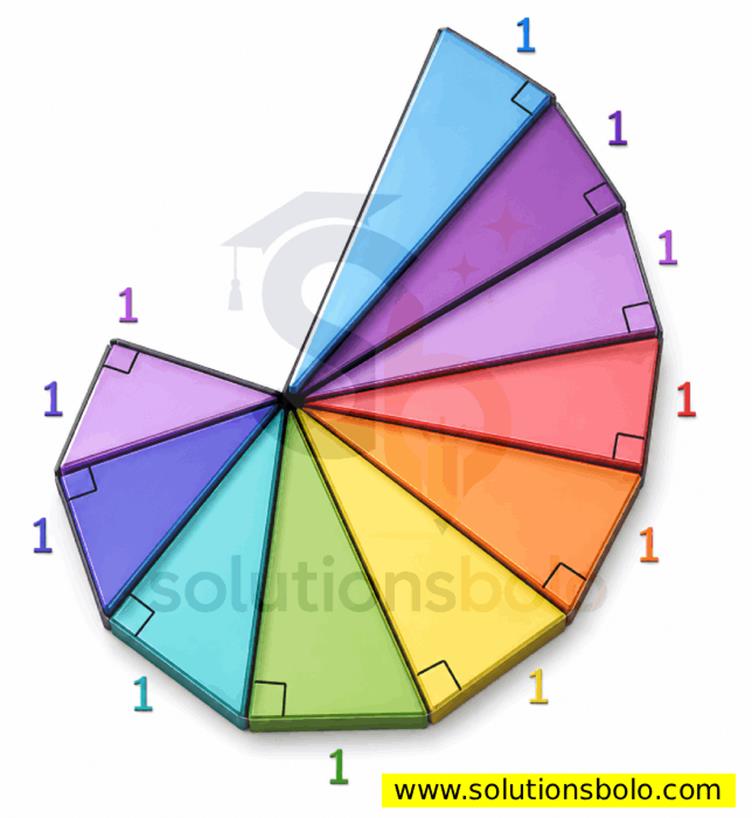
[Concept: The Square Root Spiral is formed by joining a right triangle to the previous one. Each new triangle has one leg of length 1 unit and the other leg equal to the hypotenuse of the previous triangle. The length of each new hypotenuse is found using the Pythagoras Theorem.
How to Solve: Start with the first right triangle. Apply the Pythagoras Theorem repeatedly to each new triangle, using the previous hypotenuse and the side of length 1 unit.]
Solution:
First triangle
Sides = 1 and 1
Hypotenuse² = 1² + 1²
= 2
Hypotenuse = √2
Second triangle
Sides = √2 and 1
Hypotenuse² = (√2)² + 1²
= 2 + 1
= 3
Hypotenuse = √3
Third triangle
Sides = √3 and 1
Hypotenuse² = (√3)² + 1²
= 3 + 1
= 4
Hypotenuse = √4 = 2
Fourth triangle
Sides = 2 and 1
Hypotenuse² = 2² + 1²
= 4 + 1
= 5
Hypotenuse = √5
Fifth triangle
Sides = √5 and 1
Hypotenuse² = 5 + 1
= 6
Hypotenuse = √6
Sixth triangle
Sides = √6 and 1
Hypotenuse² = 6 + 1
= 7
Hypotenuse = √7
Seventh triangle
Sides = √7 and 1
Hypotenuse² = 7 + 1
= 8
Hypotenuse = √8 = 2√2
Eighth triangle
Sides = √8 and 1
Hypotenuse² = 8 + 1
= 9
Hypotenuse = √9 = 3
Ninth triangle
Sides = 3 and 1
Hypotenuse² = 9 + 1
= 10
Hypotenuse = √10
Tenth triangle
Sides = √10 and 1
Hypotenuse² = 10 + 1
= 11
Hypotenuse = √11
Therefore, the lengths of the hypotenuses are:
√2, √3, 2, √5, √6, √7, 2√2, 3, √10 and √11.
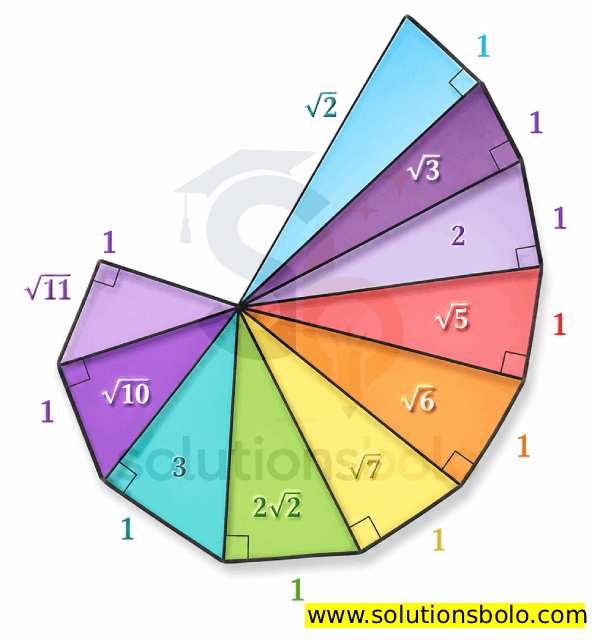
| Verification: Each hypotenuse is obtained by applying the Pythagoras Theorem: Hypotenuse² = (Previous hypotenuse)² + 1² Hence, all the calculated lengths are correct. |
Frequently Asked Questions (FAQs)
1. What are Rational Numbers and Irrational Numbers?
Answer: Rational numbers can be written in p/q form where q is not zero, having terminating or repeating decimals. Irrational numbers cannot be written as fractions and have non-terminating, non-repeating decimal expansions.
2. Is Zero a rational number or an irrational number?
Answer: Zero is a rational number because it can be written in the form p/q, such as 0/1, 0/2, or 0/-5, where the denominator q is not equal to zero.
3. How can we prove that square root of 2 is irrational?
Answer: We use Proof by Contradiction. We assume square root of 2 is rational p/q in simplest form. Solving gives p and q both even, contradicting that they share no common factors.
4. What are terminating and repeating decimals in rational numbers?
Answer: Terminating decimals stop after limited digits, like 0.35. Repeating decimals continue infinitely in a looping pattern, like 0.333…. Both forms represent rational numbers because they convert into p/q fractions.
5. How do we know if a fraction gives a terminating decimal without division?
Answer: A rational number p/q in lowest form has a terminating decimal if the prime factorization of its denominator q contains only 2s, only 5s, or a combination of both 2s and 5s.
6. Why is Pi an irrational number if 22/7 is rational?
Answer: Pi is an irrational number because its exact decimal expansion never terminates and never repeats. The fraction 22/7 is merely a convenient rational approximation used for practical calculations, not its exact value.
7. How many rational numbers exist between any two given rational numbers?
Answer: There are infinitely many rational numbers between any two rational numbers. This property is known as density. You can always find a new rational number by taking their average.
8. What is the contribution of Indian mathematicians to the World of Numbers?
Answer: Ancient Indian scholars introduced powers of 10. Philosophical Shunyata inspired mathematical zero. Brahmagupta formalized rules for zero and negative numbers (debts and fortunes). Madhava created the infinite series for Pi.
9. How to convert a repeating decimal like 0.666… into p/q form?
Answer: Let x = 0.666…. Multiply both sides by 10 to get 10x = 6.666…. Subtracting the first equation gives 9x = 6, which simplifies to x = 2/3.
10. What are Real Numbers and Imaginary Numbers?
Answer: Real numbers include all rational and irrational numbers combined, covering every point on the number line. Imaginary numbers handle square roots of negative numbers, which do not lie on the real line.