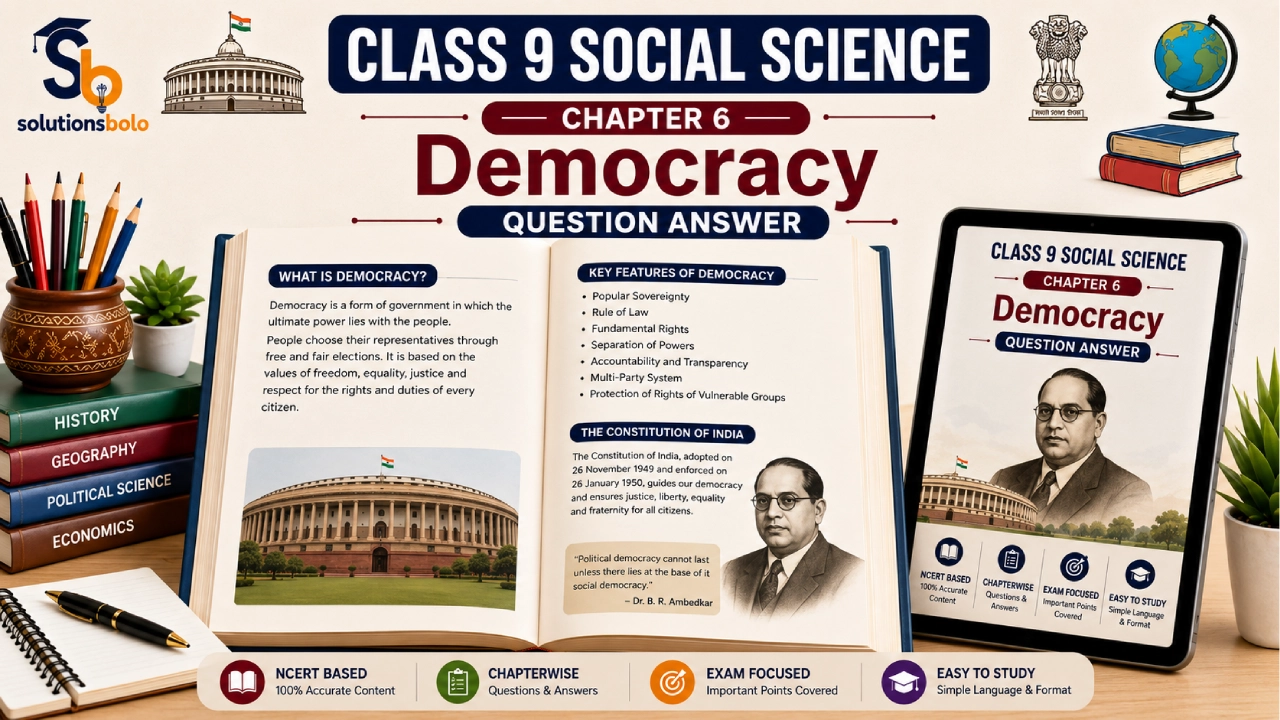
Class 9 Social Science Chapter 6 “Democracy” introduces students to the meaning, evolution and principles of democracy in India and around the world. The chapter explains the importance of the Constitution of India, Fundamental Rights, Rule of Law, Universal Adult Franchise and democratic institutions in ensuring accountable and participatory governance. It also highlights the role of citizen participation, local self-government, women and youth, transparency, accountability and constitutional values in strengthening democracy. These NCERT Solutions provide clear explanations, key terms, intext answers, important questions, MCQs, competency-based questions, case-based questions, long answers and FAQs to help students build conceptual understanding and prepare confidently according to the latest CBSE syllabus (2026–27).
Table of Contents (Quick Links):
1. Chapter Introduction
2. Key Terms and Definitions
3. Intext Question and Answer
4. Exercise Questions and Answers
5. Multiple Choice Questions (MCQs)
6. Case-Based Questions and Answers
7. Assertion Reason Questions
8. Common Mistakes Students Should Avoid & Exam Tips
9. Long Answer Questions
10. Frequently Asked Questions (FAQs)
Chapter Introduction
Chapter 6 – Democracy introduces the meaning, evolution and principles of democracy in India and around the world. It explains how the Constitution of India, Fundamental Rights and democratic institutions strengthen democratic governance. The chapter also highlights the importance of popular sovereignty, the Rule of Law, accountability, citizen participation, elections, local self-government and the role of women and youth. It shows that democracy is not limited to voting but is a way of ensuring justice, equality, freedom and responsible citizenship.
Key Terms and Definitions
Democracy
A form of government in which the ultimate source of power and authority lies with the people, who elect their representatives through free and fair elections.
Government
The system or group of elected representatives that makes policies, implements laws and governs the country on behalf of the people.
Indian democracy
The world’s largest participatory democracy, where citizens elect their representatives through free and fair elections under the Constitution of India.
Constitution of India
The supreme law of India, adopted on 26 November 1949 and enforced on 26 January 1950, which establishes democratic principles and protects the rights of citizens.
Fundamental Rights
Basic rights guaranteed by the Constitution that protect the freedom, equality, dignity and justice of every citizen and are enforceable by courts.
Active citizen participation
The involvement of citizens in democratic processes such as voting, expressing opinions and participating in decision-making at national, state and local levels.
Tracing Democratic Traditions
The study of the historical development of democratic ideas and practices in India from ancient times to the present.
Aikyamatya Sūktam
A hymn from the Ṛig Veda (10.191.3) that emphasises unity, collective thinking, consultation and shared decision-making.
Sabha
An assembly in the Vedic period where important public matters were discussed collectively
Samiti
A Vedic popular assembly that participated in consultation and collective decision-making
Vidhata
An early Vedic assembly associated with social, religious and political discussions involving collective participation
Democratic principles
The basic values of democracy, including freedom, equality, justice, rights and duties.
Bauddha Saṁghas
Monastic communities founded by Gautama Buddha that practised debate, voting and collective decision-making.
Constituent Assembly
The Constituent Assembly was formed in 1946 to draft the Constitution of India, which came into force on 26 January 1950.
Indigenous democratic traditions
India’s own ancient democratic ideas and practices that evolved over time.
Constituent Assembly’s Debates (CAD)
The discussions that shaped the Constitution of India.
Article 368
The constitutional provision that allows amendments to the Constitution.
Principles of Democracy
The essential values and rules that support a democratic system.
Sovereignty
The supreme authority of the people or the State.
Universal Adult Franchise
The right of every citizen aged 18 years and above to vote.
Articles 32
The Right to Constitutional Remedies for enforcing Fundamental Rights.
Articles 226
Empowers High Courts to protect Fundamental Rights through constitutional remedies.
Equality before the law
Every person is treated equally before the law.
Equal protection of the law
People in similar circumstances receive equal legal protection.
Procedures established by law
Legal procedures prescribed by the law of the State.
6 Fundamental Rights
The six Fundamental Rights guarantee Equality, Freedom, Protection against Exploitation, Freedom of Religion, Cultural and Educational Rights and Constitutional Remedies to every citizen.
Article 21A
Guarantees free and compulsory education for children aged 6–14 years.
Three organs of the government
The three organs of the government are the Legislature, Executive and Judiciary, which make, implement and interpret laws.
Public Interest Litigation
A Public Interest Litigation (PIL) is a legal action filed in a court to protect or promote the public interest.
State Legislative Assemblies
State Legislative Assemblies are elected bodies that make laws for their respective states according to the Constitution.
Parliament
Parliament is the highest law-making body of India, responsible for making laws and holding the government accountable.
Right to Information
The Right to Information (RTI) allows citizens to obtain information from government departments, promoting transparency and accountability.
Representation of the People Act
The Representation of the People Act, 1951, lays down the rules and regulations for elections and political parties in India.
Rights of Vulnerable Groups
These are constitutional protections that ensure equal opportunities, justice and welfare for weaker and disadvantaged sections of society.
Article 46
Article 46 directs the State to promote the educational and economic interests of weaker sections, especially SCs and STs.
Civil Society
Civil society includes voluntary groups, NGOs and community organisations that work independently for the welfare of society.
Legislative Process
The legislative process is the procedure through which laws are discussed, debated and passed by the Legislature.
Electoral Process
The electoral process is the system through which citizens vote to elect their representatives in free and fair elections.
Participatory Processes
Participatory processes allow citizens to engage in public discussions, express opinions and contribute to democratic decision-making.
Accountability Mechanisms
Accountability mechanisms are institutions and systems that ensure the government remains transparent and answerable to the people.
Decentralisation
Decentralisation is the transfer of powers and responsibilities from higher levels of government to local bodies for better governance.
Checks and Balances
Checks and balances ensure that no organ of the government becomes too powerful by limiting and supervising one another’s powers.
Separation of Powers
Separation of powers divides authority among the Legislature, Executive and Judiciary to prevent the concentration of power.
Rule of Law
The rule of law means everyone is equal before the law and no person is above the law.
Accountability and Transparency
Accountability and transparency ensure that the government works responsibly, remains answerable to the people and openly shares public information.
Question Hour
Question Hour is the first hour of a parliamentary sitting, during which Members of Parliament ask questions to hold the government accountable.
Multi-Party System
A multi-party system is a political system in which several political parties compete in elections to form the government.
Types of Democracy
The main types of democracy are Direct Democracy, Representative Democracy and Presidential Democracy, based on how people participate in governance.
Federalism
Federalism is a system of government in which powers are divided between the Union Government and the State Governments.
Representative Democracy
Representative democracy is a system in which citizens elect representatives to make laws and govern on their behalf.
Direct Democracy
Direct democracy is a system in which citizens directly participate in making important public decisions.
Presidential Democracy
Presidential democracy is a system in which the President is the head of the executive and is elected separately from the legislature.
Two parties of the USA
The two major political parties of the United States are the Democratic Party and the Republican Party.
Panchayati Raj
Panchayati Raj is a system of local self-government that enables people to participate in rural governance and development.
Autonomous District Councils
Autonomous District Councils are local self-governing bodies created to protect the rights and interests of tribal communities in certain areas.
Panchayats Extension to Scheduled Areas
The PESA Act extends the Panchayati Raj system to Scheduled Areas, giving tribal communities greater control over local governance.
Quorum
Quorum is the minimum number of members required to be present for a meeting or assembly to conduct its business legally.
Mahila Sabhas
Mahila Sabhas are meetings where women discuss local issues and suggest solutions before the Gram Sabha meeting.
Gram Sabhas
Gram Sabhas are assemblies of all registered voters in a village who participate in local decision-making and development.
Women-Friendly Panchayat
A women-friendly Panchayat promotes women’s participation, leadership, safety and equal opportunities in local governance.
Cooperatives
Cooperatives are voluntary associations where people work together to achieve common economic and social goals and benefits.
Article 243(t)
Article 243T provides reservation of seats for Scheduled Castes, Scheduled Tribes and women in Municipalities.
Reservation
Reservation provides seats or opportunities to Scheduled Castes (SCs), Scheduled Tribes (STs), Other Backward Classes (OBCs) and women to ensure equal representation and social justice.
Legislation
Legislation is the process of making, amending or repealing laws through the Legislature.
Chaudhary Charan Singh
Chaudhary Charan Singh was a former Prime Minister of India who supported farmers’ rights and democratic values.
Babu Jagjivan Ram
Babu Jagjivan Ram was a national leader who worked for social justice, equality and democratic principles.
Emergency
The Emergency (1975–1977) was a period when several democratic rights and civil liberties were restricted in India.
National Emergency
A National Emergency is a constitutional provision under which special powers are granted to the Union Government during a national crisis.
Jayaprakash Narayan
Jayaprakash Narayan was a prominent leader who led the movement to restore democracy during the Emergency.
Civic responsibility
Civic responsibility means performing one’s duties as a responsible citizen by respecting laws and participating in democracy.
National Service Scheme
The National Service Scheme (NSS) encourages students to serve society and develop civic responsibility through community service.
National Cadet Corps
The National Cadet Corps (NCC) develops discipline, leadership and a sense of service to the nation among students.
Digital participates in a democracy
Digital participation means using online platforms to access information, express opinions.
Non-digital participate in a democracy
Non-digital participation includes voting, attending public meetings, community service.
Fundamental duties
Fundamental Duties are the 11 moral responsibilities of every citizen to respect the Constitution, promote harmony, protect the nation and preserve its heritage and environment.
(Note: Democracy is founded on the principles of freedom, equality, justice, rights and duties, ensuring that citizens have the right to vote, express their opinions and participate in the decision-making processes.)
Intext Questions and Answers:
1. How has the idea of democracy evolved over time and shaped our understanding of it today?
Answer:
Democracy evolved from ancient collective assemblies like the Vedic Sabha into modern constitutional systems. Freedom movements expanded this from simple voting into a framework safeguarding universal rights and equality.
Explanation:
Historically, democracy began with collective decision-making in Vedic assemblies (Sabha, Samiti) and Buddhist Samghas, which emphasized consensus. Although colonial rule later disrupted these structures, the independence struggle revived them, leading to the world’s longest written Constitution. Today, this evolution has transformed democracy from a basic electoral system into a comprehensive framework of popular sovereignty, universal adult franchise, fundamental rights, rule of law and active grassroots participation.
2. What are the different forms of democracy and how are they practised in India and other parts of the world?
Answer:
Democracy has two main forms: Direct (citizens vote on policies, e.g., Switzerland) and Representative (citizens elect leaders). Representative democracy includes Parliamentary systems (India, Canada) and Presidential systems (USA).
Explanation:
Democracy exists as Direct Democracy, where citizens directly vote on major decisions like in Switzerland and Representative Democracy, where people elect leaders to govern. Representative systems are split into Parliamentary Democracy (practised in India, Canada), where the executive is accountable to the legislature and Presidential Democracy (practised in the USA), where the President acts independently of the legislature. India also unique practices grassroots democracy via local Panchayats.
3. What are the essential features of a democracy and how do they extend beyond government institutions?
Answer:
Essential features include popular sovereignty, rule of law and fundamental rights. These extend beyond government into civil society, media, cooperatives and schools through everyday democratic decision-making and equality.
Explanation:
The core features are popular sovereignty, the rule of law, fundamental rights, separation of powers, accountability and a multi-party system. Beyond formal state institutions like the Parliament or Judiciary, these principles extend into daily social life. Voluntary groups, civil society organizations, trade unions, media and cooperatives actively use democratic decision-making. Even grassroots local bodies and school cabinets promote values of representation, consensus and equal participation in everyday community activities.
4. What are the challenges faced by Indian democracy?
Answer:
Indian democracy faces modern socio-economic challenges including illiteracy, poverty, social discrimination, gender inequality and regionalism. Additionally, the rapid spread of digital misinformation and fake news threatens public trust.
Explanation:
While India successfully conducts massive inclusive elections, it faces significant challenges like poverty, illiteracy, regionalism and gender inequality, which create barriers to equal citizen participation. A major modern concern is the spread of fake news and digital misinformation on social media, which manipulates public opinion and creates social conflict. Historical strains include the 1975-77 Emergency when civil liberties were suspended, alongside ongoing implementation gaps that reduce public trust in democratic institutions
LET’S EXPLORE (page – 141)
5. The Constitution not only guarantees Fundamental Rights to citizens but also outlines their Fundamental Duties and the Directive Principles of State Policy. Discuss their significance and identify the differences among them.
Answer:
Fundamental Rights protect individual liberties and are legally enforceable. Directive Principles guide the government in creating welfare policies, while Fundamental Duties outline citizens’ moral and civic responsibilities toward the nation.
Explanation:
Significance: Together, these components safeguard individual dignity, guide state governance and foster civic responsibility for robust nation-building. Differences:
Fundamental Rights (Articles 14–32): Inalienable individual freedoms (like Equality and Freedom) that are directly enforceable in courts if violated.
Directive Principles: Constitutional guidelines for the State to promote economic and social justice, such as protecting weaker sections (Article 46).
Fundamental Duties: Moral obligations expecting citizens to behave responsibly and respect democratic values.
6. The Right to Education (Article 21A) was added in 2009, ensuring free and compulsory education for children aged 6 to 14. Discuss its significance.
Answer:
Article 21A is deeply significant as it establishes education as a justiciable right, directly boosting India’s literacy rate. Backed by initiatives like Shiksha Abhiyan, it systematically dismantles illiteracy, empowering children from marginalized backgrounds to participate actively and equally in our democratic framework.
Explanation:
Boosting Literacy through Shiksha Abhiyan: Article 21A plays a critical role in increasing India’s national literacy rate by legally mandating free education. Flagship programs like Shiksha Abhiyan serve as the operational vehicle to implement this right, bringing millions of out-of-school children into classrooms.
Empowering Democratic Citizenship: Eliminating illiteracy is essential for a healthy democracy. This constitutional guarantee provides children aged 6 to 14 with quality learning and authentic information, allowing them to overcome social prejudices, form independent political opinions and confidently exercise their civil liberties.
LET’S EXPLORE (page – 145)
7. The first column of the table below lists some key features of democracy in India. Fill in the second column with suitable examples from your state, town or village. One row has been completed for you.
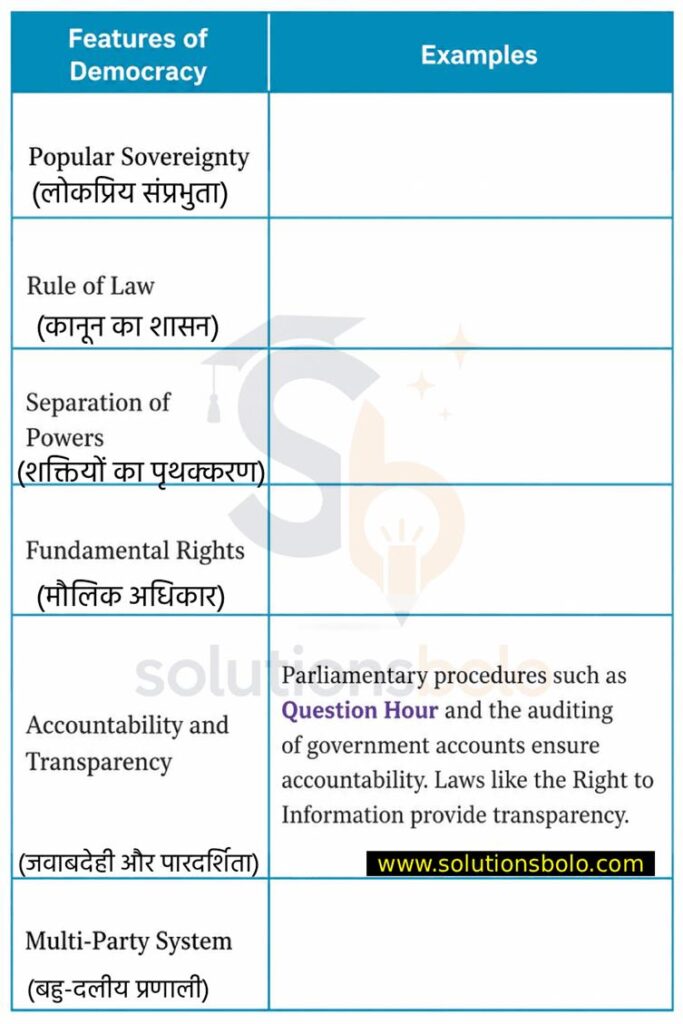
Answer:
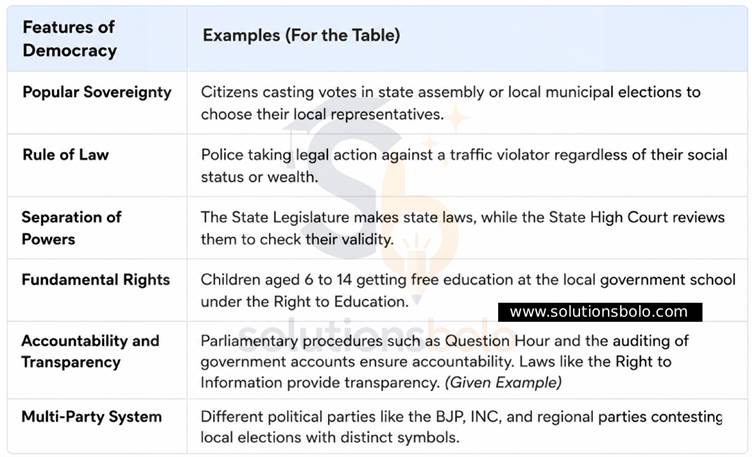
| Understand the Concept: |
Popular Sovereignty: Popular sovereignty establishes that the ultimate source of political power lies entirely with the people. In our daily lives, this principle is actively practised when every adult citizen who is 18 years of age or older exercises their Universal Adult Franchise.
Example: By casting a vote through a secret ballot during local municipal or state elections.
Rule of Law: The rule of law ensures complete equality before the law and equal protection for all individuals, establishing that no citizen is above the legal system.
Example: Legal disputes are settled fairly in local courts using due process rather than force powerful people.
Separation of Powers: This principle divides authority among the legislature, executive and judiciary to prevent a concentration of power.
For example, at the state level, the Legislative Assembly frames the laws, the executive body implements those policies and the High Court acts as an independent guardian.
Fundamental Rights: The Constitution guarantees six fundamental rights to safeguard citizen freedom and dignity.
Example is the Right to Education (Article 21A), ensuring free and compulsory education for children aged 6 to 14 in local government schools.
Multi-Party System: India hosts thousands of registered political parties operating under the Representation of the People Act, 1951, reflecting its immense socio-cultural diversity.
Example: In local elections, this system gives voters multiple choices.
LET’S EXPLORE (page – 149)
8. Work in pairs or small groups. Choose any two of India’s neighbouring countries (Afghanistan, Bangladesh, Bhutan, China, Maldives, Myanmar, Nepal, Pakistan or Sri Lanka) and find out the following:
a. Does the country hold regular elections?
Answer: (China, Pakistan)
Yes, China holds regular elections every five years, but they are limited to local bodies controlled by one party.
Yes, Pakistan holds regular periodic elections at national and provincial levels based on a multi-party political framework.
b. Who chooses the Head of the Government?
Answer: The top leadership of the single ruling Communist Party pre-selects and chooses the Head of the Government in China.
The citizens elect members of parliament, who then choose the Head of Government (Prime Minister) via voting in Pakistan.
c. Is there more than one political party?
Answer: No, China does not have a multi-party system; it is ruled entirely by a single political party.
Yes, Pakistan features an active multi-party system where several major national and regional parties contest for power.
d. How much freedom do citizens have to express their opinions and criticise the government?
Answer: Citizens of China have very limited freedom; the state heavily censors media and digital platforms and individuals face severe penalties or arrest for openly criticizing the government.
Citizens of Pakistan have also limited freedom. Freedom exists on paper, but in practice, media censorship and heavy pressure from powerful non-political state institutions make it difficult to critique the government or military openly.
e. How would you describe this system? Give reasons for your answer.
Democratic or Partially democratic or Non-democratic
Answer:
1. India (Democratic System)
India is a democratic country because the people are the ultimate source of power. Citizens elect their representatives through regular, free, fair and multi-party elections based on Universal Adult Franchise.
Reason:
Elections and Government: India conducts regular and competitive elections under the supervision of an independent Election Commission of India (ECI). Every citizen aged 18 years and above has the right to vote and elect representatives who form the government.
Fundamental Rights and Freedom: The Constitution of India guarantees Fundamental Rights, including freedom of speech and expression, peaceful assembly and constitutional remedies. An independent judiciary protects these rights and upholds the Rule of Law.
2. Pakistan (Partially Democratic System)
Pakistan has a multi-party electoral system where citizens vote to elect their representatives. However, democratic institutions have often been influenced by non-elected institutions, which affects the smooth functioning of democracy.
Reason:
Elections and Government: Pakistan conducts regular elections under a multi-party system and elected representatives form the government. However, the country’s democratic process has experienced periods of military influence and political instability.
Freedom and Classification: Citizens enjoy certain democratic rights, but restrictions on freedom of expression and the media have been reported at different times. These challenges affect democratic accountability and participation.
3. China (Non-Democratic System)
China has a single-party political system led by the Communist Party of China. Although elections are held at different levels, citizens do not choose the country’s top national leaders through a competitive multi-party election.
Reason:
Elections & Government: China holds regular elections for certain representative bodies, but the country does not have a competitive multi-party electoral system. The national leadership is selected through the Communist Party-led political process rather than through direct public elections.
Freedom & Classification: Citizens face significant restrictions on freedom of expression, political opposition and the media. These limitations reduce public participation and accountability in governance.
LET’S EXPLORE (page – 152)
9. A democratic system seeks to promote participation, ensure fairness, limit the concentration of power and resolve disagreements peacefully. Identify examples from the above case study that reflect these features.
Answer:
Jethipura Gram Panchayat promotes inclusion through Mahila Sabhas and marginalized group participation. South Manubankul empowers women in local decisions, distributing welfare resources equitably to ensure grassroots democratic fairness.
Explanation:
Promoting Participation & Fairness: Jethipura Gram Panchayat ensures adequate quorum in Gram Sabhas by actively including women, Scheduled Castes and Scheduled Tribes. It also organizes specialized Mahila Sabhas to address local issues cleanly.
Limiting Power Concentration & Resolving Disagreements: South Manubankul Gram Panchayat acts as a responsive local government by supporting self-help groups and involving women in decentralized decision-making. Grassroots community programs ensure resources are distributed equitably, resolving societal gaps peacefully.
LET’S EXPLORE (page – 153)
10. India continues to work towards more inclusive institutions. Discuss in class about the advantages of increased representation of women in the legislature.
Answer:
Increased representation ensures that gender-sensitive policies on healthcare, safety and education are prioritized. It dismantles historical social prejudices, making political institutions truly democratic, diverse and inclusive.
Explanation:
Inclusive Policy Formulation: Having more women in legislatures ensures that laws directly address critical grassroots issues such as health, sanitation, safety and compulsory education.
Overcoming Social Prejudices: While constitutional provisions like Article 243(d) guarantee 33% to 50% reservation for women in local panchayats, extending this to higher legislatures breaks down deep-rooted social prejudices. This ensures active, equal political participation and bridges the gap between citizens and state governance.
11. Explore and discuss the contributions of eminent Indian leaders who worked towards strengthening grassroots democracy.
Answer:
Eminent leaders like Dr. B.R. Ambedkar framed the Constitution and ensured equality and Fundamental Rights. Mahatma Gandhi promoted Gram Swaraj and village self-government. Balwant Rai Mehta recommended the three-tier Panchayati Raj system, in favor of Indian democracy.
Explanation:
1. Dr. B.R. Ambedkar (1891–1956)
Dr. B.R. Ambedkar was the Chairman of the Drafting Committee of the Constituent Assembly. He played a key role in framing the Constitution of India, which guarantees Fundamental Rights, equality, justice and democratic governance. His vision laid the foundation for inclusive and participatory democracy.
2. Mahatma Gandhi (1869–1948)
Mahatma Gandhi believed that India’s true democracy begins in villages. He advocated Gram Swaraj, where villages become self-governing units. He encouraged people’s participation, decentralisation, self-reliance and local decision-making, which inspired the development of Panchayati Raj Institutions.
3. Balwant Rai Mehta (1900–1965)
Balwant Rai Mehta is known as the Architect of Panchayati Raj in India. The Balwant Rai Mehta Committee (1957) recommended a three-tier Panchayati Raj system—Gram Panchayat, Panchayat Samiti and Zila Parishad—to strengthen local self-government and increase people’s participation in democracy.
Conclusion
The contributions of Dr. B.R. Ambedkar, Mahatma Gandhi and Balwant Rai Mehta strengthened grassroots democracy by promoting constitutional values, local self-government, decentralisation and active citizen participation.
LET’S EXPLORE (page – 155)
12. In small groups, identify two or three examples of information shared on social media that you believe may be misleading or false. Discuss what made you question their reliability and how such information can influence people’s opinions. Reflect on why access to accurate and authentic information is important in a democracy.
Answer:
Misleading online posts include doctored political videos, fake welfare schemes and altered election schedules. These lack verified official sources, creating public confusion and manipulating voter choices. Access to authentic information is essential for citizens to build true opinions and maintain democratic trust.
Explanation:
Examples of Misinformation: Common online examples include digitally altered videos of political leaders, fake announcements regarding government schemes and doctored schedules for local or national elections.
Reliability & Influence: These posts lack verification from credible news platforms or official government press releases. Such misinformation creates public confusion, manipulates voter perceptions and can fuel social conflicts.
Importance in Democracy: Access to authentic information is a vital civic responsibility. It empowers citizens to form informed opinions, hold representatives accountable and confidently participate in democratic processes.
LET’S EXPLORE (page – 156)
13. Observe Fig. 6.9 and explore the various other digital and non-digital ways through which you can participate in a democracy.
Take Leadership in School & Community, Follow Fundamental Duties, Understand the Constitution
Participate in Nation-Building Activities (NCC, NSS, Bharat Scouts & Guides), Be Media Literate
(Youth and Democracy)
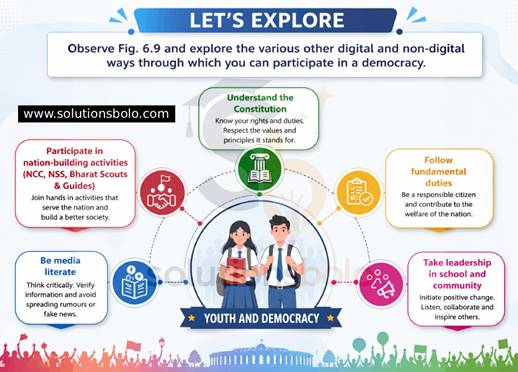
THINK, DISCUSS, ACT
Think: How do your actions as a student contribute to your school community and to democracy in a larger context?
Answer:
By understanding the Constitution and following fundamental duties daily, students maintain institutional order. In a larger context, being media literate prevents spreading rumors, making them responsible pillars of a stable democracy.
Explanation:
School Community Contribution: Students contribute by practicing leadership in school committees and strictly following campus fundamental duties, which builds a disciplined and cooperative learning environment.
Larger Democratic Context: In the wider nation, a student’s commitment to “Understand the Constitution” ensures they respect rule of law. Furthermore, active daily practice of being “media literate” stops the spread of false rumors, while participating in groups like NCC/NSS channels youth energy directly into nation-building, creating robust, informed citizens.
Discuss: Talk to your classmates about a social or community issue that you care about. How can you, as a student, make a difference?
Answer:
Students can discuss civic issues like digital misinformation or community hygiene. They make a difference by using leadership to organize awareness drives and applying digital participation to verify local information.
Explanation:
Identifying the Issue: Classmates can discuss the lack of community awareness regarding fundamental duties or the challenge of citizens falling prey to unverified online news.
Making a Difference: Students can directly “take leadership in school and community” by forming civic clubs. By actively applying “media literate” skills, they can teach others how to verify online updates and collaborate on small environmental drives, translating theoretical constitutional values into practical grassroots solutions.
Act: Choose one activity to fulfil your civic responsibility this month. Reflect on how your actions contribute to strengthening democracy and community spirit.
Answer:
Joining a nation-building activity like an NSS cleanliness drive fulfills this responsibility. This act practices fundamental duties, building mutual trust and a collaborative community spirit essential for healthy democracy.
Explanation:
Chosen Civic Activity: Choosing to “participate in nation-building activities” by volunteering for a weekend community cleanup drive or an educational campaign through the Bharat Scouts & Guides.
Reflection on Impact: This direct action allows students to practically “follow fundamental duties” regarding community welfare. Working collectively with diverse groups establishes a strong community spirit, teaching young citizens that individual constitutional awareness and shared public participation are the exact tools required to sustain grassroots democracy.
(page – 158)
Exercise Questions and Answers:
1. Read the passage and answer the questions that follow:
A school cabinet was responsible for planning a Republic Day celebration and members had different opinions on which activities to include. After a discussion, they decided to vote and the activities supported by the majority were selected.
a. Which democratic values are reflected in this situation?
Answer:
Freedom of Expression: Every member gets an opportunity to express his or her opinion freely.
Equality: Every vote has equal value and all members are treated equally.
Citizen Participation: Members actively participate in the decision-making process.
Majority Decision: The activity supported by the majority is accepted by everyone.
b. How does voting help resolve differences of opinion?
Answer:
Voting helps resolve differences of opinion by giving every member an equal vote. When people have different views, the option supported by the majority is accepted, ensuring fair, peaceful and democratic decision-making.
c. Why is the majority decision important in a democracy?
Answer:
A majority decision is important because it reflects the choice of most people. It helps in making decisions fairly and peacefully, while respecting democratic values. At the same time, the rights and opinions of minorities must also be respected.
d. Mention responsibilities of elected representatives after a decision is made.
Answer:
After a decision is made, elected representatives should respect the majority decision, implement it honestly, work together for its successful execution and remain accountable to the people they represent. They should also ensure that the views of the minority are respected while working for the common good.
2. How would democracy be affected if citizens stopped following laws and civic responsibilities? Explain with an example.
Answer:
If citizens stop following laws and civic responsibilities, democracy becomes weak because the Rule of Law, accountability and public trust are affected. Democracy can function effectively only when both the government and citizens fulfil their responsibilities.
Impact on Democracy: Responsible citizens strengthen democracy by obeying laws, respecting the Constitution, performing their Fundamental Duties and protecting public property. If these responsibilities are ignored, democratic institutions become less effective and the Rule of Law is weakened.
Example: If people damage public property during protests, public resources are diverted for repairs instead of development and welfare activities. This weakens democratic governance and affects public welfare.
3. Which situation best reflects the idea of popular sovereignty and why?
a. A law is passed without public discussion
b. Citizens vote to choose their representatives
c. A court gives a final judgment
d. A minister takes an independent decision
Answer: (b) Citizens vote to choose their representatives.
Explanation:
Popular sovereignty means that the ultimate power lies with the people. By voting in free and fair elections, citizens choose their representatives and participate in governing the country, making this the best example of popular sovereignty.
4. The Rule of Law is violated when:
a. Laws are applied equally to all
b. Courts review government actions
c. Powerful individuals are treated above the law
d. Citizens challenge laws through legal means
Answer: (c) Powerful individuals are treated above the law.
Explanation:
The Rule of Law means that everyone is equal before the law and no one is above the law, regardless of their position, wealth or power. Therefore, treating powerful individuals differently violates this democratic principle.
5. Why is the Rule of Law essential for protecting democracy?
Answer:
The Rule of Law is essential for protecting democracy because it ensures that everyone is equal before the law and no person is above the law. It safeguards Fundamental Rights, prevents the misuse of power and ensures that the government acts according to the Constitution. This promotes justice, equality and accountability in a democratic society.
6. Is voting alone enough to make a country democratic? Support your answer with examples from the chapter.
Answer:
No, voting alone is not enough to make a country democratic. Democracy also requires the Rule of Law, Fundamental Rights, accountability, transparency, active citizen participation and respect for the Constitution. Citizens strengthen democracy by participating in Gram Sabha meetings, using the Right to Information (RTI), approaching the courts through Public Interest Litigation (PIL) when required and performing their Fundamental Duties. These democratic practices ensure that the government remains accountable and works for the welfare of the people.
7. Social media allows people to express opinions freely.
a. How can this strengthen democracy?
Answer:
Social media strengthens democracy by giving citizens a platform to express their views, share information and participate in public discussions. It helps raise awareness about social issues, connects people with others and encourages active citizen participation. When used responsibly, social media promotes transparency, accountability and informed decision-making.
b. How can it weaken democracy if used irresponsibly?
Answer:
Irresponsible use of social media can spread fake news, misinformation and rumours, which may mislead people and create confusion. It can also increase hatred, social divisions and intolerance. Therefore, citizens should develop media literacy, verify information before sharing it and use digital platforms responsibly to strengthen democracy.
8. Write a paragraph on what democracy means to you as a young citizen.
Answer:
To me, democracy means having the freedom to think, express my views and participate responsibly in the life of my country. As a young citizen, I believe democracy is not limited to voting; it also means understanding the Constitution, knowing my rights and responsibilities, performing my Fundamental Duties and protecting public property. I can strengthen democracy by participating in school and community activities, taking leadership roles, joining nation-building programmes such as the NCC and NSS and developing media literacy to identify misinformation and use digital platforms responsibly. By being an active, aware and responsible citizen, I can contribute to justice, equality, accountability and strengthening Indian democracy.
9. Conduct a model parliament session or Gram Sabha in class on local issues-cleanliness, responsibilities towards public property or school safety.
Answer:
Setting: A classroom transformed into a village meeting area. Key Positions: Sarpanch (Village Head), Gram Panchayat Secretary (Government official) and Gram Sabha Members (Villagers/Students).
• Panchayat Secretary: (Rings a bell) “Namaskar, everyone. Welcome to today’s Gram Sabha meeting. As per the rules, we have a quorum present. Today, we will discuss three critical agendas: local cleanliness, the maintenance of public property and the safety of our village children at school. Let’s begin.”
• Sarpanch: “Welcome, sisters and brothers. A healthy democracy functions from the grassroots up. Recently, there have been complaints about garbage accumulation near the primary market and vandalism at our public park. I open the floor for your grievances and suggestions.”
• Villager 1 (Student A): “Sarpanch Ji, the garbage bins at the market are overflowing and the plastic waste is choking our local drainage system. It is causing a massive health hazard. We need an organized door-to-door waste collection system.”
• Sarpanch: “Your concern is valid. The Panchayat will allocate funds from the local development grant to deploy a weekly waste collection cart. However, citizen responsibility is vital. We will impose an administrative fine on anyone caught littering in public spaces.”
• Villager 2 (Student B): “What about school safety, Sarpanch Ji? The boundary wall of the government school is broken and unauthorized vehicles park outside the gate during school hours. Our children are unsafe.”
• Panchayat Secretary: “I have noted this down. We are coordinating with the local public works representative. The repair of the school boundary wall will be prioritized in the immediate action plan and the local police will be requested to monitor traffic during school hours.”
• Sarpanch: “Excellent. Let us resolve today that public property belongs to all of us. Protecting it is our fundamental duty. The minutes of this meeting are recorded and a progress report will be shared in thirty days. Meeting adjourned.”
10. Choose any one democratic institution in India (such as Parliament, Election Commission, Judiciary or Panchayat).
Prepare a short note explaining:
a. Its role in democracy
Answer:
Parliament: The Parliament is the highest law-making institution in India. It represents the people by making laws, discussing national issues, approving the government’s policies and budget and ensuring that the government works according to the Constitution. It plays an important role in strengthening democracy through law-making, debate and public representation.
b. How it ensures accountability and participation
Answer:
The Parliament ensures accountability by questioning the government through discussions, debates and Question Hour, where ministers answer questions raised by Members of Parliament. It promotes citizen participation because Members of Parliament represent the views and concerns of the people from different parts of the country. Through law-making and public debates, Parliament helps protect democratic values and strengthen representative democracy.
11. What role does the Constitution play in strengthening democracy in India?
Answer:
The Constitution of India strengthens democracy by providing a framework for democratic governance and protecting the rights of citizens. It does so in the following ways:
1. Rule of Law and Equality (Article 14)
The Constitution ensures equality before the law and equal protection of the law, so that every person is treated equally and no one is above the law.
2. Universal Adult Franchise
It gives every citizen aged 18 years and above the right to vote without discrimination, ensuring that people choose their representatives through free and fair elections.
3. Right to Constitutional Remedies (Articles 32 and 226)
The Constitution enables citizens to approach the Supreme Court and High Courts for the protection and enforcement of their Fundamental Rights, thereby strengthening the Rule of Law.
4. Separation of Powers and Checks and Balances
It divides powers among the Legislature, Executive and Judiciary. This system of checks and balances prevents the misuse of power and strengthens democratic governance.
Conclusion
Thus, the Constitution strengthens democracy by ensuring justice, liberty, equality, accountability and citizen participation.
12. What challenges do you think democracy in India faces today?
Answer:
Although India has made significant progress in strengthening democracy, it continues to face several challenges that affect democratic values and citizen participation.
1. Misinformation and Misuse of Digital Media
The spread of fake news, misinformation and irresponsible use of digital media can mislead people, influence public opinion and weaken informed decision-making.
2. Social and Economic Inequality
Challenges such as poverty, illiteracy, gender inequality, regionalism and social discrimination limit equal opportunities and reduce the effective participation of all citizens in democracy.
3. Weak Implementation of Laws and Policies
Gaps in the effective implementation of laws and public policies may reduce public trust in democratic institutions and affect good governance.
4. Lack of Civic Responsibility
Damaging public property, violating public rules, spreading misinformation or remaining indifferent to public issues weakens democratic values and the Rule of Law.
Conclusion
Democracy can be strengthened through responsible citizenship, respect for the Constitution, awareness, transparency, accountability and active participation in democratic processes.
Multiple Choice Questions (MCQs)
1. What is the ultimate source of power in a democracy?
(A) The President
(B) The Parliament
(C) The People
(D) The Judiciary
Answer: (C) The People
Explanation:
In a democracy, the people are the ultimate source of power. They elect their representatives through free and fair elections and participate in governing the country.
2. Which of the following is the supreme law of India?
(A) The Parliament
(B) The Constitution of India
(C) The Supreme Court
(D) The Representation of the People Act
Answer: (B) The Constitution of India
Explanation:
The Constitution of India is the supreme law of the country. All laws and government actions must follow its principles and provisions.
3. Which of the following is NOT one of the three organs of the Government?
(A) Legislature
(B) Executive
(C) Judiciary
(D) Election Commission
Answer: (D) Election Commission
Explanation:
The three organs of the government are the Legislature, Executive and Judiciary. The Election Commission is an independent constitutional body, not an organ of the government.
4. Which Fundamental Right allows citizens to approach the Supreme Court for the protection of their rights?
(A) Right to Equality
(B) Right to Freedom
(C) Right to Constitutional Remedies
(D) Cultural and Educational Rights
Answer: (C) Right to Constitutional Remedies
Explanation:
The Right to Constitutional Remedies (Article 32) allows citizens to approach the Supreme Court when their Fundamental Rights are violated.
5. Which of the following best describes the Rule of Law?
(A) Only elected leaders must follow the law.
(B) Everyone is equal before the law.
(C) Courts can change the Constitution.
(D) Citizens may ignore laws they disagree with.
Answer: (B) Everyone is equal before the law.
Explanation:
The Rule of Law means that every person, regardless of position or status, is equal before the law and no one is above it.
6. Which of the following strengthens democracy beyond voting?
(A) Ignoring public issues
(B) Avoiding community meetings
(C) Using the Right to Information (RTI)
(D) Depending only on elected representatives
Answer: (C) Using the Right to Information (RTI)
Explanation:
The Right to Information (RTI) enables citizens to seek information from public authorities, promoting transparency, accountability and active participation in democracy.
7. Which of the following best reflects active citizen participation in a democracy?
(A) Voting only once every five years
(B) Taking part in Gram Sabha meetings and community activities
(C) Leaving all decisions to the government
(D) Following only political leaders
Answer: (B) Taking part in Gram Sabha meetings and community activities
Explanation:
Democracy goes beyond voting. Participating in Gram Sabha meetings, community discussions and local governance strengthens democracy and makes citizens active participants.
8. Which organ of the government is primarily responsible for drafting and passing new laws in a democracy?
(A) The Executive
(B) The Judiciary
(C) The Legislature
(D) The Election Commission
Answer: (C) The Legislature
Explanation: The legislature is the law-making body of a democratic government, composed of elected representatives who debate, draft and pass statutory bills to regulate society effectively.
9. According to Fig 6.9 (Youth and Democracy), which of the following is highlighted as a key digital civic responsibility for students?
(A) Participating in school cabinet elections
(B) Being media literate to verify information and avoid rumors
(C) Joining nation-building activities like NCC or NSS
(D) Directly approaching the Supreme Court
Answer: (B) Being media literate to verify information and avoid rumors
Explanation: Figure 6.9 explicitly identifies media literacy as a vital digital way for youth to engage in a democracy, ensuring they critically filter out false online news.
10. Under which feature of democracy does the Constitution apply equally to all individuals, ensuring no citizen or leader stands above the legal framework?
(A) Popular Sovereignty
(B) Rule of Law
(C) Separation of Powers
(D) Multi-Party System
Answer: (B) Rule of Law
Explanation: The rule of law guarantees that legal codes govern the country uniformly, ensuring every individual receives equal legal treatment and that absolute political privilege is prevented.
11. Which constitutional amendment or initiative provides the legal framework to implement the Right to Education (Article 21A) at the grassroots level?
(A) Sarva Shiksha Abhiyan
(B) Right to Information Act
(C) Adult Franchise Mission
(D) Panchayati Raj Act
Answer: (A) Sarva Shiksha Abhiyan
Explanation: Sarva Shiksha Abhiyan serves as the operational mechanism to systematically execute Article 21A, ensuring free and universal primary school access for children nationwide.
12. What is the primary purpose of the ‘Separation of Powers’ within a democratic system?
(A) To allow one single ruling party to dominate the government
(B) To create a system of checks and balances and prevent absolute power concentration
(C) To conduct periodic nationwide general elections
(D) To limit the individual fundamental rights of citizens
Answer: (B) To create a system of checks and balances and prevent absolute power concentration
Explanation: Separating state organs distributes crucial administrative duties, building an effective system of checks and balances that stops any single department from abusing its public authority.
13. A system where citizens hold the ultimate governing power and exercise it through universal adult franchise is defined as:
(A) Non-Democratic System
(B) Partially Democratic System
(C) Popular Sovereignty
(D) Tyranny of the Majority
Answer: (C) Popular Sovereignty
Explanation: Popular sovereignty ensures that political legitimacy flows entirely from the consent of ordinary people, who wield ultimate power by casting periodic electoral ballots.
14. If a country holds regular elections but only allows members of a single pre-selected ruling party to participate, how is it classified?
(A) Fully Democratic System
(B) Non-Democratic System
(C) Partially Democratic System
(D) Decentralized System
Answer: (B) Non-Democratic System
Explanation: True democracies require independent political choices; limiting voters to a single party completely eliminates fair competition, rendering the entire election system non-democratic.
Case-Based Questions
Read the passage carefully and answer the questions that follow.
Riya lives in a village where the Gram Sabha meets regularly to discuss issues such as road construction, sanitation, drinking water and education. Villagers actively participate by sharing their opinions and suggesting solutions. The Panchayat considers these suggestions before making decisions. Riya also learns in school that citizens can seek information from government departments through the Right to Information (RTI) Act and can approach courts if their Fundamental Rights are violated. She realizes that democracy is not limited to voting but also requires active citizen participation, transparency, accountability and respect for the Constitution.
1. Which democratic institution is described in the passage?
(A) Parliament
(B) Gram Sabha
(C) Supreme Court
(D) Election Commission
Answer: (B) Gram Sabha
Explanation:
A Gram Sabha is a village assembly where all registered voters discuss local issues, suggest solutions and participate in decision-making for the development of their village.
2. Which law allows citizens to obtain information from government departments?
(A) Representation of the People Act
(B) Right to Information (RTI) Act
(C) Consumer Protection Act
(D) Forest Rights Act
Answer: (B) Right to Information (RTI) Act
Explanation:
The Right to Information (RTI) 2005, Act allows citizens to obtain information from public authorities, promoting transparency, accountability and responsible governance in a democracy
3. Which democratic value is best reflected when villagers participate in Gram Sabha meetings?
(A) Judicial Review
(B) Active Citizen Participation
(C) Emergency Powers
(D) Presidential Rule
Answer: (B) Active Citizen Participation
Explanation:
When villagers take part in Gram Sabha meetings, they actively contribute to discussions and decision-making. This reflects active citizen participation, which is a key feature of a healthy democracy.
4. What does this passage suggest about democracy?
Answer:
The passage shows that democracy is more than voting. It requires active citizen participation, transparency, accountability and protection of Fundamental Rights, enabling people to take part in decision-making and hold the government accountable.
Case-Based Question 2: The Emergency (1975–1977)
Read the passage carefully and answer the questions that follow.
During the Emergency (1975–1977), several Fundamental Rights were suspended, political leaders were arrested, press freedom was restricted and many democratic freedoms were limited. After the Emergency ended, elections were held and the people elected a new government. This period showed the importance of protecting democratic institutions and constitutional values.
1. Which democratic principle was most affected during the Emergency?
(A) Rule of Law
(B) Fundamental Rights
(C) Federalism
(D) Reservation
Answer: (B) Fundamental Rights
Explanation:
During the Emergency (1975–1977), several Fundamental Rights and democratic freedoms were suspended. This limited citizens’ freedom and weakened democratic principles.
2. What restored democratic governance after the Emergency?
(A) Military rule
(B) General Elections
(C) Presidential Order
(D) Judicial Appointment
Answer: (B) General Elections
Explanation:
After the Emergency ended, general elections were held. The people exercised their right to vote and elected a new government, restoring democratic governance.
3. Which lesson does the chapter highlight from the Emergency?
(A) Democracy requires constant protection.
(B) Elections should be cancelled.
(C) Parliament should have unlimited powers.
(D) Courts should not review laws.
Answer: (A) Democracy requires constant protection.
Explanation:
The Emergency showed that democracy cannot survive on elections alone. Citizens, democratic institutions and the Constitution must work together to protect Fundamental Rights, the Rule of Law and democratic values.
4. How did the Emergency demonstrate the importance of democracy?
Answer:
The Emergency showed that democracy depends on protecting Fundamental Rights, free elections, the Constitution and the Rule of Law. Citizens and democratic institutions play an important role in safeguarding these values.
Case-Based Question 3: The Constitution and Democracy
Read the passage carefully and answer the questions that follow.
The Constituent Assembly drafted the Constitution after detailed discussions known as the Constituent Assembly Debates. The Constitution guarantees Fundamental Rights, establishes the Rule of Law and creates institutions that ensure justice, equality, liberty and democratic governance. It also allows amendments under Article 368 when necessary.
1. Who prepared the Constitution of India?
(A) Parliament
(B) Constituent Assembly
(C) Supreme Court
(D) Election Commission
Answer: (B) Constituent Assembly
Explanation:
The Constituent Assembly prepared the Constitution of India after detailed discussions called the Constituent Assembly Debates. The Constitution came into force on 26 January 1950.
2. Which Article provides the procedure for amending the Constitution?
(A) Article 32
(B) Article 21A
(C) Article 368
(D) Article 226
Answer: (C) Article 368
Explanation:
Article 368 lays down the procedure for amending the Constitution. It allows Parliament to make constitutional amendments while preserving the basic principles of the Constitution.
3. Which value is protected by the Constitution?
(A) Equality before the Law
(B) Military Rule
(C) One-Party Government
(D) Emergency Powers
Answer: (A) Equality before the Law
Explanation:
The Constitution protects Equality before the Law, ensuring that every person is treated equally and that no one is above the law, which is a key principle of democracy.
4. Why is the Constitution considered the foundation of Indian democracy?
Answer:
The Constitution establishes democratic institutions, guarantees Fundamental Rights, upholds the Rule of Law and provides the framework for democratic governance in India.
Case-Based Question 4: Women’s Participation in Democracy
Read the passage carefully and answer the questions that follow.
In Sundarpur village, the Panchayat planned to improve sanitation, drinking water and street lighting. Before the Gram Sabha meeting, a Mahila Sabha was organised where women discussed the problems faced by their families and suggested practical solutions. During the Gram Sabha meeting, these suggestions were presented and accepted by the Panchayat. Women representatives also participated in the discussions and monitored the implementation of the decisions. The villagers realised that democracy becomes stronger when women actively participate in decision-making and local governance.
1. Which institution gave women an opportunity to discuss local issues before the Gram Sabha meeting?
(A) Parliament
(B)Mahila Sabha
(C) Rajya Sabha
(D) Supreme Court
Answer: (B) Mahila Sabha
Explanation:
A Mahila Sabha provides a platform for women to discuss local issues and present their suggestions before the Gram Sabha meets.
2. What is the main purpose of women’s participation in local governance?
(A) To increase taxes
(B) To strengthen democracy through inclusive decision-making
(C) To appoint government officials
(D) To conduct elections
Answer: (B)To strengthen democracy through inclusive decision-making
Explanation:
Women’s participation ensures that different viewpoints are considered, leading to more inclusive and democratic decisions.
3. Which constitutional provision encourages women’s representation in local self-government?
(A) Article 21A
(B) Article 243T
(C) Article 32
(D) Article 368
Answer: (B) Article 243T
Explanation:
Article 243T provides for the reservation of seats for women in Municipalities, encouraging their participation in local governance.
4. How does women’s participation strengthen democracy?
Answer:
Women’s participation strengthens democracy by promoting equal representation, bringing diverse perspectives into decision-making and ensuring that local governance addresses the needs of the entire community. It encourages inclusive, transparent and participatory governance.
Case-Based Question 5: Youth Participation in Democracy
Read the passage carefully and answer the questions that follow.
A group of Class 9 students in Navjeevan School decided to improve cleanliness and environmental awareness in their locality. They organised a cleanliness drive through the National Service Scheme (NSS), planted trees and encouraged people to follow their Fundamental Duties. They also used social media responsibly to spread awareness about voting, environmental protection and civic responsibilities. Their teacher explained that democracy becomes stronger when young citizens actively participate in community service and public life.
1. Which organisation mentioned in the passage encourages students to serve society through community service?
(A) Election Commission
(B) National Service Scheme (NSS)
(C) Parliament
(D) Supreme Court
Answer: (B) National Service Scheme (NSS)
Explanation:
The National Service Scheme (NSS) encourages students to participate in community service and develop a sense of civic responsibility and social commitment.
2. Which democratic value is best reflected by the students’ activities?
(A) Active Citizen Participation
(B) Emergency Powers
(C) Judicial Review
(D) Presidential Rule
Answer: (A) Active Citizen Participation
Explanation:
By serving the community, spreading awareness and participating in social activities, the students demonstrate active citizen participation, which is essential for a healthy democracy.
3. Which of the following is an example of digital participation in a democracy?
(A) Attending a Gram Sabha meeting
(B) Planting trees in the community
(C) Using social media responsibly to spread civic awareness
(D) Participating in a school sports event
Answer: (C) Using social media responsibly to spread civic awareness
Explanation:
Using digital platforms responsibly to share information, promote civic awareness and encourage democratic participation is an example of digital participation in a democracy.
4. How can young people strengthen democracy?
Answer:
Young people can strengthen democracy by participating in community service, respecting Fundamental Duties, spreading civic awareness, volunteering through organisations like NSS and NCC and using digital platforms responsibly. These actions promote responsible citizenship and active participation in democratic life.
Case-Based Question 6: Role of the Election Commission of India (ECI)
Read the passage carefully and answer the questions that follow.
During the general elections, the Election Commission of India (ECI) updated the electoral rolls, deployed election officials, monitored campaign activities and enforced the Model Code of Conduct. Polling was conducted peacefully and every eligible citizen was given an opportunity to vote. After counting the votes, the ECI declared the results fairly and transparently. These steps strengthened public confidence in the democratic process.
1. What is the primary responsibility of the Election Commission of India?
(A) Making laws
(B) Conducting free and fair elections
(C) Interpreting the Constitution
(D) Hearing court cases
Answer: (B) Conducting free and fair elections
Explanation:
The Election Commission of India conducts free, fair and impartial elections, ensuring that citizens can elect their representatives democratically.
2. Which democratic principle is best protected by the Election Commission?
(A) Universal Adult Franchise
(B) Emergency Powers
(C) Military Rule
(D) Judicial Review
Answer: (A) Universal Adult Franchise
Explanation:
The ECI ensures that every eligible citizen aged 18 years and above can exercise the right to vote, making elections inclusive and democratic.
3. Why is the Election Commission considered an important institution in a democracy?
(A) It appoints judges.
(B) It ensures free, fair and transparent elections.
(C) It amends the Constitution.
(D) It forms the government.
Answer: (B) It ensures free, fair and transparent elections.
Explanation:
By conducting impartial elections and enforcing election rules, the ECI helps ensure that governments are chosen according to the will of the people.
4. How does the Election Commission strengthen democracy?
Answer:
The Election Commission strengthens democracy by conducting free, fair and transparent elections, protecting citizens’ voting rights, ensuring equal opportunities for candidates and maintaining public confidence in the electoral process.
Assertion–Reason Questions and Answer
Directions: Choose the correct option.
A. Both Assertion (A) and Reason (R) are true and R is the correct explanation of A.
B. Both Assertion (A) and Reason (R) are true, but R is not the correct explanation of A.
C. Assertion (A) is true, but Reason (R) is false.
D. Assertion (A) is false, but Reason (R) is true.
1. Assertion (A): The Rule of Law is an essential feature of democracy.
Reason (R): It ensures that everyone is equal before the law and no one is above it.
Answer: A
Explanation: Both statements are true and the Reason correctly explains why the Rule of Law is essential in a democracy.
2. Assertion (A): Fundamental Rights protect the freedom and dignity of citizens.
Reason (R): They also guarantee free and fair elections in India.
Answer: C
Explanation: The Assertion is true. However, the Reason is false because free and fair elections are conducted by the Election Commission under constitutional provisions, not by the Fundamental Rights themselves.
3. Assertion (A): The Gram Sabha strengthens democracy at the grassroots level.
Reason (R): It allows villagers to discuss local issues and participate in decision-making.
Answer: A
Explanation: Both statements are true and the Reason correctly explains how the Gram Sabha strengthens democracy.
4. Assertion (A): The Emergency strengthened citizens’ democratic freedoms.
Reason (R): During the Emergency, several Fundamental Rights and democratic freedoms were restricted.
Answer: D
Explanation: The Assertion is false because democratic freedoms were restricted during the Emergency. The Reason is true and correctly describes what happened during that period.
5. Assertion (A): The Constitution establishes democratic institutions in India.
Reason (R): It provides a framework for justice, liberty, equality and democratic governance.
Answer: A
Explanation: Both statements are true and the Reason correctly explains why the Constitution is the foundation of Indian democracy.
Common Mistakes Students Should Avoid
1. Thinking that democracy means only voting.
Avoid: Democracy is more than elections. It also includes Fundamental Rights, Rule of Law, accountability, transparency and active citizen participation.
2. Confusing the Rule of Law with making laws.
Avoid: The Rule of Law means everyone is equal before the law and no one is above the law.
3. Forgetting the Articles related to Fundamental Rights.
Remember:
Article 21A – Right to Education
Article 32 – Right to Constitutional Remedies
Article 226 – High Courts can enforce Fundamental Rights.
4. Mixing up the three organs of the government.
Avoid: Learn their functions clearly.
Legislature – Makes laws.
Executive – Implements laws.
Judiciary – Interprets laws and protects the Constitution.
5. Confusing Gram Sabha with Panchayat.
Avoid: A Gram Sabha consists of all registered voters of a village, while the Panchayat is the elected body that carries out local administration.
6. Ignoring ancient democratic traditions.
Avoid: Remember important terms such as Sabha, Samiti, Bauddha Saṅghas and Aikyamatya Sūktam, which show that democratic ideas have ancient roots in India.
7. Forgetting that democracy requires active citizens.
Avoid: Citizens strengthen democracy by participating in Gram Sabha meetings, using RTI, filing PIL when necessary, performing Fundamental Duties and engaging in community activities.
8. Confusing different types of democracy.
Remember:
Representative Democracy – People elect representatives.
Direct Democracy – Citizens participate directly in decision-making.
Parliamentary Democracy – Executive is responsible to the Legislature.
Presidential Democracy – President is both the Head of State and Government.
9. Writing only definitions in long-answer questions.
Avoid: Support your answers with examples from the chapter, such as RTI, Gram Sabha, Mahila Sabha, Panchayati Raj, the Emergency (1975–77) or the Constitution.
10. Ignoring keywords.
Avoid: Use chapter keywords like popular sovereignty, Rule of Law, accountability, transparency, Fundamental Rights, decentralisation, separation of powers and checks and balances to score better.
Exam Tips
1. Learn important constitutional Articles:
Memorise Articles 21A, 32, 46, 226, 243T and 368, as they are frequently asked in MCQs and competency-based questions.
2. Understand concepts instead of memorising them:
Focus on the meaning of democracy, Rule of Law, accountability, transparency, decentralisation and Fundamental Rights.
3. Revise important examples from the chapter:
Examples such as the Emergency (1975–77), Gram Sabha, Mahila Sabha, RTI, NSS, NCC and Panchayati Raj help you answer case-based and long-answer questions effectively.
4. Practise competency-based questions:
Regularly solve MCQs, Assertion–Reason, Case-Based Questions and Source-Based Questions, as these are common in CBSE examinations.
5. Use democratic keywords in your answers:
Include terms like Constitution, Rule of Law, Popular Sovereignty, Fundamental Rights, Accountability, Transparency, Citizen Participation and Universal Adult Franchise wherever appropriate.
6. Support answers with chapter examples:
Whenever possible, mention examples such as Gram Sabha, RTI, the Emergency, Mahila Sabha or the Constituent Assembly to make your answers stronger.
7. Revise the chapter using keywords:
Before the exam, spend a few minutes revising the Key Terms & Definitions and Important Constitutional Articles. This helps in recalling concepts quickly during the exam.
Long Question and Answers
1. Explain the principles of democracy. How do these principles strengthen a democratic society?
Answer:
The principles of democracy are the basic values that ensure the smooth functioning of a democratic society. They strengthen democracy in the following ways:
1. Popular Sovereignty (Power of the People):
The ultimate power lies with the people. Citizens elect their representatives through free and fair elections.
2. Universal Adult Franchise (Right to Vote):
Every Indian citizen aged 18 years and above has the right to vote without discrimination.
3. Rule of Law (Equality Before Law):
The Rule of Law ensures that everyone is equal before the law and no one is above the law.
4. Fundamental Rights
The Constitution guarantees Fundamental Rights, protecting the freedom, equality and dignity of every citizen.
5. Citizen Participation
Democracy becomes stronger when citizens actively participate in elections, Gram Sabha meetings, public discussions and community activities.
6. Accountability and Transparency
The government remains answerable to the people through measures such as the Right to Information (RTI) and other democratic processes.
7. Checks and Balances
The Legislature, Executive and Judiciary work independently and keep a check on one another to prevent the misuse of power.
Conclusion
These principles ensure justice, equality, liberty, accountability and active citizen participation, making democracy effective, inclusive and responsive to the needs of the people.
2. Explain how India is a living democracy. Support your answer with suitable examples from the chapter.
Answer:
India is called a living democracy because democratic values are practised not only through elections but also in everyday life. This can be understood through the following points:
1. Ancient Democratic Traditions
India has a rich democratic heritage. Institutions such as the Sabha, Samiti, Bauddha Saṅghas and the Aikyamatya Sūktam encouraged discussion, cooperation and collective decision-making in ancient times.
2. Constitution of India
The Constitution of India is the foundation of Indian democracy. It guarantees Fundamental Rights, establishes the Rule of Law and protects the democratic values of justice, liberty, equality and fraternity.
3. Universal Adult Franchise
Every Indian citizen aged 18 years and above has the right to vote. This ensures that every eligible citizen can participate equally in choosing the government.
4. Democratic Institutions
Institutions such as Parliament, State Legislative Assemblies, Panchayati Raj Institutions, Gram Sabhas and Mahila Sabhas enable people to participate in governance and strengthen democracy at every level.
5. Active Citizen Participation
Citizens strengthen democracy by using the Right to Information (RTI), filing Public Interest Litigation (PIL), performing their Fundamental Duties and participating in community service through organisations like the NSS and NCC.
6. Transparency and Accountability
Citizens strengthen democracy by using the Right to Information (RTI), promoting transparency, demanding accountability and participating responsibly in public affairs.
7. Women’s Participation in Democracy
Women’s participation makes democracy more inclusive and representative. Through Mahila Sabhas, Panchayati Raj Institutions, reservation in local bodies and leadership in public life, women contribute to decision-making and community development, strengthening democratic governance.
8. Youth Participation in Democracy
Young people strengthen democracy by participating in community service, civic awareness programmes, the National Service Scheme (NSS), the National Cadet Corps (NCC) and responsible digital participation. Their active involvement helps build a responsible, informed and democratic society.
Conclusion
India is a living democracy because its Constitution, democratic institutions and active citizens work together to uphold justice, equality, liberty, accountability and the rule of law, ensuring that democracy remains strong and responsive to the needs of the people.
3. Explain the role of constitutional institutions and important Articles in strengthening Indian democracy.
Answer:
India’s democracy is strengthened by constitutional institutions and important constitutional Articles. They ensure justice, protect citizens’ rights and maintain accountable governance.
1. Parliament
The Parliament is the highest law-making body of India. It makes laws, discusses national issues and holds the government accountable to the people.
2. Judiciary
The Judiciary protects the Constitution, safeguards Fundamental Rights and ensures that everyone is treated equally under the Rule of Law.
3. State Legislative Assemblies and Local Governments
The State Legislative Assemblies, Panchayati Raj Institutions, Gram Sabhas and Mahila Sabhas promote people’s participation in governance and strengthen democracy at the grassroots level.
4. Article 21A – Right to Education
Article 21A guarantees free and compulsory education for children between 6 and 14 years, helping citizens become informed and responsible.
5. Articles 32 and 226 – Protection of Rights
Article 32 empowers citizens to approach the Supreme Court, while Article 226 allows the High Courts to protect Fundamental Rights.
6. Article 46 – Welfare of Vulnerable Groups
Article 46 directs the State to promote the educational and economic interests of weaker and disadvantaged sections, ensuring social justice.
7. Article 243T – Women’s Representation
Article 243T provides reservation for women in Municipalities, encouraging their participation in local self-government and making democracy more inclusive.
8. Article 368 – Constitutional Amendment
Article 368 provides the procedure for amending the Constitution, allowing it to adapt to changing needs while preserving democratic values.
Conclusion
Together, these constitutional institutions and Articles protect citizens’ rights, uphold the Rule of Law, encourage participation and ensure justice, equality, accountability and democratic governance, making Indian democracy strong and effective.
Frequently Asked Questions (FAQs)
1. What is democracy?
Answer:
Democracy is a form of government in which the people are the ultimate source of power. Citizens elect their representatives through free and fair elections and participate in public life according to the Constitution.
2. What are the main principles of democracy?
Answer:
The main principles of democracy are popular sovereignty, Universal Adult Franchise, Rule of Law, Fundamental Rights, equality, accountability, transparency and active citizen participation, which together ensure democratic governance.
3. Why is the Constitution important for democracy?
Answer:
The Constitution of India (1950) is the foundation of democracy. It guarantees Fundamental Rights, establishes democratic institutions, upholds the Rule of Law and protects justice, liberty, equality and constitutional values.
4. Why is the Rule of Law essential in a democracy?
Answer:
The Rule of Law ensures that everyone is equal before the law and that no one is above it. It protects citizens’ rights and prevents the misuse of power.
5. What is the constitutional significance of Article 21A in India?
Answer:
Added in 2009, Article 21A establishes free and compulsory education for children aged 6 to 14 as a justiciable fundamental right, aimed at systematically eliminating illiteracy across the nation.
6. What is the main definition of Popular Sovereignty in a democracy?
Answer:
Popular sovereignty means that the ultimate governing power rests entirely with the citizens. They exercise this supreme authority by electing their political representatives through regular, free and fair voting processes.
7. How does the ‘Separation of Powers’ protect individual citizen liberties?
Answer:
By dividing government functions among the legislature, executive and judiciary, it creates a robust system of checks and balances. This structural layout successfully prevents any single organ from accumulating absolute authority.
8. What is the fundamental role of the Legislature in a democratic nation?
Answer:
The legislature is the supreme law-making body composed of elected representatives. Its primary duty is to debate, draft and pass public policies and statutory laws that regulate national interest.
9. What does ‘Media Literacy’ mean for youth according to Figure 6.9?
Answer:
Media literacy is the digital civic responsibility of youth to critically analyze online content. It empowers students to verify primary sources and actively stop the spread of misleading rumors.
10. What is Universal Adult Franchise?
Answer:
Universal Adult Franchise gives every Indian citizen aged 18 years and above the right to vote, regardless of religion, caste, gender, language or economic status.
11. What are the six Fundamental Rights?
Answer:
The six Fundamental Rights are the Right to Equality, Right to Freedom, Right against Exploitation, Right to Freedom of Religion, Cultural and Educational Rights and Right to Constitutional Remedies.
12. What is the role of the Gram Sabha in democracy?
Answer:
The Gram Sabha allows villagers to discuss local issues, suggest development plans and participate in decision-making. It strengthens democracy by promoting people’s participation at the grassroots level.
13. How does the Right to Information (RTI) strengthen democracy?
Answer:
The Right to Information (RTI) enables citizens to obtain information from public authorities. It promotes transparency, accountability and responsible governance, making democracy more open and effective.
14. Why are Fundamental Duties important?
Answer:
Fundamental Duties encourage citizens to respect the Constitution, promote harmony, protect public property and the environment and contribute responsibly to the nation’s democratic development.
15. How do women and youth strengthen democracy?
Answer:
Women and youth strengthen democracy by participating in elections, local governance, community service, public discussions, NSS, NCC and responsible digital activities, making democracy more inclusive and active.