CBSE Class 9 Social Science Chapter 1 “Understanding Social Science” introduces students to the meaning, importance and scope of Social Science. The chapter explains the four major disciplines—History, Geography, Political Science and Economics—and shows how they work together to help us understand society, culture, government, the environment and economic activities. It also highlights the importance of critical thinking, observation, evidence-based reasoning, cultural diversity, climate change, sustainable development and responsible citizenship. These NCERT Solutions provide clear explanations, key terms, intext answers, important questions, MCQs, competency-based questions, long answers, summaries and FAQs to help students build conceptual understanding and prepare confidently according to the latest CBSE syllabus (2026–27).
Table of Contents (Quick Links):
4. Important Questions and Answers
5. Multiple Choice Questions (MCQs)
8. Common Mistakes Students Should Avoid
10. Frequently Asked Questions (FAQs)
Chapter Introduction
Chapter 1: Understanding Social Science introduces students to the meaning, purpose and importance of Social Science in everyday life. It explains how the four main disciplines—History, Geography, Political Science and Economics—help us understand people, societies, governments, economies and the environment. The chapter highlights that these subjects are interconnected and together provide a complete understanding of the world around us. Through real-life examples, observations and discussions, students learn why people live differently, how governments make decisions, how natural resources influence occupations and how environmental issues affect society. It also develops critical thinking, problem-solving and responsible citizenship. This chapter lays a strong foundation for studying Social Science and encourages students to become informed, aware and active members of society.
Key Terms and Definitions
• Panchamahabhuta: The five fundamental elements of nature—earth, water, fire, air and space—described in ancient Indian philosophy.
• Vasudhaiva Kutumbakam: An ancient Indian idea meaning “The whole world is one family,” promoting unity, peace and mutual respect.
• Arthashastra: An ancient Indian treatise by Kautilya (Chanakya) on governance, economics, administration and statecraft.
• Anthropology: The study of human societies, cultures, traditions and their development over time.
• Psychology: The scientific study of the human mind, emotions, behaviour and mental processes.
• Broader Social Science Family: A group of subjects that includes History, Geography, Political Science, Economics, Sociology, Anthropology, Psychology and related disciplines.
• Ethical Reasoning: The ability to make fair and responsible decisions based on moral values and principles.
• Holistic Approach: A method of studying a topic by considering all its connected aspects rather than examining only one part.
• Spatial Perspective: Understanding how location, distance and geographical features influence people, places and events.
• Temporal Perspective: Studying events by understanding how they change and develop over time.
• Indian Peninsula: The large triangular landmass of India surrounded by the Arabian Sea, the Bay of Bengal and the Indian Ocean.
• Empirical Evidence: Information or conclusions based on observation, experiments or real-world facts rather than opinions.
• Philosophical Insights: Ideas and explanations that help us understand life, knowledge, values and human behaviour through logical thinking.
• Carbon-14 Dating: A scientific method used to determine the age of ancient objects by measuring radioactive carbon.
• Genealogical Records: Documents that trace the family history, ancestry and relationships across generations.
• Legitimacy: The acceptance that a government, law or authority has the legal and moral right to exercise power.
• Hierarchies: Systems in which people or groups are organised according to different levels of authority, status or importance.
• Mahabharata: One of India’s greatest ancient epics that provides valuable historical, cultural, ethical and philosophical knowledge.
• Sukraniti: An ancient Indian text discussing governance, administration, ethics and political principles.
• Panchayati Raj System: A three-tier system of local self-government that promotes democratic participation in rural India.
• Public Policy: Plans and decisions made by the government to solve public problems and improve people’s lives.
• Recurrent Famines: Famines that occur repeatedly over time due to factors such as drought, crop failure or poor resource management.
• Gross Domestic Product (GDP): The total monetary value of all final goods and services produced within a country during a specific period, usually one year.
Intext Question Answer
1. Why do some people live in crowded cities while others live in scattered villages?
Answer: People live in different settlements because of differences in employment opportunities, natural resources, climate, land availability and basic facilities. Cities attract more people due to better education, healthcare, industries, transport and business opportunities. Villages are less crowded because agriculture requires larger areas of land. These physical and human factors together influence settlement patterns.
2. Why do different communities speak different languages and follow different traditions?
Answer: Different communities speak different languages and follow different traditions because they have lived in different geographical regions and experienced different historical developments. Climate, occupations, religions, customs and migration have also influenced their way of life. These differences have created India’s rich cultural diversity. Understanding this diversity helps us respect different cultures, promote harmony and appreciate the unity that exists among people despite their differences.
3. Why do some regions depend on farming, while others focus on industry or trade?
Answer: Different regions depend on farming, industry or trade according to their natural resources and geographical conditions. Areas with fertile soil, suitable climate and sufficient water support agriculture, while regions rich in minerals, energy resources and transport facilities develop industries. Coastal areas often become important trading centres because of ports and better connectivity. These physical and economic factors influence the occupations and development of each region.
4. How do governments make decisions that affect millions of people?
Answer: In a democracy, governments make decisions through elected representatives after discussions, research and expert advice. They consider the needs of people, available resources and national interests before making laws and policies. These decisions influence education, healthcare, transport, employment, security and development. Careful planning helps governments improve public welfare and ensure the overall progress of the country.
5. Why are certain regions more prone to floods?
Answer: Certain regions are more prone to floods because they receive heavy rainfall, have overflowing rivers or are located in low-lying areas. Poor drainage, deforestation and rapid urbanisation further increase flood risks. Climate change has also made extreme rainfall more frequent in many places. Proper planning, afforestation and effective disaster management can help reduce the impact of floods and protect people’s lives and property.
6. Why does agriculture flourish in some regions but not in others?
Answer: Agriculture flourishes in regions with fertile soil, adequate rainfall, suitable temperatures, flat land and proper irrigation facilities. In contrast, deserts, rocky areas, steep mountains and extremely cold regions make farming difficult. Modern farming methods and irrigation can improve agricultural production, but natural conditions remain the most important factor influencing successful cultivation and crop growth.
7. How does climate change influence our lives?
Answer: Climate change affects our lives by increasing temperatures, changing rainfall patterns and causing more frequent floods, droughts, heatwaves and cyclones. These changes reduce agricultural production, affect water availability, harm biodiversity and create health problems. Protecting forests, reducing pollution, conserving natural resources and adopting sustainable practices are essential steps to minimise the effects of climate change and protect future generations.
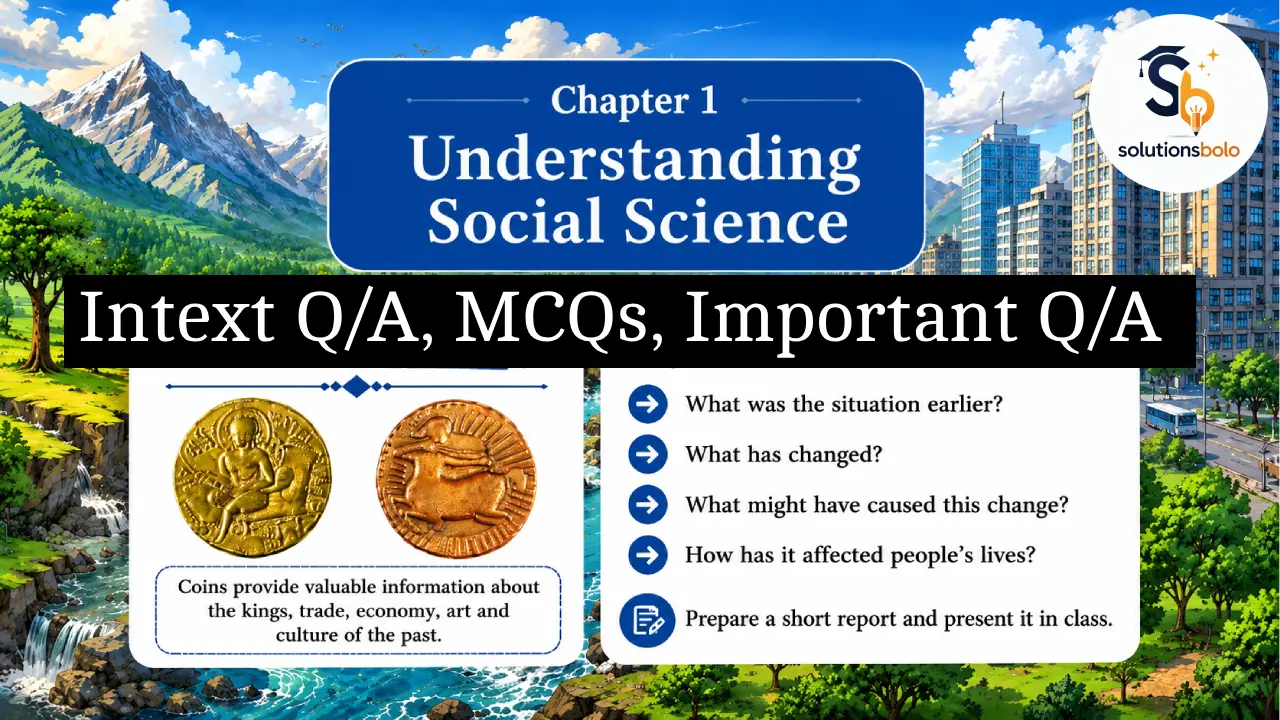
8. Observe your surroundings and identify a change that has taken place in your locality over the past five years. It could be related to transport, housing, education, technology or the environment.
Discuss in groups:
What was the situation earlier?
What has changed?
What might have caused this change?
How has it affected people’s lives?
Prepare a short report and present it in class.
Answer: Report on Changes in My Locality
Over the past five years, my locality has experienced noticeable improvements in transport and technology. Earlier, many roads were damaged and internet connectivity was slow, making travel and online learning difficult. Today, roads have been repaired, public facilities have improved and high-speed internet is available in most areas. These changes were possible because of government development projects and technological progress. As a result, travelling has become easier, communication is faster, businesses use digital payments and students can access online education more effectively. Overall, these developments have improved the quality of life and made my locality more modern and well-connected.
9. Why should we study social science?
Answer: We should study Social Science because it helps us understand society, history, geography, government, economics and the environment. It develops critical thinking, problem-solving and decision-making skills while helping us understand current issues and real-life situations. Social Science also teaches us to respect cultural diversity, protect natural resources and become informed, responsible citizens who contribute positively to society and national development.
Important Questions and Answers
1. What is Social Science?
Answer: Social Science is the study of people, societies and their interactions with each other and the environment. It includes subjects such as History, Geography, Political Science and Economics. These disciplines help us understand past events, natural surroundings, governments and economic activities. Social Science explains how societies develop, how people make decisions and how different factors shape our daily lives. It also helps us become informed, responsible and active citizens.
2. Why is the study of Social Science important in our daily life?
Answer: The study of Social Science is important because it helps us understand society, culture, government and the environment. It teaches us how people live, work and interact with one another. Social Science develops critical thinking, problem-solving and decision-making skills. It also helps us understand current issues such as climate change, poverty and equality. By studying Social Science, we become responsible citizens who can contribute positively to society and national development.
3. Name the main disciplines of Social Science.
Answer: The main disciplines of Social Science are History, Geography, Political Science and Economics. History helps us understand past events and their impact on the present. Geography studies places, people and the environment. Political Science explains governments, democracy and citizens’ rights and responsibilities. Economics focuses on the production, distribution and use of resources. Together, these disciplines help us understand society and make informed decisions in everyday life.
4. How does Geography help us understand the relationship between people and the environment?
Answer: Geography explains how landforms, climate, water, soil and natural resources influence people’s lives. It shows how people adapt to their environment and use available resources for farming, industries, transport and settlements. Geography also helps us understand environmental challenges such as floods, droughts and climate change. By studying Geography, we learn the importance of conserving natural resources and maintaining a balance between human activities and the environment.
5. What is the importance of studying History?
Answer: History helps us understand how societies, cultures and civilizations have changed over time. It teaches us about important events, leaders, achievements and struggles that shaped the present world. By studying History, we learn from past successes and mistakes, appreciate our heritage and understand the importance of peace, justice and democracy. History also develops analytical thinking and helps us make informed decisions for the future.
6. How does Political Science help us understand government and democracy?
Answer: Political Science explains how governments are formed, how laws are made and how democratic institutions function. It teaches us about the Constitution, elections, citizens’ rights and responsibilities. Political Science helps us understand the importance of participation, equality, justice and accountability in a democracy. By studying it, we become aware of our rights and duties and learn how governments work to serve the people and promote national development.
7. Why is Economics important for individuals and society?
Answer: Economics helps us understand how people use limited resources to meet unlimited needs. It explains production, consumption, saving, trade and employment. Economics also helps governments make decisions about development, taxation and public welfare. By studying Economics, we learn the importance of managing resources wisely, reducing poverty and promoting sustainable growth. It enables individuals and societies to make better financial and economic decisions for a secure future.
8. How do different Social Science disciplines work together to explain real-life issues?
Answer: Different Social Science disciplines are interconnected. History explains how past events influence the present, Geography studies the environment and resources, Political Science examines government policies and Economics analyses the use of resources. Together, they help us understand issues such as urbanisation, climate change, poverty, migration and development. By combining knowledge from these subjects, we can better understand complex problems and find practical solutions for society.
9. Why do people living in different regions have different lifestyles and cultures?
Answer: People living in different regions have different lifestyles because of variations in climate, landforms, natural resources, occupations, traditions and historical developments. These factors influence food habits, clothing, language, festivals, housing and customs. Over time, communities develop unique cultures suited to their surroundings. Social Science helps us understand and respect these differences while recognising that cultural diversity strengthens unity and enriches society.
10. How do natural resources influence people’s occupations?
Answer: Natural resources greatly influence the occupations people choose. Fertile land encourages farming, forests support forestry and related industries, mineral-rich areas develop mining activities and coastal regions promote fishing and trade. Water availability, climate and landforms also affect employment opportunities. Social Science explains how people adapt to local resources and how the careful use of natural resources supports economic development and improves people’s standard of living.
11. How can Social Science help us become responsible citizens?
Answer: Social Science teaches us about our rights, duties and responsibilities as citizens. It encourages respect for laws, democratic values, equality and cultural diversity. It develops critical thinking, empathy and awareness of social and environmental issues. By understanding how society and government function, we learn to participate actively in community life, make informed decisions and contribute to the welfare and development of our country.
12. Why is it important to respect cultural diversity?
Answer: Respecting cultural diversity promotes harmony, equality and mutual understanding among people. Different cultures bring unique languages, traditions, customs and ideas that enrich society. Accepting diversity reduces discrimination and strengthens national unity. Social Science teaches us that every culture deserves respect and appreciation. By valuing different communities and traditions, we build peaceful relationships and create an inclusive society where everyone feels respected and accepted.
13. How does Social Science help us understand climate change and environmental challenges?
Answer: Social Science helps us understand the causes and effects of climate change, pollution, deforestation and resource depletion. It explains how human activities affect the environment and how environmental changes influence people’s lives and livelihoods. It also highlights the role of governments, communities and individuals in protecting nature. By studying Social Science, we learn sustainable practices that help conserve resources and reduce environmental problems.
14. Why should decisions about development consider both people and the environment?
Answer: Development should improve people’s lives without harming the environment. Ignoring environmental protection can lead to pollution, resource depletion, climate change and natural disasters. Sustainable development balances economic growth with environmental conservation and social welfare. Social Science teaches us that responsible planning ensures resources remain available for future generations while improving living standards, creating employment and protecting biodiversity and ecosystems.
15. How does the study of Social Science help us solve present-day problems and plan for the future?
Answer: Social Science helps us analyse present-day issues such as poverty, unemployment, climate change, inequality and urbanisation. It combines knowledge from History, Geography, Political Science and Economics to understand their causes and suggest practical solutions. By learning from the past, understanding the present and planning wisely, Social Science prepares us to make informed decisions. It encourages responsible citizenship and supports sustainable and inclusive development for a better future.
Multiple Choice Questions (MCQs)
1. What is the primary purpose of studying Social Science?
(A) To memorise historical dates only
(B) To understand society, people and their relationship with the environment
(C) To study only maps and landforms
(D) To learn business skills only
Answer: (B) To understand society, people and their relationship with the environment.
Explanation: Social Science helps us understand people, societies, cultures, governments, economies and the environment. It develops critical thinking, responsible citizenship and problem-solving skills, enabling us to understand real-life issues and make informed decisions for society.
2. Which group correctly represents the four main disciplines of Social Science?
(A) Physics, Chemistry, Biology, Mathematics
(B) History, Geography, Political Science, Economics
(C) English, Hindi, Sanskrit, Mathematics
(D) Science, Computer Science, Commerce, Art
Answer: (B) History, Geography, Political Science, Economics.
Explanation: History studies the past, Geography explains places and environments, Political Science examines governments and democracy and Economics focuses on resources and development. Together, these four disciplines help us understand society from different but connected perspectives.
3. A region receives heavy rainfall every year and experiences floods frequently. Which branch of Social Science mainly explains this situation?
(A) Economics
(B) Political Science
(C) Geography
(D) History
Answer: (C) Geography.
Explanation: Geography studies landforms, climate, rivers, rainfall and natural processes. It explains why certain areas experience floods and how physical features and weather conditions affect human life and settlement patterns across different regions.
4. Why do different communities have different languages, traditions and lifestyles?
(A) Because everyone follows the same customs
(B) Because geographical conditions, history and culture differ from place to place
(C) Because governments create different cultures
(D) Because all regions have identical environments
Answer: (B) Because geographical conditions, history and culture differ from place to place.
Explanation: Communities develop unique languages, traditions and lifestyles because of differences in geography, historical experiences, occupations and cultural practices. These variations enrich society and teach us to respect diversity while promoting unity among people.
5. Which discipline mainly helps us understand how governments function and how laws are made?
(A) History
(B) Geography
(C) Political Science
(D) Economics
Answer: (C) Political Science.
Explanation: Political Science explains democratic institutions, governments, constitutions, elections, laws and citizens’ rights and duties. It helps us understand how governments make decisions and how citizens participate in democratic governance and nation-building.
6. Why do industries develop mainly in certain regions?
(A) Only because of pleasant weather
(B) Because of fertile agricultural land alone
(C) Due to the availability of resources, transport, markets and skilled workers
(D) Because every region has equal industrial development
Answer: (C) Due to the availability of resources, transport, markets and skilled workers.
Explanation: Industries grow where raw materials, electricity, transport, skilled labour and markets are easily available. These factors reduce production costs, improve efficiency and encourage economic growth, making some regions more industrially developed than others.
7. Which statement best describes the role of Economics?
(A) It studies only ancient kingdoms.
(B) It explains how people use limited resources to satisfy their needs.
(C) It focuses only on climate and weather.
(D) It studies only elections and governments.
Answer: (B) It explains how people use limited resources to satisfy their needs.
Explanation: Economics studies how individuals, businesses and governments use limited resources to meet unlimited needs. It helps us understand production, consumption, savings, employment and economic development while promoting efficient resource management and better living.
8. Which of the following is the best example of Social Science helping to solve a real-life problem?
(A) Understanding how climate change affects farming and planning suitable solutions
(B) Memorising only the names of rivers
(C) Learning multiplication tables
(D) Identifying chemical elements
Answer: (A) Understanding how climate change affects farming and planning suitable solutions.
Explanation: Social Science connects Geography, Economics and Political Science to understand environmental challenges. It helps governments and communities develop better farming methods, disaster management plans and sustainable policies to reduce the impact of climate change.
9. Why is it important to study History along with Geography, Political Science and Economics?
(A) Because History alone explains everything about society
(B) Because each discipline provides a different perspective and together they help us understand society completely
(C) Because Geography is less important than History
(D) Because only History is useful in daily life
Answer: (B) Because each discipline provides a different perspective and together they help us understand society completely.
Explanation: Each Social Science discipline explains society from a unique viewpoint. Together, they help us understand historical events, environmental conditions, government systems and economic activities, giving a complete picture of how societies function and develop.
10. Which quality is most likely to develop through the study of Social Science?
(A) Responsible citizenship and informed decision-making
(B) Memorising facts without understanding
(C) Ignoring social and environmental issues
(D) Depending only on personal opinions
Answer: (A) Responsible citizenship and informed decision-making.
Explanation: Social Science encourages critical thinking, respect for diversity, awareness of rights and responsibilities and informed decision-making. These qualities help individuals become responsible citizens who actively participate in democracy and contribute to society’s progress.
Competency-Based Questions
1. Your school is planning an educational trip to a historical monument, a nearby river and a local government office. Explain how each visit will help you understand different disciplines of Social Science.
Answer: An educational trip to these places helps us understand different branches of Social Science. Visiting a historical monument teaches us about important events, rulers and the heritage of our country, which is studied in History. A visit to a nearby river helps us learn about landforms, water resources, climate and the relationship between people and the environment, which are part of Geography. Visiting a local government office shows how public services are managed, how decisions are made and how citizens’ needs are addressed through Political Science. Together, these visits make learning practical and help us understand how different Social Science disciplines are connected.
2. Two neighbouring villages have different occupations, languages and festivals. Explain why such differences exist and how Social Science helps us understand them.
Answer: Neighbouring villages may have different occupations, languages and festivals because of differences in geography, history, culture and available resources. One village may have fertile land suitable for farming, while another may depend on fishing, handicrafts or trade. Historical developments and cultural traditions also influence the language and festivals celebrated by people. Social Science helps us understand these differences by explaining how the environment, historical events, economic activities and cultural practices shape people’s lives. It also teaches us to respect diversity and appreciate the unique identity of every community.
3. A newspaper reports that a city is facing water shortage due to rapid urbanisation. Which disciplines of Social Science can help explain this issue? Give reasons.
Answer: The problem of water shortage can be understood through all four disciplines of Social Science. Geography explains how rainfall, rivers, groundwater and climate affect water availability. Economics studies the increasing demand for water caused by population growth and urban development. Political Science explains the government’s role in water conservation, planning and public distribution. History helps us understand how traditional water conservation methods were used in the past. By combining knowledge from all these disciplines, we can understand the causes of water shortage and suggest practical solutions for sustainable water management.
4. Suppose a new highway is being built through your locality. Explain how this single development can be studied from the perspectives of Geography, Economics, Political Science and History.
Answer: The construction of a new highway can be understood from different Social Science perspectives. Geography explains how the highway changes transport routes and connects different regions. Economics studies its impact on trade, employment, businesses and income. Political Science explains the government’s role in planning, funding and implementing the project for public welfare. History records how the locality has developed over time because of improved transport facilities. Together, these disciplines help us understand how one development project can influence people’s lives, economic growth and the overall progress of a region.
5. Your grandparents often describe how life was different when they were young. Explain how History, Geography, Economics and Political Science can help you understand these changes.
Answer: The experiences shared by my grandparents help me understand how society has changed over time. History explains changes in people’s lifestyles, education and important events. Geography shows how improvements in transport, communication and the environment have changed daily life. Economics explains changes in occupations, income, technology and living standards. Political Science helps us understand how government policies, democratic institutions and public welfare programmes have improved education, healthcare and infrastructure. Together, these disciplines help us understand the past, compare it with the present and appreciate the progress made by society.
Long Questions and Answer
1. Explain the meaning and importance of Social Science. Discuss how its different disciplines work together to help us understand society and solve real-life problems.
Answer: Social Science is the study of people, societies and their interactions with each other and the environment. It helps us understand how human societies have developed, how governments function, how economies work and how natural surroundings influence our lives. It also develops critical thinking, decision-making and problem-solving skills.
The four main disciplines of Social Science are History, Geography, Political Science and Economics. History helps us understand past events and learn valuable lessons from them. Geography explains the relationship between people and the environment. Political Science teaches us about democracy, governments, laws and citizens’ rights and responsibilities. Economics explains how resources are produced, distributed and used to meet human needs.
These disciplines are closely connected. For example, solving climate change requires geographical knowledge, government policies, economic planning and lessons from history. By studying Social Science, we become informed, responsible citizens who respect diversity, protect the environment and contribute positively to society.
2. Describe the four main disciplines of Social Science—History, Geography, Political Science and Economics. Explain how each discipline contributes to our understanding of the world with suitable examples.
Answer: Social Science consists of four important disciplines that help us understand different aspects of human life and society.
History studies past events, civilizations and important personalities. It helps us understand how societies have changed over time and learn from past successes and mistakes.
Geography studies the Earth, climate, landforms, natural resources and human activities. It explains why people live differently in different regions and how the environment affects their lives.
Political Science explains how governments function, how laws are made and how democracy protects the rights and responsibilities of citizens. It encourages active participation in public life.
Economics studies the production, distribution and use of resources. It helps us understand employment, trade, poverty, development and the importance of using resources wisely.
Together, these disciplines provide a complete understanding of society and help us analyse real-life issues such as climate change, urbanisation, poverty and sustainable development.
3. Social Science helps us become informed and responsible citizens. Explain this statement by discussing its role in understanding democracy, cultural diversity, environmental conservation and sustainable development.
Answer: Social Science plays an important role in making us informed and responsible citizens. It teaches us about democracy, equality, justice and the rights and duties of every citizen. By understanding how governments work and how laws are made, we become active participants in democratic processes.
Social Science also teaches us to respect different languages, religions, traditions and cultures. It promotes unity in diversity and encourages peaceful coexistence among people.
It helps us understand environmental issues such as pollution, deforestation, climate change, floods and droughts. It also explains the importance of conserving natural resources for future generations.
The study of sustainable development teaches us to balance economic growth with environmental protection and social welfare. Overall, Social Science develops awareness, critical thinking and a sense of responsibility, enabling us to make informed decisions and contribute to a better society.
4. Imagine your locality has changed significantly over the past five years. Prepare a detailed report describing the earlier situation, the changes that have taken place, the reasons behind these changes and their impact on people’s lives. Suggest two ways to make your locality even better in the future.
Answer: Report on Changes in My Locality
Over the past five years, my locality has undergone remarkable development. Earlier, many roads were narrow and damaged, public transport was limited and internet connectivity was slow. During the rainy season, waterlogging caused inconvenience and access to some public services was difficult.
Today, the roads have been widened and repaired, streetlights have been installed and high-speed internet is available in most areas. Schools, hospitals and public facilities have also improved. Digital services, online education and cashless payments have become common.
These changes were made possible through government development projects, improved infrastructure, technological progress and increased public awareness. As a result, travelling has become easier, communication is faster, businesses have grown and students have better learning opportunities. People’s overall quality of life has improved.
To make my locality even better, more trees should be planted to reduce pollution and better waste management and recycling systems should be introduced to keep the environment clean and healthy. These steps will ensure sustainable development and improve the well-being of everyone.
Common Mistakes Students Should Avoid
• Memorising definitions without understanding the concepts.
• Confusing the roles of History, Geography, Political Science and Economics.
• Writing answers without suitable examples.
• Ignoring the connection between different Social Science disciplines.
• Giving factual answers instead of explaining why and how.
• Skipping observation-based and competency-based practice questions.
Final Exam Tip: Focus on understanding concepts rather than rote learning. If you can relate Social Science to real-life situations and explain ideas with examples, you will be able to answer short, long, competency-based and case-based questions confidently.
Class 9 Social Science Chapter 1 Summary – Understanding Social Science
Chapter 1 – Understanding Social Science introduces the meaning, purpose and importance of Social Science in understanding human society. It explains that Social Science helps us study people, societies, governments, economies, cultures and the environment. The chapter encourages us to observe the world around us, ask meaningful questions and understand how different aspects of society are connected. It also shows that Social Science helps explain everyday issues such as settlements, occupations, public services, government decisions and environmental challenges.
The chapter highlights India’s rich knowledge traditions by introducing ideas such as Panchamahabhutas, Vasudhaiva Kutumbakam and Arthashastra. These ideas show that observation, ethical thinking, good governance and public welfare have been valued in India for centuries. It also explains that modern Social Science uses evidence such as observations, surveys, interviews, archaeological remains, inscriptions, coins, genealogical records and scientific methods like Carbon-14 dating to understand how societies have changed over time.
Another important concept is that Social Science is not a single subject but a family of disciplines. The chapter introduces History, Geography, Political Science and Economics as the four main disciplines, while also mentioning Sociology, Anthropology, Philosophy and Psychology as part of the broader Social Science family. Each discipline studies society from a different perspective, but together they provide a complete understanding of human life and help explain real-world issues.
The chapter also explains that many social problems cannot be understood through one subject alone. Issues such as floods, climate change, migration, poverty and development require knowledge from different branches of Social Science. By combining these disciplines, we gain a broader understanding of society and its challenges.
Overall, Understanding Social Science builds a strong foundation for the study of Social Science in Class 9. It encourages observation, logical thinking, evidence-based understanding and respect for cultural diversity. The chapter helps us understand the relationship between people, society, government, the economy and the environment while preparing us to make informed decisions and become responsible citizens.
Frequently Asked Questions (FAQs)
1. What is Social Science and why is it important?
Answer: Social Science is the study of people, society, history, geography, government and the economy. It helps us understand how societies function, develop critical thinking and become responsible citizens. This is one of the key concepts explained in Class 9 Social Science Chapter 1 – Understanding Social Science.
2. What are the four main disciplines of Social Science?
Answer: The four main disciplines of Social Science are History, Geography, Political Science and Economics. Together, they help us understand the past, the environment, government, resources, economic activities and the way societies develop.
3. Why should students study Social Science?
Answer: Students should study Social Science because it explains society, culture, democracy, the environment and economic activities. It develops critical thinking, decision-making and responsible citizenship while helping students understand real-life issues.
4. How are History, Geography, Political Science and Economics connected?
Answer: These disciplines are interconnected because they explain different aspects of society. Together, they help us understand historical events, geographical conditions, government policies, economic activities and real-life challenges from multiple perspectives.
5. What is the main objective of Chapter 1 – Understanding Social Science?
Answer: The main objective of this chapter is to introduce the meaning, importance and scope of Social Science. It explains the four disciplines and shows how they help us understand society, solve problems and become responsible citizens.
6. Is NCERT books change in 2026–27 for Class 9?
Answer: Yes, NCERT has introduced revised textbooks for Class 9 under the latest curriculum for the 2026–27 academic session. Students should study from the new NCERT books prescribed by CBSE to prepare according to the updated syllabus and examination pattern.
7. Is Class 9 new book released?
Answer: Yes, the new NCERT Class 9 textbooks have been released for the 2026–27 academic session. These books include updated content, revised chapters and improved learning activities based on the latest CBSE curriculum and educational guidelines.
8. Is the new syllabus only for CBSE schools or for all boards?
Answer: The revised NCERT syllabus is primarily implemented in CBSE-affiliated schools. However, many state boards and schools following NCERT textbooks may also adopt the updated books according to their respective education board’s decisions and academic policies.
9. Can I use the old Class 9 NCERT Social Science book for 2026–27?
Answer: No, students should use the latest NCERT Class 9 Social Science textbook for the 2026–27 session. The revised book contains updated chapters, content and activities that match the current CBSE syllabus and examination requirements.
10. What is the main objective of studying Social Science in Class 9?
Answer: The main objective of Class 9 Social Science is to help students understand human society, historical developments, geographical environments, political structures and economic activities. It develops critical thinking, civic consciousness and a comprehensive view of how past events shape our contemporary world.
11. What are the key branches included under Social Science?
Answer: Social Science broadly integrates four key disciplines:
History: The study of past events, civilizations and societal evolution.
Geography: The exploration of Earth’s landscapes, environments and human-nature interactions.
Political Science (Civics): The examination of governance, democratic systems, rights and institutions.
Economics: The understanding of resource allocation, production, development and financial systems.
12. How does studying History help us understand modern society?
Answer: History provides context to modern cultural, social and political systems. By analyzing past struggles, achievements and mistakes, students gain insight into how modern laws, boundaries and societal norms were established, helping prevent past errors and foster informed citizenship.
13. Where can I find complete NCERT Solutions for Class 9 Social Science Chapter 1?
Answer: You can find fully solved intext questions, textbook exercises, MCQs and clear conceptual explanations for Class 9 Social Science Chapter 1 right here on Solutions Bolo, completely optimized for quick revision and exam preparation.
14. Where to get Understanding Social Science Class 9 Chapter 1 Question Answer?
Answer: You can access the complete, step-by-step NCERT textbook solutions, intext questions and summary for Class 9 Social Science Chapter 1 on Solutions Bolo for easy exam preparation.
15. What topics are covered in Class 9th SST Chapter 1 Understanding Social Science Question Answer?
Answer: The solutions cover key concepts of History, Geography, Civics and Economics, including the significance of numismatic sources, societal evolution and group discussion activities.