NCERT Class 9 Maths Ganita Manjari Chapter 1 Orienting Yourself: The Use of Coordinates Solutions includes Exercise Set 1.1, Exercise Set 1.2 and End of Chapter Exercises for session 2026-27. This chapter explains the use of coordinates to locate positions on a graph using the x-axis, y-axis and origin. Students learn plotting points, reading coordinates, understanding quadrants and using graph paper in real-life situations such as maps, navigation and games. These NCERT Solutions are useful for CBSE students preparing for exams based on the New Syllabus 2026-27.
Table of Contents (Quick Links):
Exercise Set 1.2 Solutions
End of Chapter Exercise Solutions
Introduction to Chapter
The introduction to Chapter 1 of the Class 9 textbook Ganita Manjari highlights the rich historical evolution of coordinate geometry. Grid-based thinking originated in ancient India within the well-planned streets of the Indus-Sarasvati Civilization. Later, legendary mathematicians like Baudhayana, Aryabhata, and Brahmagupta laid its foundation by introducing zero, negative numbers, and celestial mapping. Eventually, in the 17th century, René Descartes formalized this into the modern ‘Cartesian plane’, beautifully bridging algebra and geometry together.
This chapter also explains how the 2-D Cartesian Coordinate System expands the one-dimensional number line by using two perpendicular lines to locate points in a two-dimensional space. The horizontal line is referred as the x-axis, while the vertical line is the y-axis. They intersect at the origin O (0, 0). Distances measured to the right or upwards from O are treated as positive, whereas distances measured to the left or downwards are considered negative.
Exercise Set 1.1
1. Fig. 1.3 shows Reiaan’s room with points OABC marking its corners. The x- and y-axes are marked in the figure. Point O is the origin.
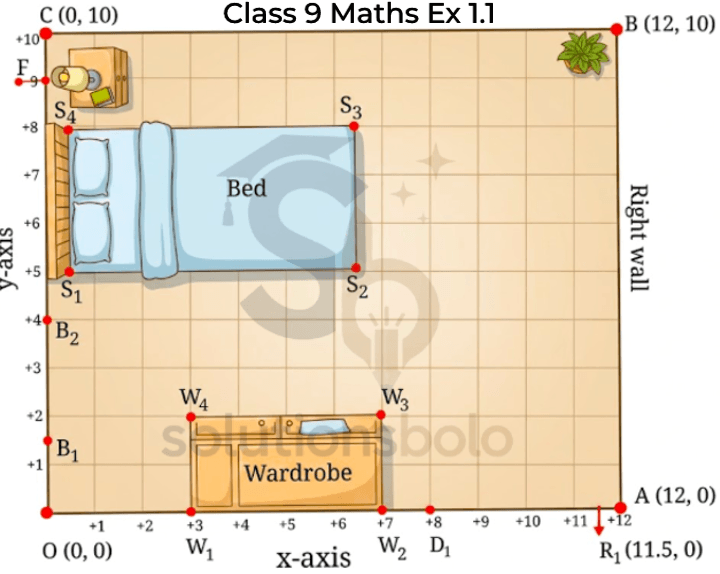
Referring to Fig. 1.3, answer the following questions:
(i) If D1 R1 represents the door to Reiaan’s room, how far is the door from the left wall (the y-axis) of the room? How far is the door from the x-axis?
Answer:
The room door lies on the x-axis, so its distance from the x-axis is 0 units.
From the figure:
• D1 = (8, 0)
• R1 = (11.5, 0)
Therefore, the door starts 8 units away from the y-axis (left wall of the room).
(ii) What are the coordinates of D1?
Answer:
The coordinates of point D1 are (8, 0).
(iii) If R1 is the point (11.5, 0), how wide is the door? Do you think this is a comfortable width for the room door? If a person in a wheelchair wants to enter the room, will he/she be able to do so easily?
Answer:
Point R1 is given as (11.5, 0). Since D1 is at (8, 0),
So, the width of the door is:
11.5 – 8 = 3.5 feet
So, the door is 3.5 feet wide.
A wheelchair user can also enter the room easily because wheelchairs generally require about 3 feet of space.
(iv) If B1 (0, 1.5) and B2 (0, 4) represent the ends of the bathroom door, is the bathroom door narrower or wider than the room door?
Answer:
The bathroom door is represented by B1 (0, 1.5) and B2 (0, 4).
Its width is:
4 – 1.5 = 2.5 feet
The room door width is 3.5 feet, while the bathroom door width is 2.5 feet. As a result we can see, the door to the bathroom is narrower than the door to the room.
Exercise Set 1.2
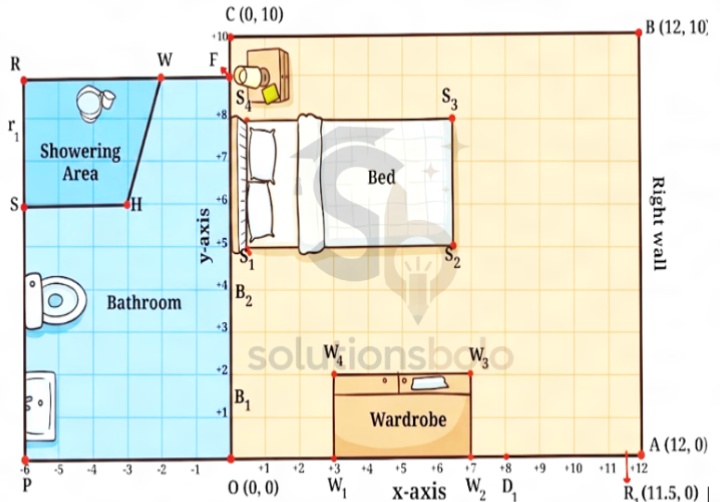
On a graph sheet, mark the x-axis and y-axis and the origin O. Mark points from (– 7, 0) to (13, 0) on the x-axis and from (0, – 15) to (0, 12) on the y-axis. (Use the scale 1 cm = 1 unit.) Using Fig. 1.5, answer the given questions.
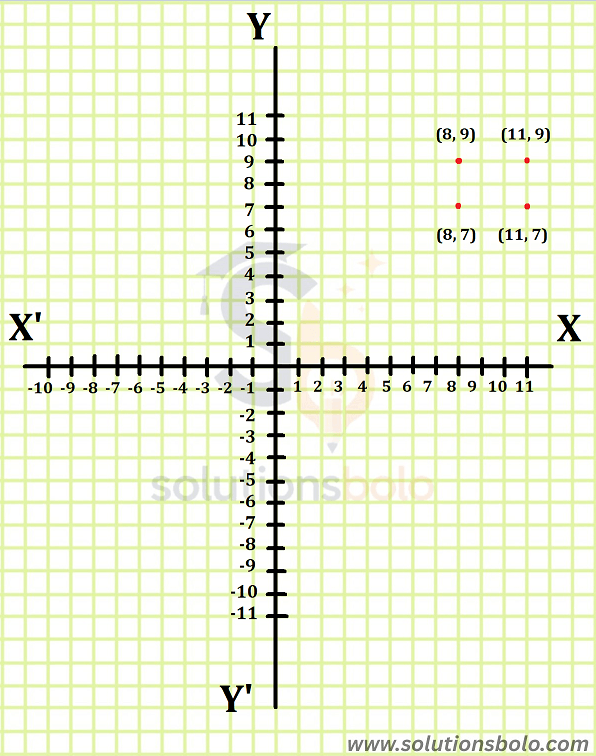
1. Place Reiaan’s rectangular study table with three of its feet at the points (8, 9), (11, 9) and (11, 7).
(i) Where will the fourth foot of the table be?
Answer:
The three feet of the rectangular table are at:
• (8, 9)
• (11, 9)
• (11, 7)
Since opposite sides of a rectangle are parallel and equal, the fourth foot will be at (8, 7).
(ii) Is this a good spot for the table?
Answer:
Yes, this is a good spot for the table. The table is placed neatly inside the room without touching the walls, door or other furniture. There is enough free space around it for movement.
(iii) What is the width of the table? The length? Can you make out the height of the table?
Answer:
The horizontal distance between (8, 9) and (11, 9) is:
11 – 8 = 3 feet
So, the width of the table is 3 feet.
The vertical distance between (11, 9) and (11, 7) is:
9 – 7 = 2 feet
So, the length of the table is 2 feet.
The height of the table cannot be determined because the figure only shows length and width in a two-dimensional (2-D) plane.
2. If the bathroom door has a hinge at B1 and opens into the bedroom, will it hit the wardrobe? Are there any changes you would suggest if the door is made wider?
Answer:
From Fig. 1.5:
• B1 = (0, 1.5)
• B2 = (0, 4)
So, the bathroom door has width:
4 – 1.5 = 2.5 units
If the door is hinged at B1 and opens into the bedroom, it will sweep an arc of radius 2.5 units from B1.
Now the wardrobe begins near:
• W1 = (3, 0)
• W4 = (3, 2)
The nearest side of the wardrobe (as pic refers) is about 3 units away from B1, which is greater than the door which widths have 2.5 units.
Hence, the bathroom door shall not hit the wardrobe.
Suggested Changes (if the Door is Wider):
If the bathroom door is made wider, it may come nearer to or hit the wardrobe. In that case:
• the wardrobe may be shifted slightly,
• the door may open inward into the bathroom, or
• a sliding door may be used for better space management.
3. Look at Reiaan’s bathroom.
(i) What are the coordinates of the four corners O, F, R, and P of the bathroom?
Answer:
From the given Figure 1.5, the coordinates of the four corners O, F, R and P of the bathroom are:
O = (0, 0)
F = (0, 9)
R = (-6, 9)
P = (-6, 0)
(ii) What is the shape of the showering area SHWR in Reiaan’s bathroom? Write the coordinates of the four corners.
Answer:
From the given figure, the coordinates of the corners of the showering area are:
S = (-6, 6)
H = (-3, 6)
W = (-2, 9)
R = (-6, 9)
Since only one pair of opposite sides (SH and RW) is parallel and their lengths are unequal, the shape of SHWR is a Trapezium.
Shape of SHWR = Trapezium
Coordinates of the corners: S = (-6, 6) H = (-3, 6) W = (-2, 9) R = (-6, 9)
(iii) Mark off a 3 ft × 2 ft space for the washbasin and a 2 ft × 3 ft space for the toilet. Write the coordinates of the corners of these spaces.
Answer:
Washbasin space (3 ft x 2 ft):
Taking the rectangular area near the bottom-left corner of the bathroom, the coordinates are:
(-6, 0.5), (-5, 0.5), (-5, 2) and (-6, 2)
Toilet space (2 ft x 3 ft):
Taking the rectangular area located just above the washbasin, the coordinates are: (-6, 3), (-4.5, 3), (-4.5, 4) and (-6, 4)
4. Other rooms in the house:
(i) Reiaan’s room door leads from the dining room which has the length 18 ft and width 15 ft. The length of the dining room extends from point P to point A. Sketch the dining room and mark the coordinates of its corners.
Answer:
From the given Figure 1.5, the length of the dining room extends horizontally along the line PA.
Coordinates of P = (-6, 0)
Coordinates of A = (12, 0)
The total length of PA = 12 – (-6) = 18 ft, which matches the given layout.
Since the house structure extends downward from this line, the dining room goes 15 units down along the negative y-axis (from y = 0 to y = -15).
Hence, the coordinates of the four corners of the dining room are:
P = (-6, 0) A = (12, 0) Q = (12, -15) S = (-6, -15)
(ii) Place a rectangular 5 ft × 3 ft dining table precisely in the centre of the dining room. Write down the coordinates of the feet of the table
Answer:
To find the exact coordinates of the dining table, we first locate the precise center of the dining room.
The length of the room extends from x = -6 to x = 12 (Total length = 18 ft).
The center of the x-axis is at: x = 3
The width of the room extends downwards from y = 0 to y = -15 (Total width = 15 ft).
The center of the y-axis is at: y = -7.5
Thus, the center point of the dining room is (3, -7.5).
The dining table has a length of 5 ft along the x-axis and a width of 3 ft along the y-axis.
Half-length = 5 / 2 = 2.5 ft
Half-width = 3 / 2 = 1.5 ft
To calculate the coordinates of the corners (feet) of the table, we add and subtract these half-values from the center coordinates:
Bottom-Left Corner: (3 – 2.5, -7.5 – 1.5) = (0.5, -9)
Bottom-Right Corner: (3 + 2.5, -7.5 – 1.5) = (5.5, -9)
Top-Right Corner: (3 + 2.5, -7.5 + 1.5) = (5.5, -6)
Top-Left Corner: (3 – 2.5, -7.5 + 1.5) = (0.5, -6)
The coordinates of the four feet of the dining table are: (0.5, -9), (5.5, -9), (5.5, -6), and (0.5, -6).
End of Chapter Exercises Solutions
1. What are the x-coordinate and y-coordinate of the point of intersection of the two axes?
Answer:
The point of intersection of the two axes (x-axis and y-axis) called the origin.
The coordinates of this point are:
x-coordinate = 0
y-coordinate = 0
Therefore, the coordinates of the point of intersection are (0, 0).
2. Point W has x-coordinate equal to – 5. Can you predict the coordinates of point H which is on the line through W parallel to the y-axis? Which quadrants can H lie in?
Answer:
If point W has an x-coordinate of -5, then any point on the vertical line passing through W parallel to the y-axis must also share the exact same x-coordinate of -5.
Therefore, the coordinates of point H will always be of the form: H = (-5, y), where y can be any real number.
Now, depending on the value of the y-coordinate, the location of point H will vary as follows:
• If y > 0 (y is positive), then H lies in Quadrant II.
• If y < 0 (y is negative), then H lies in Quadrant III.
• If y = 0, then H lies directly on the negative part of the x-axis.
Conclusion: Point H can lie in:
• Quadrant II
• Quadrant III
• or on the x-axis
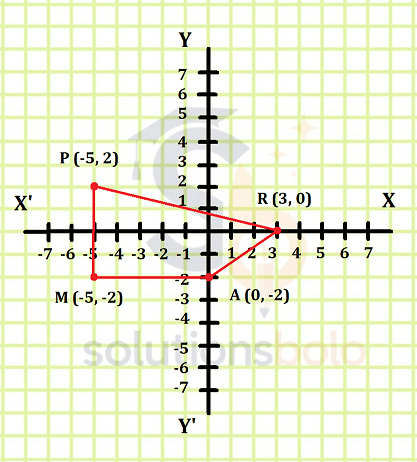
3. Consider the points R (3, 0), A (0, – 2), M (– 5, – 2) and P (– 5, 2). If they are joined in the same order, predict:
(i) Two sides of RAMP that are perpendicular to each other.
Answer:
Let us observe: AM joins A(0, -2) to M(-5, -2), so it is horizontal. MP joins M(-5, -2) to P(-5, 2), so it is vertical. A horizontal line and a vertical line are perpendicular.
Therefore: AM ⟂ MP The two perpendicular sides are AM and MP.
(ii) One side of RAMP that is parallel to one of the axes.
Answer:
AM is parallel to the x-axis because both points A and M have the same y-coordinate (-2). MP is parallel to the y-axis because both points M and P have the same x-coordinate (-5).
So, one side parallel to an axis is: AM, which is parallel to the x-axis (or MP, which is parallel to the y-axis).
(iii) Two points that are mirror images of each other in one axis. Which axis will this be? Now plot the points and verify your predictions.
Answer:
Comparing M(-5, -2) and P(-5, 2):
They have the same x-coordinate (-5).
Their y-coordinates are equal in magnitude but opposite in sign (-2 and 2).
Therefore, We can see they are mirror images of each other present in the x-axis on the graph. The points M and P are mirror images of each other. The axis of reflection is the x-axis.
Verification by Plotting: When these points are plotted on a graph sheet and joined in the order R-A-M-P-R:
• Side AM lies perfectly along the horizontal line y = -2, verifying it is parallel to the x-axis.
• Side MP lies perfectly along the vertical line x = -5, verifying it is parallel to the y-axis.
• The corner at vertex M forms an exact 90-degree angle, verifying AM ⟂ MP.
• Points M and P lie at an equal distance of 2 units below and above the x-axis respectively, verifying that they are mirror images across the x-axis.
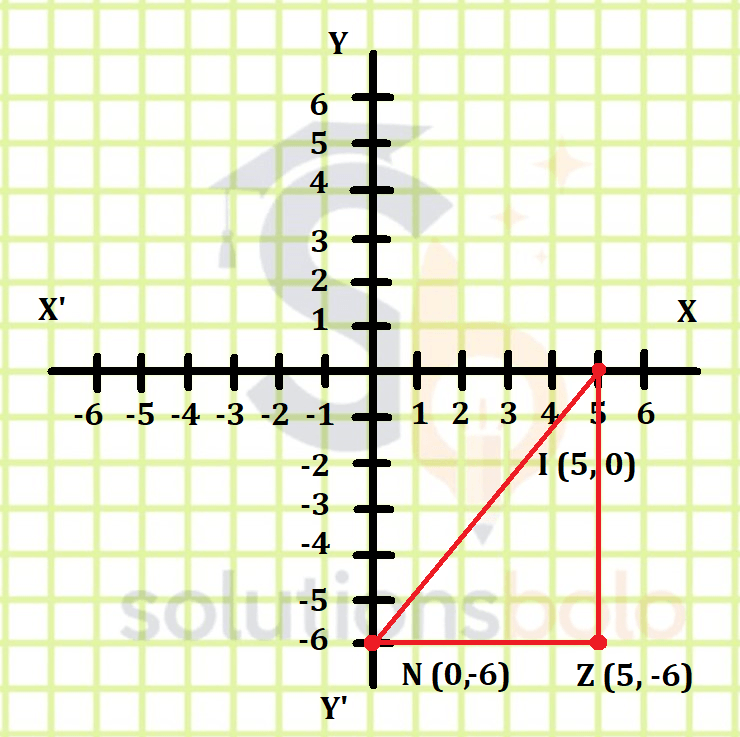
4. Plot point Z (5, – 6) on the Cartesian plane. Construct a right-angled triangle IZN and find the lengths of the three sides.
Answer:
To form a right-angled triangle easily, we can choose the other two vertices I and N on the coordinate axes such that they form a vertical line and a horizontal line meeting at Z.
Let the coordinates of the vertices be:
I = (5, 0) [on the x-axis, directly above Z]
Z = (5, -6)
N = (0, -6) [on the y-axis, directly to the left of Z]
Since line IZ is perfectly vertical and line ZN is perfectly horizontal, they meet at a 90-degree angle at vertex Z. Therefore, triangle IZN is right-angled at Z.
Lengths of the three sides:
1. Length of side IZ:
Distance between I(5, 0) and Z(5, -6) along the vertical line:
= 0 – (-6)
= 6 units
2. Length of side ZN:
Distance between Z(5, -6) and N(0, -6) along the horizontal line:
= 5 – 0
= 5 units
3. Length of side IN (Hypotenuse):
Using the distance formula between I(5, 0) and N(0, -6):
IN = √[(5 – 0)² + (0 – (-6))²]
= √(5² + 6²)
= √(25 + 36)
= √61 units
Therefore, the coordinates of the vertices of the right-angled triangle are I(5, 0), Z(5, -6), and N(0, -6), and the lengths of its sides are:
IZ = 6 units
ZN = 5 units
IN = √61 units
5. What would a system of coordinates be like if we did not have negative numbers? Would this system allow us to locate all the points on a 2-D plane?
Answer:
If we did not have negative numbers, then coordinates could only be zero or positive.
So:
• On the x-axis, we could mark only the points to the right of the origin.
• On the y-axis, we could mark only the points above the origin.
This means we could locate points only in:
• Quadrant I
• The positive part of the x-axis
• The positive part of the y-axis
• And the origin (0, 0)
We would not be able to locate:
• Points in Quadrant II
• Points in Quadrant III
• Points in Quadrant IV
• Points on the negative parts of both axes
Therefore, such a system would not allow us to locate all the points on a 2-D plane.
6. Are the points M (– 3, – 4), A (0, 0) and G (6, 8) on the same straight line? Suggest a method to check this without plotting and joining the points.
Answer:
To check whether the points M (-3, -4), A (0, 0), and G (6, 8) lie on the same straight line without plotting, we can use the Distance Formula.
Distance Formula:
d = √[(x2 – x1)² + (y2 – y1)²]
Let us calculate the distance between each pair of points:
1. Distance MA:
Using M(-3, -4) and A(0, 0):
MA = √[(0 – (-3))² + (0 – (-4))²]
= √[3² + 4²]
= √[9 + 16]
= √25 = 5 units
2. Distance AG:
Using A(0, 0) and G(6, 8):
AG = √[(6 – 0)² + (8 – 0)²]
= √[6² + 8²]
= √[36 + 64]
= √100 = 10 units
3. Distance MG:
Using M(-3, -4) and G(6, 8):
MG = √[(6 – (-3))² + (8 – (-4))²]
= √[9² + 12²]
= √[81 + 144]
= √225 = 15 units
Now, let us check the condition for collinearity: MA + AG = 5 + 10 = 15 Since 15 is equal to the length of MG (MA + AG = MG), the sum of the two shorter distances equals the third total distance.
Therefore, the points M, A, and G lie on the same straight line.
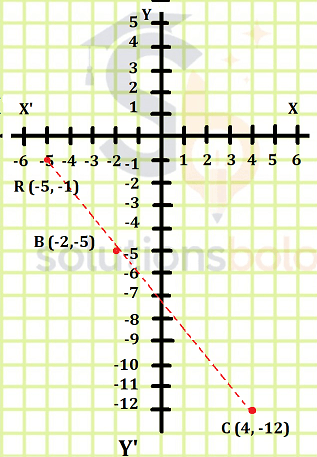
7. Use your method (from Problem 6) to check if the points R (– 5, – 1), B (– 2, – 5) and C (4, – 12) are on the same straight line. Now plot both sets of points and check your answers.
Answer:
To check whether the points R (-5, -1), B (-2, -5), and C (4, -12) lie on the same straight line without plotting, we will use the Distance Formula.
Distance Formula:
d = √[(x2 – x1)² + (y2 – y1)²]
Let us calculate the distance between each pair of points:
1. Distance RB:
Using R(-5, -1) and B(-2, -5):
RB = √[(-2 – (-5))² + (-5 – (-1))²]
= √[(-2 + 5)² + (-5 + 1)²]
= √[3² + (-4)²]
= √[9 + 16]
= √25 = 5 units
2. Distance BC:
Using B(-2, -5) and C(4, -12):
BC = √[(4 – (-2))² + (-12 – (-5))²]
= √[(4 + 2)² + (-12 + 5)²]
= √[6² + (-7)²]
= √[36 + 49]
= √85 units (approximately 9.22 units)
3. Distance RC:
Using R(-5, -1) and C(4, -12):
RC = √[(4 – (-5))² + (-12 – (-1))²]
= √[(4 + 5)² + (-12 + 1)²]
= √[9² + (-11)²]
= √[81 + 121]
= √202 units (approximately 14.21 units)
Now, let us check the condition for collinearity: The two shorter distances are RB and BC. Let us add them to check if they equal the largest distance RC:
RB + BC = 5 + 9.22 = 14.22 units
Comparing this with the largest distance RC: Since 14.22 is not exactly equal to 14.21 (and mathematically, 5 + √85 ≠ √202), the sum of the two shorter distances does not equal the third distance.
Therefore, on the same straight line, the points R, B, and C do not lie.
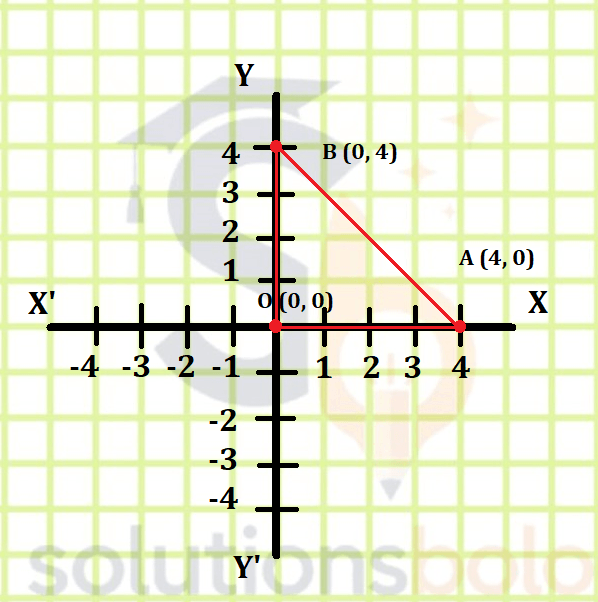
8. Using the origin as one vertex, plot the vertices of:
(i) A right-angled isosceles triangle.
Answer:
A right-angled isosceles triangle.
One possible set of vertices is: O = (0, 0) A = (4, 0) B = (0, 4)
As Explanation:
• O(0, 0) is at the origin.
• Side OA lies along the x-axis with a length of 4 units.
• Side OB lies along the y-axis with a length of 4 units.
• Since OA = OB = 4 units, the triangle is isosceles.
• Since the x-axis and y-axis meet at 90°, triangle OAB is right-angled at O.
(ii) An isosceles triangle with one vertex in Quadrant III and the other in Quadrant IV.
Answer:
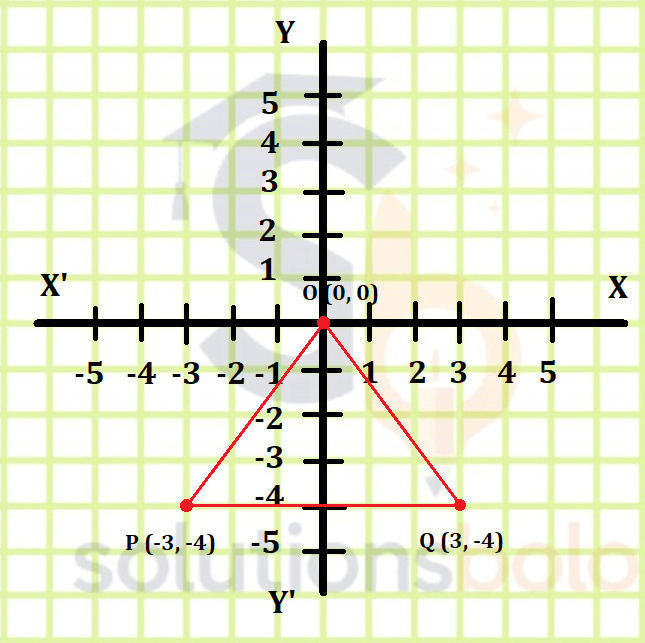
One possible set of vertices is: O = (0, 0) P = (–3, –4) Q = (3, –4)
As Explanation:
• P(–3, –4) lies in Quadrant III (since both x and y are negative).
• Q(3, –4) lies in Quadrant IV (since x is positive and y is negative).
• Using the distance formula, the lengths of the sides from the origin are:
• OP = √[(–3)² + (–4)²] = √[9 + 16] = √25 = 5 units
• OQ = √[(3)² + (–4)²] = √[9 + 16] = √25 = 5 units
Since OP = OQ = 5 units, triangle OPQ is an isosceles triangle.
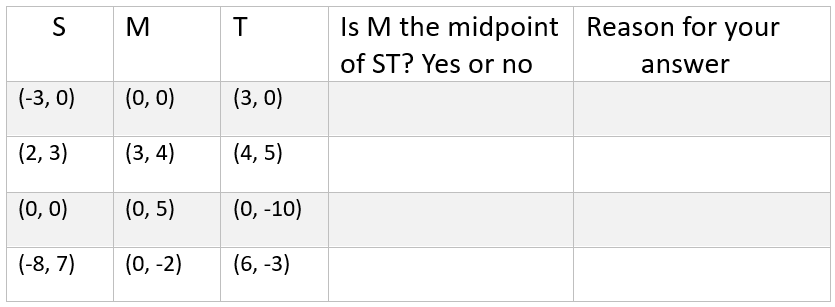
9. The following table shows the coordinates of points S, M and T. In each case, state whether M is the midpoint of segment ST. Justify your answer.
When M is the mid-point of ST, can you find any connection between the coordinates of M, S and T?
Answer:
If SM = MT and M lies on the line segment ST, then M is the midpoint.
Distance Formula: d = √[(x2 – x1)² + (y2 – y1)²]
(i) Row 1: S(−3, 0), M(0, 0), T(3, 0)
Calculate Distance SM:
SM = √[(0 − (−3))² + (0 − 0)²]
= √[3² + 0²]
= √9
= 3 units
Calculate Distance MT:
MT = √[(3 − 0)² + (0 − 0)²]
= √[3² + 0²]
= √9
= 3 units
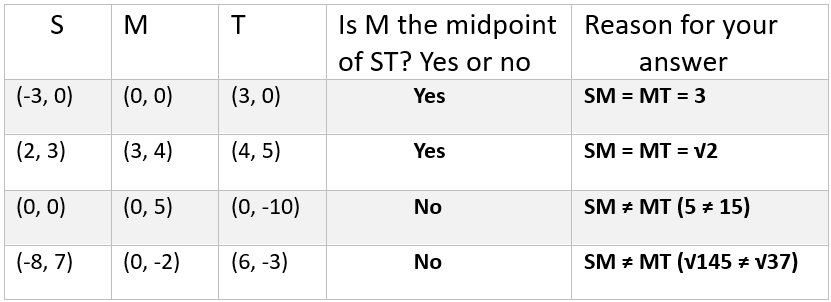
Since SM = MT = 3, the distances are equal. Yes, M is the midpoint of segment ST.
(ii) Row 2: S(2, 3), M(3, 4), T(4, 5)
Calculate Distance SM:
SM = √[(3 − 2)² + (4 − 3)²]
= √[1² + 1²]
= √[1 + 1]
= √2 units
Calculate Distance MT:
MT = √[(4 − 3)² + (5 − 4)²]
= √[1² + 1²]
= √[1 + 1]
= √2 units
Since SM = MT = √2, the distances are equal. Yes, M is the midpoint of segment ST.
(iii) Row 3: S(0, 0), M(0, 5), T(0, −10)
Calculate Distance SM:
SM = √[(0 − 0)² + (5 − 0)²]
= √[0² + 5²]
= √25
= 5 units
Calculate Distance MT:
MT = √[(0 − 0)² + (−10 − 5)²]
= √[0² + (−15)²] = √225
= 15 units
Since SM ≠ MT (5 ≠ 15), the distances are not equal. No, M is NOT the midpoint of segment ST.
(iv) Row 4: S(−8, 7), M(0, −2), T(6, −3)
Calculate Distance SM:
SM = √[(0 − (−8))² + (−2 − 7)²]
= √[8² + (−9)¹]
= √[64 + 81]
= √145 units
Calculate Distance MT:
MT = √[(6 − 0)² + (−3 − (−2))²]
= √[6² + (−1)²]
= √[36 + 1]
= √37 units
Since SM ≠ MT (√145 ≠ √37), the distances are not equal. No, M is NOT the midpoint of segment ST.
10. Use the connection you found to find the coordinates of B given that M (–7, 1) is the midpoint of A (3, – 4) and B (x, y).
Answer:
To find the coordinates of B(x, y), we will use the Midpoint Formula.
According to the formula, the coordinates of the midpoint M are given by:
M = [ (x1 + x2) / 2, (y1 + y2) / 2]
Given:
Endpoint A = (3, -4)
Here, x1 = 3
And, y1 = -4
Endpoint B = (x, y)
Here, x2 = x
And, y2 = y
Midpoint M = (-7, 1)
Now, we will equate the x-coordinate and y-coordinate separately to find the values of x and y:
For the x-coordinate:
-7 = (3 + x) / 2
Multiply both sides by 2:
-14 = 3 + x
x = -14 – 3
x = -17
For the y-coordinate:
1 = (-4 + y) / 2
Multiply both sides by 2:
2 = -4 + y
y = 2 + 4
y = 6
Conclusion: The coordinates of point B are (-17, 6).
11. Let P, Q be points of trisection of AB, with P closer to A, and Q closer to B. Using your knowledge of how to find the coordinates of the midpoint of a segment, how would you find the coordinates of P and Q? Do this for the case when the points are A (4, 7) and B (16, –2).
Answer:
To trisect the line segment AB means to divide it into 3 equal parts: AP = PQ = QB.
Given:
Endpoint A = (4, 7)
Endpoint B = (16, –2)
Let P (x1, y1) and Q (x2, y2)

Based on the midpoint concept:
• P is the midpoint of segment AQ.
• Q is the midpoint of segment PB.
Using the Midpoint Formula, we get the following equations:
For x-coordinates:
x1 = (4 + x2) / 2 …(1)
x2 = (x1 + 16) / 2 …(2)
For y-coordinates:
y1 = (7 + y2) / 2 …(3)
y2 = (y1 – 2) / 2 …(4)
Step 1: Solving for x-coordinates
From equation (2):
x2 = (x1 + 16) / 2
By putting the value of x1 from equation (1) into equation (2):
x2 = (((4 + x2) / 2) + 16) / 2
Take the LCM inside the numerator:
x2 = ((4 + x2 + 32) / 2) / 2
x2 = (x2 + 36) / 4
Multiply both sides by 4:
4×2 = x2 + 36
4×2 – x2 = 36
3×2 = 36
x2 = 12
Now, substitute the value of x2 back into equation (1):
x1 = (4 + 12) / 2
= 16 / 2
= 8
Step 2: Solving for y-coordinates
From equation (4):
y2 = (y1 – 2) / 2
By putting the value of y1 from equation (3) into equation (4):
y2 = (((7 + y2) / 2) – 2) / 2
Take the LCM inside the numerator:
y2 = ((7 + y2 – 4) / 2) / 2
y2 = (y2 + 3) / 4
Multiply both sides by 4:
4y2 = y2 + 3
4y2 – y2 = 3
3y2 = 3
y2 = 1
Now, substitute the value of y2 back into equation (3):
y1 = (7 + 1) / 2
= 8 / 2
= 4
Conclusion: The coordinates of the points of trisection are P (8, 4) and Q (12, 1).
12. (i) Given the points A (1, –8), B (–4, 7) and C (–7, –4), show that they lie on a circle K whose center is the origin O (0, 0). What is the radius of circle K?
Answer:
To show that the points A, B, and C lie on a circle K with center O(0, 0), we must prove that they are all at an equal distance from the center O. This common distance will be the radius of the circle.
We will use the Distance Formula to calculate the distances OA, OB, and OC.
Distance Formula:
d = √[(x2 – x1)² + (y2 – y1)²]
Given:
Center O = (0, 0)
Point A = (1, –8)
Point B = (–4, 7)
Point C = (–7, –4)
Step 1: Calculate the distance OA (from Center to Point A)
Here, O(0, 0) and A(1, –8)
OA = √[(1 – 0)² + (–8 – 0)²]
OA = √[1² + (–8)²]
OA = √[1 + 64]
OA = √65 units
Step 2: Calculate the distance OB (from Center to Point B)
Here, O(0, 0) and B(–4, 7)
OB = √[(–4 – 0)² + (7 – 0)²]
OB = √[(–4)² + 7²]
OB = √[16 + 49]
OB = √65 units
Step 3: Calculate the distance OC (from Center to Point C)
Here, O(0, 0) and C(–7, –4)
OC = √[(–7 – 0)² + (–4 – 0)²]
OC = √[(–7)² + (–4)²]
OC = √[49 + 16]
OC = √65 units
Conclusion: Since OA = OB = OC = √65, all three points are equidistant from the origin O(0, 0).
Therefore, the points A, B, and C lie on the circle K, and the radius of circle K is √65 units.
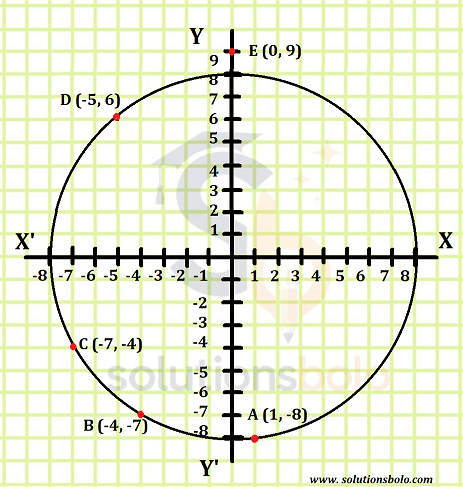
12. (ii) Given the points D (–5, 6) and E (0, 9), check whether D and E lie within the circle, on the circle, or outside the circle K.
Answer:
To determine whether points D and E lie within, on, or outside the circle K, we compare their distances from the center O(0, 0) with the radius of the circle, which is √65 units.
We will use the Distance Formula:
d = √[(x2 – x1)² + (y2 – y1)²]
Given:
Center O = (0, 0)
Radius of circle K = √65 units
Point D = (–5, 6)
Point E = (0, 9)
Step 1: Check for Point D (–5, 6)
Calculate the distance OD:
OD = √[(–5 – 0)² + (6 – 0)²]
OD = √[(–5)² + 6²]
OD = √[25 + 36]
OD = √61 units
Now, compare OD with the radius:
√61 < √65
Since the distance OD is less than the radius, point D lies within the circle K.
Step 2: Check for Point E (0, 9)
Calculate the distance OE:
OE = √[(0 – 0)² + (9 – 0)²]
OE = √[0² + 9²]
OE = √[0 + 81]
OE = √81
OE = 9 units (which is equal to √81)
Now, compare OE with the radius:
√81 > √65
Since the distance OE is greater than the radius, point E lies outside the circle K.
Conclusion:
• Point D lies within the circle.
• Point E lies outside the circle.
Note: The rules are:
• If Distance < Radius, the point lies within the circle.
• If Distance = Radius, the point lies on the circle.
• If Distance > Radius, the point lies outside the circle.
13. The midpoints of the sides of triangle ABC are the points D, E, and F. Given that the coordinates of D, E, and F are (5, 1), (6, 5), and (0, 3), respectively, find the coordinates of A, B and C.
Answer:
Let the vertices of triangle ABC be A(x1, y1), B(x2, y2), and C(x3, y3). Assume D, E, and F are the midpoints of sides BC, CA, and AB respectively.
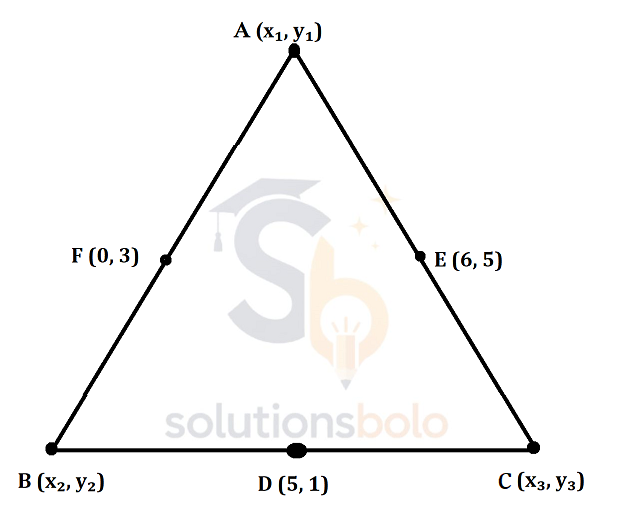
Using the Midpoint Formula, we get:
For x-coordinates:
x2 + x3 = 10 …(1)
x3 + x1 = 12 …(2)
x1 + x2 = 0 …(3)
For y-coordinates:
y2 + y3 = 2 …(4)
y3 + y1 = 10 …(5)
y1 + y2 = 6 …(6)
Step 1: Finding x-coordinates
Adding equations (1), (2), and (3):
(x2 + x3) + (x3 + x1) + (x1 + x2) = 10 + 12 + 0
2(x1 + x2 + x3) = 22
x1 + x2 + x3 = 11 …(7)
Now, find each value using equation (7):
• Subtract equation (1) from (7): x1 = 11 – 10 = 1
• Subtract equation (2) from (7): x2 = 11 – 12 = -1
• Subtract equation (3) from (7): x3 = 11 – 0 = 11
Step 2: Finding y-coordinates
Adding equations (4), (5), and (6):
(y2 + y3) + (y3 + y1) + (y1 + y2) = 2 + 10 + 6
2(y1 + y2 + y3) = 18
y1 + y2 + y3 = 9 …(8)
Now, find each value using equation (8):
• Subtract equation (4) from (8): y1 = 9 – 2 = 7
• Subtract equation (5) from (8): y2 = 9 – 10 = -1
• Subtract equation (6) from (8): y3 = 9 – 6 = 3
Conclusion: The coordinates of the vertices of triangle ABC are:
• A = (1, 7)
• B = (–1, –1)
• C = (11, 3)
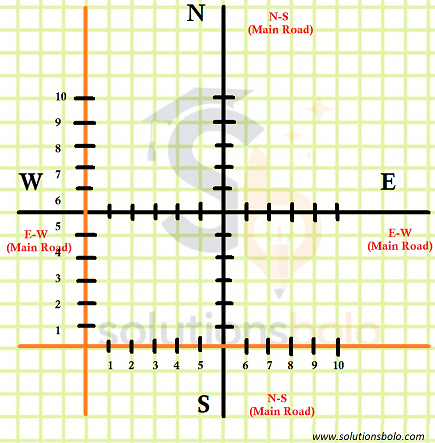
14. A city has two main roads which cross each other at the centre of the city. These two roads are along the North–South (N–S) direction and East–West (E–W) direction. All the other streets of the city run parallel to these roads and are 200 m apart. There are 10 streets in each direction.
(i) Using 1 cm = 200 m, draw a model of the city in your notebook. Represent the roads/streets by single lines.
Answer:
Model Specifications:
• Scale: 1 cm = 200 m
• Grid Structure: 10 vertical lines (N–S streets) and 10 horizontal lines (E–W streets).
• Spacing: Each consecutive line is spaced exactly 1 cm apart, forming a square grid.
(Note: Draw the above grid layout in your notebook using a scale and pencil, keeping a 1 cm distance between the lines.)
(ii) There are street intersections in the model. Each street intersection is formed by two streets – one running in the N–S direction and another in the E–W direction. Each street intersection is referred to in the following manner: If the second street running in the N–S direction and 5th street in the E–W direction meet at some crossing, then we call this street intersection (2, 5). Using this convention, find:
(a) how many street intersections can be referred to as (4, 3).
(b) how many street intersections can be referred to as (3, 4).
Answer:
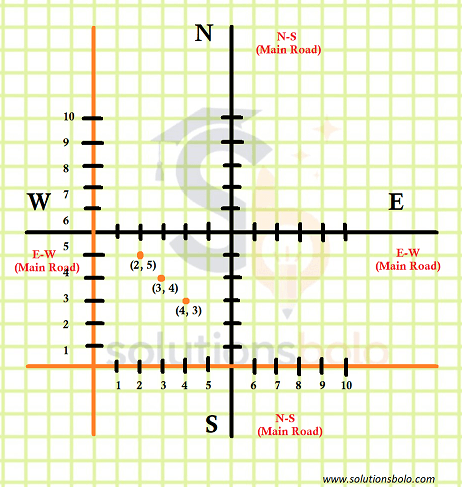
(a) There is only 1 unique street intersection that can be referred to as (4, 3).
• Reason: Only the 4th vertical street (N–S) and the 3rd horizontal street (E–W) cross each other at this specific point.
(b) There is only 1 unique street intersection that can be referred to as (3, 4).
• Reason: Only the 3rd vertical street (N–S) and the 4th horizontal street (E–W) cross each other at this specific point.
Conclusion: Both intersections (4, 3) and (3, 4) represent two completely distinct and unique positions on the city map.
15. A computer graphics program displays images on a rectangular screen whose coordinate system has the origin at the bottom-left corner.
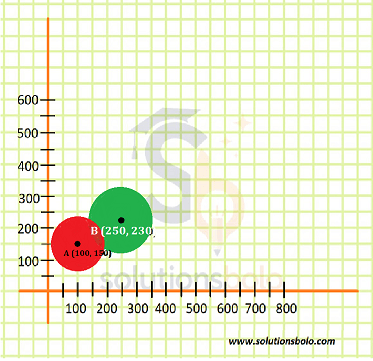
The screen is 800 pixels wide and 600 pixels high. A circular icon of radius 80 pixels is drawn with its centre at the point A (100, 150). Another circular icon of radius 100 pixels is drawn with its centre at the point B (250, 230). Determine:
(i) whether any part of either circle lies outside the screen.
(ii) whether the two circles intersect each other.
Answer:
(i) No, each of the two circles lies completely inside the screen.
• Reason: For both circles, the total horizontal (if you check graph alignment of the circle) and vertical spread fits well within the screen limits (0 to 800 pixels wide and 0 to 600 pixels high).
(ii) Yes, the two circles intersect each other as shown in the picture.
• Reason: The distance between their centres is 170 pixels, which is less than the sum of their radii (80 + 100 = 180 pixels). Hence, they overlap.
16. Plot the points A (2, 1), B (–1, 2), C (–2, –1), and D (1, –2) in the coordinate plane. Is ABCD a square? Can you explain why? What is the area of this square?
Answer:
Yes, ABCD is a square.
We can check it by finding the lengths of its sides and diagonals.
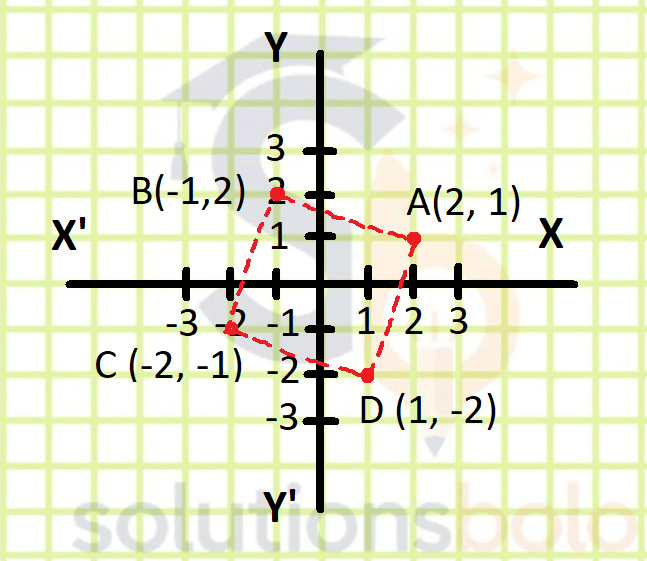
Finding the lengths of all sides:
• AB = √[(–1 − 2)² + (2 − 1)²] = √[(–3)² + 1²] = √(9 + 1) = √10
• BC = √[(–2 − (–1))² + (–1 − 2)²] = √[(–1)² + (–3)²] = √(1 + 9) = √10
• CD = √[(1 − (–2))² + (–2 − (–1))²] = √[3² + (–1)²] = √(9 + 1) = √10
• DA = √[(2 − 1)² + (1 − (–2))²] = √[1² + 3²] = √(1 + 9) = √10
All four sides are equal.
Now finding the diagonals:
• AC = √[(–2 − 2)² + (–1 − 1)²] = √[(–4)² + (–2)²] = √(16 + 4) = √20
• BD = √[(1 − (–1))² + (–2 − 2)²] = √[2² + (–4)²] = √(4 + 16) = √20
Diagonals are equal.
Since all sides are equal and both diagonals are equal, ABCD is a square.
Area of ABCD:
• Area = (side)²
• Area = (√10)² = 10 square units.