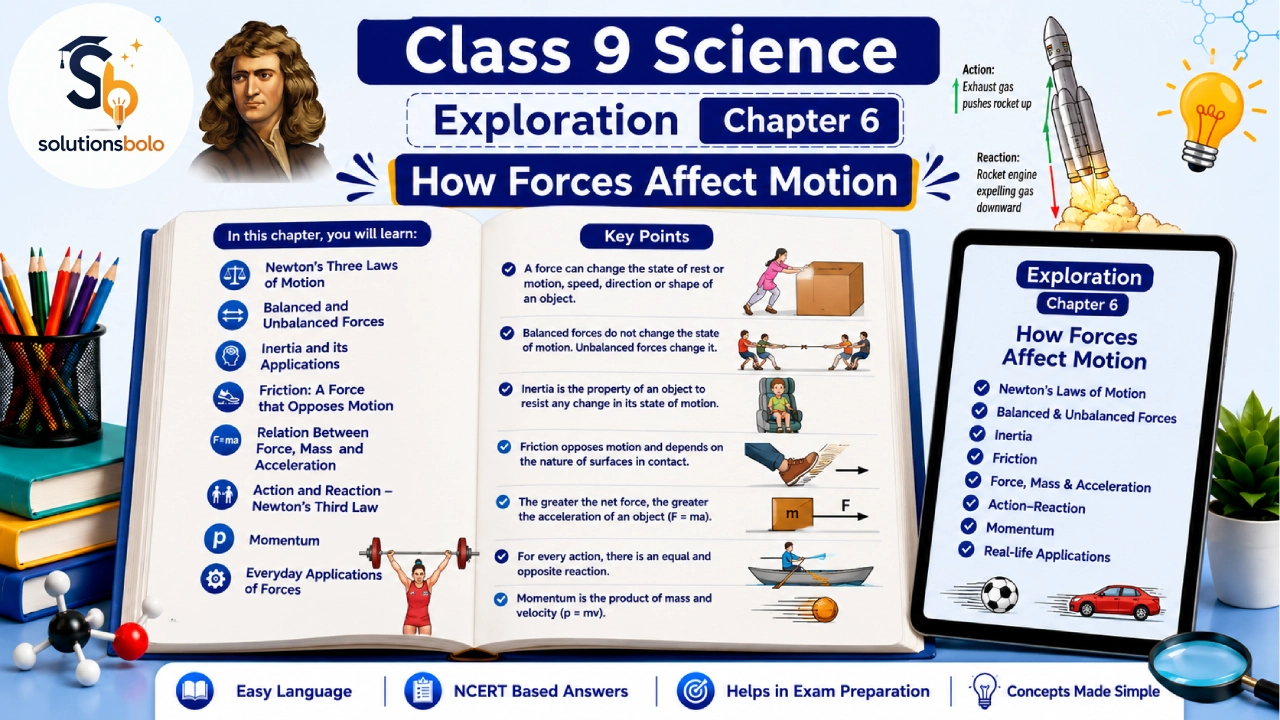
NCERT Class 9 Science Exploration Chapter 6 “How Forces Affect Motion” explains how forces influence the motion of objects through Newton’s three laws of motion. The chapter discusses balanced and unbalanced forces, inertia, acceleration, friction and the relationship between force, mass and acceleration. It explores Newton’s third law through everyday examples such as walking, rowing, rocket motion and jumping from a boat. The chapter also introduces momentum and forces acting on systems of objects. Through activities, examples, numerical problems and real-life applications, students develop a clear understanding of how forces change motion. These solutions include explanations, formulas, diagrams and competency-based questions.
Table of Contents (Quick Links):
3. NCERT Intext Questions and Answers
4. Exercise Questions and Answers
5. Scientists Mentioned in the Chapter
7. Hypothetical Based Questions Answers
8. Common Mistakes Students Make in Exams
Chapter Introduction:
While motion can be described through position, velocity and acceleration, understanding what causes or changes that motion requires exploring the concept of force. Chapter 6, How Forces Affect Motion, investigates how forces, including friction, balanced and unbalanced forces, influence the motion of objects. It introduces Sir Isaac Newton’s three laws of motion, explaining how net forces produce acceleration, how objects resist changes in their state of motion due to inertia and how interacting bodies exert equal and opposite forces on each other in everyday situations.
Keywords and Definitions:
Force (बल): Force is a push or a pull acting on an object that can change its state of rest, motion, speed, direction or shape.
Net Force (कुल या परिणामी बल): The vector sum of all individual forces acting simultaneously on a single object.
Balanced Forces (संतुलित बल): Forces acting on an object whose net force is zero, resulting in no change in the object’s state of rest or motion.
Unbalanced Forces (असंतुलित बल): Forces acting on an object whose net force is non-zero, causing an acceleration or change in velocity.
Inertia (जड़त्व): The natural tendency of an object to resist any change in its state of rest or uniform motion along a straight line.
Inertia of Rest (विराम का जड़त्व): The property of an object by which it opposes any change in its state of rest.
Inertia of Motion (गति का जड़त्व): The property of an object by which it opposes any change in its state of uniform motion.
Inertia of Direction (दिशा का जड़त्व): The property of an object by which it opposes any change in its direction of motion.
Mass (द्रव्यमान): The quantitative measure of the amount of matter in an object and the fundamental measure of its inertia.
Newton’s First Law of Motion (न्यूटन का गति का पहला नियम): States that an object remains at rest or continues to move with constant velocity unless acted upon by an unbalanced external force.
Linear Momentum (रेखीय संवेग): The product of the mass of an object and its velocity (p = m x v).
Velocity (वेग): The rate of change of displacement of an object in a specific direction.
Acceleration (त्वरण): The rate of change of velocity of an object per unit time (a = (v – u) / t).
Deceleration / Retardation (मंदता): Negative acceleration that occurs when the speed of an object decreases over time.
Newton’s Second Law of Motion (न्यूटन का गति का दूसरा नियम): States that the rate of change of momentum of an object is directly proportional to the applied net force and takes place in the direction of the force (F = m x a).
Newton (N) (न्यूटन): The SI unit of force. 1 Newton is the force required to accelerate a 1 kg mass at 1 m/s².
Newton’s Third Law of Motion (न्यूटन का गति का तीसरा नियम): States that to every action force, there is always an equal and opposite reaction force.
Action Force (क्रिया बल): The initial force exerted by one object onto another during an interaction.
Reaction Force (प्रतिक्रिया बल): The equal and opposite force exerted back by the second object onto the first during an interaction.
Friction / Frictional Force (घर्षण बल): The contact force that opposes the relative motion between two surfaces in contact.
Gravity / Gravitational Force (गुरुत्वाकर्षण बल): The attractive force exerted by the Earth (or any massive body) pulling objects toward its center.
Impact Time (प्रभाव का समय): The duration for which a force acts during a collision or interaction.
External Force (बाहरी बल): A force originating from outside the considered system acting upon an object within the system.
Contact Force (संपर्क बल): A force that acts between two objects only when they are physically touching each other.
Constant Velocity (अचर वेग): Motion at a constant speed along a straight line, where acceleration and net force are both equal to zero.
Intext Questions and Answers:
1. Why does a canoe move forward when the canoeist pushes water backwards with their paddle and why does it move faster when they push harder?
[Concept: According to Newton’s third law of motion, when a canoeist pushes water backwards (action), the water exerts an equal and opposite force on the paddle forward (reaction). Pushing harder increases this reaction force.]
Answer: When the paddle pushes water backwards, the water simultaneously pushes the paddle and canoe forward with an equal magnitude of force. Since these action and reaction forces act on different objects, they do not cancel each other out, causing the canoe to move forward. Furthermore, according to Newton’s second law (F = ma), acceleration is directly proportional to the force. Pushing harder creates a larger forward reaction force, resulting in greater acceleration and faster motion
2. Suppose the same canoeist uses the same paddle force in two different canoes, one empty and one carrying another passenger. In which case will the canoe move faster?
[Concept: According to Newton’s second law of motion, the acceleration produced by a given force is inversely proportional to the mass of the object (a = F/m). Therefore, the empty canoe will move faster.]
Answer: The empty canoe has less total mass than the canoe carrying an extra passenger. When the canoeist applies the same paddling force to both, Newton’s second law dictates that the canoe with smaller mass experiences a larger acceleration. Because the empty canoe accelerates more under the same force, its velocity increases more rapidly, allowing it to move faster than the heavier canoe.
3. What if the force of friction disappears in the world? How will the motion of objects be impacted?
[Concept: According to Newton’s first law of motion, an object in motion continues to move with constant velocity unless a net force acts upon it. Without friction, no opposing force acts on moving objects, causing them to continue moving indefinitely.]
Answer: Friction is the opposing force that slows down moving objects and allows us to control motion. If friction disappears, any moving object will never slow down or stop on its own. Additionally, basic everyday actions that rely on friction to start, direct or stop motion—such as walking, driving, pedalling a bicycle or applying brakes—would become impossible, as surfaces would slip continuously without creating traction.
Pause and Ponder
1. A weightlifter lifts a barbell (Fig. 6.8). List two forces that are acting on the barbell. Are these forces balanced if the weightlifter keeps the barbell steady?
[Concept: When an object remains steady at rest, the net force acting on it is zero. This means all forces acting on the object are equal in magnitude and opposite in direction, making them balanced forces.]
Answer: The two forces acting on the barbell are the downward gravitational force (weight) exerted by the Earth and the upward force applied by the weightlifter’s hands. When the weightlifter keeps the barbell steady, the barbell does not move. According to Newton’s first law, the upward force applied by the weightlifter exactly equals the downward gravitational force, making these two forces balanced.
2. Two players R and S are participating in an arm-wrestling match (Fig. 6.9). At the instant, when the arms tilt to the front direction (out of the page towards you), are the forces exerted by the players balanced? If not, which player exerted the larger force?
[Concept: When forces are equal and opposite, they are balanced and no motion occurs. If motion takes place in a direction, the forces are unbalanced and a net force acts along the direction of the larger force.]
Answer: The forces exerted by the players are not balanced because the arms tilt and move. When forces are unbalanced, a non-zero net force acts on the object, causing motion in the direction of the force of larger magnitude. Therefore, whichever player exerted force towards the front direction applied the force of larger magnitude.
3. An object is moving with a constant velocity. Is there a net force acting upon it?
[Concept: According to Newton’s first law of motion, an object continues to move with constant velocity unless a net force acts upon it. Since constant velocity means zero acceleration (a = 0), no net force acts on the object.]
Answer: Constant velocity means that there is no change in speed or direction, which gives an acceleration of zero (a = 0). By Newton’s second law, Net Force = mass x acceleration (F = ma). Substituting a = 0 gives Net Force = m x 0 = 0 N. Therefore, the net force acting on an object moving with constant velocity is zero.
4. Suppose, no net force is acting on an object. Which of the following situations are possible?
(i) Object remains at rest if at rest.
(ii) Object keeps moving with a constant velocity if already moving.
(iii) Object is moving with a constant acceleration.
[Concept: According to Newton’s first law of motion, when the net force acting on an object is zero, its acceleration is zero (a = 0). Therefore, the object either stays at rest or continues moving with a constant velocity. Situations (i) and (ii) are possible, whereas situation (iii) is not possible]
Answer: Newton’s first law states that an object maintains its state of rest or uniform motion in a straight line unless a net force acts upon it. When net force is zero, velocity cannot change, which means acceleration must be zero. Consequently, an object at rest remains stationary (i) and a moving object continues with constant velocity (ii). Situation (iii) is not possible because non-zero acceleration always requires a non-zero net force (F = ma).
5. In the real world, it is difficult to find a situation where no forces are acting on an object. But by applying additional forces, a condition can be achieved where the net force on the object is zero. Explain with the help of an example.
[Concept: When multiple forces act on an object, an additional force equal in magnitude and opposite in direction can be applied to balance them, making the net force zero.]
Answer: Consider a box kept on a floor. The downward gravitational force is balanced by the upward normal force exerted by the floor. When you apply a force to push the box forward, the force of friction opposes it in the backward direction. If you apply a pushing force that is exactly equal in magnitude to the frictional force, the two opposing forces balance each other. Consequently, the net force on the box becomes zero, allowing it to move at a constant velocity according to Newton’s first law.
6. A toy car of mass 100 g is moving with a constant velocity of 0.5 m s–1. What is the net force acting on the toy car?
[Concept: When an object moves with a constant velocity, its speed and direction do not change, so its acceleration is zero (a = 0). According to Newton’s first and second laws, zero acceleration means the net force acting on the object is zero.]
Answer: The toy car moves with a constant velocity of 0.5 m s–1, which means there is no change in velocity over time. Since acceleration is the rate of change of velocity, acceleration a = 0 m s–2. Converting mass to SI units gives m = 100 g = 0.1 kg. Using Newton’s second law of motion, Net Force = mass x acceleration (F = ma) gives Net Force = 0.1 kg x 0 m s–2 = 0 N. Thus, the net force acting on the toy car is zero.
7. Two children of different masses are sitting on identical swings. To impart identical initial acceleration, for which child would you require to apply a larger force? Explain why.
[Concept: According to Newton’s second law of motion (F = ma), for a given acceleration, the required force is directly proportional to the mass of the object. Therefore, the child with larger mass requires a larger force.]
Answer: A larger force is required for the child with the larger mass. Newton’s second law states that Force = mass x acceleration (F = ma). When both children are given the same initial acceleration (a), the force needed depends entirely on their mass (m). A heavier child has more mass and greater inertia, meaning they resist a change in motion more than a lighter child. Consequently, to produce the same acceleration, a force of greater magnitude must be applied to the child with larger mass.
8. How are glass items packed for transportation using a bubble wrap or hay protected from damage?
[Concept: Bubble wrap or hay increases the time duration over which a sudden impact occurs. By increasing the time taken for velocity to reduce, the acceleration and resulting impact force are significantly reduced.]
Answer: During shocks or falls in transit, packing materials like bubble wrap or hay compress easily, which increases the time duration taken for the glass items to slow down or stop. According to Newton’s second law, increasing the time of impact decreases the rate of change of velocity (acceleration). Since Force = mass x acceleration (F = ma), a smaller acceleration results in a much smaller force acting on the fragile glass items, preventing them from breaking.
9. Why does a fireperson sometimes struggle when holding the pipe issuing water?
Concept: According to Newton’s third law of motion, whenever an object exerts a force on another object, the second object exerts an equal and opposite force on the first. The forward rush of water creates a backward reaction force.
Answer: When a hose pipe issues water at high speed, the water molecules are pushed forward with a large force. In response, the exiting water exerts an equal and opposite reaction force on the pipe in the backward direction (Newton’s third law). This strong recoil force pushes the pipe backward, making it tend to push away or slip, so the fireperson must exert significant physical effort to hold it steady.
10. Suppose a spacecraft is moving in a region of space where the gravitational force acting upon it is negligible. Suggest how can it change its velocity.
[Concept: According to Newton’s third law of motion, expelling gas in one direction exerts an equal and opposite reaction force on the spacecraft. This net force (F = ma) causes acceleration and changes velocity.]
Answer: The spacecraft can change its velocity by firing its thruster engines to expel exhaust gases.
In deep space with no external friction or gravity, a spacecraft relies on its rocket engines. When the thrusters burn fuel and expel exhaust gases rapidly in one direction, the escaping gases push back against the spacecraft with an equal and opposite force. This unbalanced reaction force creates acceleration in the desired direction, allowing the spacecraft to speed up, slow down or alter its path.
Exercise Questions and Answers:
1. Using a horizontal force F, a table is moved across the floor at a constant velocity. How much is the frictional force exerted by the floor on the table?
[Concept: When an object moves with a constant velocity, its acceleration is zero. According to Newton’s first law of motion, the net force acting on the object must be zero.]
Answer: The frictional force exerted by the floor on the table is equal to F in magnitude and acts in the direction opposite to the applied force.
Moving at a constant velocity means there is no change in speed or direction. According to Newton’s first law, the applied horizontal force F must be balanced by an opposing force of equal magnitude. Since the force of friction acts in the direction opposite to motion, the floor exerts a frictional force of magnitude F backwards. As a result, the net force becomes zero (F – F = 0), allowing the table to continue moving smoothly at constant velocity.
2. For a ball moving on a smooth frictionless surface, choose the appropriate option that will make the following statements physically correct.
(i) If no net force is applied on the ball, the velocity of the ball will remain the same/increase/decrease.
(ii) If a net force is applied on the ball in the direction of its motion, the magnitude of the velocity of the ball will remain the same/ increase/decrease.
(iii) If a net force is applied on the ball in a direction opposite to the direction of its motion, the magnitude of the velocity of the ball will remain the same/increase/decrease.
[Concept: According to Newton’s laws of motion, a net force is required to change velocity. Without a net force, velocity stays constant, while applying a force in or against the direction of motion changes its speed.]
Answer: (i) remain the same (ii) increase (iii) decrease
(i) When no net force acts on the ball, its acceleration is zero, so the velocity will remain the same according to Newton’s first law. (ii) Applying a net force in the direction of motion produces acceleration in that direction, causing the magnitude of velocity to increase. (iii) Applying a net force in the direction opposite to motion opposes the movement, causing the magnitude of velocity to decrease.
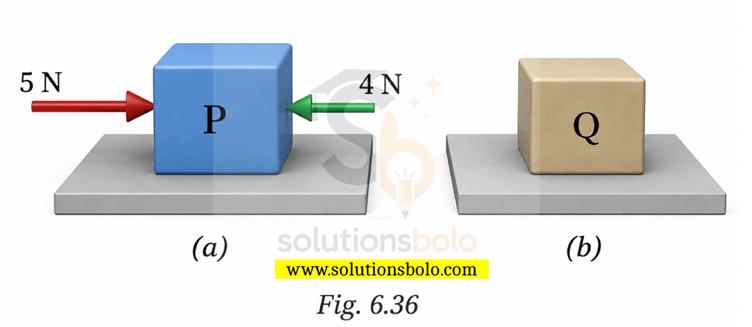
3. Two blocks P and Q on a smooth horizontal surface are shown in Fig. 6.36a and Fig. 6.36b. Two forces of magnitudes 4 N and 5 N are acting in opposite directions on block P, while block Q is moving with a constant velocity.
Which of the following statement is correct?
(i) P experiences a net force and Q does not experience a net force.
(ii) P does not experience a net force and Q experiences a net force.
(iii) Both P and Q experience a net force.
(iv) Neither P nor Q experiences a net force
[Concept: Opposing forces of unequal magnitude produce a non-zero net force. Conversely, an object moving with constant velocity has zero acceleration, meaning no net force acts on it.]
Answer: (i) P experiences a net force and Q does not experience a net force.
For block P, two opposing forces of 5 N and 4 N act on it, creating an unbalanced net force of 1 N (5N – 4N = 1N) in the direction of the larger force. For block Q, because it is moving with a constant velocity, its acceleration is zero, which means the net force acting on it is zero according to Newton’s first law. Therefore, statement (i) is correct.
4. While practising for the snake boat race (Vallum kalli in Kerala), 100 oarsmen are rowing a boat together. Out of these, 95 row backwards to propel the boat forward. But by mistake, 5 oarsmen row in the opposite direction. If each oarsman applies a horizontal force of 200 N, what is the net force on the snake boat? (Ignore drag forces, air friction, etc.)
[Concept: When multiple forces act on an object in opposite directions, the magnitude of the net force is equal to the difference between the forces and its direction is along the force of larger magnitude.]
Answer: The 95 oarsmen apply a force to propel the boat forward, while the 5 mistaken oarsmen apply a force in the backward direction.
Forward force = 95 x 200 N = 19000 N
Backward force = 5 x 200 N = 1000 N
Net force = Forward force – Backward force
= 19000 N – 1000 N = 18000 N.
Thus, the net force acting on the boat is 18000 N pointing in the forward direction.
5. When a net force acts on an object, we observe that the object accelerates:
(i) opposite to the direction of force, with acceleration proportional to the force acting on the object.
(ii) opposite to the direction of force, with acceleration proportional to the mass of the object.
(iii) in the direction of force, with acceleration inversely proportional to the force acting on the object.
(iv) in the direction of force, with acceleration proportional to the force acting on the object.
[Concept: According to Newton’s second law of motion, when a net force acts on an object, it accelerates in the direction of the net force. The acceleration is directly proportional to the force and inversely proportional to the mass (a = F/m).]
Answer: (iv) in the direction of force, with acceleration proportional to the force acting on the object.
Newton’s second law states that force equals mass times acceleration (F = ma or a = F/m). This mathematical relationship shows two things: first, the object accelerates in the exact direction in which the net force is applied and second, increasing the net force increases the acceleration proportionally for a given mass. Therefore, statement (iv) is correct.
6. The position-time graph for four objects A, B, C and D moving along a straight line are given in Fig. 6.37. A net force acts on:
(i) Object A
(ii) Object B
(iii) Object C
(iv) Object D
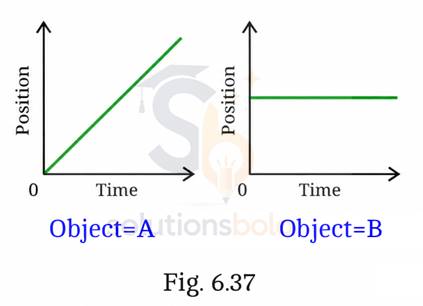
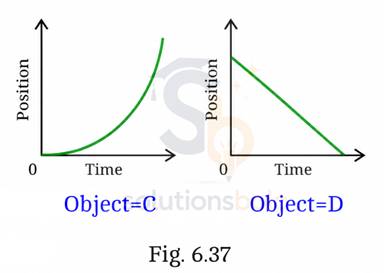
[Concept: A net force acts on an object only when its velocity changes over time (accelerated motion). In a position-time graph, a curved line represents changing velocity and non-zero acceleration.]
Answer: (iii) Object C
For objects A and D, the position-time graphs are straight inclined lines, indicating motion with constant velocity, so their acceleration and net force are zero. Object B is at rest as its position remains constant over time, meaning no net force acts on it. Object C has a curved position-time graph, which means its slope (velocity) changes continuously with time. A changing velocity implies non-zero acceleration, which according to Newton’s second law (F = ma), requires a net force to act on the object. Therefore, option (iii) is correct.
7. A sailor jumps out from a small boat to the shore (Fig. 6.38). As the sailor jumps forward, will the boat move? If yes, in which direction and why.
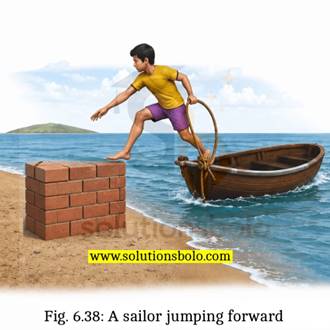
[Concept: According to Newton’s third law of motion, whenever one object exerts a force on a second object, the second object simultaneously exerts an equal and opposite force on the first. Action and reaction forces are always equal in magnitude and opposite in direction.]
Answer: Yes, the boat will move in the backward direction (away from the shore).
To jump forward toward the shore, the sailor exerts a force on the boat in the backward direction using his feet (action). In response, the boat exerts an equal force on the sailor in the forward direction (reaction), propelling him onto the shore. Because the action force applied by the sailor’s feet acts directly on the boat in the backward direction, the boat moves backward away from the shore.
8. During a high jump event, a landing mat or sand bed is placed for the athlete to fall upon (Fig. 6.39). Explain the reason behind it.
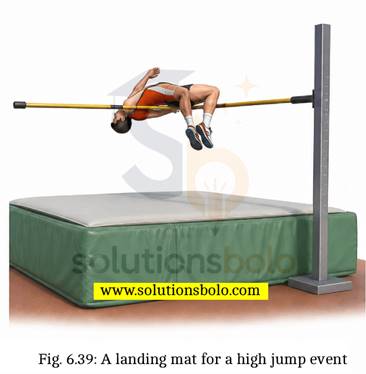
[Concept: A cushioned mat or sand bed increases the time taken by the falling athlete to come to rest. By increasing the stopping time, the rate of change of velocity (acceleration) decreases, significantly reducing the impact force acting on the athlete.]
Answer: When a high jumper lands, they have a high downward velocity. Landing on a soft mat or sand bed allows the surface to sink in, which increases the time duration (Δt) required for the athlete’s velocity to reduce to zero.
According to Newton’s second law (f = ma), acceleration is inversely proportional to the stopping time (Δt↑⇒a↓). A longer landing time produces a much smaller acceleration, resulting in a smaller impact force on the athlete’s body and preventing serious injury.
9. A hand cart loaded with vegetables collides with an identical but empty hand cart. During the collision:
(i) the loaded cart exerts a force of larger magnitude on the empty cart.
(ii) the empty cart exerts a force of larger magnitude on the loaded cart.
(iii) neither cart exerts a force on the other.
(iv) the loaded cart and the empty cart, both exert an equal magnitude of force on each other.
[Concept: According to Newton’s third law of motion, whenever two objects interact or collide, they exert forces on each other that are equal in magnitude and opposite in direction, regardless of their masses.]
Answer: (iv) the loaded cart and the empty cart, both exert an equal magnitude of force on each other.
During the collision, the loaded cart exerts a force on the empty cart (action) and simultaneously, the empty cart exerts an equal and opposite force on the loaded cart (reaction). Although the loaded cart has a larger mass and will undergo a smaller acceleration than the empty cart (a = F/m), the magnitude of the contact force acting between them during impact remains exactly equal. Therefore, option (iv) is correct.
10. The acceleration-mass graph for the acceleration produced by a force on objects of different masses is plotted in Fig. 6.40. Plot the force-mass graph for this case.
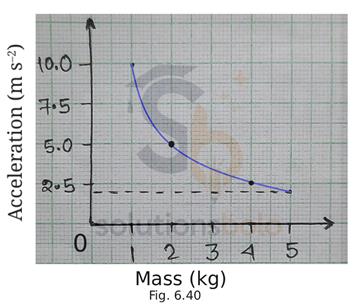
[Concept: According to Newton’s second law of motion, Force = mass x acceleration (F = ma). Calculating the product of mass and acceleration at various points on the given graph shows that the applied force remains constant regardless of the mass.]
Answer: From the given acceleration-mass graph (Fig. 6.40), let us calculate the force (F = ma) for different mass values:
For mass m = 1 kg, acceleration a = 10 m s⁻²: Force F = 1 kg x 10 m s⁻² = 10 N
For mass m = 2 kg, acceleration a = 5 m s⁻²: Force F = 2 kg x 5 m s⁻² = 10 N
For mass m = 4 kg, acceleration a = 2.5 m s⁻²: Force F = 4 kg x 2.5 m s⁻² = 10 N
For mass m = 5 kg, acceleration a = 2 m s⁻²: Force F = 5 kg x 2 m s⁻² = 10 N
Since the value of force remains fixed at 10 N for all masses, when you plot Force on the Y-axis and Mass on the X-axis, the resulting graph is a straight horizontal line parallel to the Mass axis at Y = 10 N.
11. The velocity-time graph of an object of mass 10 kg moving along a straight line is shown in Fig. 6.41. Calculate the force acting on the object by using the graph.
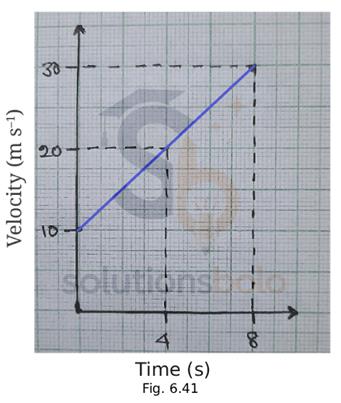
[Concept: The slope of a velocity-time graph gives the acceleration of an object. According to Newton’s second law (F = ma), multiplying this acceleration by the object’s mass gives the net force acting on it.]
Answer: From the graph (Fig. 6.41), at time t = 0 s, velocity u = 10 m/s⁻¹ and at t = 4 s, velocity v = 20 m/s⁻¹.
Acceleration, a = (v – u) / t = (20 – 10) / 4 = 2.5 m/s⁻².
Given mass, m = 10 kg.
Using Newton’s second law:
Force, F = m x a = 10 kg x 2.5 m/s⁻² = 25 N.
Thus, the force acting on the object is 25 N.
12. A bullet of mass 50 g moving with a speed of 100 m s⁻¹ enters a heavy stationary wooden block and stops after penetrating a distance of 50 cm. Estimate the stopping force acting on the bullet (assume that the bullet undergoes constant acceleration within the block).
[Concept: The deceleration of an object can be determined using kinematic equations from its initial velocity, final velocity and stopping distance. Newton’s second law (F = ma) then determines the required opposing stopping force.]
Answer: Converting the given values to SI units:
Mass, m = 50 g = 0.05 kg
Initial velocity, u = 100 m/s⁻¹
Final velocity, v = 0 m/ s⁻¹
Distance, s = 50 cm = 0.5 m
Using the third equation of motion (v² = u² + 2as):
0² = (100)² + 2 x a x 0.5
0 = 10000 + 1a
a = – 10000 m/s²
Using Newton’s second law (F = ma):
Stopping Force, F = 0.05 kg x (-10000 m/s²) = -500 N.
The negative sign indicates that the 500 N force acts in the direction opposite to the bullet’s motion.
13. An ace footballer converted a penalty shot by kicking the football with a speed of 108 km h⁻¹. The estimated force they imparted was 800 N. The mass of the football was 0.4 kg. Calculate the time of contact between their foot and the ball.
[Concept: The force applied to an object causes it to accelerate according to Newton’s second law (F = ma). The time of contact can then be found using the relation between acceleration, initial velocity, final velocity and time (a = (v – u) / t).]
Answer: Given data in SI units:
Initial velocity of the stationary ball, u = 0 m/s⁻¹
Final velocity, v = 108 km/h⁻¹
= 108 x (5 / 18) = 30 m/s⁻¹
Mass of the football, m = 0.4 kg
Applied force, F = 800 N
Using Newton’s second law:
F = m x a
800 = 0.4 x a
a = 800 / 0.4
= 2000 m/s⁻²
Now using the kinematic equation:
a = (v – u) / t
2000 = (30 – 0) / t
t = 30 / 2000
= 0.015 s
Thus, the time of contact between the foot and the ball is 0.015 seconds.
14. An object of mass 2 kg moving with a constant velocity of 10 m s⁻¹ encounters a rough patch where the force of friction on the object is 7 N. At the same time, an additional constant force of 3 N opposing the motion is applied on the object. After entering the rough patch, how much distance does the object travel before coming to rest?
[Concept: When multiple opposing forces act on a moving object, they add up to form a total retarding force (Fnet). This net force produces deceleration (a = Fnet /m) according to Newton’s second law (F = ma), which can be used to calculate the stopping distance using kinematic equations (v² = u² + 2as).]
Answer: Given data:
Mass of the object, m = 2 kg
Initial velocity, u = 10 m/s⁻¹
Final velocity, v = 0 m/s⁻¹
Frictional force = 7 N (opposing motion)
Additional force = 3 N (opposing motion)
Total opposing net force:
Fnet = 7 N + 3 N = 10 N (in direction opposite to motion)
Using Newton’s second law:
Fnet = m x a
-10 = 2 x a
a = -5 m/s⁻²
Using the third equation of motion (v² = u² + 2as):
0² = 10² + 2 x (-5) x s
0 = 100 – 10s
10s = 100
s = 10 m
Therefore, the object travels a distance of 10 meters before coming to rest.
15. A tractor pulls a harrow (a ploughing tool) of mass m₁ with a net force F resulting in an acceleration of a₁. The same tractor pulls a trolley of mass m₂ with a force F producing an acceleration of a₂. If the tractor now pulls the trolley with the harrow placed on it (with the same force F), then obtain an expression for the resulting acceleration in terms of a₁ and a₂. Ignore friction.
[Concept: According to Newton’s second law (F = ma) force equals mass times acceleration. When connected objects move together as a single system, their masses add up and the resulting acceleration is given by dividing the total force by the total mass.]
Answer: For the harrow: F = m₁a₁
So, m₁ = F/a₁
For the trolley: F = m₂a₂
So, m₂ = F/a₂
When both are together:
Total mass = m₁ + m₂
Let resulting acceleration be a.
Then, F = (m₁ + m₂)a
Substituting values of m₁ and m₂:
F = (F/a₁ + F/a₂)a
⇒ F = F(1/a₁ + 1/a₂)a
⇒ 1 = (1/a₁ + 1/a₂)a
⇒ a = 1/(1/a₁ + 1/a₂)
⇒ a = 1 / ((a₂ + a₁)/(a₁a₂))
Therefore, a = (a₁a₂)/(a₁ + a₂)
The resulting acceleration is a = (a₁a₂)/(a₁ + a₂).
16. When the pole of a bar magnet is brought close to a magnetic compass, the bar magnet and the compass needle (which is also a magnet) exert a magnetic force on each other. As per Newton’s third law of motion, both the forces are equal in magnitude and opposite in direction. However, the compass needle moves, whereas the bar magnet does not move (Fig. 6.42). Explain why.
[Concept: According to Newton’s third law, interacting objects exert forces of equal magnitude on each other. However, according to Newton’s second law (a = F/m), equal forces do not produce equal accelerations because acceleration is inversely proportional to mass.]
Answer: The compass needle moves because its mass is extremely small compared to the large mass of the bar magnet.
While the magnetic force exerted on the compass needle and the bar magnet is equal in magnitude, their masses are significantly different. The compass needle has a very small mass (m), so the force produces a large, visible acceleration (a = F/m), causing it to pivot quickly. In contrast, the bar magnet has a much larger mass (M), resulting in an extremely small acceleration (a = F/M), that is too tiny to produce any observable movement.
Scientists Mentioned in this Chapter:
1. Galileo Galilei
Year: 1608 – 1638
Contribution: Conducted inclined plane experiments (1608) and published “Two New Sciences” (1638), establishing the concept of inertia and proving that an object continues moving with constant velocity if no net external force acts on it.
2. Sir Isaac Newton
Year: 1687
Contribution: Published “Philosophiae Naturalis Principia Mathematica” in 1687, presenting the three fundamental laws of motion, defining momentum and formulating the mathematical law of force (F = ma).
Competency Based Questions and Answers:
1. A cyclist suddenly applies the brakes while moving on a road. The bicycle slows down and eventually stops. Explain why the bicycle does not continue moving even though no one is pushing it backwards. Identify the force responsible for this change in motion.
[Concept: According to Newton’s first law, an object continues with constant velocity unless a net force acts on it. Newton’s second law explains the resulting change in motion.]
Answer: When a cyclist applies brakes, friction between the tyres and road acts opposite to the direction of motion. This produces a net force opposite to the bicycle’s velocity. According to Newton’s second law, F = ma, the net force produces acceleration opposite to the motion, so the bicycle decelerates. As long as this braking force continues to act, the bicycle’s velocity decreases until it becomes zero and the bicycle stops.
2. An empty trolley and a trolley loaded with books are pushed with the same horizontal force on the same floor. The empty trolley accelerates faster than the loaded trolley. Explain why. What will happen to the acceleration if the applied force is doubled while the mass remains unchanged?
[Concept: According to Newton’s second law, acceleration is directly proportional to net force and inversely proportional to mass. The relationship is a = F/m.]
Answer: The empty trolley has less mass than the loaded trolley. For the same applied force, Newton’s second law gives a = F/m, so the trolley with smaller mass has greater acceleration. Therefore, the empty trolley gains velocity more rapidly. If the same force is doubled while the mass remains unchanged, the acceleration also doubles. Thus, both mass and applied force determine the acceleration produced by a given net force.
3. A rocket is moving upward after its engine starts expelling gases downward. If the engine produces a greater thrust while the mass of the rocket remains unchanged, what will happen to the rocket’s acceleration? Explain the direction of the forces involved and why the rocket moves upward.
[Concept: According to Newton’s third law, the gases expelled downward exert an equal and opposite force on the rocket. According to Newton’s second law, a = F/m, greater net force produces greater acceleration.]
Answer: The rocket engine expels gases downward and the gases exert an equal and opposite force upward on the rocket. When this upward thrust is greater than the rocket’s weight, the net force acts upward and the rocket accelerates upward. If the thrust is increased while the rocket’s mass remains unchanged, the net upward force increases. Therefore, according to a = F/m, the rocket’s upward acceleration also increases.
Hypothetical Based Questions and Answers:
1. Suppose a spacecraft is moving in deep space where gravitational force and other external forces are negligible. If its engines are switched off, what will happen to its velocity? If the spacecraft needs to change its velocity, what must it do?
[Concept: According to Newton’s first law of motion, an object continues to move with constant velocity when no net external force acts on it. A change in velocity requires a net force.]
Answer: If the spacecraft is moving with a certain velocity and its engines are switched off, it will continue moving with the same velocity because the net external force is negligible. It will neither speed up nor slow down. To change its velocity, the spacecraft must produce a net force by operating its engines. According to Newton’s second law, F = ma, this force will produce acceleration and change its velocity.
2. Suppose two identical carts are initially at rest on a smooth horizontal surface. A force of 20 N is applied to the first cart, while a force of 40 N is applied to the second cart. Which cart will acquire greater acceleration? If their masses are equal, compare their accelerations.
[Concept: According to Newton’s second law of motion, acceleration is directly proportional to the net force when the mass remains constant. The relationship is a = F/m.]
Answer: Since both carts have equal masses, their accelerations depend directly on the forces applied to them. For the first cart, a1 = 20/m, while for the second cart, a2 = 40/m. Therefore, a2 = 2a1. The second cart will acquire twice the acceleration of the first cart because twice the force is applied to a body of the same mass.
3. Suppose a person is standing on a skateboard and throws a heavy ball forward. The person and skateboard move backward immediately after the ball is thrown. Explain why this happens even though the person intended to move the ball only forward.
[Concept: According to Newton’s third law, forces always occur in equal and opposite pairs acting on different interacting objects. The resulting acceleration depends on the mass of each object.]
Answer: When the person throws the ball forward, they exert a forward force on the ball. At the same time, the ball exerts an equal and opposite force on the person’s hands. This backward force is transmitted to the person and skateboard, causing them to move backward. Since the skateboard and person can move freely, the reaction force produces backward acceleration. Thus, the backward motion is a consequence of Newton’s third law.
Common Mistakes make By Students (with Exam Tips):
1. Believing Action and Reaction Forces Cancel Each Other Out
The Error: Assuming that because action and reaction forces are equal in magnitude and opposite in direction, the net force is zero and no motion can occur.
The Correction: Action and reaction forces act on two different objects. Forces can only cancel out if they act on the same object. For instance, when rowing a canoe, the paddle exerts a force on the water and the water exerts a reaction force on the paddle.
2. Thinking a Continuous Net Force is Needed to Maintain Motion
The Error: Assuming an object moving at constant velocity must have a continuous net forward force acting on it.
The Correction: According to Newton’s First Law, if an object moves at a constant velocity (constant speed in a straight line), its acceleration is zero (a = 0), which means the net force is zero (Fnet = 0). Any applied forward force in real life is merely balancing opposing forces like friction.
3. Assuming Equal Action-Reaction Forces Cause Equal Acceleration
The Error: Expecting interacting objects to move or accelerate identically because the forces between them are equal (Newton’s Third Law).
The Correction: Acceleration depends on mass (a = F / m). While the interactive forces are identical, the object with a much smaller mass experiences a much larger acceleration (e.g., a gun recoiling vs. a bullet firing or a compass needle pivoting vs. a bar magnet remaining still).
4. Misinterpreting Position-Time (s-t) vs. Velocity-Time (v-t) Graphs
The Error: Treating a straight, sloped line on a position-time graph as an accelerating object with a net force.
The Correction: On a Position-Time graph, a straight sloped line indicates constant velocity (a = 0 → Fnet = 0). A net force only exists if the line is curved.
On a Velocity-Time graph, a straight sloped line indicates constant acceleration (a ≠ 0 → Fnet ≠ 0).
5. Forgetting SI Unit Conversions in Numerical Problems
The Error: Plugging mass in grams (g), distance in centimeters (cm) or speed in km/h directly into F = ma or kinematic equations.
The Correction: Always convert values to standard SI units before applying formulas:
Mass: g to kg (divide by 1000)
Distance: cm to m (divide by 100)
Speed: km/h to m/s (multiply by 5/18)
| Exam Tips & Strategies: |
The 3-Step Numerical Rule:
1. Write down all given values and convert them immediately to SI units.
2. Calculate the Net Force (Fnet = Fapplied – Ffriction) before using F = ma.
State the final answer with its correct unit (N, m/s² or kg).
Combined Mass / System Problems: When two or more objects are pulled together by the same force F (e.g., tractor pulling trolley + harrow), combine their masses (mtotal = m₁ + m₂) to find the system acceleration using a = F / (m₁ + m₂).
Conceptual Reasoning Questions: When asked “why” something happens in daily life (e.g., catching a cricket ball, vehicle airbags, jumping off a boat):
Name the specific Newton’s Law or principle involved.
Explicitly state the relationship between impact time (Δt), acceleration (a) and force (F).
Frequently Asked Questions (FAQs):
1. Why do we fall forward when a moving bus suddenly stops?
Answer: We fall forward due to the Inertia of Motion. When the bus stops, the lower part of our body comes to rest along with the bus, but the upper part tends to stay in its state of motion at the same speed.
2. Is a continuous force required to keep an object moving with a constant velocity?
Answer: No. An object moving with constant velocity has zero acceleration, which means the net external force is zero (Fnet = 0 N). An applied force is only needed to balance opposing forces like friction.
3. If action and reaction forces are equal and opposite, why do they not cancel each other out?
Answer: Action and reaction forces do not cancel each other out because they act on two different objects, whereas forces can only cancel each other if they act on the exact same object.
4. Why does a fielder pull their hands backward while catching a fast cricket ball?
Answer: Pulling hands backward increases the time duration of the impact, which decreases the rate of change of momentum and significantly reduces the force exerted on the fielder’s hands.
5. Why is Newton’s First Law of Motion also called the ‘Law of Inertia’?
Answer: It is called the Law of Inertia because it describes the natural property of all objects to resist any change in their state of rest or uniform motion along a straight line.
6. Why does a gun recoil backward when a bullet is fired from it?
Answer: According to Newton’s Third Law (and the Law of Conservation of Momentum), the forward force exerted on the bullet (action) produces an equal and opposite backward force on the gun (reaction).
7. Why does a heavier object have more inertia than a lighter object?
Answer: Mass is the direct quantitative measure of inertia. The greater the mass of an object, the greater its resistance to any change in its state of rest or motion.
8. What is the definition of 1 Newton (1 N) of force?
Answer: 1 Newton is defined as the amount of force required to accelerate a mass of 1″ kg” at a rate of 1 m s⁻² (1N = 1 kg x 1 m s⁻²).
9. What is the SI unit of momentum?
Answer: The SI unit of linear momentum is kilogram meter per second (kg m s⁻¹ or kg m.s) derived from the formula p = m x v.
10. What physical quantity is represented by the slope of a Velocity-Time (v – t) graph?
Answer: The slope of a velocity-time graph represents acceleration (a = v-u/t), which is used to calculate the net force (F = ma).