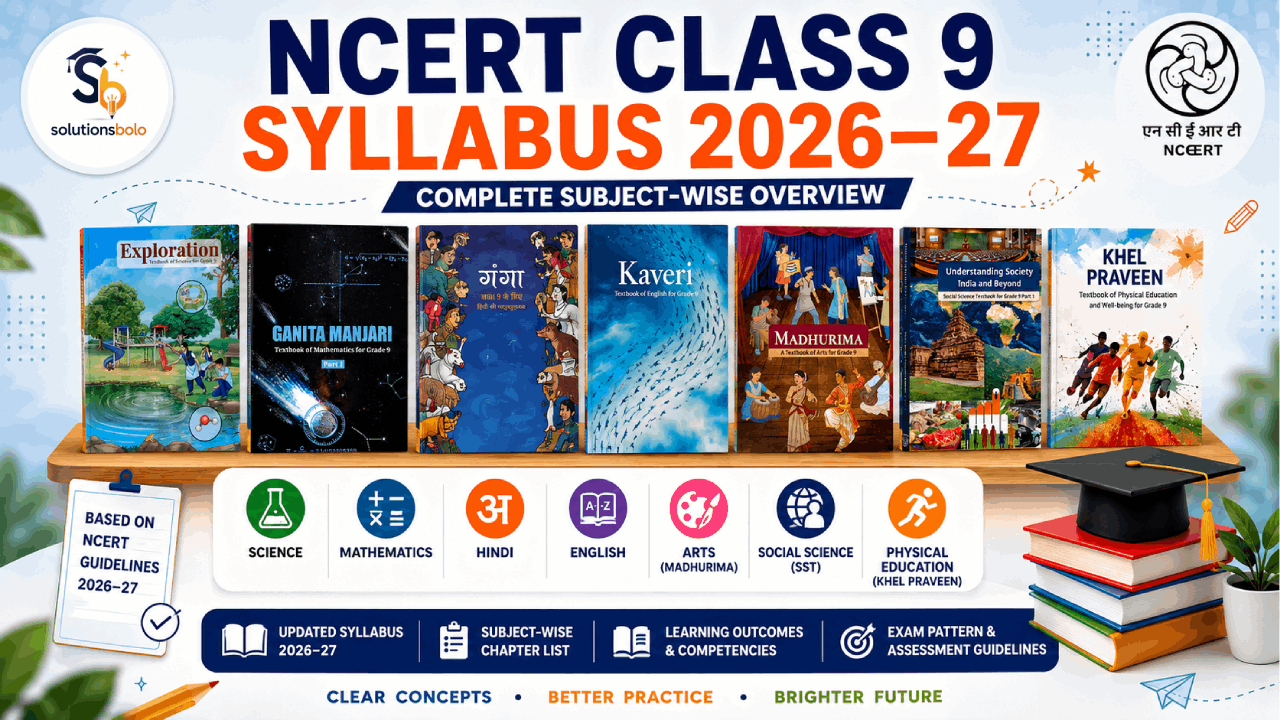
NCERT Class 9 Syllabus 2026–27 has been updated in accordance with NEP 2020 and the latest CBSE 2026–27 Curriculum, offering a more competency-based and student-centred approach to learning. The revised syllabus introduces newly designed textbooks, updated chapter structures, activity-based learning and real-world applications across all major subjects. On this page, you’ll find the complete subject-wise Class 9 syllabus, chapter lists, curriculum updates and essential study resources for Science (Exploration), Mathematics (Ganita Manjari), Social Science, English (Kaveri), Hindi (Ganga), Sanskrit (Sharada), Arts (Madhurima), Physical Education (Khel Praveen) and Skill Education (Kaushal Vikas)—helping students prepare confidently for the 2026–27 academic session.
NCERT Released Class 9 Syllabus in 2026-27
1. Science (Exploration)
2. Mathematics (Ganita Manjari)
3. Social Science (Understanding Society: India and Beyond – Part 1)
4. English (Kaveri)
5. Hindi (Ganga)
6. Sanskrit (Sharada)
7. Arts (Madhurima)
8. Physical Education and Well Being (Khel Praveen)
9. Urdu (Jamuna)
10. ICT
11. Skill Education (Kaushal Vikas)
CBSE Class 9 Syllabus 2026-27
| Science (Exploration): The revised Science syllabus includes 13 chapters covering Physics, Chemistry, Biology and Earth Science. It encourages inquiry-based learning, practical exploration and conceptual understanding. Explore the complete chapter-wise syllabus below. |
Chapter 1: Exploration – Entering the World of Secondary Science
Science begins with curiosity and this opening chapter encourages students to observe, ask questions and investigate the world around them. It explains how scientific ideas are tested through experiments and evidence instead of assumptions. Learners also get introduced to laboratory work, safe practices and the role of science in solving everyday problems, creating a strong base for the chapters that follow.
Chapter 2: Cell – The Building Block of Life
Every living organism is made up of cells, making them the foundation of life. Students explore different types of cells, their structures and the functions of important cell organelles. Simple illustrations and everyday examples make microscopic concepts easier to understand while building a clear understanding of how living organisms grow, function and survive.
Chapter 3: Tissues in Action
This chapter explains how similar cells work together to form tissues with specific functions. Learners study the major plant and animal tissues and understand their roles in support, transport, movement and protection. By connecting cells with tissues and organ systems, the lesson helps students understand how living organisms function efficiently.
Chapter 4: Describing Motion Around Us
From walking to travelling in a vehicle, motion is a part of everyday life. Students learn about distance, displacement, speed, velocity and acceleration through familiar situations and simple numerical examples. The lesson also introduces motion graphs, helping learners interpret movement more confidently and develop a strong foundation in Physics.
Chapter 5: Exploring Mixtures and their Separation
Mixtures are all around us, from drinking water to the air we breathe. This chapter introduces solutions, suspensions and colloids before explaining practical separation techniques such as filtration, evaporation, crystallisation, distillation, sublimation and chromatography. Everyday applications help students understand why these methods are important in homes, laboratories and industries.
Chapter 6: How Forces Affect Motion
Forces influence the movement of every object around us. This lesson covers balanced and unbalanced forces, inertia, friction and Newton’s laws through relatable activities and real-life situations. Whether pushing a cart or riding a bicycle, students discover how forces control motion and shape the physical world.
Chapter 7: Work, Energy and Simple Machines
This chapter introduces the ideas of work, energy and power by linking them with everyday activities. Students explore different forms of energy, the law of conservation of energy and the working of simple machines such as levers, pulleys and inclined planes. Practical examples show how these machines reduce effort and improve efficiency in daily life.
Chapter 8: Journey Inside the Atom
The world inside an atom is far more fascinating than it appears. This chapter traces the discovery of electrons, protons and neutrons while introducing important atomic models developed by scientists. It helps students understand the internal structure of matter through the history of scientific discoveries.
Chapter 9: Atomic Foundations of Matter
After learning about atoms, students discover how they combine to form elements, compounds and different kinds of matter. The chapter covers chemical symbols, atomic mass and the properties of elements, making the basic ideas of chemistry easier to understand through familiar examples.
Chapter 10: Sound Waves – Characteristics and Applications
Sound travels through vibrations and this chapter explains how it is produced, transmitted and heard. Learners explore amplitude, frequency, wavelength, pitch, loudness, echoes and the reflection of sound. Real-life applications in music, communication and technology make the topic more meaningful.
Chapter 11: Reproduction – How Life Continues
The continuity of life depends on reproduction. This chapter describes both asexual and sexual reproduction in plants and animals, highlighting their importance in growth, survival and biodiversity. Everyday examples make biological processes easier to understand.
Chapter 12: Patterns in Life – Diversity and Classification
Life on Earth exists in countless forms, making classification essential for scientific study. Students learn how organisms are grouped based on common characteristics and evolutionary relationships. The chapter also highlights the importance of biodiversity and its conservation.
Chapter 13: Earth as a System – Energy, Matter and Life
Earth functions as a connected system where air, water, land and living organisms constantly interact. Students explore natural cycles, environmental balance, resource conservation and the impact of human activities. The chapter concludes by encouraging responsible and sustainable living.
| Mathematics (Ganita Manjari): Ganita Manjari consists of 8 chapters that develop mathematical thinking, logical reasoning and problem-solving skills. Explore the complete chapter-wise overview below. |
Chapter 1: Orienting Yourself – The Use of Coordinates
The journey begins with the Cartesian coordinate system, where students learn how points are represented on a graph. They explore the x-axis, y-axis origin, quadrants and plotting coordinates through simple activities and practical examples. The chapter develops spatial thinking while showing how coordinates are used in maps, navigation, architecture and technology, providing a strong foundation for coordinate geometry.
Chapter 2: Introduction to Linear Polynomials
Linear polynomials introduce students to the basics of algebra through variables, constants, coefficients and simple polynomial expressions. Practical examples help connect algebraic concepts with everyday situations, making abstract ideas easier to understand. By solving different types of problems, learners strengthen logical reasoning and gain confidence in working with algebraic expressions and equations.
Chapter 3: The World of Numbers
Numbers form the foundation of mathematics and this chapter explores rational numbers, irrational numbers and the real number system. Students discover the relationships between different types of numbers and learn how they are represented on the number line. Through engaging examples and mathematical reasoning, the chapter develops analytical thinking and strengthens essential numerical skills.
Chapter 4: Exploring Algebraic Identities
Algebraic identities make mathematical calculations faster and more efficient. Students learn to expand, factorise and simplify algebraic expressions using standard identities through logical reasoning and step-by-step methods. Regular practice helps improve problem-solving skills while building a solid foundation for equations, factorisation and advanced algebraic concepts.
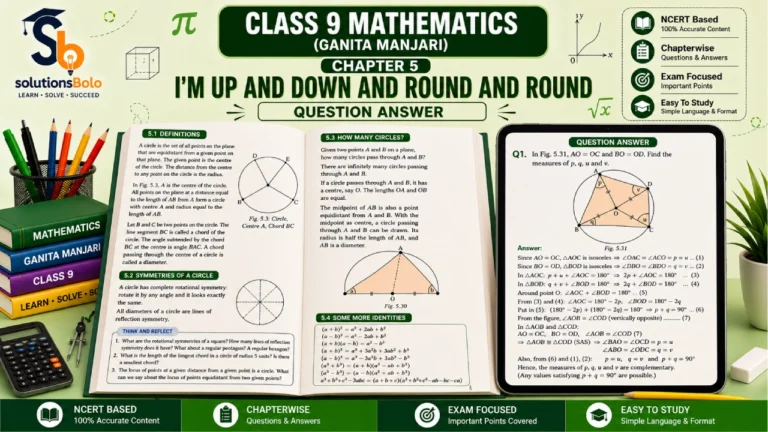
Chapter 5: I’m Up and Down and Round and Round
Circles and their properties come alive through observation, activities and practical examples. Students investigate concepts such as chords, arcs, angles and circular shapes while discovering mathematical relationships instead of simply memorising them. The chapter develops visual reasoning and demonstrates how circular forms appear in everyday life, nature and engineering.
Chapter 6: Measuring Space: Perimeter and Area
Measuring perimeter and area helps students solve practical problems involving two-dimensional shapes. They apply mathematical formulas to everyday situations such as land measurement, construction and design while understanding the importance of mensuration. Practical applications strengthen calculation skills and encourage confidence in using mathematics beyond the classroom.
Chapter 7: The Mathematics of Maybe – Introduction to Probability
Probability introduces students to the mathematics of chance and uncertainty. They explore outcomes, events and the likelihood of different situations using coins, dice, cards and familiar real-life examples. Engaging activities help learners understand how probability supports predictions, decision-making and logical reasoning in everyday life.
Chapter 8: Predicting What Comes Next – Exploring Sequences and Progressions
Patterns and sequences help students recognise relationships between numbers and predict future values using logical reasoning. Through activities and practical examples, learners identify mathematical patterns, think systematically and solve problems creatively. The chapter strengthens mathematical thinking while preparing students for more advanced concepts in higher class
| Social Science (Understanding Society India and Beyond – Part I): The Social Science syllabus consists of 9 chapters that integrate History, Geography, Political Science and Economics into a connected learning experience. Explore the complete chapter-wise overview below. |
Chapter 1: Understanding Social Science
Students begin by exploring the meaning and importance of Social Science in everyday life. The chapter explains how History, Geography, Economics and Political Science work together to help us understand society, people and the environment. It encourages observation, questioning and critical thinking while building a strong foundation for the topics covered throughout the syllabus.
Chapter 2: Shaping of the Earth’s Surface
Earth is constantly changing through natural forces such as plate movements, weathering, erosion, volcanoes and earthquakes. Students discover how these processes create mountains, plains and valleys while shaping both landscapes and human life. Practical examples make physical geography easier to understand and relate to the world around us.
Chapter 3: Atmosphere and Climate
Weather and climate influence almost every aspect of our daily lives. This chapter explains the structure of the atmosphere, air circulation, rainfall and the factors that affect climate. It also introduces environmental challenges such as climate change, helping students understand their impact on ecosystems, agriculture and human activities.
Chapter 4: Early Humans and Beginning of Civilisation
Long before modern societies existed, early humans relied on hunting, gathering and simple tools for survival. This chapter traces their journey towards agriculture, permanent settlements and the rise of the first civilisations. Archaeological evidence helps students understand how human societies gradually evolved over time.
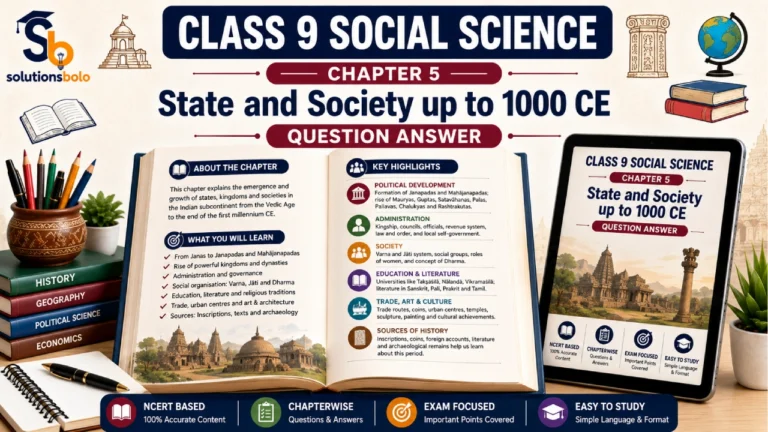
Chapter 5: State and Society up to 1000 CE
As kingdoms expanded and societies became more organised, systems of governance, trade and culture also evolved. Students examine major historical developments up to 1000 CE through historical sources and evidence, gaining a broader understanding of political and social change.
Chapter 6: Democracy
Democracy gives people the power to participate in governing their country. Students learn about equality, justice, rights, responsibilities and the role of citizens in strengthening democratic institutions. Real-life examples show why democratic values remain important in modern society.
Chapter 7: Elections
Choosing representatives through free and fair elections is a key feature of democracy. Students explore the electoral process, universal adult franchise, voting procedures and the role of the Election Commission. The chapter highlights how elections ensure public participation and accountable government.
Chapter 8: Building Blocks in Economics – The Problem of Choice
Every day, individuals, families, businesses and governments make choices because resources are limited. This chapter introduces scarcity, needs, wants and resource allocation through familiar examples, helping students understand the basic principles of economics.
Chapter 9: The Price Puzzle – What Drives the Market
Why do prices of goods and services rise or fall? This chapter answers that question by explaining demand, supply, competition, consumer behaviour and market forces through practical examples. Students gain a clearer understanding of how markets influence everyday economic decisions.
| English (Kaveri): The English syllabus includes 8 chapters of engaging prose and poetry designed to improve reading, writing, grammar, communication and critical thinking. Explore the complete chapter-wise overview below |
Chapter 1: How I Taught My Grandmother to Read
Learning has no age limit and this inspiring story beautifully conveys that message. Students discover how a grandmother’s determination to read transforms her life while strengthening the bond between generations. The story promotes respect for education, self-confidence and perseverance, while naturally improving reading comprehension, vocabulary and communication skills.
Chapter 2: The Pot Maker
The life of a skilled pot maker reflects the dignity of labour and the value of traditional craftsmanship. Through this meaningful story, students appreciate creativity, patience, dedication and the importance of preserving cultural heritage. It also encourages empathy, observation and respect for every profession that contributes to society.
Chapter 3: Winds of Change
Positive change often begins with a single idea. This chapter explores how innovation, determination and thoughtful action can improve lives while respecting traditions and sustainable practices. Through relatable situations, students develop critical thinking, environmental awareness and problem-solving skills, realising that even small efforts can make a meaningful difference.
Chapter 4: Vitamin-M
Money alone cannot define happiness and this chapter explores the true value of relationships, kindness and emotional well-being. Through relatable situations and thoughtful storytelling, students reflect on personal priorities, healthy relationships and responsible decision-making while strengthening their reading and analytical skills.
Chapter 5: The World of Limitless Possibilities
Every achievement begins with the courage to dream. This inspiring chapter encourages students to think creatively, overcome challenges and believe in their abilities through curiosity, perseverance and continuous learning. It motivates learners to face new opportunities with confidence and a positive outlook.
Chapter 6: Twin Melodies
Friendship and music come together in this engaging play filled with lively conversations and meaningful interactions. Students enjoy dramatic situations while improving their understanding of dialogue, stage presentation and communication. The chapter also promotes teamwork, empathy and appreciation for artistic expression.
Chapter 7: Carrier of Words
Words have the power to inform, inspire and connect people across cultures and generations. This chapter highlights the importance of language in shaping ideas, preserving knowledge and building relationships. Along the way, students strengthen vocabulary, comprehension and communication skills while appreciating the impact of thoughtful expression.
Chapter 8: Follow That Dream
Dreams become meaningful when they are supported by determination and consistent effort. Through an uplifting narrative, students learn the value of self-belief, resilience and learning from setbacks. The chapter encourages goal-setting, lifelong learning and a positive attitude towards future challenges.
| Hindi (Ganga): Ganga includes prose, poetry and language activities that help students strengthen reading, writing, grammar, communication and literary appreciation. Explore the 12 complete chapter-wise overview below. |
Chapter 1: दो बैलों की कथा
मुंशी प्रेमचंद की यह प्रसिद्ध कहानी हीरा और मोती नामक दो बैलों की मित्रता, स्वाभिमान, निष्ठा और साहस का मार्मिक चित्रण करती है। उनके संघर्ष और व्यवहार के माध्यम से विद्यार्थी पशुओं के प्रति संवेदनशीलता, स्वतंत्रता का महत्व और सच्ची मित्रता का मूल्य समझते हैं। सरल भाषा और प्रभावशाली घटनाएँ इस रचना को यादगार बनाती हैं तथा हिंदी साहित्य के प्रति रुचि विकसित करती हैं।
Chapter 2: क्या लिखूँ?
रचनात्मक लेखन की शुरुआत विचारों और अनुभवों की सच्ची अभिव्यक्ति से होती है। यह पाठ विद्यार्थियों को कल्पनाशक्ति, भाषा कौशल और प्रभावी लेखन के महत्व से परिचित कराता है। रोचक शैली में प्रस्तुत यह अध्याय आत्मविश्वास के साथ अपने विचार व्यक्त करने, पढ़ने-लिखने की रुचि बढ़ाने और सृजनात्मक सोच विकसित करने की प्रेरणा देता है।
Chapter 3: संवादहीन
बदलती जीवनशैली में संवाद की कमी रिश्तों को किस प्रकार प्रभावित करती है, यह पाठ उसी विषय को प्रभावशाली ढंग से प्रस्तुत करता है। वास्तविक परिस्थितियों के माध्यम से विद्यार्थी संवाद, विश्वास और संवेदनशीलता के महत्व को समझते हैं। साथ ही, यह अध्याय विचारशीलता, सहानुभूति और प्रभावी संचार कौशल विकसित करने में महत्वपूर्ण भूमिका निभाता है।
Chapter 4: ऐसी भी बातें होती हैं
प्रेरणादायक अनुभव और सार्थक बातचीत इस अध्याय को विशेष बनाते हैं। एक रोचक साक्षात्कार के माध्यम से विद्यार्थी प्रश्न पूछने, नए दृष्टिकोण अपनाने और अनुभवों से सीखने का महत्व समझते हैं। यह पाठ जिज्ञासा, आत्मविश्वास, संवाद क्षमता और विश्लेषणात्मक सोच को प्रोत्साहित करता है।
Chapter 5: आख़िरी चट्टान तक
प्रकृति, रोमांच और यात्रा के अनुभव इस यात्रा-वृत्तांत को रोचक बनाते हैं। जीवंत वर्णन के माध्यम से विद्यार्थी विभिन्न स्थानों, संस्कृतियों और प्राकृतिक परिवेश से परिचित होते हैं। यह पाठ अवलोकन क्षमता, कल्पनाशक्ति और पर्यावरण के प्रति संवेदनशीलता विकसित करते हुए यात्रा से मिलने वाली जीवन-सीख का महत्व भी बताता है।
Chapter 6: रीढ़ की हड्डी
सामाजिक कुरीतियों और रूढ़िवादी सोच पर तीखा व्यंग्य इस एकांकी की विशेषता है। प्रभावशाली संवाद और नाटकीय घटनाएँ विद्यार्थियों को आत्मसम्मान, समानता और सामाजिक जागरूकता जैसे मूल्यों से परिचित कराती हैं। साथ ही, यह पाठ तर्कसंगत सोच, अभिव्यक्ति क्षमता और समाज के प्रति जिम्मेदार दृष्टिकोण विकसित करने की प्रेरणा देता है।
Chapter 7: मैं और मेरा देश
राष्ट्र के प्रति प्रेम और जिम्मेदारी की भावना इस अध्याय का मुख्य संदेश है। विद्यार्थी देश के प्रति सम्मान, एकता, ईमानदारी और नागरिक कर्तव्यों के महत्व को सरल भाषा में समझते हैं। यह पाठ बताता है कि प्रत्येक नागरिक का योगदान राष्ट्र के विकास में महत्वपूर्ण होता है तथा अच्छे संस्कार, जिम्मेदार नागरिकता और सकारात्मक सोच अपनाने की प्रेरणा देता है।
Chapter 8: पद
संत रैदास के प्रेरणादायक पद भक्ति, समानता, विनम्रता और मानवता का गहरा संदेश देते हैं। सरल एवं सहज भाषा में रचित ये पद विद्यार्थियों को सच्चे ज्ञान, ईश्वर-भक्ति और सदाचार का महत्व समझाते हैं। साथ ही, यह अध्याय भक्तिकालीन साहित्य की विशेषताओं से परिचित कराते हुए नैतिक मूल्यों और साहित्यिक रुचि का विकास करता है।
Chapter 9: राम-लक्ष्मण-परशुराम संवाद
रामचरितमानस का यह प्रसिद्ध प्रसंग प्रभावशाली संवादों और आदर्श चरित्रों के लिए जाना जाता है। भगवान राम, लक्ष्मण और परशुराम के बीच होने वाली घटनाओं के माध्यम से धैर्य, विनम्रता, आत्मविश्वास और मर्यादा जैसे जीवन मूल्यों का सुंदर चित्रण मिलता है। यह अध्याय भाषा कौशल के साथ भारतीय सांस्कृतिक परंपराओं की समझ भी विकसित करता है।
Chapter 10: भारति, जय, विजयकरे!
सूर्यकांत त्रिपाठी ‘निराला’ की यह ओजपूर्ण कविता भारत माता की महिमा, शक्ति और गौरव का प्रभावशाली चित्र प्रस्तुत करती है। राष्ट्रप्रेम और आत्मगौरव से भरपूर यह रचना विद्यार्थियों को देश के प्रति समर्पण और उत्तरदायित्व की भावना विकसित करने के लिए प्रेरित करती है। साथ ही, वे आधुनिक हिंदी कविता की भाषा, शैली और सौंदर्य से भी परिचित होते हैं।
Chapter 11: झाँसी की रानी
रानी लक्ष्मीबाई का अदम्य साहस और देशभक्ति इस प्रसिद्ध कविता की सबसे बड़ी विशेषता है। सुभद्रा कुमारी चौहान की ओजस्वी रचना स्वतंत्रता संग्राम के संघर्षों को जीवंत रूप में प्रस्तुत करती है। कविता विद्यार्थियों में साहस, आत्मविश्वास और राष्ट्रप्रेम की भावना जगाने के साथ हिंदी साहित्य की प्रेरणादायक काव्य परंपरा से भी परिचित कराती है।
Chapter 12: घर की याद
घर, परिवार और अपनेपन की मधुर स्मृतियाँ इस भावपूर्ण कविता का मूल भाव हैं। भवानी प्रसाद मिश्र सहज भाषा में पारिवारिक संबंधों, संस्कारों और आत्मीयता के महत्व को व्यक्त करते हैं। यह कविता विद्यार्थियों में संवेदनशीलता और मानवीय मूल्यों को विकसित करते हुए हिंदी साहित्य की भावात्मक अभिव्यक्ति का सुंदर परिचय कराती है।
| Sanskrit (Sharada): Sharada includes stories, verses, grammar and language activities that strengthen vocabulary, translation, reading comprehension and communication skills while introducing students to India’s rich cultural and classical heritage. Explore the chapter-wise overview below. |
Chapter 1: सत्यं शिवं सुन्दरं संस्कृतम्
संस्कृत भाषा भारतीय ज्ञान, संस्कृति और साहित्य की अमूल्य धरोहर है। यह अध्याय विद्यार्थियों को संस्कृत की वैज्ञानिकता, साहित्यिक सौंदर्य और सांस्कृतिक महत्व से परिचित कराता है। प्रेरणादायक शैली में प्रस्तुत यह पाठ भाषा के प्रति रुचि विकसित करते हुए भारतीय ज्ञान-परंपरा को समझने और संस्कृत अध्ययन के प्रति आत्मविश्वास बढ़ाने की प्रेरणा देता है।
Chapter 2: सुखस्य मूलं धर्मः धर्मस्य मूलम् अर्थः
धर्म, अर्थ और सुख के बीच संतुलन ही सार्थक जीवन की आधारशिला है। यह अध्याय सरल उदाहरणों के माध्यम से बताता है कि वास्तविक सुख केवल धन से नहीं, बल्कि नैतिकता, कर्तव्य और सदाचार से प्राप्त होता है। साथ ही, यह विद्यार्थियों में जीवन-मूल्यों, जिम्मेदारी और व्यावहारिक सोच का विकास करता है।
Chapter 3: आत्मवत्सर्वभूतेषु यः पश्यति सः पण्डितः
दूसरों के सुख-दुःख को अपना समझना ही सच्ची विद्वता का परिचय है। यह अध्याय करुणा, समानता और सहानुभूति जैसे मानवीय मूल्यों का प्रभावशाली संदेश देता है। प्रेरणादायक विचारों के माध्यम से विद्यार्थी सामाजिक सद्भाव, नैतिक जीवन और सकारात्मक दृष्टिकोण के महत्व को समझते हैं।
Chapter 4: न खलु वयस्तेजसो हेतुः
प्रतिभा और योग्यता का संबंध आयु से नहीं, बल्कि ज्ञान, परिश्रम और आत्मविश्वास से होता है। प्रेरक उदाहरणों के माध्यम से विद्यार्थी समझते हैं कि दृढ़ संकल्प और निरंतर प्रयास सफलता की सबसे बड़ी कुंजी हैं। यह पाठ आत्मविश्वास, सकारात्मक सोच और निरंतर सीखने की भावना को प्रोत्साहित करता है।
Chapter 5: एषा सा कृतकबुद्धिः मानवबुद्धेः सहकरी
आधुनिक तकनीक और मानव बुद्धि का संतुलित सहयोग इस अध्याय का मुख्य विषय है। कृत्रिम बुद्धिमत्ता (Artificial Intelligence) के उदाहरणों के माध्यम से विद्यार्थी समझते हैं कि तकनीक मानव की सहायता के लिए विकसित की गई है। यह पाठ नवाचार, जिम्मेदार उपयोग और वैज्ञानिक दृष्टिकोण को बढ़ावा देते हुए संस्कृत को समकालीन विषयों से जोड़ता है।
Chapter 6: मनःपूतं समाचरेत्
शुद्ध विचार और श्रेष्ठ आचरण एक सफल व्यक्तित्व की पहचान हैं। यह अध्याय बताता है कि किसी भी कार्य से पहले मन, विचार और उद्देश्य की पवित्रता आवश्यक है। सत्यनिष्ठा, अनुशासन और आत्मसंयम जैसे जीवन-मूल्यों पर आधारित यह पाठ विद्यार्थियों को जिम्मेदार निर्णय लेने और नैतिक जीवन अपनाने की प्रेरणा देता है।
Chapter 7: उपायं चिन्तयेत् प्राज्ञस्तथापायं च चिन्तयेत्
किसी भी कार्य में सफलता केवल अच्छे विचारों से नहीं, बल्कि संभावित कठिनाइयों को पहले से समझने पर भी निर्भर करती है। यह अध्याय विद्यार्थियों को सिखाता है कि बुद्धिमान व्यक्ति समाधान के साथ-साथ जोखिमों का भी आकलन करता है। प्रेरणादायक प्रसंगों के माध्यम से यह पाठ दूरदर्शिता, विवेकपूर्ण निर्णय और योजनाबद्ध कार्य करने की प्रेरणा देता है।
Chapter 8: अन्नाद् आनन्दं प्रति
अन्न केवल भोजन नहीं, बल्कि प्रकृति, किसान और समाज के सामूहिक परिश्रम का अमूल्य उपहार है। इस पाठ में विद्यार्थियों को भोजन के महत्व, संसाधनों के सम्मान और अन्न की बर्बादी रोकने का संदेश दिया गया है। साथ ही, यह कृतज्ञता, जिम्मेदारी और स्वस्थ जीवनशैली अपनाने की प्रेरणा भी देता है।
Chapter 9: कृतं प्रतिकृतं भूयादेष धर्मः सनातनः
भारतीय संस्कृति सदैव उपकार और कृतज्ञता को जीवन का महत्वपूर्ण मूल्य मानती है। लेखक इस अध्याय के माध्यम से बताते हैं कि दूसरों के अच्छे कार्यों का सम्मान करना और अवसर मिलने पर उसका प्रतिदान देना सच्चे मानवीय व्यवहार का परिचायक है। यह पाठ नैतिक मूल्यों, सद्भाव और सामाजिक उत्तरदायित्व को मजबूत बनाता है।
Chapter 10: णमो अरिहन्ताणम्
जैन दर्शन का मूल संदेश अहिंसा, आत्मसंयम और सत्य पर आधारित है। इस अध्याय में विद्यार्थियों को इन आदर्शों के साथ भारतीय आध्यात्मिक परंपरा और सांस्कृतिक विविधता से परिचित कराया गया है। यह पाठ करुणा, सहिष्णुता और सभी जीवों के प्रति सम्मान की भावना विकसित करने की प्रेरणा देता है।
Chapter 11: वर्णोच्चारण-शिक्षा (२)
संस्कृत भाषा को सही ढंग से सीखने के लिए शुद्ध उच्चारण का अभ्यास अत्यंत आवश्यक है। इसी उद्देश्य से यह अध्याय स्वरों, व्यंजनों और ध्वनियों के सही उच्चारण का अभ्यास कराता है। नियमित अभ्यास के माध्यम से विद्यार्थियों की पढ़ने, बोलने और समझने की क्षमता बेहतर होती है तथा आगे के अध्ययन के लिए मजबूत भाषा-आधार तैयार होता है।
Chapter 12: अन्वयः
अन्वयः विद्यार्थियों को संस्कृत वाक्यों और श्लोकों का सही क्रम समझने में सहायता करता है। इसके अभ्यास से कठिन पद्यों और गद्यांशों का अर्थ स्पष्ट रूप से समझना आसान हो जाता है। यह अनुभाग वाक्य संरचना, भाषा की समझ तथा अनुवाद कौशल को बेहतर बनाने में महत्वपूर्ण भूमिका निभाता है और विद्यार्थियों की संस्कृत विषय पर पकड़ को मजबूत करता है।
Chapter 13: समासः
समासः संस्कृत व्याकरण का एक महत्वपूर्ण भाग है, जिसमें दो या दो से अधिक शब्दों को मिलाकर संक्षिप्त एवं प्रभावशाली शब्द बनाए जाते हैं। इस अनुभाग के माध्यम से विद्यार्थी विभिन्न प्रकार के समास, उनके निर्माण और प्रयोग को सरल उदाहरणों के साथ समझते हैं। यह भाषा को अधिक शुद्ध, प्रभावशाली और व्याकरण की दृष्टि से सुदृढ़ बनाने में सहायक होता है।
Chapter 14: वाच्यम्
वाच्यम् के अंतर्गत कर्तृवाच्य, कर्मवाच्य और भाववाच्य जैसे महत्वपूर्ण व्याकरणिक रूपों का अध्ययन कराया जाता है। विद्यार्थी सीखते हैं कि वाक्य की संरचना और अर्थ के अनुसार वाच्य कैसे बदलता है। यह अनुभाग संस्कृत वाक्य निर्माण, अनुवाद तथा व्याकरण संबंधी प्रश्नों को समझने और हल करने की क्षमता को विकसित करता है।
Chapter 15: शब्दरूपाणि
शब्दरूपाणि संस्कृत भाषा सीखने की आधारशिला माने जाते हैं। इस अनुभाग में विभिन्न संज्ञा शब्दों के रूपों का व्यवस्थित अभ्यास कराया गया है, जिससे विभक्तियों का सही प्रयोग समझना सरल हो जाता है। नियमित अभ्यास से विद्यार्थियों की भाषा पर पकड़ मजबूत होती है तथा वे संस्कृत वाक्यों का शुद्ध निर्माण और विश्लेषण अधिक आत्मविश्वास के साथ कर पाते हैं।
Chapter 16: धातुरूपाणि
धातुरूपाणि विद्यार्थियों को संस्कृत क्रियाओं के विभिन्न कालों और पुरुषों में प्रयोग को समझने में सहायता करते हैं। इस अनुभाग के माध्यम से वे धातुओं के रूपों का सही प्रयोग सीखते हैं, जिससे वाक्य निर्माण और अनुवाद दोनों सरल हो जाते हैं। यह व्याकरण की मजबूत नींव तैयार करता है और परीक्षा की दृष्टि से भी अत्यंत उपयोगी माना जाता है।
शब्दकोश / अभ्यास सामग्री
पुस्तक के अंत में दिए गए शब्दकोश एवं अभ्यास सामग्री विद्यार्थियों के लिए त्वरित संदर्भ (Quick Reference) का कार्य करते हैं। शब्दकोश नए शब्दों के अर्थ समझने में सहायता करता है, जबकि अभ्यास सामग्री सीखे गए विषयों का पुनरावर्तन और आत्ममूल्यांकन करने का अवसर प्रदान करती है। नियमित अभ्यास से भाषा कौशल, शब्दावली और व्याकरण की समझ में निरंतर सुधार होता है तथा परीक्षा की तैयारी अधिक प्रभावी बनती है.
| Arts (Madhurima): Madhurima introduces Visual Arts, Music, Dance and Theatre through creative activities and artistic exploration. It encourages imagination, self-expression, cultural appreciation and creativity. Explore the complete chapter-wise overview below. |
Chapter 1: Exploring the World of Arts
Art is an important part of everyday life, helping people express ideas, emotions and creativity in different ways. This opening chapter introduces students to visual arts, music, dance and theatre through simple observations and activities. It builds artistic awareness, encourages imagination and prepares learners to explore different forms of creative expression with confidence.
Chapter 2: Understanding the Navarasas
Students explore the concept of Navarasas, the nine emotions that form the foundation of Indian performing arts. Through expressions, music, movement and drama, they understand how artists communicate feelings such as joy, courage, compassion and wonder. The lesson also develops observation skills while introducing learners to India’s rich artistic heritage.
Chapter 3: Visual Composition and Design
This chapter explains the basic principles of visual composition, including balance, proportion, harmony, contrast, colour, shape and space. Students explore how artists organise different elements to create meaningful and attractive artworks. Practical activities encourage creativity, observation and experimentation with various artistic techniques. The chapter develops visual thinking and helps learners understand the importance of design in art as well as everyday life.
Chapter 4: The Language of Colours
This chapter explores how colours influence emotions, ideas and artistic expression. Students learn about primary, secondary and complementary colours, colour harmony and their creative applications in paintings and designs. Through observation and hands-on activities, learners discover how colours communicate feelings and enhance visual storytelling. The chapter encourages imagination, experimentation and appreciation for the role of colour in art, culture and everyday life.
Chapter 5: Lines, Shapes and Patterns
Every drawing begins with simple elements such as lines and shapes. This lesson introduces these basic building blocks of visual art and explains how they combine to create attractive designs and meaningful compositions. Regular practice improves drawing skills while encouraging creativity and a deeper appreciation of patterns found in nature and everyday life.
Chapter 6: Folk and Tribal Art Traditions
India’s rich folk and tribal art traditions are the focus of this chapter. Students explore unique regional art forms, traditional painting styles and the cultural stories they represent. The lesson highlights the importance of preserving indigenous artistic heritage while encouraging respect for cultural diversity. Through engaging examples and creative activities, learners develop a deeper appreciation for India’s vibrant artistic traditions and their continued relevance today.
Chapter 7: Music Around Us
This chapter introduces students to the fascinating world of music and its role in everyday life. Learners discover rhythm, melody, tempo and the basic elements of vocal and instrumental music through enjoyable activities. The chapter encourages careful listening, musical appreciation and creative expression while demonstrating how music connects people, cultures and emotions. It also highlights the importance of practice, discipline and teamwork in musical learning.
Chapter 8: Rhythm and Movement
Rhythm connects music with movement and gives life to every dance performance. Students learn to identify rhythmic patterns and express them through coordinated body movements and creative activities. The chapter builds confidence, physical awareness and artistic expression while making dance learning enjoyable and interactive.
Chapter 9: Exploring Indian Dance Forms
India’s classical and folk dances reflect the country’s rich cultural diversity and traditions. This chapter introduces students to different dance forms, their costumes, gestures, expressions and cultural significance. Through simple activities and observations, learners discover how dance conveys stories, emotions and values while encouraging artistic appreciation and creative confidence.
Chapter 10: Theatre and Storytelling
Stories become more engaging when they are brought to life through theatre. In this chapter, students learn the basics of acting, dialogue delivery, voice modulation, facial expressions and stage presentation. Interactive activities promote teamwork, confidence and communication skills while helping learners understand theatre as a powerful form of artistic expression.
Chapter 11: Creative Expression Through Art
Every individual has a unique way of expressing thoughts and emotions. This lesson encourages students to explore drawing, painting, music, movement and drama as creative outlets. By participating in artistic activities, they develop imagination originality and self-confidence while recognising creativity as an important life skill.
Chapter 12: Art in Our Everyday Life
From festivals and architecture to clothing and handicrafts, art is woven into everyday life. The chapter helps students identify artistic elements in their surroundings through observation and practical examples. It also highlights the close connection between creativity, culture and daily experiences, encouraging learners to appreciate beauty in ordinary moments.
Chapter 13: Appreciating Cultural Heritage
India’s monuments, paintings, sculptures, music and traditional crafts reflect a rich cultural legacy. This chapter explains why preserving these artistic treasures is important for future generations. Along with developing cultural awareness, it encourages students to value diversity and take responsibility for protecting the nation’s heritage.
Chapter 14: Art, Nature and Environment
Nature has inspired artists for centuries with its colours, landscapes and changing seasons. Through this chapter, students observe the connection between the natural world and artistic creativity. Activity-based learning also promotes environmental awareness while encouraging learners to express their experiences through art in meaningful ways.
Chapter 15: Art and Technology
Modern technology has opened new possibilities for creative expression. Students explore digital drawing, photography, animation and other artistic tools while understanding how innovation complements traditional art forms. The chapter promotes responsible use of technology and introduces learners to contemporary creative practices and emerging career opportunities.
Chapter 16: Working Together Through Art
Art often becomes more meaningful when people collaborate. This chapter highlights teamwork through group projects, performances, exhibitions and creative activities. Students learn communication, cooperation, planning and respect for different ideas while creating shared artistic experiences. The chapter develops leadership qualities, confidence and social skills, showing how collaboration enhances both creativity and learning.
Chapter 17: Celebrating Creativity
Creativity grows through curiosity, practice and imagination. As the concluding chapter, it encourages students to reflect on their artistic journey and appreciate different forms of creative expression. The lesson inspires learners to see art as a meaningful part of everyday life while expressing their ideas with confidence
ICT (will be uploaded shortly)
Skill Education (Kaushal Vikas) (will be uploaded shortly)
| Physical Education and Well Being (Khel Praveen): Khel Praveen consists of 23 chapters that promote physical fitness, health, sports, yoga and overall well-being through activity-based learning. Explore the complete chapter-wise overview below. |
Chapter 1: Physical Education and Well-being
Physical education plays an important role in leading a healthy and active life. Students learn how regular exercise, balanced nutrition, emotional well-being and healthy habits contribute to overall fitness, personal growth and lifelong wellness.
Chapter 2: History and Culture of Physical Education in India
This chapter explores the rich history and cultural heritage of physical education in India. Students discover the evolution of traditional games, yoga, martial arts and indigenous sports while understanding their contribution to fitness, discipline and national identity.
Chapter 3: Careers in Physical Education
Sports today offer opportunities far beyond the playing field. This lesson introduces students to careers in coaching, fitness, sports science, physical education and health management, encouraging them to explore future possibilities based on their interests and abilities.
Chapter 4: Fitness and its Components
The chapter explains the essential components of physical fitness, including strength, endurance, flexibility, speed and coordination. Through practical activities, students understand how balanced fitness supports better health, sports performance and overall well-being.
Unit 2: Science and Sports
Chapter 5: Understanding Our Body
Understanding how the human body functions helps students perform physical activities more effectively. This chapter explains the basic body systems and their role in movement, coordination and maintaining overall health.
Chapter 6: Cardiorespiratory System
The heart and lungs work together to supply oxygen throughout the body during physical activity. Students learn how the cardiorespiratory system supports endurance and why maintaining cardiovascular fitness is essential for a healthy lifestyle.
Chapter 7: Growth, Development and Maturation
This chapter explores the physical, mental and emotional changes that occur during adolescence. It also highlights the importance of proper nutrition, regular exercise and healthy habits for balanced growth and development.
Chapter 8: First Aid
Knowing basic first aid can make a significant difference during emergencies. Students learn simple techniques to respond safely to common injuries and provide immediate care until professional medical help is available.
Unit 3: Olympism
Chapter 9: Ancient Olympic Games
The Olympic movement began in ancient Greece with competitions that celebrated physical excellence and sportsmanship. Students explore the history, traditions and values that later inspired the modern Olympic Games.
Chapter 10: Modern Olympic Games
This chapter explains the revival and growth of the Modern Olympic Games. Learners become familiar with Olympic symbols, ceremonies and the values of excellence, friendship and respect that unite athletes around the world.
Chapter 11: India at the Olympic Games
India’s Olympic journey reflects determination, hard work and sporting excellence. Students discover the achievements of Indian athletes and understand how dedication and perseverance have shaped the country’s Olympic history.
Chapter 12: Olympic Values
The chapter introduces the core Olympic values of excellence, friendship and respect. It encourages students to practise fair play, teamwork, discipline and mutual respect both on the field and in everyday life.
Unit 4: Sports for All
Chapter 13: Inclusion in Sports
This chapter explains the importance of making sports accessible to everyone, regardless of age, gender, ability or background. Students learn how inclusive sports promote equality, participation, confidence and respect for diversity, helping create a more welcoming sporting environment.
Chapter 14: Indigenous Games and Martial Arts
India’s traditional games and martial arts reflect the country’s rich cultural heritage and sporting traditions. Students explore their significance while understanding how these activities promote physical fitness, discipline, teamwork and respect for indigenous knowledge.
Chapter 15: Adventure Sports
Adventure sports offer exciting opportunities to build courage, leadership and decision-making skills. Through this lesson, students also learn about safety measures, responsible participation and the importance of protecting nature during outdoor activities.
Chapter 16: Recreation and Leisure
The chapter explains how recreation and leisure contribute to physical fitness, mental well-being and a balanced lifestyle. Students discover how hobbies and enjoyable activities help reduce stress while improving overall health and quality of life.
Unit 5: Sports Skills
Chapter 17: Fundamental Movement Skills
Basic movement skills form the foundation of every sport and physical activity. Students learn movements such as running, jumping, throwing, catching and balancing, helping them improve coordination, fitness and athletic performance.
Chapter 18: Athletics
This chapter introduces the fundamentals of athletics, including track and field events such as running, jumping and throwing. It also highlights the importance of proper technique, regular practice, discipline and sportsmanship.
Chapter 19: Team Games
Team sports encourage cooperation, communication and leadership both on and off the field. Students understand how teamwork, discipline and mutual respect contribute to better performance and enjoyable sporting experiences.
Chapter 20: Individual Games
The chapter introduces different individual sports that help students develop concentration, confidence and self-discipline. Regular practice encourages perseverance, responsibility and continuous personal improvement.
Unit 6: Sports and Yoga for Holistic Health
Chapter 21: Yoga for Health and Well-being
Yoga promotes physical fitness, mental peace and emotional balance through simple daily practices. Students explore basic yoga postures, breathing exercises and relaxation techniques that support a healthy and active lifestyle.
Chapter 22: Meditation and Stress Management
This chapter explains how meditation and mindfulness help improve concentration, reduce stress and strengthen emotional well-being. Practical techniques encourage students to develop self-awareness and maintain a balanced approach to everyday life.
Chapter 23: Healthy Lifestyle and Wellness
Healthy habits play a key role in lifelong fitness and overall wellness. The concluding chapter encourages students to follow balanced nutrition, regular exercise, adequate rest and positive lifestyle choices while taking responsibility for their physical, mental and social well-being.
How to Study the NCERT Class 9 Syllabus 2026–27 for Better Marks with 95+
Students should focus more on conceptual understanding, competency-based learning, practical application and analytical thinking. Instead of memorising every line, students should understand concepts, practise regularly and revise consistently. A smart study routine, proper notes and weekly self-assessment can help you score better while reducing exam stress.
1. Understand the Syllabus Before You Start
Before opening your textbooks, go through the complete syllabus once. Mark every chapter and create a realistic study plan. This helps you avoid skipping important topics and keeps your preparation organised.
2. Study for 2–3 Hours Daily After School
School itself covers a large part of your learning. After returning home, aim for 2–3 focused study hours instead of long, tiring sessions. Divide your study time into short blocks with small breaks to improve concentration and retention.
3. Focus on Understanding, Not Memorising
The latest syllabus gives more importance to understanding concepts than rote learning. Read every topic carefully, relate it to daily life and make sure you know why and how something happens before trying to memorise it.
4. Prepare Short Notes While Studying
Instead of copying entire chapters, write short notes using keywords, formulas, definitions, diagrams and important points. These notes will become your quickest revision material before tests and examinations.
5. Use Highlighters Smartly
Highlight only important formulas, definitions, dates, keywords and difficult concepts. Avoid colouring entire pages. A clean and organised textbook makes revision much faster.
6. Revise Every Sunday
Reserve Sunday for revision instead of starting new chapters. Review everything studied during the week and identify weak topics before moving ahead. Regular revision reduces last-minute pressure.
7. Take a Weekly Self-Test at Home
Attempt one chapter test or a mixed-subject test every week without looking at your books. Self-testing improves confidence, reveals mistakes and prepares you for school examinations.
8. Practise NCERT Questions First
Always complete the textbook exercises, examples and in-text questions before solving additional material. Most school exams are based directly on NCERT concepts and their applications.
9. Use Solutions Bolo for Better Understanding
Whenever you find a topic difficult, study its explanation, chapter summary, important points and NCERT solutions on Solutions Bolo. First try solving questions yourself, then compare your answers to understand mistakes and improve your writing style.
10. Follow a Simple Daily Routine
Study consistently, sleep for 7–8 hours, stay active and avoid leaving chapters for the last moment. Small daily efforts are far more effective than studying for long hours just before examinations.
Frequently Asked Questions (FAQs)
1. Which are the new NCERT Class 9 books for the 2026–27 session?
Answer: The latest NCERT Class 9 books include Science (Exploration), Mathematics (Ganita Manjari), English (Kaveri), Hindi (Ganga), Sanskrit (Sharada), Social Science, Arts, Physical Education and Skill Education.
2. Are the NCERT Class 9 books updated according to NEP 2020?
Answer: Yes. The new NCERT Class 9 textbooks are developed in line with NEP 2020, NCF-SE 2023 and the latest CBSE 2026–27 curriculum for concept-based learning.
3. Has CBSE introduced new NCERT books for Class 9 in 2026–27?
Answer: Yes. CBSE has implemented the latest NCERT textbooks for Class 9 from the 2026–27 academic session, introducing several newly designed books across major subjects.
4. Where can I download the NCERT Class 9 book PDF for 2026–27?
Answer: Students can access the latest NCERT Class 9 book PDFs through the official NCERT platforms or use chapter-wise study resources and explanations available on trusted educational websites.
5. What is the name of the new Class 9 Science book?
Answer: The new NCERT Class 9 Science textbook is Science (Exploration), designed to promote inquiry-based learning, experiments and real-life scientific understanding.
6. Which Mathematics book is prescribed for Class 9 CBSE 2026–27?
Answer: For the CBSE 2026–27 session, the prescribed NCERT Mathematics textbook is Ganita Manjari, focusing on conceptual learning and logical problem-solving.
7. What is the new Hindi book for NCERT Class 9?
Answer: The new NCERT Class 9 Hindi textbook is Ganga, an integrated book that combines prose, poetry, grammar and language learning in one volume.
8. Are chapter-wise NCERT Class 9 solutions available for the new books?
Answer: Yes. Chapter-wise solutions, explanations, revision notes and important questions are available for all the latest NCERT Class 9 textbooks to support effective exam preparation.
9. Which is the best website for NCERT Class 9 Books, Solutions and Notes?
Answer: Choose a website that provides the latest NCERT 2026–27 books, chapter-wise solutions, concept-based explanations, revision notes and regularly updated CBSE study resources in one place.
10. How should I complete the CBSE Class 9 syllabus on time?
Answer: Create a realistic study timetable, complete one chapter at a time, revise regularly, solve textbook exercises and practise sample questions consistently throughout the academic session.
11. Are the old NCERT Class 9 books valid for the 2026–27 session?
Answer: No. CBSE schools are expected to follow the latest NCERT textbooks prescribed for the 2026–27 session. Students should study from the newly introduced books for accurate syllabus coverage.
12. Why were the NCERT Class 9 books changed in 2026–27?
Answer: The textbooks were redesigned to align with NEP 2020 and NCF-SE 2023, making learning more competency-based, activity-oriented and connected to real-life applications.
13. Are NCERT Class 9 Books enough to score good marks in CBSE exams?
Answer: Yes. NCERT textbooks are the primary study resource recommended by CBSE. Understanding every chapter thoroughly and practising regularly is usually sufficient for excellent academic performance.
14. Do the new NCERT Class 9 books include competency-based questions?
Answer: Yes. The latest books include competency-based learning, real-life examples, inquiry-based activities and application-oriented exercises to strengthen conceptual understanding and problem-solving skills.
15. Are the chapter names different in the new NCERT Class 9 books?
Answer: Yes. Several subjects have completely new book titles and chapter names, reflecting the revised curriculum introduced under the latest CBSE 2026–27 academic framework.
16. Which NCERT Class 9 book should I study first?
Answer: Begin with the subject currently being taught in your school. Following your classroom schedule helps you understand concepts better and complete the syllabus in an organised manner.
17. Are NCERT Class 9 book PDFs available in both English and Hindi?
Answer: Yes. NCERT publishes Class 9 textbooks in multiple languages, including English and Hindi, depending on the subject and the officially released editions.
18. How can I prepare for exams using the new NCERT Class 9 books?
Answer: Read every chapter carefully, solve all textbook exercises, revise important concepts, practise competency-based questions and regularly review your notes for better exam preparation.