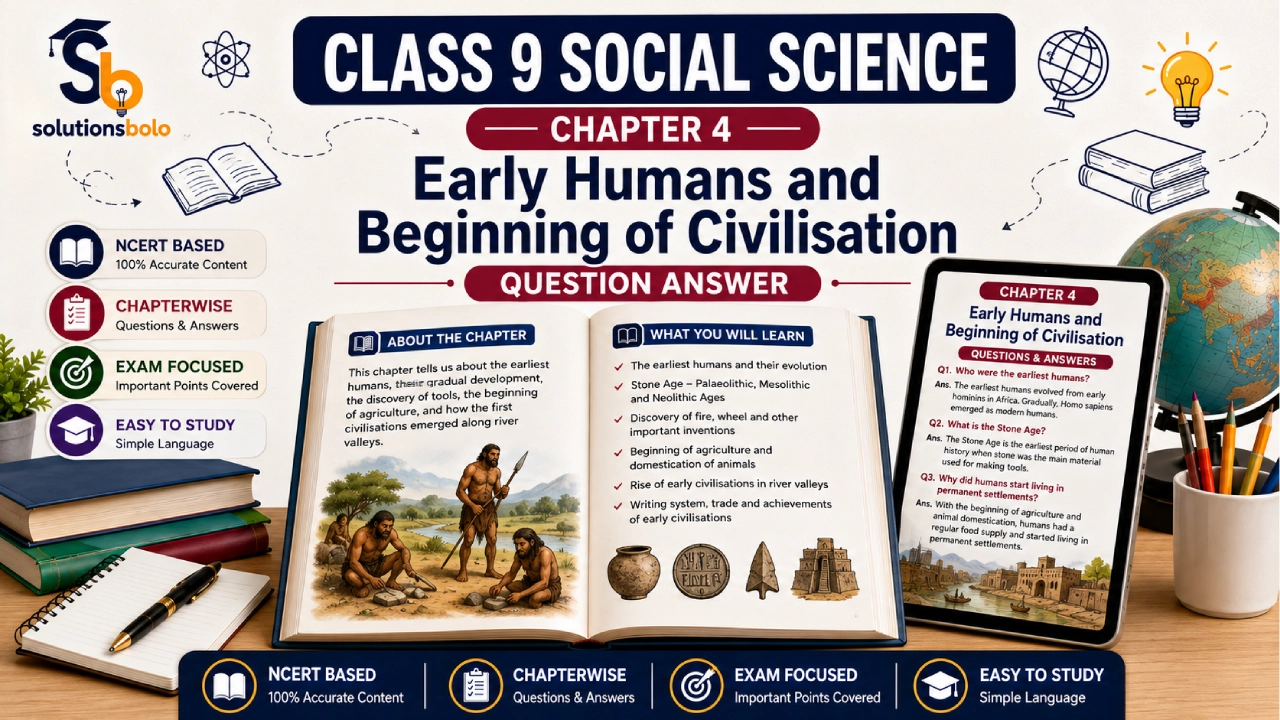
Class 9 Social Science Chapter 4 “Early Humans and Beginning of Civilisation” introduces students to the evolution of early humans and the gradual development of civilisation. The chapter explains the stages of the Stone Age, the beginning of farming and settled life and the rise of early river-valley civilisations such as the Sindhu–Sarasvatī, Mesopotamian, Egyptian and Chinese Civilisations. It also highlights the importance of archaeology, fossils, tools, writing systems, trade, social organisation and cultural achievements in understanding the past. These NCERT Solutions provide clear explanations, key terms, intext answers, important questions, MCQs, competency-based questions and FAQs to help students build conceptual understanding and prepare confidently according to the latest CBSE syllabus (2026–27).
Table of Contents (Quick Links):
1. Chapter Introduction
2. Key Terms & Definitions
3. NCERT Intext Questions
4. Exercise Questions
5. MCQs with Explanations
6. Assertion & Reason MCQs
7. Case-Based MCQs
8. Competency-Based Questions
9. Common Mistakes & Exam Tips
10. Frequently Asked Questions (FAQs)
Chapter Introduction
Class 9 Social Science Chapter 4 – Early Humans and Beginning of Civilisation traces the remarkable journey of humankind from early hunter-gatherers to the builders of the world’s first civilisations. The chapter explains how early humans adapted to different environments, developed stone tools, discovered fire and gradually learned farming and animal domestication. It describes the transition from a nomadic lifestyle to permanent settlements during the Neolithic Age, leading to the growth of villages, trade, crafts and organised societies. Students also learn about the rise of the Mesopotamian civilisation, including the Sumerians, city-states, ziggurats and the invention of cuneiform writing. Through archaeological evidence, the chapter highlights how innovation, cooperation and technological advancements laid the foundation of human civilisation and shaped the development of the modern world.
Key Terms & Definitions
Sindhu–Sarasvati Civilisation:
The Sindhu–Sarasvati Civilisation was one of the world’s earliest urban civilisations that flourished mainly along the Indus River and the Ghaggar–Sarasvati river system. It is also known as the Harappan Civilisation.
Indus Valley Civilisation:
The Indus Valley Civilisation was an ancient civilisation that developed in the north-western part of the Indian subcontinent. It is famous for its well-planned cities, drainage systems and trade.
Harappan Civilisation:
The Harappan Civilisation is another name for the Indus Valley Civilisation, derived from Harappa, one of its first excavated cities.
Archaeological Evidence:
Archaeological evidence includes artefacts, tools, pottery, buildings, inscriptions and human remains that help historians understand ancient societies.
Archaeology:
Archaeology is the study of human history through the excavation and analysis of ancient objects, structures and other physical remains.
Prehistory:
Prehistory is the period before the invention of writing. Information about this period is obtained mainly from archaeological evidence.
Pictographic Script:
A pictographic script is a writing system in which pictures or symbols are used to represent objects, ideas or actions.
Sindhu Lipi:
Sindhu Lipi refers to the undeciphered script found on seals and other objects of the Sindhu–Sarasvati (Harappan) Civilisation.
Logographic Script:
A logographic script is a writing system in which each symbol represents a word or a meaningful idea instead of a single sound.
Sumerians:
The Sumerians were the people who established the earliest known city-states in southern Mesopotamia and developed cuneiform writing.
Hieroglyphic Script:
Hieroglyphic script was the ancient writing system of Egypt that used pictures and symbols to represent words and sounds.
Egypt:
Egypt is an ancient civilisation that developed along the Nile River and is famous for its pyramids, pharaohs and hieroglyphic writing.
Brahmi Script:
Brahmi is one of the earliest known scripts of the Indian subcontinent and became the ancestor of many modern Indian scripts.
Ganga Valley:
The Ganga Valley is the fertile region around the Ganga River that became an important centre of agriculture and civilisation in ancient India.
Australopithecines:
Australopithecines were early human ancestors who lived in Africa and walked upright but had smaller brains than modern humans.
Homo erectus:
Homo erectus was an early human species that walked fully upright, made stone tools and learned to use fire.
Homo sapiens:
Homo sapiens are modern humans, known for advanced thinking, language, creativity and complex societies.
Hominin:
A hominin is any member of the human evolutionary family after it separated from the ancestors of chimpanzees.
Old World:
The Old World refers to the continents of Asia, Africa and Europe, where the earliest human evolution and many ancient civilisations developed.
Quaternary Period:
The Quaternary Period is the most recent geological period, beginning about 2.6 million years ago, during which modern humans evolved.
Fossils:
Fossils are the preserved remains or traces of ancient plants, animals or humans found in rocks. They help scientists study the history of life on Earth.
Handaxes and Cleavers:
Handaxes and cleavers are early stone tools used by prehistoric humans for cutting, hunting, digging and preparing food.
Stone Age:
The Stone Age was the earliest period of human history when stone was the main material used for making tools and weapons. It is divided into the Palaeolithic, Mesolithic and Neolithic Ages.
Palaeolithic Age:
The Palaeolithic Age or Old Stone Age, was the earliest phase of the Stone Age. People lived as hunter-gatherers and used simple stone tools for survival.
Mesolithic Age:
The Mesolithic Age or Middle Stone Age, was the transitional period between the Palaeolithic and Neolithic Ages. People developed smaller stone tools and gradually began domesticating animals.
Neolithic Age:
The Neolithic Age or New Stone Age, marked the beginning of agriculture, animal domestication, pottery, weaving and permanent settlements.
Chalcolithic Age:
The Chalcolithic Age, also known as the Copper-Stone Age, was the period when people began using copper along with stone tools.
Bronze Age:
The Bronze Age was the period when bronze tools and weapons became common, leading to the growth of cities, trade and advanced civilisations.
Hunter-Gatherers:
Hunter-gatherers were early humans who survived by hunting wild animals, fishing and collecting fruits, roots and edible plants.
Nomadic Life:
Nomadic life is a way of living in which people move from one place to another in search of food, water and shelter instead of living permanently in one location.
Permanent Settlement:
A permanent settlement is a place where people build homes and live for long periods, usually after adopting agriculture and animal husbandry.
Ghaggar–Sarasvati Basin:
The Ghaggar–Sarasvati Basin is the region around the Ghaggar River, where many sites of the Sindhu–Sarasvati (Harappan) Civilisation have been discovered.
Fertile Crescent:
The Fertile Crescent is a fertile region in West Asia where agriculture first developed and some of the world’s earliest civilisations, including Mesopotamia, emerged.
Mesopotamian Civilisation:
The Mesopotamian Civilisation developed between the Tigris and Euphrates Rivers and is regarded as one of the world’s earliest urban civilisations.
Egyptian Civilisation:
The Egyptian Civilisation flourished along the Nile River and is famous for its pyramids, pharaohs, hieroglyphic writing and remarkable achievements in architecture and science.
City-State:
A city-state is an independent city with its own government and surrounding territory. Many Sumerian cities functioned as city-states.
Ziggurat:
A ziggurat was a large stepped temple built in ancient Mesopotamian cities for religious worship and ceremonial purposes.
Cuneiform:
Cuneiform was one of the earliest writing systems, developed by the Sumerians. It was written on clay tablets using wedge-shaped symbols.
Akkadians:
The Akkadians were an ancient Mesopotamian people who established one of the world’s first empires under Sargon of Akkad.
Assyrians:
The Assyrians were a powerful Mesopotamian civilisation known for their strong army organised administration and magnificent cities.
Babylonians:
The Babylonians ruled Mesopotamia after the Akkadians and are especially remembered for their contributions to law, mathematics and astronomy.
Hammurabi:
Hammurabi was a famous Babylonian king who introduced one of the earliest written law codes, known as the Code of Hammurabi.
Hittites:
The Hittites were an ancient civilisation of Anatolia (modern-day Türkiye) known for using iron technology and building a powerful kingdom in West Asia.
Number System (Base 60):
The Base 60 number system was developed by the Mesopotamians. It is still used today for measuring time (60 seconds, 60 minutes) and angles (360°).
Epic of Gilgamesh:
The Epic of Gilgamesh is one of the world’s oldest known literary works. It narrates the adventures of King Gilgamesh and explores themes of friendship, courage and the search for immortality.
Dilmun, Magan and Meluhha:
Dilmun, Magan and Meluhha were important regions mentioned in Mesopotamian records. They were connected through maritime trade, with Meluhha widely associated with the Sindhu–Sarasvati (Harappan) Civilisation.
Herodotus:
Herodotus was an ancient Greek historian, often called the “Father of History,” because he recorded historical events in a systematic manner.
Description de l’Égypte:
Description de l’Égypte is a famous multi-volume work prepared by French scholars after Napoleon’s Egyptian expedition. It documents Egypt’s history, monuments, culture and geography.
Papyrus:
Papyrus was a writing material made from the papyrus plant that grew along the Nile River. Ancient Egyptians used it to write documents, religious texts and records.
Sindbad the Sailor:
Sindbad the Sailor is a legendary character from One Thousand and One Nights, famous for his adventurous sea voyages across distant lands.
Aesop’s Fables:
Aesop’s Fables is a collection of short moral stories, usually featuring animals as characters, that teach important life lessons.
Cinderella:
Cinderella is a well-known folk tale about kindness, hope and courage. Different versions of the story are found in many cultures around the world.
Rosetta Stone:
The Rosetta Stone is an ancient stone inscription written in Hieroglyphic, Demotic and Greek scripts. It helped scholars decipher Egyptian hieroglyphs.
Egyptian Calendar:
The Egyptian calendar was based on the annual flooding of the Nile River and consisted of 365 days, making it one of the earliest solar calendars.
Kemet:
Kemet was the ancient Egyptian name for Egypt, meaning “the Black Land,” referring to the fertile black soil deposited by the Nile River.
Mummification:
Mummification was the ancient Egyptian practice of preserving dead bodies by carefully treating and wrapping them to prevent decay.
Sistrum:
A sistrum was a musical instrument used in ancient Egyptian religious ceremonies. It produced a rattling sound and was associated with temple worship.
Pharaoh:
A pharaoh was the ruler of ancient Egypt. Pharaohs were regarded as both political leaders and sacred figures responsible for governing the kingdom.
Cleopatra:
Cleopatra VII was the last active ruler of ancient Egypt’s Ptolemaic Kingdom. She is remembered for her leadership and her role in Egyptian and Roman history.
Oracles:
Oracles were sacred places or individuals believed to communicate divine messages or predictions, often consulted before making important decisions.
Silk Route:
The Silk Route was an ancient network of trade routes connecting Asia, Europe and Africa. It promoted the exchange of goods, ideas, technologies, religions and cultures among different civilisations.
Intext Questions and Answers:
1. How did humans live on Earth before the beginning of civilisation?
Answer:
Before civilisation, humans lived as hunter-gatherers. They moved from place to place in search of food and water, used simple stone tools, hunted animals, gathered fruits and roots and gradually learned to control fire and make shelters.
Explanation:
Before the beginning of civilisation, humans led a nomadic life as hunter-gatherers. They survived by hunting wild animals, fishing and collecting fruits, roots and edible plants. They used stone tools for cutting and hunting and lived in caves or temporary shelters. Gradually, they learned to control fire, make better tools and cooperate in groups. These developments eventually led to agriculture, animal domestication, permanent settlements and the rise of civilisation.
2. How did humans communicate before writing was invented?
Answer:
Before writing was invented, humans communicated through spoken language, gestures, facial expressions, sounds, symbols, cave paintings and rock art. These methods helped them share ideas, experiences, hunting plans and cultural traditions.
Explanation:
Before the invention of writing, humans communicated mainly through speech, gestures, facial expressions and symbolic signs. They also expressed their thoughts through cave paintings, rock art, carvings and simple drawings. These methods helped people exchange information, plan hunting activities, perform religious rituals and preserve cultural traditions. Such early forms of communication laid the foundation for the later development of scripts and written languages.
3. How is archaeology helpful in understanding our past?
Answer:
Archaeology helps us understand the past by studying artefacts, tools, pottery, buildings, inscriptions, fossils and human remains. These discoveries reveal how ancient people lived, worked, traded, worshipped and developed civilisations.
Explanation:
Archaeology helps historians reconstruct the past by examining material remains such as tools, pottery, buildings, seals, inscriptions, fossils and human skeletons. These discoveries provide valuable evidence about the lifestyle, economy, beliefs, technology and culture of ancient societies. Archaeological findings are especially important for understanding prehistoric periods, where written records are unavailable, making them a reliable source of historical knowledge.
4. How did early civilisations interact with each other?
Answer:
Early civilisations interacted through trade, cultural exchanges and the sharing of ideas, technologies and goods. Land and sea routes connected regions, encouraging cooperation and helping different civilisations grow and influence one another.
Explanation:
Early civilisations maintained contact through trade, migration and cultural exchanges. Merchants travelled by land and sea, exchanging goods such as metals, textiles, pottery and precious stones. Along with trade, people shared ideas, technologies, religious beliefs, writing systems and artistic traditions. Civilisations such as Mesopotamia, Egypt and the Sindhu–Sarasvati Civilisation developed connections that promoted economic growth, innovation and cultural interaction.
5. why do you think early humans left Africa to migrate to other regions?
Answer:
Early humans migrated from Africa in search of food, water, favourable climate and better living conditions. Population growth, environmental changes and curiosity to explore new regions also encouraged them to move to different parts of the world.
Explanation:
Early humans left Africa because changing climates, shrinking food resources and increasing population made survival difficult in some areas. They searched for fertile land, water, animals and safer places to live. As they gradually adapted to different environments, they spread across Asia, Europe and other regions. This migration helped humans occupy diverse habitats and contributed to the development of different cultures and civilisations.
6. How do we know about our ancestors?
Answer:
We know about our ancestors through fossils, stone tools, cave paintings, bones, pottery and other archaeological discoveries. These remains help historians and archaeologists understand how early humans lived, worked and gradually developed civilisation.
Explanation:
Knowledge about our ancestors comes mainly from archaeological evidence such as fossils, skeletons, stone tools, cave paintings, pottery and ancient settlements. Archaeologists carefully study these remains to understand early human life, food habits, technology, migration and culture. Scientific methods and careful excavation also help determine the age of these discoveries, enabling historians to reconstruct the story of human evolution and civilisation.
7. Do you notice any changes in the shape or features of the skulls across different ancestors?
Answer:
Yes. The skulls show gradual changes over time. Brain size increased, the forehead became higher, jaws became smaller and facial features became less prominent, reflecting the gradual evolution of early humans into modern humans.
Explanation:
Yes, the skulls of different human ancestors show clear evolutionary changes. Earlier skulls had smaller brains, sloping foreheads and larger jaws. Over time, brain size increased, the forehead became higher, the face became flatter and the jaws became smaller. These gradual changes indicate the development of modern human features and improved thinking abilities throughout the process of human evolution.
8. Can you observe a gradual straightening of the face?
Answer:
Yes. The faces of early human ancestors gradually became straighter and flatter over time. The projecting jaws reduced, the forehead became more upright and the facial structure slowly developed into that of modern humans.
Explanation:
Yes, a gradual straightening of the face can be observed during human evolution. Earlier ancestors had projecting jaws, heavy brow ridges and sloping foreheads. As evolution progressed, the face became flatter, the forehead rose higher and the jaws became smaller. These changes, along with increased brain size, gave modern humans their distinctive facial appearance and improved ability to think, communicate and adapt.
9. Why do you think the shift to farming during the Neolithic period is called a revolution rather than a simple change? Discuss with your classmates.
Answer:
The shift to farming is called a revolution because it completely transformed human life. People settled permanently, produced food, domesticated animals, developed villages, increased trade and laid the foundation for early civilisations.
Explanation:
The shift to farming during the Neolithic Age is called the Neolithic Revolution because it brought a major and lasting transformation in human life rather than a small or gradual change. Before farming, people lived as hunter-gatherers and moved from place to place in search of food. With the beginning of agriculture and animal domestication, humans started producing their own food and settled permanently in villages.
This change led to food surplus, population growth, specialised occupations, trade, improved tools and the development of organised communities. Over time, these permanent settlements grew into towns and early river-valley civilisations. Thus, farming changed almost every aspect of human life, making it a true revolution in human history rather than a simple change.
10. Observe the chart (Fig. 4.14) and identify the animals that were domesticated. Also try and identify the types of human habitats and objects that were used. Are any of these still used in present times?
Answer:
The chart shows domesticated animals such as cattle, sheep, goats, pigs and buffaloes. People lived in permanent huts and villages and used pottery, farming tools and storage vessels. Many of these are still used today.
Explanation:
The chart shows that early people domesticated animals such as cattle, sheep, goats, pigs and buffaloes in different regions. They gradually shifted from temporary shelters to permanent houses and villages. Pottery, farming tools, storage vessels and agricultural fields became common features of settled life. Even today, people use pottery, domesticated animals, permanent houses and farming techniques, although modern technology has greatly improved these practices.
11. Can you imagine how long-distance trade would have been affected had the Harappans not followed a standard system of weights?
Answer:
Without standard weights, trade would have become unfair and confusing. Merchants could not measure goods accurately, leading to disputes, mistrust and difficulties in maintaining long-distance trade with other regions.
Explanation:
A standard system of weights ensured fairness and accuracy in trade. Without it, merchants would have faced problems in measuring goods correctly, resulting in cheating, misunderstandings and frequent disputes. Long-distance trade with distant regions such as Mesopotamia would have become less reliable and efficient. Standard weights therefore played an important role in promoting trade, trust and economic development in the Harappan Civilisation.
12. Why were rivers important in the growth of early civilisations?
Answer:
Rivers supplied water for drinking, farming and daily needs. They provided fertile soil, supported agriculture, encouraged settlements and trade and helped early civilisations develop into prosperous societies.
Explanation:
Rivers played a vital role in the rise of early civilisations by providing a reliable source of water for drinking, irrigation and domestic use. Floods deposited fertile soil, making agriculture productive. Rivers also served as transport routes for trade and communication. As a result, many great civilisations, including the Sindhu–Sarasvati, Mesopotamian and Egyptian Civilisations, flourished along river valleys and developed prosperous settlements.
13. Can you find out which countries constitute West Asia in present times?
Answer:
West Asia today includes countries such as Iraq, Iran, Syria, Türkiye, Jordan, Lebanon, Israel, Saudi Arabia, Kuwait, Qatar, Bahrain, the United Arab Emirates, Oman and Yemen.
Explanation:
West Asia is a geographical region that includes countries such as Iraq, Iran, Syria, Türkiye, Jordan, Lebanon, Israel, Saudi Arabia, Kuwait, Qatar, Bahrain, the United Arab Emirates, Oman and Yemen. This region is historically significant because some of the world’s earliest civilisations, including Mesopotamia, developed there. Today, it continues to be important for its history, culture, trade and natural resources.
14. Do you find any similarities between the temples in India and those of the Sumerian civilisation as centres of socio-cultural and economic activity?
Answer:
Yes. Both Indian temples and Sumerian ziggurats served as important religious centres. They also became places for social gatherings, cultural activities, administration and economic functions such as storing goods and supporting trade.
Explanation:
Yes, there are several similarities. Sumerian ziggurats, like many temples in India, were not only places of worship but also important centres of social, cultural and economic life. They supported religious ceremonies, managed resources, stored agricultural produce and encouraged trade and community activities. These institutions helped organise society and played a significant role in the daily lives of the people, showing that temples often served purposes beyond religion.
15. Do you think our understanding of a civilisation changes when its script is deciphered compared to when it is not?
Answer:
Yes. When a script is deciphered, historians can read inscriptions and records directly. This provides clearer knowledge about a civilisation’s language, government, beliefs, trade and daily life than archaeological evidence alone.
Explanation:
Yes. Deciphering a script greatly improves our understanding of a civilisation because written records reveal information about administration, laws, trade, religion, literature and everyday life. When a script remains undeciphered, historians depend mainly on archaeological evidence such as buildings, tools, seals and pottery. Therefore, deciphered scripts provide a much deeper and more accurate picture of the civilisation’s history and achievements.
16. How was the Egyptian script deciphered?
Answer:
The Egyptian script was deciphered with the help of the Rosetta Stone. Since it contained the same text in three scripts, scholars could compare them and understand Egyptian hieroglyphs.
Explanation:
The Egyptian script was deciphered using the Rosetta Stone, which carried the same inscription in Hieroglyphic, Demotic and Greek scripts. Because scholars already understood Greek, they compared the three texts to identify the meaning of hieroglyphic symbols. This remarkable discovery unlocked the language of ancient Egypt and greatly expanded our knowledge of its history, religion, administration and culture.
17. Why do you think there is a scale with a heart on one side and a feather on the other (fig. 4.29)? What can this papyrus tell us about early Egyptian beliefs?
Answer:
The scale represents the Egyptian belief that a person’s heart was weighed against the feather of Ma’at (truth and justice) after death. It reflects their belief in moral conduct, divine judgement and the afterlife.
Explanation:
The illustration shows the ancient Egyptian belief in the “Weighing of the Heart” ceremony after death. They believed that a person’s heart was weighed against the feather of Ma’at, the goddess of truth and justice. If the heart was pure, the person could enter the afterlife. This papyrus reveals that Egyptians believed in honesty, righteous living, divine judgement and life after death. It also highlights the importance of religion in shaping Egyptian society and culture.
18. Can you locate the River Nile on the given map? Why do you think the northern part is called Lower Egypt and the southern part Upper Egypt?
Answer:
Yes. The River Nile flows from south to north into the Mediterranean Sea. The southern region is called Upper Egypt because it is at a higher elevation, while the northern delta region is Lower Egypt.
Explanation:
The River Nile flows northwards from the highlands of East Africa and empties into the Mediterranean Sea. Therefore, the southern part of Egypt is called Upper Egypt because it lies at a higher elevation, while the northern delta region is known as Lower Egypt because it is lower in altitude. These names are based on the river’s flow and land elevation, not on the map’s direction.
19. Look at the social hierarchy pyramid in the image. What were the social classes of early Egypt? What were the different kinds of occupations? What could have been a typical daily routine of the people from each class?
Answer:
Ancient Egyptian society included the Pharaoh, nobles, priests, scribes, soldiers, merchants, artisans, farmers and labourers. Each group had different occupations and daily responsibilities that helped the kingdom function smoothly and remain prosperous.
Explanation:
The social hierarchy pyramid shows that ancient Egyptian society was organised into different social classes, each with specific responsibilities. At the top was the Pharaoh, who ruled the kingdom, made important decisions and performed religious duties. Below the Pharaoh were the nobles and government officials, who helped administer the kingdom and supervise different regions.
Priests conducted religious ceremonies and looked after temples, while scribes maintained records, collected taxes and prepared official documents. Soldiers protected the kingdom and defended its borders. Merchants traded goods within Egypt and with other civilisations and artisans produced pottery, jewellery, tools, furniture and other useful objects.
At the base of the pyramid were farmers and labourers, who formed the largest section of society. Farmers cultivated crops, cared for animals and supplied food, while labourers helped construct temples, monuments, canals and other public works. Although their occupations differed, every social class contributed to the prosperity, administration and development of ancient Egyptian civilisation.
20. Observe the images given above. What do they tell you about Egyptian fashion?
Which social classes do you think used these items?
What clues in the images help you to make this guess?
Try to explain your reasoning based on the materials, designs or accessories shown in the pictures.
Answer:
The images show that Egyptians wore linen clothes, wigs, jewellery and cosmetics. Elaborate ornaments and finely decorated accessories probably belonged to the Pharaoh, nobles and priests, while ordinary people likely wore simpler clothes with fewer decorations.
Explanation:
From the given images, it appears that ancient Egyptians gave great importance to clothing, jewellery, hairstyles and personal appearance. Men and women wore neatly woven linen garments, while many also used wigs, necklaces, bracelets, earrings, rings and decorative collars. Some figures are shown wearing crowns, elaborate headdresses or richly designed ornaments, suggesting that dress reflected a person’s social position.
The finely crafted jewellery made of precious metals and stones, along with luxurious clothing and royal accessories, was most likely used by the Pharaoh, nobles, priests and other wealthy people. In contrast, farmers, artisans, labourers and servants probably wore simple linen garments with very few ornaments because their daily work required practical clothing.
The materials, detailed craftsmanship, colourful decorations, crowns and expensive-looking accessories shown in the images provide important clues about the wearer’s wealth and status. These illustrations suggest that fashion in ancient Egypt was not only for beauty but also reflected occupation, social rank and religious importance.
21. The Chinese script is logographic, with characters representing entire words or morphemes (smallest meaningful units of language), rather than sounds.
Explore more examples of Chinese characters that resemble the objects or ideas they represent. Note down at least two such characters and explain how their shapes are connected to their meanings.
Answer:
The Chinese script uses symbols that often resemble the objects they represent. For example, 山 (shān) means mountain and looks like mountain peaks, while 木 (mù) means tree and resembles a tree with branches.
Explanation:
Chinese is a logographic writing system, in which many characters represent complete words or meaningful ideas instead of individual sounds. Some of the earliest Chinese characters were simple pictures that gradually developed into standard written symbols.
For example, 山 (shān) means mountain. Its three vertical peaks resemble the shape of a mountain range. Another example is 木 (mù), which means tree. Its shape looks like a tree with a trunk and spreading branches. Similarly, 日 (rì) represents the sun, while 月 (yuè) represents the moon.
These examples show how early Chinese writing was closely connected to nature and everyday life. Although modern Chinese characters have become more stylised over time, many still preserve visual clues to their original meanings, making the script one of the world’s oldest continuously used writing systems.
22. What could have been the other reasons for building the Great Wall of China? Explore and share your findings on the Great Wall through a model or presentation.
Answer:
Besides defence, the Great Wall helped control trade routes, regulate migration, collect taxes, transmit military signals and protect important settlements. It also symbolised the strength and unity of the Chinese Empire.
Explanation:
Although the Great Wall of China was mainly built to protect China from invasions, it served several other important purposes. It helped control the movement of people across the borders, regulated trade along important routes and enabled the collection of taxes and customs duties. Watchtowers along the wall were used to send warning signals using smoke or fire, allowing soldiers to communicate quickly over long distances.
The wall also protected agricultural lands and important settlements from raids. Beyond its military role, it became a symbol of the power organisation and engineering skills of ancient China. Even today, the Great Wall stands as one of the world’s greatest architectural achievements and an important reminder of China’s rich cultural heritage.
23. Do you remember studying about the Silk Route in Grade 7? How was India connected with it? Can you recollect China’s contact with India with reference to Buddhism that you studied in Grade 7?
Answer:
India was connected to the Silk Route through trade and cultural exchanges. Buddhism spread from India to China through monks and travellers, strengthening religious, educational and cultural ties between the two ancient civilisations.
Explanation:
The Silk Route was an ancient network of land and sea trade routes connecting Asia, Europe and Africa. India played an important role in this network by trading goods such as spices, cotton textiles, precious stones, ivory and handicrafts with many regions, including China.
India and China were also closely connected through Buddhism. Indian monks travelled to China to spread the teachings of Gautama Buddha, while Chinese pilgrims such as Faxian (Fa-Hien) and Xuanzang (Hiuen Tsang) visited India to study Buddhist scriptures and visit sacred places. These exchanges encouraged the sharing of knowledge, art, architecture, literature and religious ideas.
Thus, the Silk Route was not only a trade network but also an important bridge that promoted cultural, religious and intellectual interaction between India and China.
Exercise Questions and Answers: (page 93)
1. Do you think life became easier or more challenging after humans started farming? Give two reasons for your answer.
Answer:
I think life became easier after humans started farming because it provided a regular food supply and encouraged permanent settlements. However, farming also brought new responsibilities such as hard work, irrigation and protecting crops from natural disasters.
Explanation:
I think life became easier overall after humans started farming, although it also brought new challenges.
First, farming provided a more regular and dependable food supply than hunting and gathering. People no longer had to move constantly in search of food. They began living in permanent settlements, which led to the growth of villages, trade and early civilisations.
Second, agriculture encouraged the domestication of animals, storage of surplus food and the development of specialised occupations. As communities became more organised, people could engage in trade, craftwork and other activities beyond farming.
However, farming also required continuous hard work. People had to prepare fields, sow seeds, irrigate crops, protect them from pests and depend on favourable rainfall and climate. Floods, droughts and crop failures could still threaten their livelihood.
2. The environment offers human societies both opportunities as well as challenges. Explain with reference to early farming communities and river-valley civilisations.
Answer:
The environment provided fertile land, rivers and natural resources for farming and settlements. However, floods, droughts, changing climates and limited resources also created challenges that early farming communities had to overcome.
Explanation:
The environment played a vital role in the development of early farming communities and river-valley civilisations by offering both opportunities and challenges. Fertile river valleys such as those of the Sindhu (Indus), Nile, Tigris and Euphrates provided rich soil, fresh water and favourable conditions for agriculture. These advantages encouraged permanent settlements, increased food production, supported trade and helped early civilisations prosper.
At the same time, the environment could also be unpredictable. Floods sometimes destroyed crops and settlements, while droughts and changing climatic conditions often led to food shortages. Early farming communities therefore had to manage water resources carefully, protect their settlements and adapt to changing natural conditions.
Thus, the environment shaped the growth of early civilisations by providing essential resources for development while also creating challenges that required planning, cooperation and adaptation.
3. Why do historians divide early human history into different ages such as Stone Age, Bronze Age and Iron Age? What does this classification tell us about human progress?
Answer:
Historians divide early human history into different ages based on the materials used for making tools and weapons. This classification shows how technology, skills and human societies gradually developed over time.
Explanation:
Historians divide early human history into the Stone Age, Bronze Age and Iron Age to understand the gradual development of human societies through changes in technology and the use of different materials.
During the Stone Age, humans mainly used stone tools for hunting, gathering and daily activities. The Bronze Age began with the use of bronze tools and weapons, leading to improved farming, trade, craftsmanship and the growth of towns and civilisations. In the Iron Age, stronger iron tools and weapons increased agricultural production, expanded trade and supported the rise of more organised kingdoms and societies.
This classification does not simply describe the materials people used. It shows the steady progress of human knowledge, technology, economic activities and social organisation. It helps historians understand how early humans gradually evolved from simple hunter-gatherers into builders of advanced civilisations.
4. Imagine you are a Neolithic farmer. Describe one day of your life. What challenges would you face that a hunter-gatherer would not?
Answer:
As a Neolithic farmer, I would grow crops, care for animals and live in a permanent settlement. Unlike a hunter-gatherer, I would depend on successful harvests, changing seasons and protecting crops from pests and natural disasters.
Explanation:
If I were a Neolithic farmer, my day would begin by working in the fields. I would prepare the land, sow seeds, remove weeds, irrigate crops and care for domesticated animals such as cattle, sheep or goats. I would also help store grain, repair my house and work with other members of the village. Living in a permanent settlement would allow me to build a stable home and produce food for my family.
However, my life would also have challenges that a hunter-gatherer did not face. I would depend heavily on rainfall, fertile soil and favourable weather for a successful harvest. Floods, droughts, pests or crop diseases could destroy months of hard work. I would also need to protect my fields, stored grain and livestock from wild animals and thieves. Although farming provided a more reliable food supply, it demanded continuous labour, careful planning and cooperation within the community.
5. Imagine that the Harappan script gets deciphered tomorrow. What new types of information do you think historians might learn?
Answer:
If the Harappan script were deciphered, historians could understand its language, administration, trade, religion, laws, literature and daily life. This would greatly improve our knowledge of the Harappan Civilisation.
Explanation:
If the Harappan script were deciphered, it would become one of the most important discoveries in the study of ancient India. Historians could directly read inscriptions on seals, tablets, pottery and other objects instead of relying only on archaeological evidence.
This might reveal the names of rulers, cities, officials and important people. It could explain how the Harappans governed their cities, maintained trade, collected taxes and organised society. Historians might also learn about their religious beliefs, festivals, customs, laws, language and literature. Information about trade with regions such as Mesopotamia, daily life, education and cultural practices could also become clearer.
The decipherment of the Harappan script would therefore provide a deeper and more accurate understanding of one of the world’s earliest urban civilisations and answer many questions that remain unanswered today.
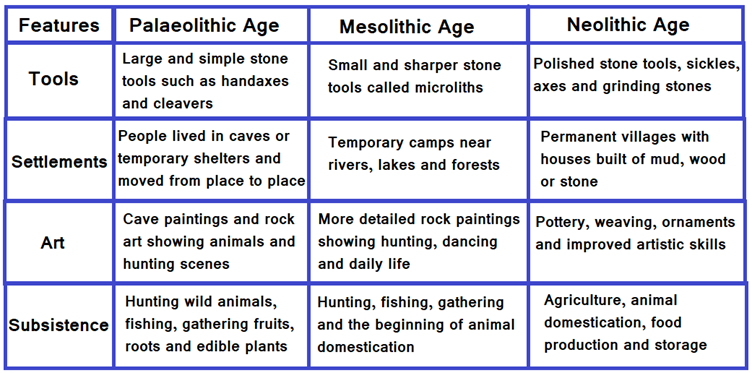
6. Prepare a table with three columns-Palaeolithic, Mesolithic and Neolithic and fill in their distinctive features: tools, settlements, art and subsistence.
Answer:
The three stages of the Stone Age show gradual progress in human life. Tools became more advanced, settlements became permanent, art improved and people gradually shifted from hunting and gathering to farming and animal domestication.
Explanation:
7. “Bronze Age civilisations developed independently but shared common features.” Examine this statement with reference to the civilisations given in the chapter.
Answer:
The Bronze Age civilisations developed in different regions, yet they shared common features such as agriculture, planned settlements, trade, writing, specialised occupations and organised governments, showing similar stages of social and economic development.
Explanation:
The Bronze Age civilisations, including the Sindhu–Sarasvati (Harappan), Mesopotamian, Egyptian and Chinese Civilisations, developed independently in different regions of the world. However, they displayed several common features that reflect similar patterns of human progress.
Most of these civilisations grew along river valleys, where fertile land and abundant water supported agriculture and permanent settlements. They developed organised towns and cities, practised farming, domesticated animals and produced surplus food. Trade flourished within and beyond their regions, encouraging economic growth and cultural exchanges.
These civilisations also developed writing systems, specialised occupations, skilled craftsmanship organised governments and religious institutions. Although their languages, scripts, beliefs and cultural traditions differed, they all showed remarkable achievements in architecture, technology, administration and social organisation.
Thus, while the Bronze Age civilisations emerged independently in different geographical regions, they shared many essential characteristics that contributed to the growth of complex societies and the rise of civilisation.
8. Although rivers provided many benefits, they also created challenges for early societies. Discuss both the advantages and disadvantages of settling near rivers.
Answer:
Rivers supported farming, trade and permanent settlements by providing water and fertile soil. However, floods, changing river courses and water-related diseases often threatened crops, homes and the lives of early communities.
Explanation:
Rivers played a central role in the rise of early civilisations by providing numerous advantages. They supplied fresh water for drinking, irrigation and domestic use, while the fertile soil deposited during floods made agriculture highly productive. Rivers also served as natural routes for transport and trade, encouraging communication between settlements and supporting the growth of prosperous civilisations such as the Sindhu–Sarasvati, Mesopotamian and Egyptian Civilisations.
However, living near rivers also involved several challenges. Seasonal floods could destroy crops, houses and stored food. In some regions, rivers changed their course, affecting settlements and agricultural land. Waterlogged areas and stagnant water sometimes increased the spread of diseases. Communities therefore had to develop methods of managing water, protecting settlements and adapting to natural changes.
Thus, rivers were both a source of prosperity and a challenge, shaping the development of early civilisations in many ways.
9. With the help of your teacher, find out more about the Code of Hammurabi. Why was it important? Do you think it was fair to all sections of society? Give reasons for your answer.
Answer:
The Code of Hammurabi was one of the earliest written law codes. It established rules for society and promoted justice. However, its punishments and rights often differed according to a person’s social status.
Explanation:
The Code of Hammurabi, introduced by the Babylonian king Hammurabi, is one of the earliest known written collections of laws in history. It covered many aspects of daily life, including trade, property, family matters, contracts and punishment for crimes. By writing laws publicly, it helped maintain order and ensured that people knew the rules they were expected to follow.
The Code was important because it strengthened the administration of the kingdom and established a system of justice based on clearly defined laws. However, many punishments were not the same for everyone. The severity of punishment often depended on a person’s social status, with nobles, common people and enslaved individuals sometimes receiving different treatment for similar offences.
Therefore, while the Code of Hammurabi was a significant step towards organised law and governance, it would not be considered completely fair by modern standards because equality before the law was not always followed.
10. If you had to choose one major innovation from early civilisations that changed the world permanently, what would it be and why?
Answer:
I would choose the invention of writing because it made it possible to record knowledge, laws, trade and history. Writing helped preserve ideas and enabled civilisations to pass knowledge from one generation to another.
Explanation:
If I had to choose one major innovation from early civilisations, I would choose the invention of writing. Writing transformed human society by making it possible to record information accurately and preserve it for future generations. It allowed people to maintain records of trade, laws, taxes, religious beliefs and important events.
Writing also helped rulers administer kingdoms more effectively and enabled merchants to keep accounts of goods and transactions. It encouraged the growth of literature, education and communication between different regions. Today, much of what we know about ancient civilisations comes from written records that have survived over time.
Although other innovations such as agriculture, metal tools and the wheel were also important, writing permanently changed the way knowledge was created, preserved and shared. It became the foundation for education, administration, science and cultural development across the world.
11. Compare the social hierarchy and daily life of people in the Egyptian civilisation with those in Mesopotamia or China. What similarities and differences do you notice?
Answer:
Egyptian, Mesopotamian and Chinese societies had rulers, officials, farmers, artisans and labourers. While all followed a social hierarchy, their beliefs, writing systems, architecture and cultural traditions differed according to their regions.
Explanation:
The Egyptian and Mesopotamian civilisations had well-organised social hierarchies. In both societies, the ruler occupied the highest position and was supported by nobles, priests, officials, scribes, merchants, artisans, farmers and labourers. Each group had specific responsibilities that contributed to the administration and development of the civilisation.
The daily life of the people also showed many similarities. Most people depended on agriculture, while artisans produced pottery, tools, jewellery and other goods. Merchants carried out trade, scribes maintained official records and priests performed religious ceremonies. Rivers played a vital role in farming, transport and trade in both civilisations.
However, there were important differences. In Egypt, the Pharaoh was regarded as both a king and a divine figure and beliefs about the afterlife strongly influenced religion, architecture and practices such as mummification. In Mesopotamia, society was organised into independent city-states, each ruled by its own king and ziggurats served as important religious and administrative centres. Their writing systems also differed—Egypt used hieroglyphs, while Mesopotamia developed cuneiform.
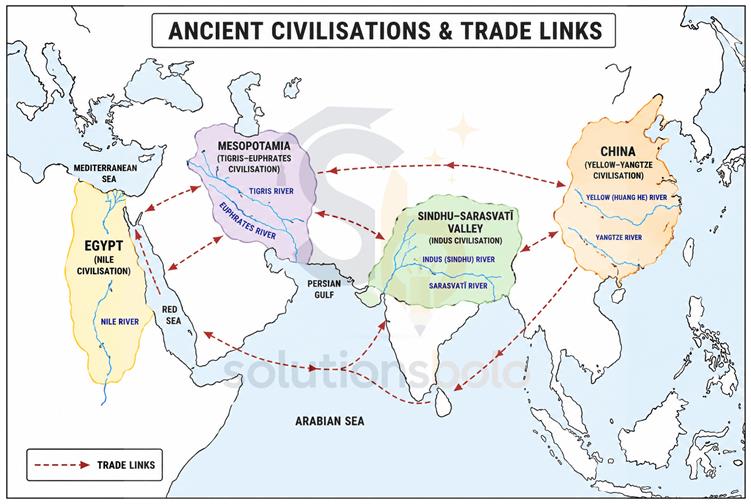
12. Activity: Using maps, locate the major rivers and civilisations of Mesopotamia, Egypt, China and the Sindhu-Sarasvatī Valley. Mark the trade links between them.
Answer:
The map shows the major river-valley civilisations of Mesopotamia, Egypt, the Sindhu–Sarasvatī Valley and China. It also highlights important land and sea trade routes that connected these civilisations and encouraged trade, cultural exchange and economic development.
Explanation:
The map identifies the four major early river-valley civilisations: Mesopotamia along the Tigris and Euphrates, Egypt along the Nile, the Sindhu–Sarasvatī Valley along the Indus (Sindhu) and Sarasvatī, and China along the Yellow (Huang He) and Yangtze Rivers. The marked land and sea trade links show that these civilisations exchanged goods, ideas and technologies over long distances. Such trade strengthened economic growth, cultural interaction and the development of early civilisations.
13. Activity: Choose one early civilisation (Mesopotamia, Egypt or China) and prepare a mini-scrapbook or a presentation showing their innovations in tools, writing, art and architecture. Include pictures, brief descriptions and explain their significance.
(Answer will uploaded shortly)
Multiple Choice Questions (MCQs) with Explanations
1. Which development most clearly marked the beginning of settled human life?
A. Discovery of fire
B. Domestication of animals
C. Beginning of agriculture
D. Use of stone tools
Answer: C. Beginning of agriculture
Explanation:
Agriculture enabled people to produce their own food instead of depending entirely on hunting and gathering. This encouraged permanent settlements, food storage, animal domestication and the growth of villages. Over time, these settled communities became the foundation of early civilisations.
2. Why is archaeological evidence important for studying early civilisations?
A. It predicts future events.
B. It provides direct evidence through objects and remains.
C. It replaces all written records.
D. It explains only modern history.
Answer: B. It provides direct evidence through objects and remains.
Explanation:
Archaeologists study tools, pottery, buildings, fossils ornaments, seals and other remain left by ancient people. These discoveries help historians understand how people lived, worked, traded and organised their societies, especially when written records are unavailable or undeciphered.
3. Which of the following best explains why most early civilisations developed near rivers?
A. Rivers contained valuable minerals only.
B. Rivers provided fertile land, water and transport.
C. Rivers prevented all natural disasters.
D. Rivers had colder climates throughout the year.
Answer: B. Rivers provided fertile land, water and transport.
Explanation:
River valleys supplied fresh water for drinking and irrigation, fertile soil for farming and convenient transport routes for trade. These advantages supported agriculture, encouraged permanent settlements and helped early civilisations prosper despite occasional floods.
4. What was the main advantage of developing writing systems in early civilisations?
A. They replaced farming.
B. They helped preserve information and maintain records.
C. They eliminated trade.
D. They reduced the need for rulers.
Answer: B. They helped preserve information and maintain records.
Explanation:
Writing enabled people to record laws, trade transactions, taxes, religious beliefs and historical events. It also improved administration and communication, allowing knowledge to be preserved and passed from one generation to the next.
5. The Harappan Civilisation is also known as the:
A. Egyptian Civilisation
B. Mesopotamian Civilisation
C. Sindhu–Sarasvatī Civilisation
D. Chinese Civilisation
Answer: C. Sindhu–Sarasvatī Civilisation
Explanation:
The Harappan Civilisation flourished mainly in the Sindhu (Indus) and Sarasvatī river basins. Recent archaeological discoveries have shown that many important settlements were located along the Sarasvatī system, making Sindhu–Sarasvatī Civilisation a more appropriate name.
6. Why do historians divide early human history into the Stone Age, Bronze Age and Iron Age?
A. To classify people according to their language.
B. To show changes in the materials used for tools and technology.
C. To identify different religions.
D. To describe climate change.
Answer: B. To show changes in the materials used for tools and technology.
Explanation:
The classification reflects the gradual development of technology. As humans learned to use stone, bronze and later iron, their tools became more efficient, improving agriculture, craftsmanship, trade and the organisation of society.
7. Which feature was common to the Egyptian, Mesopotamian and Sindhu–Sarasvatī Civilisations?
A. They were located on high mountains.
B. They depended mainly on river valleys for their development.
C. They used exactly the same writing system.
D. They had identical governments.
Answer: B. They depended mainly on river valleys for their development.
Explanation:
Although these civilisations developed independently, they all grew near major rivers. Rivers provided fertile land, water for irrigation and transport routes, supporting agriculture, trade and the growth of organised settlements.
8. Why has the Harappan script remained one of history’s greatest mysteries?
A. No inscriptions have ever been found.
B. The script has not yet been deciphered.
C. It was written only on paper.
D. It was created in modern times.
Answer: B. The script has not yet been deciphered.
Explanation:
Many Harappan seals and inscriptions have been discovered, but scholars have not yet understood their language or writing system. If deciphered, the script could reveal valuable information about Harappan administration, religion, trade and daily life.
9. Which innovation contributed most directly to the growth of trade in early civilisations?
A. Cave paintings
B. Standardised weights and measures
C. Stone shelters
D. Hunting techniques
Answer: B. Standardised weights and measures
Explanation:
Standardised weights and measures made buying and selling more accurate and fair. They increased trust among traders, supported long-distance commerce and helped organise economic activities within and between early civilisations.
10. Which statement best explains the importance of early civilisations in human history?
A. They existed only for a short period.
B. They laid the foundations of organised society, agriculture, trade, writing and governance.
C. They depended entirely on hunting.
D. They had no influence on later societies.
Answer: B. They laid the foundations of organised society, agriculture, trade, writing and governance.
Explanation:
Early civilisations transformed human life through permanent settlements organised governments, agriculture, writing systems, trade and technological innovations. Many ideas and institutions that began during this period continue to influence modern societies around the world.
Assertion & Reason MCQs
1. Assertion (A): The beginning of agriculture encouraged humans to establish permanent settlements.
Reason (R): Farming provided a more regular food supply than hunting and gathering.
A. Both A and R are true and R is the correct explanation of A.
B. Both A and R are true, but R is not the correct explanation of A.
C. A is true, but R is false.
D. A is false, but R is true.
Answer: A
Explanation:
Agriculture allowed people to grow food instead of depending entirely on hunting and gathering. A regular food supply encouraged people to settle permanently, build villages, domesticate animals and develop organised societies. Thus, the reason correctly explains the assertion.
2. Assertion (A): Most early civilisations developed near major rivers.
Reason (R): Rivers provided fertile soil, water for irrigation and routes for transport and trade.
A. Both A and R are true and R is the correct explanation of A.
B. Both A and R are true, but R is not the correct explanation of A.
C. A is true, but R is false.
D. A is false, but R is true.
Answer: A
Explanation:
River valleys offered fertile land, reliable water and easy transport, making them ideal locations for agriculture and settlements. These advantages supported trade, population growth and the rise of early civilisations. Therefore, the reason fully explains the assertion.
3. Assertion (A): Archaeology helps historians understand the Harappan Civilisation.
Reason (R): The Harappan script has been completely deciphered.
A. Both A and R are true and R is the correct explanation of A.
B. Both A and R are true, but R is not the correct explanation of A.
C. A is true, but R is false.
D. A is false, but R is true.
Answer: C
Explanation:
Archaeology provides valuable information through excavated objects such as seals, pottery, buildings and tools. However, the Harappan script has not yet been deciphered, so historians continue to depend mainly on archaeological evidence to study this civilisation.
4. Assertion (A): The invention of writing was an important achievement of early civilisations.
Reason (R): Writing helped maintain records, laws, trade and communication.
A. Both A and R are true and R is the correct explanation of A.
B. Both A and R are true, but R is not the correct explanation of A.
C. A is true, but R is false.
D. A is false, but R is true.
Answer: A
Explanation:
Writing enabled early civilisations to preserve knowledge and maintain records of administration, trade, taxation and religious practices. It also improved communication and governance, making it one of the greatest innovations in human history.
5. Assertion (A): Bronze Age civilisations developed independently in different parts of the world.
Reason (R): They had no similarities in agriculture, trade or social organisation.
A. Both A and R are true and R is the correct explanation of A.
B. Both A and R are true, but R is not the correct explanation of A.
C. A is true, but R is false.
D. A is false, but R is true.
Answer: C
Explanation:
The major Bronze Age civilisations developed in different geographical regions. However, they shared many common features, including agriculture, trade organised governments, specialised occupations and writing systems. Therefore, the assertion is true, but the reason is incorrect.
Case-Based MCQs
Case Study 1: The Beginning of Farming
Early humans depended on hunting wild animals and gathering fruits, roots and edible plants for thousands of years. Gradually, they learnt to grow crops and domesticate animals. This change encouraged people to settle in one place, produce surplus food and establish permanent villages. Over time, these villages developed into organised societies.
1. Which development most directly encouraged permanent settlements?
A. Cave paintings
B. Agriculture and animal domestication
C. Discovery of metals
D. Sea trade
Answer: B. Agriculture and animal domestication
Explanation:
Agriculture provided a regular food supply, while domesticated animals supplied food, labour and other resources. Together, they encouraged people to settle permanently instead of moving from place to place in search of food, laying the foundation for villages and civilisation.
Case Study 2: Life Near Rivers
The earliest civilisations developed near rivers such as the Sindhu, Nile, Tigris-Euphrates and Huang He. These rivers supplied water for drinking and irrigation, fertile soil for farming and convenient routes for transport and trade. However, floods sometimes damaged settlements and crops.
2. Which statement best explains why river valleys became centres of civilisation?
A. Rivers completely prevented natural disasters.
B. Rivers supplied fertile land, water and transport facilities.
C. Rivers were located only in deserts.
D. Rivers eliminated the need for farming.
Answer: B. Rivers supplied fertile land, water and transport facilities.
Explanation:
River valleys offered fertile soil, abundant water and transport routes, making agriculture and trade easier. Although floods occasionally caused destruction, the overall benefits encouraged people to establish permanent settlements and develop organised civilisations.
Case Study 3: The Mystery of the Harappans
Archaeologists have discovered thousands of Harappan seals, pottery, buildings and tools. Many seals contain short inscriptions written in the Harappan script. However, this script has not yet been deciphered, so historians depend mainly on archaeological evidence to understand Harappan society.
3. If the Harappan script were deciphered, what would historians most likely learn?
A. Future weather forecasts
B. Details about administration, language, trade and beliefs
C. Modern political systems
D. Information about the Industrial Revolution
Answer: B. Details about administration, language, trade and beliefs
Explanation:
Deciphering the Harappan script could reveal valuable information about rulers, administration, religion, language, trade, laws and everyday life. This would greatly improve our understanding of one of the world’s earliest urban civilisations.
Case Study 4: Trade Between Civilisations
Ancient civilisations exchanged goods over long distances through land and sea routes. Merchants used standardised weights and measures to ensure fair trade. These exchanges also spread ideas, technologies and cultural practices between different regions.
4. Why were standardised weights and measures important for ancient trade?
A. They made agriculture unnecessary.
B. They ensured fairness and accuracy in buying and selling.
C. They reduced the need for writing.
D. They replaced river transport.
Answer: B. They ensured fairness and accuracy in buying and selling.
Explanation:
Standardised weights and measures helped merchants trade fairly and accurately. They built trust between traders, reduced disputes and supported the growth of local as well as long-distance trade among early civilisations.
Case Study 5: Comparing Ancient Civilisations
The Egyptian, Mesopotamian, Sindhu–Sarasvatī and Chinese Civilisations developed independently in different regions. Although each had its own culture and writing system, they all established organised societies with agriculture, trade, specialised occupations and systems of governance.
5. Which feature was common to all these early civilisations?
A. They used the same language.
B. They followed identical religious beliefs.
C. They developed organised societies based on agriculture.
D. They built the same type of monuments.
Answer: C. They developed organised societies based on agriculture.
Explanation:
Despite developing independently, these civilisations shared several important features, including agriculture, permanent settlements, specialised occupations, trade and organised governance. Their languages, religions and architectural styles, however, differed from one another.
Competency-Based Questions
1. Imagine archaeologists discover a new ancient settlement near a river. What kinds of evidence would help them decide whether it was a developed civilisation?
Answer:
If archaeologists discovered a new settlement near a river, they would carefully examine the evidence left behind by its inhabitants. Permanent houses, well-planned streets, drainage systems, granaries, pottery, tools ornaments and workshops would suggest that people lived in an organised society. Evidence of farming, domesticated animals and trade would indicate a stable economy. If inscriptions or writing were found, they could provide valuable information about administration, religion and daily life. Together, these discoveries would help historians determine whether the settlement belonged to a developed civilisation.
2. A village has fertile land but no nearby river. Another village is located beside a river but often experiences floods. Which place would have been more suitable for an early civilisation? Give reasons for your answer.
Answer:
A settlement near a river would usually be a better choice for an early civilisation. Rivers supplied fresh water for drinking, irrigation and domestic use, while fertile soil supported successful agriculture. They also served as transport routes that encouraged trade and communication. Although floods sometimes damaged crops and settlements, the long-term advantages of reliable water and fertile land were greater than the risks. Many early civilisations, including the Sindhu–Sarasvatī, Egyptian and Mesopotamian Civilisations, developed in river valleys because people learned to adapt to these environmental challenges.
3. Suppose the Harappans had not followed a standard system of weights and measures. How might this have affected trade and daily life?
Answer:
Standardised weights and measures were essential for maintaining fairness and accuracy in trade. Without them, merchants would have found it difficult to buy and sell goods confidently. Different measures could lead to misunderstandings, cheating and frequent disputes. Long-distance trade with other regions would become less organised because traders would not have a common system for measuring goods. As a result, economic activities would slow down, reducing trust among merchants and affecting the prosperity of the Harappan Civilisation.
4. Compare the life of a hunter-gatherer with that of a Neolithic farmer. Which lifestyle do you think offered greater security? Give reasons for your answer.
Answer:
Hunter-gatherers moved from place to place in search of food and depended on hunting wild animals, fishing and gathering plants. In contrast, Neolithic farmers lived in permanent settlements, cultivated crops and domesticated animals. Farming provided a more regular food supply and encouraged the development of villages, trade and organised communities. However, farmers also faced new challenges such as droughts, floods, pests and crop failures. Despite these difficulties, the settled life of Neolithic farmers offered greater stability and laid the foundation for the growth of civilisation.
Common Mistakes & Exam Tips
1. Confusing the Stone Age with the Bronze Age
Common Mistake: Students often mix up the characteristics of the Palaeolithic, Mesolithic and Neolithic Ages or confuse them with the Bronze Age.
Exam Tip: Learn the sequence of the ages and remember the major developments in each stage, such as hunting and gathering, farming, animal domestication and the use of metals.
2. Confusing the Harappan Civilisation with the Indus Valley Civilisation
Common Mistake: Many students think the Harappan Civilisation was limited only to the Indus Valley.
Exam Tip: Remember that the latest NCERT also uses the term Sindhu–Sarasvatī Civilisation, as many important sites were located along the Sarasvatī river system.
3. Forgetting the Importance of Rivers
Common Mistake: Students remember the names of rivers but fail to explain why early civilisations developed near them.
Exam Tip: Always mention fertile soil, water supply, irrigation, transport and trade whenever writing about river-valley civilisations.
4. Mixing Up Different Writing Systems
Common Mistake: Students confuse Harappan script, cuneiform, hieroglyphs and the Chinese logographic script.
Exam Tip: Revise which civilisation used each writing system and remember that the Harappan script remains undeciphered, unlike Egyptian hieroglyphs and Mesopotamian cuneiform.
5. Memorising Facts Without Understanding the Changes
Common Mistake: Students memorise names and dates but cannot explain how human life changed from hunting and gathering to farming.
Exam Tip: Focus on the gradual transition from nomadic life → agriculture → permanent settlements → villages → civilisations, as this is the central theme of the chapter.
6. Ignoring Archaeological Evidence
Common Mistake: Students often write only about written sources when explaining how historians study the past.
Exam Tip: Mention archaeological evidence such as fossils, tools, pottery, seals, buildings and human remains. These are key sources for understanding early human life and ancient civilisations.
7. Writing One-Sided Answers
Common Mistake: In discussion questions, students explain only the advantages or only the disadvantages.
Exam Tip: For questions using words like “Discuss,” “Compare,” “Examine,” or “Evaluate,” present both sides before writing a balanced conclusion.
8. Forgetting to Compare Civilisations Properly
Common Mistake: Students describe only one civilisation instead of comparing two civilisations as asked in the question.
Exam Tip: When answering comparison questions organise your answer by discussing social hierarchy, daily life, similarities and differences before concluding.
9. Ignoring Map-Based Learning
Common Mistake: Students focus only on theory and overlook the locations of major rivers and ancient civilisations.
Exam Tip: Practise locating the Sindhu–Sarasvatī, Nile, Tigris–Euphrates and Huang He (Yellow River) on a map, as map-based questions are important in examinations.
10. Missing Important NCERT Keywords
Common Mistake: Students write lengthy answers but forget important geographical and historical terms. (given in books as above u read already)
Exam Tip: Naturally include keywords such as archaeology, fossils, Neolithic, Bronze Age, river-valley civilisation, cuneiform, hieroglyphs, Harappan script, trade and agriculture wherever relevant.
Frequently Asked Questions (FAQs)
1. Who were the earliest humans on Earth?
Answer:
The earliest humans evolved over millions of years from early hominins in Africa. Gradually, different human species developed and Homo sapiens eventually became the modern human species. They spread to different parts of the world through migration.
2. Why is the Stone Age divided into the Palaeolithic, Mesolithic and Neolithic Ages?
Answer:
The Stone Age is divided into three stages because human life and technology changed gradually over time. Stone tools became more advanced, people shifted from hunting and gathering to farming and permanent settlements eventually developed.
3. Why is agriculture considered a turning point in human history?
Answer:
Agriculture enabled humans to produce food instead of depending entirely on hunting and gathering. It encouraged permanent settlements, animal domestication, food storage, trade and the growth of villages, laying the foundation for early civilisations.
4. Why did most early civilisations develop near rivers?
Answer:
Rivers provided fresh water, fertile soil for farming, transportation routes and favourable conditions for settlement. These advantages supported agriculture, trade and population growth, making river valleys ideal locations for early civilisations.
5. Why is the Harappan script still a mystery?
Answer:
Although many Harappan seals and inscriptions have been discovered, scholars have not yet deciphered the script. Until it is understood, historians must rely mainly on archaeological evidence to study the Harappan Civilisation.
6. What is archaeology and why is it important?
Answer:
Archaeology is the study of the human past through material remains such as tools, pottery, buildings, fossils ornaments and inscriptions. It helps historians understand ancient societies, especially where written records are unavailable.
7. What were the major achievements of the Bronze Age civilisations?
Answer:
Bronze Age civilisations developed planned settlements, agriculture, trade, writing systems, metal tools, specialised occupations and organised governments. These achievements greatly influenced the growth of later societies and civilisations.
8. What are the main differences between hunter-gatherers and Neolithic farmers?
Answer:
Hunter-gatherers moved from place to place in search of food, while Neolithic farmers lived in permanent settlements, cultivated crops and domesticated animals. Farming provided greater stability but also required continuous labour and dependence on natural conditions.
9. What is the importance of writing in early civilisations?
Answer:
Writing helped people record laws, trade, taxes, religious beliefs and historical events. It improved administration, preserved knowledge and enabled ideas to be passed from one generation to the next.
10. What can we learn from early civilisations today?
Answer:
Early civilisations teach us the importance of agriculture organised societies, trade, cooperation, innovation and cultural development. Their achievements in technology, writing and governance continue to influence the modern world.