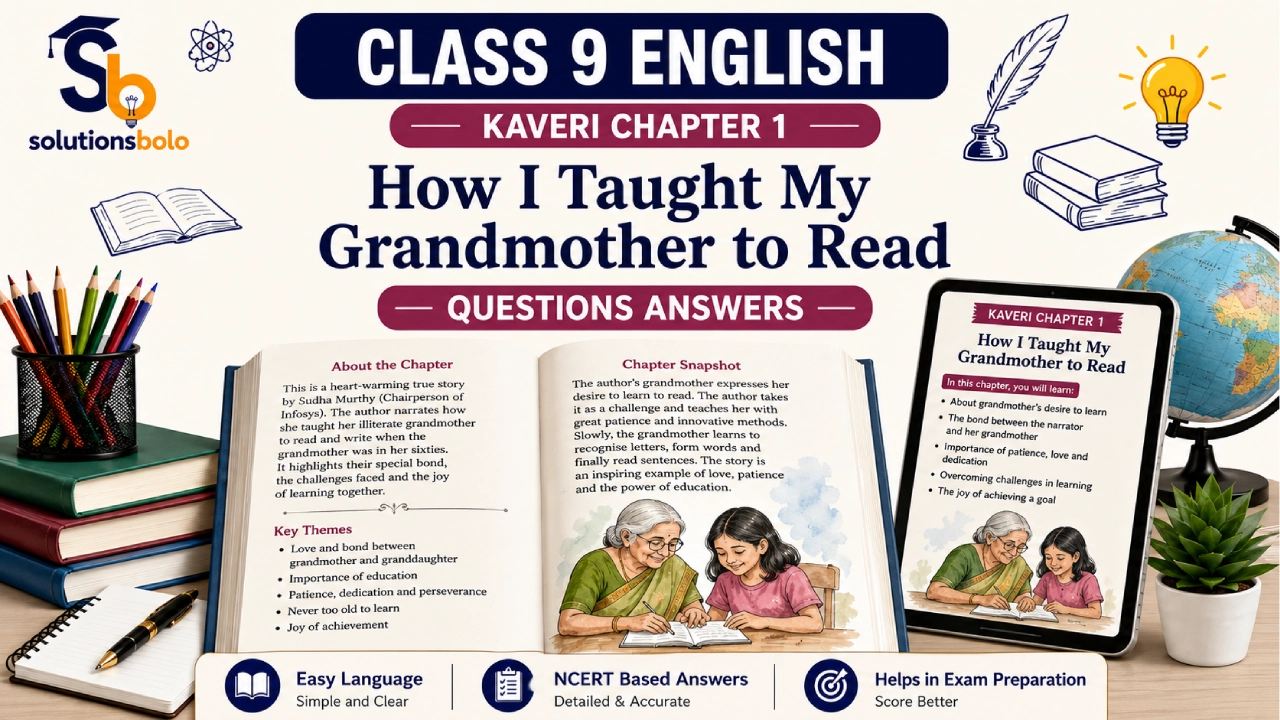
Class 9 English Kaveri Chapter 1, How I Taught My Grandmother to Read, is an inspiring autobiographical story by Sudha Murty that highlights the transformative power of education and lifelong learning. The chapter narrates the touching relationship between a grandmother and her granddaughter, showing how determination, hard work and respect for knowledge can overcome the barriers of age and illiteracy. It emphasizes important values such as self-reliance, gratitude, perseverance, humility and the importance of teachers in shaping lives. Solutions Bolo provides accurate, well-explained and exam-oriented answers to all textbook questions. The solutions help students understand the central theme, character traits, literary values, vocabulary, grammar and important messages of the chapter. They also include clear explanations, summary, exercise questions, English to Hindi translate, competency-based questions, HOTS (Higher Order Thinking Skills), value-based questions as very short, short and long questions and answers, FAQs and previous-year exam-oriented answers according to the latest CBSE syllabus (2026–27).
Chapter 1 Quick Links:
1. Kaveri Chapter 1 Questions and Answers
2. Chapter 1 Line by line Hindi Translation & word meaning
3. Students Make Mistakes in this Chapter
4. Kaveri Chapter 1 Summary (Part 1)
5. Kaveri Chapter 1 Summary (Part 2)
6. Competency-Based Questions with Answers (CBSE 2026–27)
7. HOTS (Higher Order Thinking Skills) Questions with Answers
8. Previous-Year Exam-Oriented Questions with Answers
9. Very Short Questions with Answers
10. Short Questions with Answers
11. Long Questions with Answers
Kaveri Chapter 1 Questions and Answers
I. Complete the given word web.
Why is it important to learn how to read and write?
Answer: 1. To become independent.
2. To gain knowledge and information.
3. To communicate effectively.
4. To improve education and career opportunities
II. Read the questions given below and share your answers with your classmates and teacher.
1. Which language(s) do your grandparents or elderly relatives speak?
Answer: My grandparents mainly speak Kannada and understand a little Hindi. They are most comfortable communicating in Kannada. They enjoy speaking their mother tongue with family members and sharing stories, traditions and life experiences.
2. How do they spend their time? How do you spend time with them?
Answer: My grandparents spend their time reading religious books, gardening and watching television. I spend time talking with them, listening to their stories, helping them with simple tasks and going for evening walks together
3. What is your favourite experience with them?
Answer: My favourite experience is listening to my grandmother’s childhood stories during holidays. She also teaches me traditional recipes and family values. Spending time with her always makes me feel happy, loved and inspired.
4. What is something that the elderly in your family cannot do easily but enjoy watching you do? Answer: My grandparents cannot use smartphones and computers easily. However, they enjoy watching me use technology for studying, making presentations, finding information online and showing them family photos and videos.
III. Read the following passage. Match the highlighted words with their meanings given in the box below.
1. excitedly 2. Believable 3. people living in one particular area
4. discussion 5. a part of a story 6. Focus
7. main character 8. Directed
The casting for the (i) protagonist of our school’s annual play was done after a lot of (ii) debate as many good actors had auditioned for the role. We had decided to present an (iii) episode from an inspirational story. It was a life story of a group of children who worked with the (iv) community to spread literacy. Every day, we reached school early to practise with (v) concentration. We waited (vi) eagerly for the final presentation. All of us played our roles in a very (vii) convincing manner as our theatre teacher had (viii) guided us well.
Answer:
| Highlighted Word | Meaning |
| (i) protagonist | 7. main character |
| (ii) debate | 4. discussion |
| (iii) episode | 5. a part of a story |
| (iv) community | 3. people living in one particular area |
| (v) concentration | 6. focus |
| (vi) eagerly | 1. excitedly |
| (vii) convincing | 2. believable |
| (viii) guided | 8. Directed |
Check Your Understanding (Page – 6)
Complete the cause and effect table given below based on Part I of the story. Share your answers with your classmates and teacher.
| Cause: 1. |
| Effect: (i) The morning papers arrived late in the day and weekly magazines would come one day late. |
Answer: Cause 1: There were very few means of transport and communication in the village.
| Cause: 2. The grandmother, Krishtakka, never went to school. |
| Effect: (ii) |
Answer: Effect (ii): She remained illiterate and could not read books or magazines by herself.
| Cause: 3. |
| Effect: (iii) She was deeply interested in the story and discussed it with her friends. |
Answer: Cause 3: The grandmother listened to the novel Kashi Yatre every week.
| Cause: 4. The narrator went to a wedding for a week. |
| Effect: (iv) |
Answer: Effect (iv): The grandmother could not read next episode of Kashi Yatre and became very sad and helpless.
| Cause: 5. |
| Effect: (v) The grandmother never went to school. |
Answer: Cause 5. In those days, girl were married off early and education for girls was not considered essential.
| Cause: 6. The grandmother regretted not going to school. |
| Effect: (vi) |
Answer: Effect (vi): She ensured that all her children and grandchildren studied well, and she herself worked hard to become literate.
II. Do you think the narrator expected to see her grandmother in tears when she returned to the village? If yes, why? If no, why not?
Answer: No. The narrator did not expect to see her grandmother in tears because she had never seen her cry even in most difficult situations. She was deeply surprised to find her crying and only later understood that her grandmother felt completely helpless because she could not read the novel by herself.
III. How might the narrator help her grandmother to fulfil her desire to learn to read and write?
Answer: The narrator helped her grandmother by happily agreeing to become her teacher. She patiently taught her the Kannada alphabet every day, gave her homework and constantly encouraged her until she became fully confident and self-reliant.
Check Your Understanding (Page – 9)
I. State whether the following sentences are true or false. Share your answers with your classmates and teacher.
1. The grandmother wanted to learn the Kannada alphabet to gain independence.
Answer: True
2. The grandmother asked someone in the village to read Kashi Yatre to her while the narrator was away.
Answer: False
3. The narrator was the grandmother’s first teacher and taught her how to read Kannada.
Answer: True
4. The grandmother believed that there was no age limit for learning.
Answer: True
5. The grandmother touched the narrator’s feet as a mark of respect for her as a teacher.
Answer: True
6. The narrator was disappointed with the progress her grandmother made in learning to read.
Answer: False
Critical Reflection (Page – 10)
(i) Complete the following sentence with the appropriate option.
The phrase ‘never seen her cry in the most difficult situations’ tells us that the grandmother was ________________________.
A. strong-willed
B. understanding
C. considerate
D. bold
Answer: A. strong-willed
(ii) Complete the following with the correct option from those given in the brackets.
Grandmother did not reply when the narrator asked if she was alright because she might have been too ________________________ (emotional/tired) to respond.
Answer: emotional
(iii) Identify the clue from the extract that indicates a rural setting with traditional customs.
Answer: The clue is the grandmother sitting on the terrace in the twilight and later touching her granddaughter’s feet, which strictly reflects traditional Indian customs.
(iv) Which lines of the extract establish a tender atmosphere?
Answer: She held my hand and said, ‘Child, I have something to tell you.'” and her crying in the quiet twilight on the terrace.
(v) Which of the following aspect is NOT emphasised in the given extract?
A. the emotional turmoil of the grandmother
B. the affectionate bond between the narrator and her grandmother
C. the grandmother’s regret over her lack of education
D. the narrator’s concern for her grandmother
Answer: D. the narrator’s concern for her grandmother
(Page – 12)
2. (i) What does the grandmother’s statement, “I want to be independent,” reveal about her character?
A. She wanted to be literate.
B. She desires self-sufficiency.
C. She wants to prove her intelligence to others.
D. She feels pressured by society to learn.
Answer: B. She desires self-sufficiency.
(ii) Fill in the blank with the appropriate option from those given in brackets.
The grandmother’s determination shows that learning has no ___________________. (age limit/gender bias/cultural barriers)
Answer: age limit
(iii) Complete the following with a suitable reason.
The narrator laughs at her grandmother’s decision to learn the alphabet at the age of sixty-two because ___________________.
Answer: She found it highly unusual and amusing for a sixty-two-year-old woman to start learning the alphabet like a young school child.
(iv) List any two qualities displayed by the grandmother.
Answer: Determination and perseverance
(v) How can we say that the narrator is making assumptions about her grandmother?
Answer: The narrator makes assumptions by believing that a sixty-two-year-old woman cannot learn to read and write at an advanced age, which makes her laugh at her grandmother’s decision initially.
Answer the following questions. (Page – 12)
1. Why do you think the grandmother felt embarrassed to ask someone else to read to her while the narrator was away?
Answer: The grandmother felt embarrassed because she was illiterate and had to depend on others to read for her. When the narrator was away, she realised how helpless she was without someone to assist her. She felt ashamed to look for help from outsiders for a story she loved, which deeply hurt her self-respect and made her determined to learn reading and writing.
2. Why does the narrator initially laugh at her grandmother’s determination to learn at the age of sixty-two?
Answer: The narrator initially laughs because she finds it surprising that her sixty-two-year-old grandmother wants to learn the alphabet like a young school child. She thinks it is highly unusual for an elderly person to begin formal learning. However, she soon understands that her grandmother is completely serious and determined, which changes her amusement into deep respect.
3. What significance does the story of Kashi Yatre have in both the grandmother’s life and the story?
Answer: Kashi Yatre plays a crucial role because it acts as the catalyst that inspires the grandmother to learn reading and writing. She feels deeply disappointed when she cannot read the next episode while the narrator is away, identifying herself with the protagonist of the novel. In the story, Kashi Yatre becomes the ultimate turning point that highlights the core themes of education, determination, and self-reliance.
4. What does the grandmother’s desire to learn the Kannada alphabet reflect about her?
Answer: The grandmother’s desire to learn the Kannada alphabet reflects her extraordinary determination, strong self-respect, and eagerness to become independent. Although she is sixty-two years old, she refuses to let age stop her from learning. Her positive attitude shows that sincere effort and strong willpower can help anyone achieve their goals regardless of age.
5. What lessons can we infer from the grandmother’s action of touching the narrator’s feet?
Answer: The grandmother touches the narrator’s feet as a mark of respect because she considers her granddaughter to be her teacher. This action teaches us that knowledge deserves respect regardless of the teacher’s age or relation. It also highlights the grandmother’s deep humility, gratitude, and respect for education, reminding us that true learners always value those who guide them.
6. What does the following line tell us about the broader theme of the story?
‘For a good cause if you are determined, you can overcome any obstacle.’
Answer: This line expresses the central theme of the story that determination and hard work can help people overcome any difficulty. The grandmother proves this by learning to read and write successfully despite her old age and lack of formal schooling. The story encourages readers to remain committed and never give up on their goals due to difficult circumstances.
7. How effectively does the story highlight the value of education in supporting personal independence?
Answer: The story effectively highlights that education is the ultimate key to personal independence and dignity. The grandmother feels completely helpless because she cannot read by herself and depends on others. Her journey to literacy changes her life, giving her immense confidence and self-respect, proving that education empowers individuals and frees them from the chains of dependency.
Vocabulary and Structures in Context (Page – 13)
I. The expression ‘hide and seek’ is used in the text. This is called a binomial. Binomials are expressions consisting of two words, usually linked by a conjunction like ‘and’ or ‘or’, that are commonly used together in a fixed order. For example: odds and ends, right or wrong.
Match the binomials in Column 1 with their meanings in Column 2. You may refer to a dictionary.
| Column 1 | Column 2 |
| 1. sink or swim | (vii) succeed or fail without help |
| 2. on and off | (v) sometimes, occasionally |
| 3. mix and match | (i) put different things together to get a range of possibilities |
| 4. all or nothing | (viii) something to be done completely or not at all |
| 5. part and parcel | (ii) complete part of or belong to |
| 6. pick and choose | (iii) choose only the best (things, people, etc.) |
| 7. sooner or later | (iv) at some time in the future |
| 8. leaps and bounds | (vi) increase or develop very quickly |
Answer:
| Column 1 | Column 2 |
| 1. sink or swim | (vii) succeed or fail without help |
| 2. on and off | (v) sometimes, occasionally |
| 3. mix and match | (i) put different things together to get a range of possibilities |
| 4. all or nothing | (viii) something to be done completely or not at all |
| 5. part and parcel | (ii) complete part of or belong to |
| 6. pick and choose | (iii) choose only the best (things, people, etc.) |
| 7. sooner or later | (iv) at some time in the future |
| 8. leaps and bounds | (vi) increase or develop very quickly |
| Sentence Examples of Binomials: 1. When Rahul started his new job, he had to sink or swim without anyone’s guidance. 2. It rained on and off throughout the day. 3. You can mix and match different colours to create a beautiful outfit. 4. She has an all or nothing attitude towards her studies. 5. Hard work is part and parcel of success. 6. The customers could pick and choose the fruits they wanted. 7. If you keep working hard, you will succeed sooner or later. 8. The company has grown by leaps and bounds over the last few years. |
II. Read the following words from the text given in the box below.
(Unhappy, unusual, unfortunately, irrespective, independent)
These words are made by adding suitable prefixes (‘un’, ‘ir’ and ‘in’) to give an opposite or negative meaning to the words. Now, make words by adding the suitable prefixes given in the box to the words from the text in Column 1. Write the prefixed words in Column 2. One example has been done for you.
(un /im /dis /in /mis /extra)
| Column 1 | Column 2 |
| 1. popular | (i) unpopular |
| 2. belief | (ii) |
| 3. important | (iii) |
| 4. respect | (iv) |
| 5. correct | (v) |
| 6. continue | (vi) |
| 7. understand | (vii) |
| 8. ordinary | (viii) |
| 9. interesting | (ix) |
| 10. possible | (x) |
Answer:
| Column 1 | Column 2 |
| 1. popular | (i) unpopular (given) |
| 2. belief | (ii) disbelief |
| 3. important | (iii) unimportant |
| 4. respect | (iv) disrespect |
| 5. correct | (v) incorrect |
| 6. continue | (vi) discontinue |
| 7. understand | (vii) misunderstand |
| 8. ordinary | (viii) extraordinary |
| 9. interesting | (ix) uninteresting |
| 10. possible | (x) impossible |
III Identify any five words with prefixes from the story and make sentences using each.
Answer:
• Unhappy – The child felt unhappy after losing her favourite book.
• Unusual – It was unusual to see an elderly woman learning the alphabet.
• Unfortunately – Unfortunately, the bus arrived very late.
• Irrespective – Everyone should be treated equally, irrespective of their age.
• Independent – The grandmother wanted to become independent by learning to read.
IV. In the sentence, “I knew, then, that my student had passed with flying colours”, the phrase “passed with flying colours” is an idiom. It means outstanding performance.
Now, match the idioms related to ‘learning’ given in Column 1 with their meanings in Column 2. You may refer to a dictionary.
| Column 1 | Column 2 |
| 1. to hit the books | (i) to memorise something |
| 2. to draw a blank | (ii) to think very hard |
| 3. to learn the ropes | (iii) to study seriously |
| 4. to rack one’s brain | (iv) to study or work late into the night |
| 5. to learn by heart | (v) to be unable to remember |
| 6. burn the midnight oil | (vi) to understand how to do an activity |
| Column 1 | Column 2 |
| 1. to hit the books | (iii) to study seriously |
| 2. to draw a blank | (v) to be unable to remember |
| 3. to learn the ropes | (vi) to understand how to do an activity |
| 4. to rack one’s brain | (ii) to think very hard |
| 5. to learn by heart | (i) to memorise something |
| 6. burn the midnight oil | (iv) to study or work late into the night |
Examples of Idioms in Sentences:
1. I must hit the books before my final examination.
2. I drew a blank when the teacher asked me the answer.
3. It took Riya a week to learn the ropes at her new job.
4. I racked my brain to solve the difficult puzzle.
5. We had to learn the poem by heart.
6. She burnt the midnight oil to complete her project.
(Page – 15 and 16)
V. Read the following sentences from the text and underline the verbs.
1. Secretly, I bought Kashi Yatre which had been published as a novel by that time.
2. I knew, then, that my student had passed with flying colours.
In sentence 1, verb ‘bought’ is in simple past tense. In sentence 2, verb ‘had passed’ is in past perfect tense.
(i) Fill in the blanks with simple past and past perfect tense form of the verbs given in brackets.
A. When the delegates _________ (arrive) at the conference, the keynote speaker _________ (already begin) the session.
B. After the students _________ (learn) how to identify fake news online, they _________ (start) verifying information before sharing it.
C. Before Kiran _________ (start) using digital payment platforms, she _________ (ensure) her understanding of online fraud prevention.
D. By the time Varun _________ (recognise) the importance of budgeting, he _________ (exhaust) most of his savings.
E. When Raghu _________ (log in) to the cybersecurity webinar, the instructor _________ (already discuss) the importance of strong passwords
Answer: A. When the delegates arrived at the conference, the keynote speaker had already begun the session.
B. After the students had learnt how to identify fake news online, they started verifying information before sharing it.
C. Before Kiran started using digital payment platforms, she had ensured her understanding of online fraud prevention.
D. By the time Varun recognised the importance of budgeting, he had exhausted most of his savings.
E. When Raghu logged in to the cybersecurity webinar, the instructor had already discussed the importance of strong passwords.
(ii) Fill in the blanks with the correct form of verbs given in brackets.
Last year, my parents and I A. _________ (take) a financial planning course. When we B. _________ (review) our expenses, we realised we C. _________ (spend) too much on unnecessary purchases. After my parents D. _________ (discuss) ways to save, I E. _________ (open) a savings account.
By the time we F. _________ (set) our budget, the course G. _________ (already introduce) investment strategies. We H. _________ (hurry) to take notes, but many participants I. _________ (complete) their financial plans. Despite that, we J. _________ (enjoy) learning how to manage money wisely.
Answer:
Last year, my parents and I took a financial planning course. When we reviewed our expenses, we realised we had spent too much on unnecessary purchases. After my parents had discussed ways to save, I opened a savings account.
By the time we set our budget, the course had already introduced investment strategies. We hurried to take notes, but many participants had completed their financial plans. Despite that, we enjoyed learning how to manage money wisely.
Listen and Respond: (Page – 17)
I. You will listen to a speaker talk about digital literacy. As you listen, complete the following sentences with one to three exact words that you hear. (Transcript for teacher on page 259)
1. Literacy these days includes the ability to use _____________.
2. Digital literacy is also about protecting _____________.
3. Digital literacy enables the elderly to ______________.
4. Digital literacy encourages using the internet safely by helping us recognise ______________ and _______________.
5. The National Digital Literacy Mission helps people across the country by imparting ______________.
Answer:
1. Literacy these days includes the ability to use digital tools.
2. Digital literacy is also about protecting personal data.
3. Digital literacy enables the elderly to stay connected.
4. Digital literacy encourages using the internet safely by helping us recognise misinformation and scams.
5. The National Digital Literacy Mission helps people across the country by imparting IT training.
Writing Task (Page – 19)
I. As a socially responsible citizen, you strongly believe that students can contribute significantly in promoting adult literacy. Write a letter to the Editor of a local newspaper emphasising the importance of student participation in adult literacy camps conducted by various organisations. Discuss the benefits of such initiatives for both students and society. Suggest effective ways to spread awareness and encourage more students to volunteer for this noble cause.
A letter to the editor is a formal letter in which the writer gives suggestions and creates awareness on an issue of public interest or an issue already raised in an article/write-up/published letter.
Answer:
45, Gandhi Nagar
Vijayawada – 520010
20 June 2026
The Editor
The Hindu
Vijayawada
Subject: Student Participation in Adult Literacy Camps
Sir/Madam,
This is with reference to the article on adult literacy published in your newspaper recently. As a concerned citizen, I would like to draw your attention to the importance of encouraging students to participate in adult literacy camps organised by various organisations. Many adults remain illiterate, which limits their opportunities and affects their confidence and independence.
Adult illiteracy is a serious social issue that affects individuals, families and the overall development of society. Student volunteers can make a meaningful contribution by teaching basic reading, writing and numeracy skills. Such programmes also help students develop compassion, communication skills, leadership qualities and a strong sense of social responsibility. It would be beneficial if schools and colleges regularly encouraged students to volunteer in these literacy drives.
I request the concerned authorities and educational institutions to organise awareness campaigns, workshops and community outreach programmes to motivate more students to join adult literacy camps. Certificates, appreciation programmes and social media campaigns can further inspire greater participation. I trust this matter will be considered seriously and I hope this letter will create awareness among readers and encourage more students to support this noble cause.
Yours truly,
ABC
Learning Beyond the Text (Page – 20)
I. India has 22 major languages according to the Eighth Schedule of the Indian Constitution. Each language has its own unique identity. Talk to your classmates and teacher and complete the given table with words from any five Indian languages.
You can complete the table using any five Indian languages. Here is one correct example:
Answer:
| Language | 1. Kannada | 2. Hindi |
| Grandmother | Avva | Dadi |
| Grandfather | Ajja | Dada |
| Mother | Amma | Maa |
| Father | Appa | Papa |
| Sister | Akka | Behen |
| Brother | Anna | Bhai |
| 3. Telugu | 4. Tamil | 5. Malayalam |
| Avva | Paati | Ammumma |
| Thaatha | Thaatha | Appooppan |
| Amma | Amma | Amma |
| Nanna | Appa | Achan |
| Akka | Akka | Chechi |
| Anna | Anna | Chettan |
(Page – 22)
Talk to your grandparents and find out which book or magazine they enjoy reading. Buy a copy of it and present it to them as a gift.
Answer: I talked to my grandparents about their favourite reading material. They told me they enjoy reading the Bhagavad Gita and a monthly spiritual magazine. I bought a copy of the Bhagavad Gita and presented it to them as a gift. They were very happy and thanked me warmly. It was a memorable experience and I felt proud to encourage their reading habit while spending quality time with them.
2. Chapter 1 Line by line Hindi Translation & word meaning
Paragraph 1: When I was a girl of about twelve… magazines and the post.
जब मैं लगभग बारह वर्ष की लड़की थी, तब मैं उत्तर कर्नाटक के एक गाँव में अपने दादा-दादी के साथ रहती थी। उन दिनों परिवहन व्यवस्था अच्छी नहीं थी, इसलिए हमें सुबह का अखबार दोपहर में मिलता था। साप्ताहिक पत्रिका भी एक दिन की देरी से आती थी। हम सभी बस का बेसब्री से इंतज़ार करते थे, क्योंकि वही बस अखबार, साप्ताहिक पत्रिकाएँ और डाक लेकर आती थी।
• weekly magazine – A magazine published once every week (साप्ताहिक पत्रिका)
• eagerly – With excitement and impatience (उत्सुकता से / बेसब्री से)
• used to stay – lived regularly in the past (रहा/रहती था/थी)
• one day late – arrived after one day (एक दिन की देरी से)
• wait eagerly – wait with excitement (बेसब्री से इंतज़ार करना)
Paragraph 2: At that time, Triveni …. very interesting.
उस समय त्रिवेणी कन्नड़ भाषा की बहुत प्रसिद्ध लेखिका थीं। वे एक अद्भुत लेखिका थीं। उनकी लिखने की शैली सरल थी और पाठकों को बहुत प्रभावित करती थी। उनकी कहानियाँ सामान्य लोगों के जीवन की जटिल मनोवैज्ञानिक समस्याओं पर आधारित होती थीं और हमेशा बहुत रोचक होती थीं।
• Style – the special way of writing or doing something (शैली)
• Convincing – making someone believe something (विश्वास दिलाने वाला, प्रभावशाली)
• Usually – most of the time (आमतौर पर)
• Dealt with – discussed or was about (से संबंधित होना, वर्णन करना)
• Complex – difficult to understand (जटिल)
• Psychological – related to the mind or emotions (मनोवैज्ञानिक)
• At that time – during that period (उस समय)
Paragraph 3: Unfortunately ….. her novels.
दुर्भाग्यवश कन्नड़ साहित्य के लिए, उनका निधन बहुत कम उम्र में हो गया। आज भी, चालीस वर्ष बाद, लोग उनके उपन्यासों की सराहना करते हैं और उन्हें बड़े प्रेम से पढ़ते हैं।
• Died – Passed away; stopped living (निधन हो गया / मृत्यु हो गई)
• Continue – To keep doing something (जारी रखना)
• Novels – Long fictional stories in book form (उपन्यास)
• Even now – till the present time (आज भी / अब भी)
• continue to appreciate – keep admiring or valuing (सराहना करते रहना)
Paragraph 4: One of her novels, called Kashi Yatre ………… Lord Vishweshwara at Kashi.’
उन दिनों उनका एक उपन्यास ‘काशी यात्रा’ कन्नड़ साप्ताहिक पत्रिका ‘कर्मवीर’ में धारावाहिक (किस्तों) के रूप में प्रकाशित हो रहा था। यह एक वृद्ध महिला और काशी (वाराणसी) जाने की उसकी प्रबल इच्छा की कहानी है। अधिकांश हिंदुओं का विश्वास है कि काशी जाकर भगवान विश्वेश्वर की पूजा करना सबसे बड़ा पुण्य है। उस वृद्ध महिला का भी यही विश्वास था, और काशी जाने के उसके संघर्ष का वर्णन इस उपन्यास में किया गया है। कहानी में एक युवा अनाथ लड़की भी है, जो प्रेम कर बैठती है, लेकिन उसके विवाह के लिए पैसे नहीं होते। अंत में, वह वृद्ध महिला काशी गए बिना अपनी सारी बचत उस लड़की को दे देती है। वह कहती है, “इस अनाथ लड़की की खुशी, काशी में भगवान विश्वेश्वर की पूजा करने से भी अधिक महत्वपूर्ण है।”
• appearing as a serial – published in parts regularly (धारावाहिक रूप में प्रकाशित होना)
• Ardent – Very strong and sincere (प्रबल, गहरी)
• Desire – A strong wish (इच्छा)
• Ultimate – Greatest; highest (सर्वोच्च, सबसे बड़ा)
• Punya – Spiritual merit from good deeds (पुण्य)
• Orphan – A child whose parents are dead (अनाथ)
• Gives away – Donates or gives to others (दान कर देना)
• struggle to go there – efforts and difficulties to reach there (वहाँ जाने का संघर्ष)
• falls in love – begins to love someone (प्रेम में पड़ जाना)
• gives away all her savings – donates all the money she had saved (अपनी सारी बचत दान कर देना)
• more important than – having greater value than (से अधिक महत्वपूर्ण)
Paragraph 5: My grandmother … serial out to her. (page 3 and 4)
मेरी दादी, कृष्टक्का, कभी स्कूल नहीं गई थीं, इसलिए वे पढ़ नहीं सकती थीं। हर बुधवार पत्रिका आती थी और मैं उन्हें इस कहानी का अगला भाग पढ़कर सुनाता/सुनाती था/थी। उस समय वे अपना सारा काम भूल जाती थीं और पूरे ध्यान से कहानी सुनती थीं। बाद में वे पूरी कहानी को याद करके दोहरा भी लेती थीं। मेरी दादी भी कभी काशी नहीं गई थीं, इसलिए वे स्वयं को उपन्यास की मुख्य पात्र से जोड़कर देखती थीं। इसी कारण वे सबसे अधिक उत्सुक रहती थीं कि आगे कहानी में क्या होगा और हमेशा मुझसे धारावाहिक का अगला भाग पढ़कर सुनाने का आग्रह करती थीं।
• Krishtakka – grandmother’s name [कृष्टक्का (दादी का नाम)]
• read the next episode – read the next part of the story (कहानी का अगला भाग पढ़ना)
• forget all her work – stop thinking about all her work (अपना सारा काम भूल जाना)
• with the greatest concentration – with complete attention (पूरे ध्यान से)
• repeat the entire text by heart – recite everything from memory (पूरी कहानी याद से दोहराना)
• identified herself with – felt connected to (स्वयं को उससे जोड़कर देखना)
• protagonist – main character of a story (मुख्य पात्र)
• used to insist – repeatedly requested (बार-बार आग्रह करना)
• read the serial out to her – read the serial aloud to her (उन्हें धारावाहिक पढ़कर सुनाना)
Paragraph 6: After hearing what …. hide and seek.
काशी यात्रा में आगे क्या हुआ, यह सुनने के बाद वे मंदिर के आँगन में अपनी सहेलियों के साथ जा मिलती थीं, जहाँ हम बच्चे भी आँख-मिचौली (लुका-छिपी) खेलने के लिए इकट्ठा होते थे।
• After hearing – after listening to something (सुनने के बाद)
• what happened next – what took place after that (आगे क्या हुआ)
• join – become part of a group (शामिल होना / जा मिलना)
• courtyard – open area inside or around a building (आँगन / प्रांगण)
• gather – come together (इकट्ठा होना)
• hide and seek – a game (आँख-मिचौली / लुका-छिपी)
Paragraph 7: She would discuss …. debate about the story.
वे अपनी सहेलियों के साथ कहानी के नवीनतम (ताज़ा) भाग पर चर्चा करती थीं। उस समय मैं कभी समझ नहीं पाता/पाती था कि इस कहानी को लेकर इतनी अधिक बहस क्यों होती थी।
• discuss – talk about something in detail (चर्चा करना)
• latest episode – the most recent part of a serial story (कहानी का नवीनतम / ताज़ा भाग)
• at that time – during that period (उस समय)
• never understood – did not understand (कभी समझ नहीं पाया/पाई)
• so much of debate – a lot of discussion or argument (बहुत अधिक बहस / चर्चा)
Paragraph 8: Once I went for a wedding …. here for a week.
एक बार मैं अपने चचेरे-ममेरे भाई-बहनों के साथ पास के गाँव में एक शादी में गया/गई। उन दिनों शादी एक बहुत बड़ा उत्सव हुआ करती थी। हम बच्चों ने वहाँ खूब आनंद लिया। हम बिना किसी रोक-टोक के खूब खाते और खेलते थे, क्योंकि सभी बड़े लोग अपने कामों में व्यस्त रहते थे। मैं वहाँ केवल दो दिनों के लिए गया/गई था/थी, लेकिन अंत में पूरा एक सप्ताह वहीं रुक गया/गई।
• cousins – the children of your uncle or aunt (चचेरे / ममेरे / फुफेरे / मौसेरे भाई-बहन)
• neighbouring village – a village nearby (पड़ोसी / पास का गाँव)
• enjoyed ourselves thoroughly – had a lot of fun (भरपूर आनंद लिया / खूब मज़े किए)
• endlessly – without stopping (लगातार / बिना रुके)
• savouring the freedom – enjoying the feeling of being free (आज़ादी का भरपूर आनंद लेना)
• elders – older members of the family (घर के बड़े लोग / बुज़ुर्ग)
• a couple of days – two or a few days (दो दिन / कुछ दिन)
• ended up staying – finally stayed longer than planned (आखिरकार वहीं रुक गया/गई)
Paragraph 9, 10, 11: When I came …. spoken in north Karnataka. (page – 6)
जब मैं अपने गाँव वापस लौटी, तो मैंने अपनी दादी को रोते हुए देखा। मैं बहुत हैरान थी, क्योंकि मैंने उन्हें सबसे कठिन परिस्थितियों में भी कभी रोते नहीं देखा था। आखिर क्या हुआ था? मैं बहुत चिंतित हो गई।
मैंने पूछा, “अव्वा, क्या सब कुछ ठीक है? क्या आप ठीक हैं?”
मैं अपनी दादी को “अव्वा” कहकर बुलाती थी। उत्तर कर्नाटक में बोली जाने वाली कन्नड़ भाषा में “अव्वा” का अर्थ “माँ” होता है।
• in tears – crying (आँसू बहाते हुए / रोते हुए)
• surprised – feeling unexpected shock (हैरान / आश्चर्यचकित)
• most difficult situations – the hardest circumstances (सबसे कठिन परिस्थितियाँ)
• worried – feeling anxious or concerned (चिंतित)
• used to call – regularly called in the past (कहकर बुलाती थी)
Paragraph 12: She nodded but …. “What is the matter?”
उन्होंने हाँ में सिर हिलाया, लेकिन कोई उत्तर नहीं दिया। मैं उनकी बात समझ नहीं पाई और उस बात को भूल गई। रात में, रात का भोजन करने के बाद, हम अपने घर की खुली छत पर सो रहे थे। गर्मियों की रात थी और पूरा चाँद निकला हुआ था। तभी अव्वा मेरे पास आकर बैठ गईं। उन्होंने अपने स्नेहभरे हाथों से मेरे माथे को छुआ। मुझे समझ में आ गया कि वे मुझसे कुछ कहना चाहती थीं। मैंने उनसे पूछा, “क्या बात है?”
• nodded – moved her head up and down to say “yes” (हाँ में सिर हिलाया)
• forgot about it – stopped thinking about it (उस बात को भूल गई)
• open terrace – the open roof of a house (खुली छत)
• full moon – the moon in its complete round shape (पूर्णिमा का चाँद / पूरा चाँद)
• sat next to me – sat beside me (मेरे पास आकर बैठ गईं)
• affectionate hands – hands full of love and care (स्नेहभरे / प्यार भरे हाथ)
• touched my forehead – placed her hand on my forehead (मेरे माथे को छुआ)
• realised – came to know or understood (समझ गई / एहसास हुआ)
• What is the matter? – what has happened? (क्या बात है?)
Paragraph 13: ‘When I was a young girl, I lost my mother… studied well…’
“जब मैं छोटी लड़की थी, तब मैंने अपनी माँ को खो दिया था। मेरी देखभाल करने और मुझे सही मार्गदर्शन देने वाला कोई नहीं था। मेरे पिता बहुत व्यस्त रहते थे और उन्होंने दूसरी शादी कर ली थी। उन दिनों लोग लड़कियों की शिक्षा को आवश्यक नहीं मानते थे, इसलिए मैं कभी स्कूल नहीं जा सकी। मेरी शादी बहुत कम उम्र में हो गई और मेरे बच्चे हो गए। मैं घर-परिवार की ज़िम्मेदारियों में बहुत व्यस्त हो गई। बाद में मेरे पोते-पोतियाँ हुए और तुम सबके लिए खाना बनाकर और तुम्हें खिलाकर मुझे बहुत खुशी मिलती थी। कभी-कभी मुझे इस बात का पछतावा होता था कि मैं स्कूल नहीं जा सकी। इसलिए मैंने यह सुनिश्चित किया कि मेरे बच्चे और पोते-पोतियाँ अच्छी तरह पढ़ाई करें…”
• lost my mother – my mother died (अपनी माँ को खो दिया / मेरी माँ का निधन हो गया)
• look after – take care of (देखभाल करना)
• guide me – show me the right way (मार्गदर्शन करना)
• got married again – married for the second time (दूसरी शादी कर ली)
• considered – thought or believed (मानना / समझना)
• education essential – education is necessary (शिक्षा आवश्यक होना)
• never went to school – did not receive school education (कभी स्कूल नहीं गई)
• got married very young – married at an early age (बहुत कम उम्र में शादी हो गई)
• grandchildren – children of one’s son or daughter (पोते-पोतियाँ / नाती-नातिन)
• at times – sometimes (कभी-कभी)
• used to regret – often felt sorry about something (पछतावा करना)
• made sure – ensured or took care that (यह सुनिश्चित किया)
Chapter 1 English to Hindi Translation (Part 2)
Paragraph 14: I could not understand why my …. you in any way?’
“मैं यह समझ नहीं पा रही थी कि मेरी बासठ वर्ष की दादी आधी रात को मुझे, जो केवल बारह साल की थी, अपने जीवन की कहानी क्यों सुना रही थीं। लेकिन मैं जानती थी कि मैं उनसे बहुत प्यार करती थी और उनके मुझसे बात करने का कोई न कोई कारण अवश्य होगा। मैंने उनके चेहरे की ओर देखा। वह उदास था और उनकी आँखें आँसुओं से भरी हुई थीं। वह एक सुंदर महिला थीं, जो सामान्यतः हमेशा मुस्कुराती रहती थीं। आज भी मैं उनके चेहरे पर उस चिंतित भाव को नहीं भूल पाती। मैं थोड़ा आगे झुकी और उनका हाथ पकड़ लिया।
“अव्वा, मत रोइए। क्या बात है? क्या मैं किसी भी तरह आपकी मदद कर सकती हूँ?”
• could not understand – was unable to know the meaning (समझ नहीं पाई)
• immensely – extremely or very much (बहुत अधिक / बेहद)
• had to be some reason – must be a specific cause (कोई न कोई कारण अवश्य होगा)
• filled with tears – crying / eyes full of water (आँसुओं से भरी हुई)
• worried expression – anxious or tense look on face (चिंतित भाव)
• leaned forward – bent her body towards her (आगे झुक गई)
• Can I help you in any way? – is there any method by which I can assist you? (क्या मैं किसी भी तरह आपकी मदद कर सकती हूँ?)
Paragraph 15: ‘Yes, I need your … I cannot be independent?’
“हाँ, मुझे तुम्हारी मदद चाहिए। तुम्हें पता है, जब तुम यहाँ नहीं थीं, तब कर्मवीरा पत्रिका हमेशा की तरह आई थी। मैंने पत्रिका खोली। मैंने काशी यात्रा कहानी के साथ छपी तस्वीर देखी, लेकिन मैं उसमें लिखा हुआ कुछ भी समझ नहीं पाई। कई बार मैंने अपने हाथ उन पन्नों पर फेरे, मानो वे मुझे लिखा हुआ समझा सकें। लेकिन मैं जानती थी कि यह संभव नहीं था। काश, मैं पर्याप्त शिक्षित होती।
मैं तुम्हारे लौटने का बेसब्री से इंतज़ार करती रही। मुझे लगता था कि तुम जल्दी आ जाओगी और मुझे पढ़कर सुनाओगी। मैंने तो यह भी सोचा था कि मैं उस गाँव में आकर तुमसे पढ़कर सुनाने के लिए कहूँ। मैं इस गाँव में किसी और से भी पढ़ने के लिए कह सकती थी, लेकिन मुझे ऐसा करने में बहुत शर्म महसूस हो रही थी। मैं अपने आप को बहुत निर्भर और असहाय महसूस कर रही थी। हम आर्थिक रूप से सम्पन्न हैं, लेकिन जब मैं स्वयं स्वतंत्र नहीं हूँ, तो धन का क्या लाभ?”
• as usual – in the normal way every time (हमेशा की तरह)
• accompanies the story – appears along with the story (कहानी के साथ छपी / संलग्न)
• rubbed my hands over the pages – moved hands across the pages (पन्नों पर हाथ फेरना)
• educated enough – having sufficient education (पर्याप्त रूप से शिक्षित)
• too embarrassed – felt very shy or ashamed (बहुत शर्मिंदा / संकोच महसूस करना)
• well-off – financially comfortable (आर्थिक रूप से सम्पन्न)
• what use is money – money is of no benefit (धन का क्या लाभ)
• independent – able to do things on one’s own (स्वतंत्र / आत्मनिर्भर)
Paragraph 16: I did not know ….. laughed at her.
“मुझे समझ नहीं आ रहा था कि मैं क्या उत्तर दूँ। अव्वा ने आगे कहा।
‘मैंने निर्णय कर लिया है कि मैं कल से कन्नड़ वर्णमाला सीखना शुरू करूँगी। मैं बहुत मेहनत करूँगी। मैं दशहरा के दौरान आने वाले सरस्वती पूजा के दिन को अपनी अंतिम तिथि (डेडलाइन) मानूँगी। उस दिन तक मुझे अपने दम पर एक उपन्यास पढ़ने में सक्षम हो जाना चाहिए। मैं आत्मनिर्भर बनना चाहती हूँ।’
मैंने उनके चेहरे पर दृढ़ निश्चय देखा। फिर भी मैं उन पर हँस पड़ी।”
• did not know what to answer – could not think of a reply (क्या उत्तर दूँ, समझ नहीं पाया)
• continued – went on speaking (आगे बोलती रहीं)
• have decided – made a firm decision (पक्का निर्णय कर लिया)
• deadline – fixed target date (अंतिम तिथि / समय-सीमा)
• on my own – by myself (अपने दम पर)
• determination – strong will to achieve something (दृढ़ निश्चय)
• laughed at her – made fun of her (उस पर हँसना / मज़ाक उड़ाना)
Paragraph 17: ‘Avva, at this age of sixty-two … there is no age bar.’
“अव्वा, बासठ वर्ष की उम्र में आप वर्णमाला सीखना चाहती हैं? आपके सारे बाल सफेद हो चुके हैं, आपके हाथों पर झुर्रियाँ पड़ गई हैं, आप चश्मा पहनती हैं और रसोई में इतना काम भी करती हैं…”
बचपने में मैंने उस बुज़ुर्ग महिला का मज़ाक उड़ाया। लेकिन वे केवल मुस्कुरा दीं।
उन्होंने कहा, “यदि आपका उद्देश्य अच्छा हो और आप दृढ़ निश्चयी हों, तो आप किसी भी बाधा को पार कर सकते हैं। मैं सबसे अधिक मेहनत करूँगी, लेकिन मैं इसे करके दिखाऊँगी। सीखने के लिए कोई उम्र की सीमा नहीं होती।”
• grey hair – hair that has turned white with age (सफेद बाल)
• wrinkled hands – hands with lines due to old age (झुर्रियों वाले हाथ)
• childishly – in an immature or childish way (बचकाने ढंग से)
• made fun of – laughed at or mocked someone (मज़ाक उड़ाना)
• good cause – a noble or worthwhile purpose (अच्छा / नेक उद्देश्य)
• determined – firmly decided to achieve something (दृढ़ निश्चयी)
• overcome – succeed in dealing with something (पार पाना / जीत लेना)
• any obstacle – any difficulty or challenge (कोई भी बाधा / कठिनाई)
• work harder than anybody – put in more effort than others (सबसे अधिक मेहनत करना)
• no age bar – no age limit or restriction (कोई आयु सीमा नहीं)
• for learning there is no age bar – one can learn at any age (सीखने की कोई उम्र नहीं होती)
Paragraph 18: The next day onwards … teach hundreds of students.
अगले दिन से मैंने अपनी पढ़ाई (ट्यूशन) शुरू कर दी। अव्वा एक बहुत ही अच्छी छात्रा थीं। वे जितना गृहकार्य करती थीं, वह वास्तव में आश्चर्यजनक था। वे पढ़तीं, दोहरातीं, लिखतीं और याद करके सुनातीं। मैं उनकी एकमात्र शिक्षिका थी और वे मेरी पहली छात्रा थीं। उस समय मुझे बिल्कुल भी नहीं पता था कि एक दिन मैं कंप्यूटर साइंस की शिक्षिका बनूँगी और सैकड़ों विद्यार्थियों को पढ़ाऊँगी।
• amount of homework – quantity of assigned work (गृहकार्य की मात्रा)
• amazing – very surprising and impressive (आश्चर्यजनक / अद्भुत)
• recite – say from memory (याद करके सुनाना)
• little did I know – I did not know at all at that time (मुझे बिल्कुल भी पता नहीं था)
Paragraph 19: The Dassara festival came … was not correct.
दशहरा का त्योहार हमेशा की तरह आ गया। मैंने चुपके से काशी यात्रा पुस्तक खरीदी, जो तब तक उपन्यास के रूप में प्रकाशित हो चुकी थी। मेरी दादी ने मुझे पूजा के स्थान पर बुलाया और एक स्टूल पर बैठने के लिए कहा। उन्होंने मुझे फ्रॉक के कपड़े का एक उपहार दिया।
फिर उन्होंने कुछ ऐसा किया जो बहुत असामान्य था। वे झुक गईं और मेरे पैर छू लिए। मैं आश्चर्यचकित रह गई और यह देखकर हक्का-बक्का रह गई। बड़े लोग कभी छोटों के पैर नहीं छूते। हम हमेशा भगवान, बड़ों और शिक्षकों के पैर छूते हैं। हम इसे सम्मान का प्रतीक मानते हैं। यह एक महान परंपरा है, लेकिन आज इसका उल्टा हो गया था। यह सही नहीं था।
• unusual – not common or ordinary (असामान्य)
• bent down – lowered her body forward (झुक गईं)
• taken aback – greatly surprised or shocked (हक्का-बक्का रह जाना)
• mark of respect – sign of honour and respect (सम्मान का प्रतीक)
• great tradition – an important cultural practice (महान परंपरा)
• the reverse had happened – the opposite situation occurred (उल्टा हो गया था)
• made me sit down – asked me to take a seat (मुझे बैठाया)
Paragraph 20: She said, ‘I am touching …. gender and age?’
उन्होंने कहा, “मैं अपनी पोती के नहीं, बल्कि एक शिक्षक के चरण स्पर्श कर रही हूँ; ऐसे शिक्षक के, जिसने मुझे इतने प्रेम और स्नेह से पढ़ाया कि मैं इतने कम समय में किसी भी उपन्यास को आत्मविश्वास के साथ पढ़ सकती हूँ। अब मैं आत्मनिर्भर हो गई हूँ। एक शिक्षक का सम्मान करना मेरा कर्तव्य है। क्या हमारे धर्मग्रंथों में यह नहीं लिखा है कि शिक्षक का सम्मान किया जाना चाहिए, चाहे उसका लिंग या उम्र कुछ भी हो?”
• teacher, not my granddaughter – seeing her as a teacher rather than a family member (पोती नहीं, बल्कि शिक्षक मानना)
• taught me so well – educated me very effectively (बहुत अच्छी तरह पढ़ाया)
• affection – love, care and kindness (स्नेह / प्रेम)
• in such a short period – within a very little time (इतने कम समय में)
• respect a teacher – show honour to a teacher (शिक्षक का सम्मान करना)
• scriptures – holy religious books (धर्मग्रंथ)
• should be respected – deserves honour and respect (सम्मान किया जाना चाहिए)
• irrespective of – without considering differences (की परवाह किए बिना)
• self-reliant – able to manage on one’s own (स्वावलंबी / आत्मनिर्भर)
• honour and respect – high regard and admiration (आदर और सम्मान)
• irrespective of gender and age – whether young or old, male or female (उम्र और लिंग की परवाह किए बिना)
Paragraph 21: I did return her namaskara ….. passed with flying colours.
मैंने भी उनके चरण स्पर्श करके उनका नमस्कार लौटाया और अपना उपहार अपनी पहली छात्रा को दे दिया। उन्होंने उसे खोला और तुरंत त्रिवेणी द्वारा लिखित काशी यात्रा का शीर्षक तथा प्रकाशक का नाम पढ़ लिया। तभी मुझे विश्वास हो गया कि मेरी छात्रा ने बहुत उत्कृष्ट सफलता प्राप्त की है।
• return her namaskara – respond to her gesture of respect (उनके नमस्कार का प्रत्युत्तर देना)
• publisher’s name – name of the publishing company/person (प्रकाशक का नाम)
• knew then – realised at that moment (उसी समय समझ गया/गई)
• passed with flying colours – achieved excellent success (बहुत शानदार सफलता प्राप्त करना)
• namaskara – a traditional gesture of greeting and respect (नमस्कार)
• gesture of respect – an action showing honour (सम्मान का संकेत)
• excellent success – outstanding achievement (उत्कृष्ट सफलता)
• passed with flying colours – passed with very high marks or distinction (बहुत अच्छे अंकों से सफल होना / शानदार सफलता प्राप्त करना)
• realised at that moment – understood clearly at that time (उसी क्षण समझ जाना)
• outstanding achievement – remarkable accomplishment (उल्लेखनीय उपलब्धि)
• confidence in reading – ability to read without assistance (स्वयं पढ़ने का आत्मविश्वास)
• first student had succeeded – the grandmother successfully achieved her learning goal (पहली छात्रा अपने सीखने के लक्ष्य में सफल हो गई)
Kaveri Chapter 1 Summary (Part 1)
Part I of How I Taught My Grandmother to Read describes the narrator’s childhood days spent with her grandparents in a village in North Karnataka. In those days, newspapers and magazines arrived late because the transport system was not very good. The family eagerly waited for the weekly Kannada magazine Karmaveera, which carried the serialised novel Kashi Yatre written by Triveni.
The narrator’s grandmother, Krishtakka, had never gone to school and therefore could not read. Every week, the narrator would read the latest episode of Kashi Yatre aloud to her grandmother. The story deeply interested the grandmother because she identified herself with the old lady in the novel who longed to visit Kashi. After listening to each episode, she would discuss it with her friends.
Once, the narrator went to a neighbouring village to attend a wedding and stayed there for a week. During her absence, a new issue of the magazine arrived. When she returned home, she was surprised to find her grandmother in tears. Later that night, the grandmother revealed the reason for her sadness. She explained that she had been unable to read the latest episode on her own and felt helpless and dependent on others. She regretted never receiving an education and decided to learn to read and write, marking the beginning of a new journey in her life.
Part II Summary
Part II of How I Taught My Grandmother to Read focuses on the grandmother’s determination to become literate. After expressing her helplessness at being unable to read Kashi Yatre by herself, she decided to learn the Kannada alphabet. She set herself a goal—to be able to read a novel independently by the time of Saraswati Puja during the Dassara festival. Although the narrator initially laughed at the idea of a sixty-two-year-old woman learning to read, her grandmother remained firm and said that there was no age bar for learning.
From the next day, the narrator became her grandmother’s teacher. The grandmother proved to be a dedicated and hardworking student. She practised regularly by reading, writing, repeating and reciting her lessons. Her enthusiasm and commitment impressed the narrator.
When Dassara arrived, the narrator secretly bought a copy of Kashi Yatre, which had been published as a novel. During the festival, the grandmother called her to the puja room, gifted her some frock material and then did something unexpected—she touched her granddaughter’s feet. She explained that she was not bowing to her granddaughter but to her teacher, who had helped her become independent. The grandmother then confidently read the title of the book and the publisher’s name. The narrator proudly realised that her first student had passed with flying colours.
Competency-Based Questions with Answers
1. Avva was sixty-two years old when she decided to become literate. Suppose one of your grandparents wants to learn how to use a smartphone but feels they are too old to learn. Based on the lesson, what advice would you give them?
Answer:
I would encourage my grandparent by telling them that age is never a barrier to learning. Like Avva, they should believe in themselves and learn step by step with regular practice. Every new skill takes time, but determination and patience lead to success. Learning to use a smartphone will make them more independent and confident.
2. Avva touched her granddaughter’s feet after learning to read. Do you think respect should always be based on age? Give reasons with reference to the story.
Answer:
No, respect should not depend only on age. In the story, Avva respected her granddaughter because she was her teacher. She believed that knowledge deserves the highest honour, regardless of a person’s age. The incident teaches us that teachers should always be respected for the knowledge and guidance they provide.
3. Many children today have access to education but do not value it. What lesson does How I Taught My Grandmother to Read teach such students?
Answer:
The story teaches students that education is a precious gift that should never be taken for granted. Avva deeply valued learning because she understood the pain of illiteracy. Her determination reminds students to study sincerely, respect their teachers and make the best use of every opportunity to learn and grow
HOTS (Higher Order Thinking Skills) Questions with Answers
1. Avva felt ashamed because she had to depend on others for reading. Do you think self-dependence is more important than comfort? Justify your answer with reference to the story.
Answer:
Yes, self-dependence is more important than comfort because it gives a person confidence, dignity and freedom. Avva realised that depending on others for reading limited her independence. Instead of accepting her weakness, she worked hard to become literate. Her determination teaches us that true satisfaction comes from being capable of doing things independently rather than relying on others.
2. If Avva had accepted her illiteracy and never tried to learn, how would her life have been different? Explain your opinion.
Answer:
If Avva had accepted her illiteracy, she would have remained dependent on others throughout her life. She would have missed the joy of reading independently and lacked self-confidence. By choosing to learn, she gained knowledge, self-respect and freedom. The story teaches that taking the first step towards learning can completely transform a person’s life.
3. The story proves that learning has no age limit. How can this message inspire people in today’s fast-changing world? Give suitable examples.
Answer:
In today’s world, people must continuously learn new skills to keep up with changing technology and lifestyles. Avva’s determination inspires students, adults and senior citizens to keep learning without fear of failure. Whether learning computers, new languages or digital skills, continuous learning builds confidence, opens opportunities and helps people remain independent and successful throughout life.
Previous-Year Exam-Oriented Questions with Answers
1. Why did Avva decide to become literate? Explain the incident that changed her life.
Answer:
Avva decided to become literate after she realised the difficulties of being unable to read. She loved listening to the weekly novel Kashi Yatre, which her granddaughter read aloud. When the granddaughter went to attend a wedding, Avva could not read the next episode herself. She had to wait for someone else to read it, which made her feel helpless and dependent. This incident changed her thinking and she decided to learn reading and writing. Her determination helped her become literate before Saraswati Puja.
2. Describe Avva’s character with suitable examples from the story.
Answer:
Avva was determined, hardworking, humble and eager to learn. Although she was sixty-two years old, she never allowed her age to stop her from learning. She practised reading every day with dedication and successfully fulfilled her goal. She was also respectful towards teachers, as shown when she touched her granddaughter’s feet after learning to read. Her confidence, perseverance and positive attitude make her an inspiring character.
3. Why did the narrator feel emotional when Avva touched her feet?
Answer:
The narrator felt emotional because her elderly grandmother touched her feet as a mark of respect. Avva believed that a teacher deserves the highest honour, regardless of age. Although the narrator was much younger, she accepted the role of a teacher with sincerity. The incident taught her that knowledge is more important than age and that a true teacher should always be respected.
4. What message does Sudha Murty convey through How I Taught My Grandmother to Read?
Answer:
Sudha Murty conveys that education is the foundation of confidence, independence and self-respect. The story teaches that learning has no age limit and that determination can overcome every obstacle. It also highlights the importance of respecting teachers, valuing education and remaining eager to learn throughout life. These timeless values inspire readers to become lifelong learners.
5. How does the story prove that determination is the key to success?
Answer:
Avva’s determination is the central strength of the story. Even at sixty-two, she decided to become literate and worked sincerely towards her goal. She practised regularly, remained disciplined and never gave up despite the challenges. Her success on Saraswati Puja proved that strong determination, combined with hard work and perseverance, can help anyone achieve their goals, regardless of age or circumstances.
Very Short Questions with Answers
1. Why was Avva unable to read the story herself?
Answer:
Avva had never attended school because education for girls was not encouraged in her childhood. Therefore, she could not read the magazine and depended on her granddaughter to read it aloud.
2. Why did Avva feel helpless when her granddaughter went to a wedding?
Answer:
Avva felt helpless because she missed the next episode of Kashi Yatre. Since she could not read, she had to wait for her granddaughter to return and read it.
3. What inspired Avva to learn to read?
Answer:
Avva’s inability to read the magazine independently made her realize the importance of education. She decided to become literate so she would never depend on anyone again.
4. Why was the novel Kashi Yatre so popular?
Answer:
Kashi Yatre was popular because it was an emotional and interesting story about an old woman’s dream of visiting Kashi and the sacrifices she made for others.
5. How did the granddaughter help Avva?
Answer:
The granddaughter became Avva’s teacher. She patiently taught her the Kannada alphabet, words and reading skills every day until Avva learned to read confidently.
6. Why did Avva touch her granddaughter’s feet?
Answer:
Avva touched her granddaughter’s feet to show respect and gratitude. She believed that a teacher deserves the highest honour, regardless of age or relationship.
7. What promise did Avva make to herself?
Answer:
Avva promised herself that she would learn to read and write before the festival of Saraswati Puja. She worked hard and successfully fulfilled her determination.
8. What lesson does the story teach about education?
Answer:
The story teaches that education gives confidence, independence and self-respect. It also shows that learning has no age limit if a person has determination and dedication.
9. How did Avva prove that age is not a barrier to learning?
Answer:
Despite being sixty-two years old, Avva learned the alphabet, practised regularly and achieved her goal. Her determination proved that anyone can learn at any age.
10. What was the happiest moment for Avva in the story?
Answer:
Avva’s happiest moment came on Saraswati Puja when she read a book independently for the first time. She felt proud, confident and free from dependence on others.
Short Questions with Answers
1. Why did Avva decide to learn to read and write?
Answer:
Avva decided to learn to read and write after she felt helpless when her granddaughter was away. She could not read the next episode of Kashi Yatre and had to depend on others. This experience made her realize that education brings independence, confidence and self-respect.
2. Describe the relationship between the narrator and her grandmother.
Answer:
The narrator and her grandmother shared a loving and affectionate relationship. The granddaughter regularly read stories aloud to Avva and later became her teacher. She patiently taught her with care and respect, while Avva appreciated her efforts and proudly accepted her as her guru.
3. How did the granddaughter teach Avva to read?
Answer:
The granddaughter taught Avva the Kannada alphabet, simple words and reading skills every day. She encouraged regular practice and patiently corrected mistakes. Avva worked sincerely with determination and gradually gained confidence. Her hard work helped her become an independent reader before Saraswati Puja.
4. Why did Avva touch the feet of her granddaughter on Saraswati Puja?
Answer:
On Saraswati Puja, Avva touched her granddaughter’s feet as a mark of respect for her teacher. She believed that a teacher deserves honour regardless of age. It was her way of expressing gratitude for helping her become literate and self-reliant.
5. How did Avva prove that determination is the key to success?
Answer:
Although Avva was sixty-two years old, she never gave up. She practised reading every day with complete dedication and fulfilled her promise before Saraswati Puja. Her strong determination, regular effort and positive attitude proved that age can never stop a willing learner.
6. What is the significance of the novel Kashi Yatre in the story?
Answer:
Kashi Yatre plays an important role because it inspires Avva to become literate. Her eagerness to read the weekly episodes independently makes her realize the value of education. The novel becomes the turning point that changes her life and motivates her lifelong learning.
7. What message does Sudha Murty convey through ‘How I Taught My Grandmother to Read’?
Answer:
Sudha Murty conveys that education is a lifelong journey and should never be limited by age. Learning gives confidence, independence and dignity. The story also highlights respect for teachers, the importance of determination and the loving bond between grandparents and grandchildren that makes learning meaningful and successful.
Long Questions with Answers
1. Why did Avva decide to learn to read? How did she achieve her goal?
Answer:
Avva decided to learn to read after she experienced the pain of depending on others. She loved listening to the weekly novel Kashi Yatre, which her granddaughter read aloud. When the granddaughter went to attend a wedding, Avva could not read the next episode herself. She felt helpless and realised that illiteracy had taken away her independence. Determined to change her life, she requested her granddaughter to become her teacher. The young girl happily accepted the responsibility and patiently taught her the Kannada alphabet, simple words and reading lessons every day. Avva worked hard with complete dedication and never missed her practice. She set a clear goal of becoming literate before Saraswati Puja. On the festival day, she successfully read a book on her own. Her achievement filled her with pride and confidence. Avva’s journey teaches that determination, regular practice and a strong desire to learn can overcome every obstacle, including old age.
2. Describe the relationship between the narrator and her grandmother. What values does it reflect?
Answer:
The relationship between the narrator and her grandmother is full of love, trust, care and mutual respect. Every week, the granddaughter lovingly read the serialised novel Kashi Yatre to Avva because she could not read. She understood her grandmother’s feelings and always helped her with patience. When Avva expressed her desire to become literate, the granddaughter willingly accepted the role of a teacher. She encouraged Avva, taught her regularly and never lost patience during the learning process. On Saraswati Puja, Avva touched her granddaughter’s feet as a mark of respect for her teacher. The granddaughter felt emotional because her elderly grandmother respected knowledge more than age. Their relationship reflects the values of respect for education, gratitude, humility and family bonding. It also teaches that a teacher deserves honour regardless of age and true learning becomes meaningful when it is shared with love, patience and encouragement.
3. ‘How I Taught My Grandmother to Read’ highlights the importance of education. Discuss.
Answer:
The story beautifully highlights the importance of education in human life. Education gives people confidence, independence and self-respect. Avva had never attended school because girls were not encouraged to study during her childhood. As a result, she depended on others to read books and magazines. When she missed an important episode of Kashi Yatre, she realised the difficulties caused by illiteracy. She decided to learn to read and write so that she would never depend on anyone again. With determination and regular practice, she achieved her goal before Saraswati Puja. Her success proved that learning has no age limit. The story also shows that education is not only about reading books but also about gaining freedom and dignity. Through Avva’s inspiring journey, Sudha Murty encourages every reader to value education and reminds us that sincere effort and determination can make any dream come true, regardless of age or circumstances.
4. How did Avva prove that age is not a barrier to learning? Explain with examples from the story.
Answer:
Avva proved that age is never a barrier to learning through her determination and hard work. At the age of sixty-two, she realised that she could not remain dependent on others for reading. Instead of accepting her weakness, she decided to overcome it. She requested her young granddaughter to teach her the Kannada alphabet and basic reading skills. Although learning at an advanced age was difficult, Avva practised sincerely every day without losing hope. She remained disciplined and focused on her goal of becoming literate before Saraswati Puja. Her consistent efforts helped her read a book independently on the festival day. She even touched her granddaughter’s feet to honour her as a teacher, showing her respect for knowledge. Avva’s success proves that determination, patience and continuous practice are more important than age. Her inspiring example motivates everyone to keep learning throughout life and never stop improving themselves.
5. What is the central message of ‘How I Taught My Grandmother to Read’? Explain with suitable examples.
Answer:
The central message of How I Taught My Grandmother to Read is that education is the key to independence, confidence and self-respect and that learning has no age limit. Avva’s inability to read made her realise the disadvantages of illiteracy when she could not enjoy the next episode of Kashi Yatre without help. Instead of feeling discouraged, she took a firm decision to become literate. Her granddaughter became her teacher and guided her with patience and affection. Through regular practice and determination, Avva achieved her goal before Saraswati Puja and proudly read a book on her own. She expressed her gratitude by touching her granddaughter’s feet, showing that teachers deserve the highest respect regardless of age. Sudha Murty’s story inspires readers to value education, remain determined in the face of challenges, respect teachers and believe that sincere effort can help anyone achieve success at any stage of life.
Frequently Asked Questions (FAQs) with Answers
1. Who is the author of How I Taught My Grandmother to Read?
Answer:
How I Taught My Grandmother to Read is written by Sudha Murty, a renowned Indian author, educator and social worker known for her inspiring real-life stories and values.
2. Why was Avva unable to read books and magazines?
Answer:
Avva never attended school because girls’ education was not encouraged during her childhood. As a result, she remained illiterate and depended on others for reading throughout her life.
3. What is Kashi Yatre in the story?
Answer:
Kashi Yatre is a popular Kannada novel published in weekly installments. Avva loved listening to it and it became the main reason behind her decision to learn reading.
4. Why did Avva choose Saraswati Puja as her deadline?
Answer:
Avva considered Saraswati Puja, the festival dedicated to the Goddess of Learning, an auspicious occasion. She wanted to read independently before that day as a personal achievement.
5. Why did the granddaughter agree to teach Avva?
Answer:
The granddaughter loved and respected Avva deeply. She happily accepted the responsibility of teaching her because she wanted her grandmother to become confident and independent.
6. What qualities of Avva impress the readers most?
Answer:
Avva’s determination, hard work, humility, self-respect and eagerness to learn inspire readers. Her courage to begin education at sixty-two proves that age never limits true learning.
7. Why did Avva touch her granddaughter’s feet?
Answer:
Avva touched her granddaughter’s feet to honour her as a teacher. She believed that a guru deserves the highest respect, regardless of age, family relationship or social status.
8. What role did the granddaughter play in Avva’s success?
Answer:
The granddaughter acted as a patient and encouraging teacher. She guided Avva with love, regular practice and constant support, helping her achieve the dream of becoming literate.
9. What is the central theme of the story?
Answer:
The story highlights the importance of education, lifelong learning, determination, self-reliance and respect for teachers. It teaches that sincere effort can overcome every obstacle, including old age.
10. What is the main moral of How I Taught My Grandmother to Read?
Answer:
The story teaches that learning has no age limit. Education brings confidence, freedom and dignity, while determination, hard work and respect for teachers lead to lifelong success and happiness.