NCERT Class 9 Science Exploration Chapter 5 “Exploring Mixtures and their Separation” explains the nature of mixtures, their classification into homogeneous and heterogeneous mixtures and the methods used to separate their components. The chapter discusses solutions, suspensions and colloids, their properties, concentration of solutions, solubility and factors affecting solubility. It also covers important separation techniques such as handpicking, threshing, winnowing, sieving, sedimentation, decantation, filtration, evaporation, crystallization, sublimation, chromatography, centrifugation, separating funnel and distillation. Through activities, experiments and real-life examples, students learn how differences in physical properties help separate substances effectively. These solutions help students understand key scientific concepts through clear explanations, labelled diagrams, solved numerical problems and competency-based questions as per the latest CBSE syllabus (2026–27).
Table of Contents (Quick Links):
1. Chapter Introduction:
2. Important Points of the Chapter:
3. Common Mistakes Students Make in Exams:
4. NCERT Intext Questions and Answers:
5. Exercise Questions and Answers
6. Scientists Mentioned in the Chapter:
7. Hypothetical / Imagination Based Questions Answers
8. How this Chapter is Related to Our Surroundings
9. Very Short Answer Type Questions
10. Short Answer Type Questions
Chapter Introduction:
Matter around us is rarely found in a pure form. Most substances that we use in our daily life, such as air, milk, soil, seawater and food items, are mixtures made up of two or more components. Understanding the nature of mixtures and the methods used to separate their components is important in science as well as in everyday life. Different substances in a mixture can often be separated because they possess different physical properties such as size, density, solubility, boiling point and magnetic behaviour.
This chapter introduces the concept of mixtures and their classification into homogeneous and heterogeneous mixtures. It explains the characteristics of solutions, suspensions and colloids, along with their particle size, stability and ability to scatter light. The chapter also discusses concentration of solutions, solubility and the factors that affect the dissolving of substances in liquids.
Various separation techniques such as handpicking, threshing, winnowing, sieving, sedimentation, decantation, filtration, evaporation, crystallization, sublimation, centrifugation, chromatography, separating funnel and distillation are explained with suitable activities and examples. These methods help in separating solids from solids, solids from liquids and liquids from liquids based on differences in their physical properties. Through experiments, observations and real-life applications, students learn how scientific principles are used to separate useful substances, purify materials and analyse mixtures effectively.
Important Points of the Chapter:
• A mixture is a combination of two or more substances that are not chemically combined and can be separated by physical methods.
• Mixtures are classified into homogeneous mixtures and heterogeneous mixtures based on the uniformity of composition.
• A homogeneous mixture has a uniform composition throughout, whereas a heterogeneous mixture has a non-uniform composition.
• A solution is a homogeneous mixture consisting of a solute dissolved in a solvent.
• The concentration of a solution can be expressed as percentage by mass (% m/m) or percentage by volume (% v/v).
• Solubility is the maximum amount of solute that can dissolve in a given quantity of solvent at a specific temperature.
• A saturated solution contains the maximum amount of solute that can dissolve at a given temperature.
• The solubility of most solid substances increases with an increase in temperature.
• Suspensions are heterogeneous mixtures containing large particles that settle down on standing and can be separated by filtration.
• Colloids are heterogeneous mixtures in which particles remain dispersed and do not settle down on standing.
• Colloidal particles scatter light and show the Tyndall effect.
• Solutions do not show the Tyndall effect because their particles are extremely small.
• Handpicking is used to separate larger unwanted particles from a mixture.
• Threshing is used to separate grains from harvested stalks.
• Winnowing separates lighter and heavier components of a mixture using air currents.
• Sieving separates particles based on differences in their sizes.
• Sedimentation allows heavier insoluble particles to settle at the bottom of a liquid.
• Decantation is used to separate the clear liquid from settled solid particles.
• Filtration separates insoluble solids from liquids using a filter medium.
• Evaporation is used to recover dissolved solids by removing the solvent.
• Crystallization is used to obtain pure and well-defined crystals of a solid from its solution.
• Sublimation separates substances that change directly from solid to vapour without passing through the liquid state.
• Centrifugation separates suspended particles from liquids by rapid spinning.
• Chromatography is used to separate coloured components or substances present in very small quantities.
• A separating funnel is used to separate immiscible liquids based on differences in density.
• Distillation separates liquids based on differences in boiling points and can also recover the solvent from a solution.
• Different separation techniques are selected based on the physical properties of the substances present in a mixture.
Common Mistakes Students Make in Exams:
• Homogeneous and heterogeneous mixtures are often confused. Homogeneous mixtures have a uniform composition throughout, whereas heterogeneous mixtures have a non-uniform composition with visibly different components.
• Solutions, suspensions and colloids are frequently mixed up. Solutions are homogeneous mixtures, suspensions contain large particles that settle down, while colloids contain intermediate-sized particles that remain dispersed.
• Students often assume that all mixtures are solutions. However, suspensions and colloids are also important types of mixtures with distinct properties.
• The terms solute and solvent are commonly confused. The solute is the substance that gets dissolved, while the solvent is the substance that dissolves the solute.
• Saturated and unsaturated solutions are often misunderstood. A saturated solution contains the maximum amount of solute that can dissolve at a given temperature, whereas an unsaturated solution can still dissolve more solute.
• Students sometimes think that increasing temperature always increases solubility. While this is true for many solids, the extent of increase varies for different substances.
• The Tyndall effect is often incorrectly associated with solutions. True solutions do not show the Tyndall effect, whereas colloids and some suspensions scatter light.
• Evaporation and crystallization are frequently considered the same process. Evaporation removes the solvent to obtain the solute, while crystallization is used to obtain pure and well-defined crystals.
• Distillation and evaporation are often confused. Distillation allows recovery of the solvent through condensation, whereas evaporation does not recover the solvent.
• Filtration is sometimes incorrectly applied to solutions. Filtration can separate insoluble solids from liquids but cannot separate dissolved substances from a solution.
• Sedimentation and decantation are often mixed up. Sedimentation is the settling of heavier particles at the bottom, while decantation is the process of carefully pouring off the clear liquid.
• Students frequently confuse sublimation with evaporation. Sublimation is the direct conversion of a solid into vapour, whereas evaporation is the conversion of a liquid into vapour.
• The functions of a separating funnel and filtration are often confused. A separating funnel is used for immiscible liquids, while filtration is used for separating insoluble solids from liquids.
• Chromatography is sometimes misunderstood as a method for separating all mixtures. It is specifically useful for separating coloured substances or components present in very small quantities.
• Students often forget that the choice of separation method depends on differences in physical properties such as particle size, density, solubility, boiling point and ability to sublime.
• The concepts of miscible and immiscible liquids are commonly confused. Miscible liquids mix completely with each other, whereas immiscible liquids form separate layers.
• Many students incorrectly assume that colloids are homogeneous mixtures. Although they appear uniform, colloids are actually heterogeneous mixtures.
• During numerical problems, students often use incorrect formulas for calculating percentage concentration, leading to errors in final answers.
• Students sometimes assume that all dissolved substances can be recovered by simple evaporation, even when crystallization or distillation may be more suitable methods.
• The order of separation techniques in a multi-component mixture is often confused. Students should identify the physical properties of each component before selecting the appropriate sequence of separation methods.
NCERT Intext Questions and Answers:
1. Why do suspended particles settle in muddy water over time but not in milk?
Answer:
Muddy water is a suspension containing large, heavy particles that gravity gradually pulls downward. Milk is a colloid with much smaller particles that remain uniformly dispersed and never settle.
Explanation:
Muddy water is classified as a heterogeneous suspension. Its suspended soil particles are relatively large—greater than 1000 nm in diameter—and heavy. When left undisturbed, gravity pulls these large particles down, causing them to settle at the bottom. Conversely, milk is a colloid containing much smaller particles, ranging between 1 nm and 1000 nm. These tiny particles are continuously dispersed throughout the liquid, allowing them to remain stable without ever settling over time.
2. How is evaporation different from boiling?
Answer:
Evaporation is a slow surface phenomenon occurring at any temperature where liquid turns into vapour. Boiling is a rapid bulk phenomenon that takes place only at a specific fixed boiling point temperature.
Explanation:
Evaporation and boiling are distinct vaporization processes. Evaporation is a silent, surface-level phenomenon where molecules escape from the liquid’s surface into a gaseous state. This process occurs gradually at all temperatures below the liquid’s boiling point. In contrast, boiling is a rapid bulk phenomenon that happens throughout the entire volume of the liquid. It only occurs when the liquid is heated to its specific, fixed boiling point temperature, such as water boiling at 100 degree C.
3. Why do you see bright rays of sunlight when it passes through small gaps between the leaves of a dense tree?
Answer:
This visual phenomenon is caused by the Tyndall effect. The tiny dust, moisture and smoke particles suspended in the forest air scatter the incoming sunlight, making the path of the rays visible.
Explanation:
This occurrence is a natural demonstration of the Tyndall effect, which involves the scattering of light by suspended particles. The atmosphere surrounding a dense tree functions like a heterogeneous mixture, filled with tiny dust, smoke and water droplets. As sunlight streams through the small gaps between the leaves, these dispersed environmental particles scatter the light beams. This scattering illuminates the light’s trajectory, allowing us to clearly see the bright rays.
4. Have you ever wondered how sweet, white crystals of sugar are obtained from tall, green sugarcane plants?
Answer:
Sugar crystals are manufactured using the scientific process of crystallization. Sugarcane juice is purified and concentrated into a hot, saturated solution, which deposits pure, sweet sugar crystals upon cooling.
Explanation:
The extraction of white sugar from sugarcane relies on industrial separation techniques, primarily crystallization. First, the raw sugarcane juice is extracted, cleaned and heated to evaporate excess water, transforming it into a highly concentrated, hot saturated solution. As this syrupy solution is allowed to cool slowly, the solubility of the sugar decreases. This causes the pure sugar molecules to lock together into regular geometric patterns, forming solid crystals.
5. How do doctors detect diseases like malaria using just a few drops of blood?
Answer:
Doctors isolate blood components using high-speed centrifugation. Spinning separates the heavier cellular components from the lighter plasma, isolating infected cells so medical professionals can easily identify disease biomarkers.
Explanation:
Medical professionals detect diseases like malaria by using diagnostic separation techniques, specifically centrifugation. A patient’s blood sample is placed inside a specialized spinning device, such as a laboratory centrifuge or a manual paper fuge. Spinning the sample at extreme speeds generates a powerful centrifugal force that drives the heavier blood cells to the bottom while the lighter plasma rises. This precise separation isolates infected blood cells, allowing doctors to spot malaria parasites.
6. When farmers spray pesticides on their crops, they must mix the right amount of pesticide with a fixed amount of water to prepare a solution. If they do not do so, what is likely to happen?
Answer:
Improper concentration disrupts crop safety. Adding too little pesticide fails to protect the crops from pests, while adding too much can severely damage the crops, soil and environment.
Explanation:
Maintaining the exact proportion is essential when preparing chemical solutions for agricultural use. If a farmer prepares an incorrect concentration, it leads to negative consequences. Adding too little pesticide means the solution will be weak and won’t protect crops from damaging pests. Conversely, adding too much pesticide creates a highly concentrated mixture that can poison the crops, degrade soil health and harm the surrounding environment.
7. What do you think will happen if you make a saturated solution at a higher temperature and cool it slowly?
Answer:
Slowly cooling a hot saturated solution decreases its solubility. The excess dissolved solute can no longer remain in the solution and separates out as large, pure, well-shaped crystals.
Explanation:
When a saturated solution is prepared at a higher temperature, it holds more dissolved solute because solubility generally increases with heat. As you cool this solution down slowly, its solubility drops. Because the liquid can no longer hold the excess solute, the surplus substance precipitates out. The slow cooling rate provides ample time for the particles to arrange themselves into large, highly pure and beautifully well-formed geometric crystals.
8. If a hot, saturated solution of copper sulfate is cooled rapidly in ice-cold water, smaller and less well-formed crystals will form than if it is cooled slowly at room temperature. How would you design and perform an experiment to test this hypothesis?
Answer:
Prepare a hot saturated copper sulfate solution and divide it equally into two separate beakers. Cool one beaker slowly at room temperature and submerge the other in ice-cold water to compare crystal sizes.
Explanation:
To test this hypothesis, prepare a hot, saturated solution of copper sulfate in a beaker. Divide this liquid equally into two separate test containers. Leave the first container undisturbed at room temperature to cool down slowly. Place the second container into a water bath filled with ice-cold water to force rapid cooling. After cooling, examine the solid deposits under a magnifying glass to check if slow cooling produced larger, cleaner crystals.
9. Have you visited a place where large crystal deposits can be observed in nature?
Answer:
Yes, massive crystal formations exist deep inside the Earth’s crust, natural caves and mines. A prime example is the Mawsmai Cave located in Sohra, Cherrapunji, known for stunning natural mineral formations.
Explanation:
Large crystal deposits can be found across various geological locations globally, occurring naturally inside deep underground mines, rocky caves and within the Earth’s crust. A famous natural site in India is the Mawsmai Cave, which is located in Sohra (Cherrapunji). This cave is highly celebrated for its fascinating natural rock and crystal formations. Another beautiful example of such naturally occurring geometric structures is quartz crystals found embedded in outdoor rock beds.
10. What if, two immiscible liquids of the same density are mixed in a separating funnel, how will the layers form?
Answer:
Immiscible liquids form separate layers because they do not mix, normally driven by density differences. If their densities are identical, they will form random, highly unstable droplets or a erratic mosaic.
Explanation:
A separating funnel isolates immiscible liquids because they naturally refuse to mix and settle into distinct layers based entirely on their differing densities, with the heavier liquid draining first. However, if two immiscible liquids possess the exact same density, gravity cannot pull one below the other. Instead of stacking neatly into top and bottom layers, they will form a chaotic, unstable mixture of suspended droplets or a random mosaic inside the funnel.
11. Can you think of any other mixtures where sublimation can be used to separate the components?
Answer:
Sublimation effectively separates solid mixtures containing a sublimable substance like iodine mixed with non-sublimable sand or ammonium chloride mixed with common salt, where one transitions directly from solid to gas.
Explanation:
Sublimation is ideal for separating solid-solid heterogeneous mixtures where only one component changes directly into a gas upon heating. A common example is a mixture of solid iodine and sand; heating vaporizes the purple iodine, leaving the sand behind. Another classic laboratory combination is ammonium chloride and common salt. When heated, the ammonium chloride sublimes into white vapours that deposit back into a pure solid on a cooler surface, cleanly isolating it from the salt.
12. How can we separate mud from water?
Answer:
Muddy water can be separated by letting it sit so heavy particles settle through sedimentation, followed by decantation. Complete purification requires adding alum for chemical coagulation, followed by filtration.
Explanation:
Because muddy water is a heterogeneous suspension, it can be separated using multiple steps. Allowing the mixture to stand undisturbed lets larger soil particles settle at the bottom via gravity-driven sedimentation, after which the top water can be poured out through decantation. However, to remove the tiny, remaining suspended particles that keep the water cloudy, you must introduce powdered alum to induce coagulation. This causes the fine particles to clump together, making them easy to filter out completely.
13. Have you ever observed light scattering by particles in your surroundings?
Answer:
Yes, this scattering is frequently observed in daily life. Common examples include seeing a crisp beam of sunlight pierce through a dark, dusty room or observing vehicle headlights slicing through dense winter fog.
Explanation:
Light scattering by microscopic particles, known as the Tyndall effect, is visible in many everyday scenarios. You can observe it clearly when a sharp shaft of morning sunlight enters a dark, poorly ventilated room through a tiny window gap, illuminating the suspended dust floating in the air. It is also prominently seen outdoors during winter nights, where powerful car headlights create a visible path of light as they hit tiny water droplets suspended in thick fog.
14. Can you think of some other substances that could be colloids?
Answer:
Common everyday colloids include gelatin, foggy mist, shaving cream, mayonnaise, colored gemstones, paint and ink. These substances consist of microscopic particles permanently dispersed inside another medium without ever settling.
Explanation:
Colloids are present in numerous household products and natural phenomena. In addition to blood and milk, everyday examples include shaving cream and fog, which are gases dispersed in liquids and liquids dispersed in gases respectively. Food items like mayonnaise, butter, gelatin and jelly are also excellent examples. Synthetic materials such as muddy paint, writing ink and even solid colored gemstones function as stable colloidal systems where tiny particles remain permanently dispersed through the medium.
15. Imagine trying to separate all the ingredients in a lemonade once they have been mixed. Can you do it?
Answer:
Yes, but separating lemonade is highly complex because it is a solution. While filtration fails, advanced physical methods like distillation can isolate the water, while crystallization can slowly recover the dissolved sugar.
Explanation:
Separating mixed lemonade is highly challenging but scientifically possible. Because lemonade is a homogeneous solution, simple physical methods like filtration cannot isolate the dissolved components. To separate them, you would have to use distillation to heat the mixture, vaporizing and recovering the pure water solvent first. The remaining concentrated syrup could then undergo controlled crystallization to separate the sugar crystals, while specialized chemical extraction or chromatography would be required to isolate the complex lemon juices.
Pause and Ponder
1. A common talcum powder contains 4 % m/m zinc oxide, which acts as an antiseptic. How much zinc oxide is present in 300 g of the talcum powder?
Answer:
A talcum powder contains 4% zinc oxide by mass. Therefore, the amount of zinc oxide in 300 g talcum powder is 4/100 × 300 = 12 g. Hence, 12 g zinc oxide is present in the powder.
Explanation:
Mass by mass percentage indicates the mass of solute present in 100 g of a mixture. The talcum powder contains 4% zinc oxide, meaning 4 g zinc oxide is present in every 100 g powder. Therefore, in 300 g talcum powder, the amount of zinc oxide is calculated as (4/100) × 300 = 12 g. Hence, the talcum powder contains 12 g of zinc oxide, which acts as an antiseptic in the product.
2. Your mother gives you a bottle of orange juice concentrate to mix with water and serve it to your visiting friends. She asks you to mix two tablespoons of the concentrate with water in a glass tumbler. If each tablespoon measures 15 mL and you make 150 mL of juice per person, what is the % v/v of orange juice concentrate in the mixture you prepared?
Answer:
Two tablespoons of concentrate equal 30 mL (2 × 15 mL). The total volume of juice prepared is 150 mL. Therefore, % v/v concentration = (30/150) × 100 = 20%. Hence, the orange juice concentrate is 20% v/v.
Explanation:
Volume by volume percentage expresses the volume of solute present in 100 mL of solution. Here, each tablespoon contains 15 mL of orange juice concentrate. Therefore, two tablespoons provide 30 mL concentrate. The total volume of juice prepared is 150 mL. Using the formula, % v/v = (Volume of solute ÷ Volume of solution) × 100, we get (30 ÷ 150) × 100 = 20%. Thus, the orange juice mixture contains 20% v/v concentrate.
3. Vinegar, used as a food preservative and additive, contains 5 % v/v acetic acid. Glacial acetic acid is a liquid, i.e., 100% acetic acid. If you want to make vinegar from glacial acetic acid, how would you proceed?
Answer:
To prepare vinegar containing 5% v/v acetic acid, mix 5 mL of glacial acetic acid with enough water to make 100 mL of solution. This dilution gives the required concentration. Thus, vinegar can be prepared safely and accurately.
Explanation:
Vinegar contains 5% v/v acetic acid, meaning 5 mL of acetic acid is present in every 100 mL of solution. Glacial acetic acid is pure acetic acid (100%). Therefore, to prepare vinegar, measure 5 mL of glacial acetic acid and add water until the total volume becomes 100 mL. This process is called dilution. The resulting solution will contain 5% v/v acetic acid and can be used as vinegar.
4. Refer to the solubility curves given in Activity 5.2. If equal masses of hot, saturated solutions of compounds ‘A’ and ‘B’ are cooled from 80 °C to 60 °C, which solution is likely to deposit more solid?
Answer:
Compound ‘B’ is likely to deposit more solid when cooled from 80 °C to 60 °C. Its solubility decreases more sharply than that of compound ‘A’. Therefore, a greater amount of dissolved solute separates out as crystals during cooling.
Explanation:
Crystallization depends on the decrease in solubility when a saturated solution is cooled. From the solubility curves, compound ‘B’ shows a larger reduction in solubility between 80 °C and 60 °C than compound ‘A’. Since equal masses of hot saturated solutions are cooled, the compound with the greater decrease in solubility will deposit more solid. Therefore, more crystals of compound ‘B’ separate from the solution during the cooling process than compound ‘A’.
5. Will there be any change in the size of common salt crystals if the rate of evaporation is increased or decreased? Explain.
Answer:
Yes, the size of common salt crystals changes with the evaporation rate. Faster evaporation produces smaller crystals, while slower evaporation forms larger crystals. Slow evaporation allows particles more time to arrange themselves into bigger, well-shaped crystals properly.
Explanation:
The size of crystals depends on how quickly the solvent evaporates. When evaporation occurs slowly, dissolved salt particles get sufficient time to move and arrange themselves in an orderly pattern, producing larger and better-shaped crystals. However, if evaporation is rapid, crystals form quickly and remain smaller because the particles have less time to organize properly. Therefore, decreasing the rate of evaporation increases crystal size, whereas increasing the rate of evaporation results in smaller salt crystals.
6. State whether the following statements are True or False. Also, correct the False statements.
(i) Salt can be separated from a salt solution by evaporation or distillation.
Answer:
True. Salt can be separated from a salt solution by evaporation or distillation. Evaporation removes water and leaves salt behind. Distillation also separates water from salt solution, allowing recovery of both the salt and water.
Explanation:
The statement is true because both evaporation and distillation can separate salt from a salt solution. In evaporation, water changes into vapour and escapes, leaving solid salt behind. In distillation, water is heated to form vapour and then condensed to recover pure water, while salt remains in the distillation flask. Thus, evaporation is useful when only salt is needed, whereas distillation is preferred when both salt and water need to be obtained separately.
(ii) Distillation can be used for separation of two liquids even when these have the same boiling point.
Answer:
False. Distillation cannot separate two liquids having the same boiling point. It is effective only when the liquids have different boiling points. A sufficient difference in boiling points allows one liquid to vaporise before the other during heating.
Explanation:
Distillation works on the principle that different liquids have different boiling points. The liquid with the lower boiling point vaporises first and is then condensed separately. If two liquids have the same boiling point, they vaporise together and cannot be separated by distillation. Therefore, distillation is useful only when there is a difference in boiling points between the liquids. The greater the difference, the easier and more effective the separation process becomes.
(iii) In paper chromatography, the solvent level should be above the sample spot at the beginning of the experiment.
Answer:
False. In paper chromatography, the solvent level should be below the sample spot at the beginning of the experiment. This allows the solvent to rise through the paper and separate the components of the mixture properly.
Explanation:
The statement is false because the sample spot must remain above the solvent level initially. If the solvent covers the sample spot, the sample may dissolve directly into the solvent instead of moving upward with it. In chromatography, the solvent rises through the paper by capillary action and carries the sample components at different rates. This movement causes separation. Therefore, keeping the solvent below the sample spot is essential for obtaining clear and accurate chromatographic separation.
(iv) Evaporation and crystallization are the same processes.
Answer:
False. Evaporation and crystallization are different processes. Evaporation removes the solvent to obtain the solute, whereas crystallization forms pure solid crystals from a saturated solution by cooling or controlled solvent removal.
Explanation:
Evaporation and crystallization are not the same. In evaporation, the solvent changes into vapour, leaving the dissolved solid behind. This method may not always produce pure solids. Crystallization is a purification technique in which a saturated solution is cooled slowly so that pure crystals of the solute form. The process depends on differences in solubility at different temperatures. Therefore, crystallization is generally preferred when pure and well-formed crystals of a substance are required.
7. Why do immiscible liquids form two separate layers in a separating funnel?
Answer:
Immiscible liquids form two separate layers because they do not mix with each other. Due to differences in density, the heavier liquid settles at the bottom while the lighter liquid remains on top, forming distinct layers.
Explanation:
Immiscible liquids, such as oil and water, cannot mix uniformly because their molecules do not interact effectively. When placed in a separating funnel and left undisturbed, they separate naturally into layers. The liquid with greater density settles at the bottom, while the liquid with lower density stays above it. This clear separation allows each liquid to be collected individually by opening the stopcock carefully. Thus, differences in miscibility and density cause the formation of separate layers.
8. Is sublimation different from evaporation? Justify.
Answer:
Yes, sublimation is different from evaporation. Sublimation involves a solid changing directly into vapour without becoming liquid, whereas evaporation involves a liquid changing into vapour from its surface at temperatures below its boiling point.
Explanation:
Sublimation and evaporation are different physical processes. In sublimation, certain solids such as camphor or naphthalene change directly into vapour without passing through the liquid state. In evaporation, only liquids change into vapour, usually from their surface and at temperatures below their boiling point. Sublimation occurs only in specific substances, while evaporation can occur in most liquids. Therefore, the two processes involve different states of matter and different mechanisms of conversion into vapour.
9. Clouds are made up of tiny water droplets or ice crystals floating in the air. Based on what you know about solutions, suspensions and colloids, what type of mixture do you think clouds are and why?
Answer:
Clouds are colloids because tiny water droplets or ice crystals remain dispersed in air without settling quickly. Their particles are larger than solution particles but smaller than suspension particles, allowing them to stay uniformly distributed.
Explanation:
Clouds consist of tiny water droplets or ice crystals dispersed in air. These particles are small enough to remain suspended for long periods without settling rapidly, yet they are larger than particles present in true solutions. This behaviour is characteristic of colloids. Like other colloidal systems, clouds scatter light and exhibit the Tyndall effect, making them visible. Therefore, clouds are best classified as colloidal mixtures because their dispersed particles remain distributed throughout the air.
10. Why do cities with a lot of smoke and dust in the air often look hazy?
Answer:
Cities with large amounts of smoke and dust appear hazy because these particles scatter sunlight. The scattered light reduces visibility and makes the atmosphere look cloudy or unclear, producing a hazy appearance throughout the city.
Explanation:
Smoke and dust particles suspended in air act as colloidal or suspension particles. When sunlight passes through the atmosphere, these particles scatter light in different directions. This phenomenon is known as the Tyndall effect. Because of continuous scattering, less direct light reaches the observer, reducing visibility and making distant objects appear blurred. As a result, the atmosphere looks hazy and less clear. Therefore, cities with high levels of smoke and dust often experience noticeable haze.
Exercise Questions and Answers
1. Which of the following mixtures are correctly classified as homogeneous (Hm) and heterogeneous (Ht)? Choose the correct option.
(i) Air — Hm, Milk — Ht, Sugar solution — Hm, Smoke — Hm
(ii) Brass — Ht, Fog — Ht, Vinegar — Ht, Muddy water — Hm
(iii) Copper sulfate solution — Hm, Salt solution — Hm, Milk — Hm, Bronze — Hm
(iv) Muddy water — Ht, Milk — Ht, Blood — Ht, Brass — Hm
Answer:
The correct option is (iv). Muddy water, milk and blood are heterogeneous mixtures, while brass is a homogeneous mixture. Therefore, option (iv) correctly classifies all the given mixtures according to their nature and composition.
Explanation:
Option (iv) is correct because muddy water contains visible suspended particles, making it a heterogeneous mixture. Milk is a colloid and is also considered heterogeneous. Blood contains cells suspended in plasma, so it is heterogeneous. Brass is an alloy of copper and zinc with a uniform composition throughout, making it a homogeneous mixture. The other options contain incorrect classifications, such as smoke being homogeneous, vinegar being heterogeneous or milk being homogeneous, which are scientifically incorrect.
2. Choose the correct options and explain the reason for the correct and incorrect options.
Which among the following mixtures show the Tyndall Effect? A mixture of:
(a) air and dust particles
(b) copper sulfate and water
(c) starch and water
(d) acetone and water
(i) a and b (ii) b and d (iii) a and c (iv) c and d
Answer: The correct option is (iii) a and c. Air with dust particles and starch with water show the Tyndall effect because they contain suspended or colloidal particles that scatter light. Therefore, the path of light becomes visible.
Explanation: The Tyndall effect is the scattering of light by colloidal or suspended particles. Air mixed with dust particles contains suspended matter that scatters light. Starch in water forms a colloidal mixture and also scatters light. Copper sulfate in water and acetone in water form true solutions with very small particles that do not scatter light. Therefore, options containing b or d are incorrect. Hence, only mixtures (a) and (c) exhibit the Tyndall effect.
3. A mixture can be categorised as a solution, a suspension or a colloid, each possessing distinct properties. Utilise the words or phrases provided in the box to fill in the Table 5.2. Words and phrases may be used more than once.
| Solution | Suspension | Colloid |
| Properties | Properties | Properties |
| Examples | Examples | Examples |
Answer:
| Solution |
| Properties: Small-sized particles (less than 1 nm diameter), Transparent, Cannot be separated by filtration, Particles remain evenly distributed. |
| Examples: Salt solution, Brass. |
| Suspension |
| Properties: Large-sized particles, Settles down when left undisturbed, Separates by filtration, Heterogeneous mixture. |
| Examples: Sand in water, Mud. |
| Colloid |
| Properties: Moderate-sized particles (1–1000 nm), Does not settle down, Scatters light, Heterogeneous mixture. |
| Examples: Milk, Smoke, Butter. |
Explanation:
(i) Solutions contain very small particles that remain uniformly distributed and cannot be separated by filtration. They appear transparent and do not scatter light.
(ii) Suspensions contain large particles that settle when left undisturbed and can be separated by filtration.
(iii) Colloids have intermediate-sized particles that do not settle but scatter light, showing the Tyndall effect. Examples such as salt solution and brass are solutions, sand in water and mud are suspensions, while milk, smoke and butter are common colloidal mixtures.
4. Solve the following problems:
(i) A cake recipe uses dry ingredients, namely 75 g of sugar for 420 g of all-purpose flour and 5 g of sodium hydrogencarbonate. Express the concentration of each component in the mixture using an appropriate method.
Answer:
Total mass of mixture = 75 + 420 + 5 = 500 g. Sugar = 15% by mass, flour = 84% by mass and sodium hydrogencarbonate = 1% by mass. These percentages represent their concentrations in the mixture.
Explanation:
Mass percentage is calculated using the formula:
(Mass of component ÷ Total mass of mixture) × 100.
The total mass is 500 g.
Therefore, sugar concentration = (75 ÷ 500) × 100 = 15%.
Flour concentration = (420 ÷ 500) × 100 = 84%.
Sodium hydrogencarbonate concentration = (5 ÷ 500) × 100 = 1%.
Thus, the cake mixture contains 15% sugar, 84% flour and 1% sodium hydrogencarbonate by mass.
(ii) A brass alloy contains 70% copper by mass. Calculate the quantities of copper and zinc present in 120 g of brass.
Answer:
Copper in 120 g brass = 70% of 120 g = 84 g. The remaining mass is zinc. Therefore, zinc = 120 − 84 = 36 g. Thus, brass contains 84 g copper and 36 g zinc.
Explanation:
Brass contains 70% copper by mass.
Therefore,
the mass of copper in 120 g brass is (70 ÷ 100) × 120 = 84 g.
Since brass consists of copper and zinc, the remaining mass represents zinc.
Thus, zinc mass = 120 − 84 = 36 g.
Therefore,
a 120 g sample of brass contains 84 g of copper and 36 g of zinc.
Together, these masses add up to the total mass of the alloy.
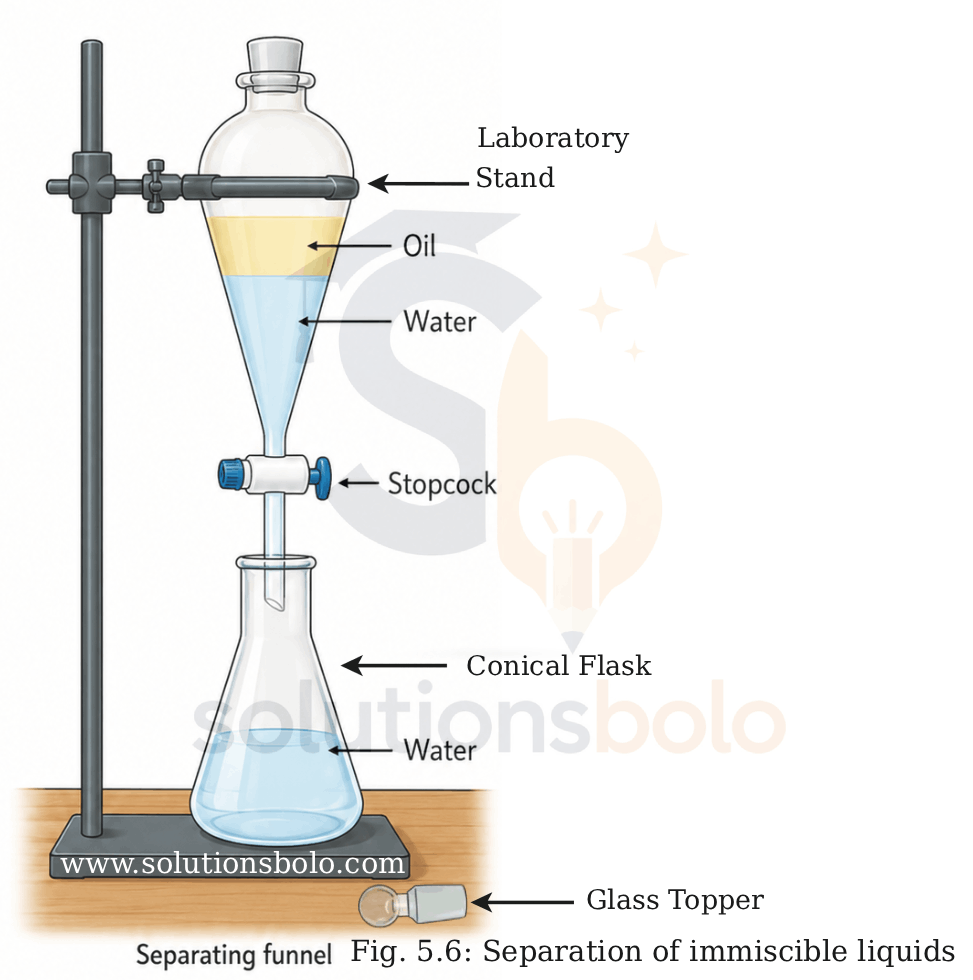
5. The label on a cooking oil pack says one litre (910 g). If this oil is mixed with water, will it form a separate layer? If so, which substance will be on top? How will you separate the two layers? Also, draw the diagram of the apparatus used.
Answer:
Yes, cooking oil and water will form separate layers because they are immiscible liquids. Oil will remain on top since it is less dense than water. The layers can be separated using a separating funnel effectively.
Explanation:
One litre of cooking oil has a mass of 910 g, indicating that its density is lower than that of water. Therefore, when mixed, oil and water do not dissolve in each other and form separate layers. The lighter oil floats on top, while water remains below. A separating funnel is used to separate them. After allowing the layers to settle, the lower water layer is drained through the stopcock, leaving the oil behind in the funnel.
6. Assertion (A): Solutions do not exhibit the Tyndall effect.
Reason (R): The particles in solutions are larger than 100 nm, so they cannot scatter light.
Choose the correct option:
(i) Both A and R are true and R is the correct explanation of A.
(ii) Both A and R are true, but R is not the correct explanation of A.
(iii) A is true, but R is false.
(iv) A is false, but R is true.
Answer:
The correct option is (iii). Assertion (A) is true because solutions do not exhibit the Tyndall effect. Reason (R) is false because solution particles are extremely small, less than 1 nm and cannot scatter light.
Explanation:
Solutions do not show the Tyndall effect because their particles are very small, usually less than 1 nm in diameter. Such tiny particles cannot scatter light, making the path of light invisible. Therefore, the assertion is true. The reason is false because it incorrectly states that solution particles are larger than 100 nm. In reality, particles larger than 100 nm are characteristic of colloids or suspensions. Hence, option (iii) is the correct answer.
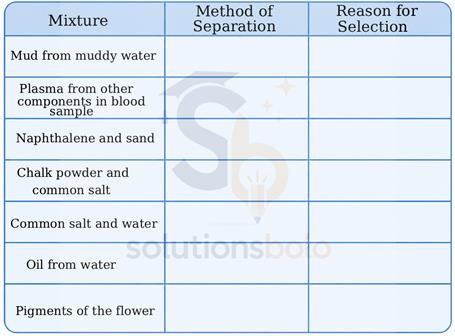
7. How would you separate the mixtures given in Table 5.3? Mention the reason for choosing your method. If a mixture cannot be separated, explain why.
Answer:
(a) Mud from muddy water
Separation: Mud can be separated from muddy water by filtration.
Reason: Mud particles are insoluble and larger than the pores of filter paper, allowing water to pass through while retaining the mud on the filter.
Explanation:
Filtration is suitable because mud particles are suspended solids that do not dissolve in water. When the mixture is poured through filter paper, water passes through as filtrate while mud remains as residue. The difference in particle size makes filtration effective. Sedimentation followed by decantation may also be used before filtration to improve efficiency. Therefore, filtration is the most appropriate method for separating mud from muddy water.
(b) Plasma from other components in blood
Separation: Plasma can be separated from blood by centrifugation.
Reason: Rapid spinning causes heavier blood cells to settle at the bottom, while the lighter plasma remains above and can be collected separately.
Explanation:
Centrifugation separates components based on differences in density. During rapid spinning, red blood cells, white blood cells and platelets move outward and settle at the bottom of the tube. Plasma, being lighter, remains at the top. This method is widely used in laboratories and blood banks to obtain different blood components. Therefore, centrifugation is the most suitable technique for separating plasma from the remaining constituents of blood.
(c) Naphthalene and sand
Separation: Naphthalene and sand can be separated by sublimation.
Reason: Naphthalene changes directly into vapour on heating, while sand remains unchanged. The vapour can then be cooled to obtain solid naphthalene separately.
Explanation:
Sublimation is used when one component changes directly from solid to vapour without becoming liquid. Naphthalene is a sublimable substance, whereas sand does not sublime. On heating the mixture, naphthalene vapour forms and can be collected on a cool surface through deposition. Sand remains behind in the container. Thus, the difference in physical properties allows easy separation of the two substances by sublimation.
(d) Chalk powder and common salt
Separation: Chalk powder and common salt can be separated by dissolving, filtration and evaporation.
Reason: Salt dissolves in water, whereas chalk powder remains insoluble and can be filtered out before recovering salt.
Explanation:
The separation is based on differences in solubility. Common salt dissolves completely in water, forming a solution, while chalk powder remains undissolved. Filtration removes the chalk powder from the mixture. The filtrate contains dissolved salt, which can be recovered by evaporation or crystallization. Therefore, a combination of dissolution, filtration and evaporation effectively separates chalk powder and common salt.
(e) Common salt and water
Separation: Common salt and water can be separated by evaporation or distillation.
Reason: Evaporation leaves salt behind, whereas distillation allows recovery of both salt and pure water from the mixture separately.
Explanation:
Salt is dissolved in water and cannot be separated by filtration. In evaporation, water escapes as vapour, leaving solid salt behind. In distillation, water vapour is condensed and collected as pure liquid while salt remains in the flask. Distillation is preferred when both components are required. Thus, either evaporation or distillation may be used depending on the desired product.
(f) Oil and water
Separation: Oil and water can be separated using a separating funnel.
Reason: Since they are immiscible liquids with different densities, they form separate layers that can be removed individually from the funnel.
Explanation:
Oil and water do not mix and therefore form two distinct layers. Water, being denser, settles at the bottom while oil remains on top. In a separating funnel, the lower water layer is drained through the stopcock first, leaving the oil behind. This method is simple and efficient because it uses differences in density and immiscibility. Hence, a separating funnel is the best choice.
(g) Pigments of the flower
Separation: Pigments of a flower can be separated by paper chromatography.
Reason: Different pigments move at different rates on the paper with the solvent, resulting in distinct coloured bands.
Explanation:
Paper chromatography separates substances based on differences in their movement through paper with a solvent. Flower pigments dissolve in the solvent and travel upward. Since each pigment has a different affinity for the paper and solvent, they move at different speeds and become separated into coloured spots or bands. This technique is commonly used for analysing plant pigments and coloured substances. Therefore, paper chromatography is the suitable method.
8. Two miscible liquids, A and B, are present in a mixture. The boiling point of A is 60 °C and the boiling point of B is 90 °C. Suggest a method to separate them. Also, draw a labelled diagram of the method suggested.
Answer:
The mixture can be separated by simple distillation. Liquid A, having a lower boiling point of 60°C, vaporises first and condenses in the receiver. Liquid B, with a boiling point of 90°C, remains behind initially.
Explanation:
Distillation is suitable for separating miscible liquids with different boiling points. When the mixture is heated, liquid A reaches its boiling point first and changes into vapour. The vapour passes through a condenser, cools and collects as liquid in a receiving flask. Liquid B remains in the distillation flask until its boiling point is reached. Since the boiling point difference is 30°C, distillation effectively separates the two liquids and yields relatively pure components.
(Principle – in simple distillation, the component having the lower boiling point vaporises first and is collected by condensation while the component with the higher boiling point remains behind.)
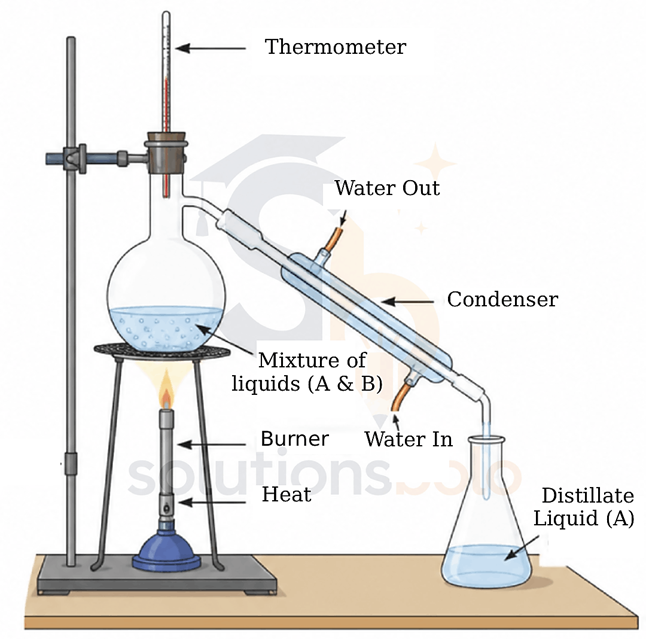
9. Compare evaporation, crystallization and distillation. In which situation, would you prefer each of these over the others?
Answer:
Evaporation removes solvent, crystallization obtains pure crystals and distillation separates liquids using boiling points. Evaporation is preferred for recovering solute, crystallization for obtaining pure solids and distillation for recovering both solvent and solute.
Explanation:
| Evaporation involves heating a solution until the solvent escapes as vapour, leaving the solute behind. Crystallization produces pure crystals from a saturated solution, usually by cooling. Distillation separates substances using differences in boiling points and allows recovery of the solvent. |
| Firstly, evaporation does not produce pure solids because impurities may remain mixed with the solute. Crystallization produces purer solids as impurities are left behind in the solution. Distillation can produce a pure liquid by condensing the vapour formed during heating. |
• Prefer Evaporation when: Only the solid solute is needed, purity is not a major concern and you want a quick, straightforward process (e.g., getting crude salt from seawater).
• Prefer Crystallization when: You need the solid in its absolute purest form with a well-defined crystal structure (e.g., obtaining pure copper sulphate from an impure sample).
• Prefer Distillation when: You need to recover both the solid and the liquid solvent or when you need to separate two miscible liquids with different boiling points (e.g., separating acetone and water).
10. Blood is an example of a colloidal mixture. (i) What would happen if blood behaved like a true suspension inside the body? (ii) In a blood sample, identify the dispersed phase and the dispersion medium.
(i) What would happen if blood behaved like a true suspension?
Answer:
If blood behaved like a true suspension, its particles would settle down on standing. This would disrupt the transport of oxygen, nutrients, hormones and wastes, affecting normal body functions seriously.
Explanation:
Blood functions efficiently because its components remain dispersed throughout the plasma. If blood behaved like a true suspension, blood cells would settle under gravity when circulation slowed or stopped. This settling would prevent uniform distribution of oxygen, nutrients, hormones and waste materials throughout the body. As a result, tissues would not receive essential substances properly, leading to severe health problems. Therefore, the colloidal nature of blood is necessary for maintaining normal physiological functions.
(ii) Identify the dispersed phase and dispersion medium.
Answer:
In blood, the dispersed phase consists of blood cells such as red blood cells, white blood cells and platelets. The dispersion medium is plasma, which keeps these particles uniformly distributed throughout blood.
Explanation:
A colloid consists of a dispersed phase and a dispersion medium. In blood, the solid cellular components, including red blood cells, white blood cells and platelets, act as the dispersed phase. These particles are suspended throughout plasma, which serves as the dispersion medium. Plasma is the liquid part of blood and helps transport nutrients, hormones, gases and wastes. Thus, blood cells form the dispersed phase, while plasma acts as the continuous medium supporting them.
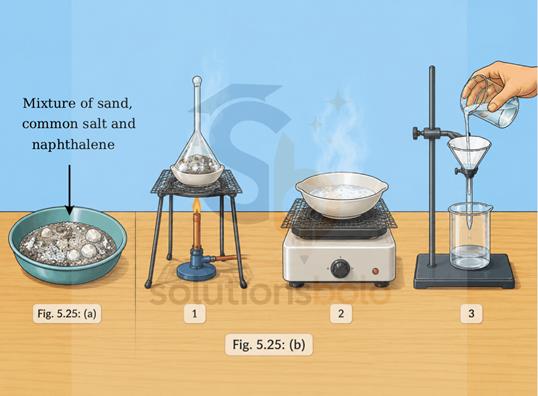
11. You are given a mixture of sand, common salt and naphthalene (Fig. 5.25a). The Fig. 5.25b depicts various steps used to separate the components of this mixture. Identify and write down the correct sequence of separation techniques.
Answer:
The correct sequence of separation technique is: Sublimation → Dissolution in water → Filtration → Evaporation (or Crystallization). Naphthalene is first separated by sublimation. Salt is dissolved in water, sand is removed by filtration and salt is recovered by evaporation.
Explanation:
The mixture contains sand, common salt and naphthalene. Naphthalene is separated first by sublimation because it changes directly from solid to vapour on heating. The remaining mixture of sand and salt is treated with water so that salt dissolves while sand remains insoluble. Filtration separates sand from the salt solution. Finally, evaporation or crystallization is used to remove water and recover solid salt. Thus, all three components are separated successfully using their different physical properties.
12. Why is distillation an effective method for separating a mixture of water and acetone?
Answer:
Distillation effectively separates water and acetone because they have different boiling points. Acetone boils at 56°C, while water boils at 100°C. Acetone vaporises first, condenses and is collected separately from water.
Explanation:
Distillation separates liquids based on differences in their boiling points. Acetone has a boiling point of 56°C, whereas water boils at 100°C. When the mixture is heated, acetone reaches its boiling point first and changes into vapour. The vapour passes through a condenser where it cools and becomes liquid again. Water remains in the distillation flask until a higher temperature is reached. Therefore, the significant difference in boiling points makes distillation an effective method for separating water and acetone.
13. Answer the following questions with the help of the data given in Table 5.4.
(i) What mass of potassium nitrate would be needed to prepare its saturated solution in 50 g of water at 40 °C?
Answer:
At 40°C, 62 g of potassium nitrate dissolves in 100 g of water. Therefore, in 50 g of water, the required mass is (62 × 50)/100 = 31 g. Thus, 31 g is needed.
Explanation:
According to Table 5.4, the solubility of potassium nitrate at 40°C is 62 g per 100 g of water. To find the amount required for 50 g of water, a direct proportion is used. Since 50 g is half of 100 g, the required potassium nitrate is also half of 62 g. Therefore, (62 × 50)/100 = 31 g. Thus, 31 g of potassium nitrate is needed to prepare a saturated solution in 50 g of water at 40°C.
(ii) A student makes a saturated solution of potassium chloride in water at 80 °C and leaves the solution to cool at room temperature (25 °C). What would she observe as the solution cools? Explain.
Answer:
As the solution cools, crystals of potassium chloride will separate out. Its solubility decreases with decreasing temperature, so the excess dissolved potassium chloride can no longer remain in solution and crystallizes.
Explanation:
At 80°C, potassium chloride has a high solubility of 54 g per 100 g of water. As the solution cools to room temperature, its solubility decreases significantly. The solution, which was saturated at 80°C, now contains more dissolved potassium chloride than can remain dissolved at the lower temperature. Consequently, the excess potassium chloride separates from the solution in the form of crystals. This process is called crystallization and occurs because solubility decreases as temperature falls.
(iii) What is the effect of a change in temperature on the solubility of salts? Also, compare the changes in the solubility of the four given salts with increasing temperature from 10 °C to 80 °C.
Answer:
Generally, solubility increases with temperature. Potassium nitrate shows the greatest increase, ammonium chloride and potassium chloride show moderate increases, while sodium chloride shows only a very slight increase in solubility with temperature.
Explanation:
Temperature usually increases the solubility of salts in water, though the extent varies among different salts. Potassium nitrate shows the largest increase, rising from 21 g at 10°C to 167 g at 80°C. Ammonium chloride also shows a considerable increase from 24 g to 66 g. Potassium chloride increases moderately from 35 g to 54 g. Sodium chloride exhibits only a small increase from 36 g to 37 g. Thus, temperature affects different salts differently, with potassium nitrate being most sensitive.
14. Three students, A, B and C, are preparing sugar solutions for an experiment:
• Student A dissolves 20 g of sugar in 80 g of water.
• Student B dissolves 20 g of sugar in 100 g of water.
• Student C dissolves 30 g of sugar in 80 g of water.
(i) Calculate the mass percentage (% m/m) concentration of sugar in each student’s solution.
Answer:
Student A: 20%, Student B: 16.67%, Student C: 27.27%. These values are obtained using the formula: Mass percentage = (Mass of solute ÷ Mass of solution) × 100.
Explanation:
For Student A, total mass = 20 + 80 = 100 g,
so concentration = (20/100) × 100 = 20%.
For Student B, total mass = 20 + 100 = 120 g,
so concentration = (20/120) × 100 = 16.67%.
For Student C, total mass = 30 + 80 = 110 g,
so concentration = (30/110) × 100 = 27.27%.
Thus, the concentrations are 20%, 16.67% and 27.27% respectively for Students A, B and C.
(ii) Whose solution is the most concentrated? Explain why.
Answer:
Student C’s solution is the most concentrated because it has the highest mass percentage of sugar, 27.27%. A greater percentage indicates more sugar dissolved per unit mass of solution.
Explanation:
Concentration depends on the amount of solute present relative to the total mass of the solution. Student A’s solution contains 20% sugar, Student B’s contains 16.67% and Student C’s contains 27.27%. Since Student C has the highest mass percentage, the solution contains the greatest amount of sugar relative to its total mass.
Therefore, Student C’s solution is the most concentrated among the three solutions prepared for the experiment.
15. Examine Fig. 5.26. (i) Identify the separation technique marked as ‘S’. (ii) Label the apparatus A, B and C. (iii) Which of the following mixtures can be separated by the technique identified above? Use the data given in Table 5.5. Mixtures:
(a) water — acetone
(b) water — salt
(c) acetone — alcohol
(d) sand — salt
(e) alcohol — chloroform
(f) alcohol — benzene
Boiling points of some compounds:
| Solvent | Temperature (°C) |
| Water | 100 °C |
| Acetone | 56 °C |
| Alcohol | 78 °C |
| Chloroform | 61 °C |
| Benzene | 80 °C |
15(i). Answer:
The separation technique marked as S is distillation. It is used to separate liquids based on differences in their boiling points and can also recover the solvent from a solution.
Explanation:
The apparatus shown includes a distillation flask, condenser and receiving flask, indicating the process of distillation. In this technique, a liquid mixture is heated so that the component with the lower boiling point vaporises first. The vapour then passes through a condenser, cools and collects as liquid. Distillation is useful for separating miscible liquids and for obtaining pure solvents from solutions. Therefore, the technique represented by S is distillation.
15(ii). Answer:
A – Distillation flask
B – Condenser
C – Receiving flask
These are the main parts of a simple distillation setup used for separating liquids based on differences in boiling points.
Explanation:
In a simple distillation apparatus, the mixture is heated in the distillation flask (A). Vapours produced during heating pass into the condenser (B), where cooling converts them back into liquid form. The condensed liquid is then collected in the receiving flask (C). These three components work together to separate and collect liquids efficiently. Therefore, A is the distillation flask, B is the condenser and C is the receiving flask.
15(iii). Answer:
The apparatus shows simple distillation. Water–acetone and water–salt can be separated by this method because they have suitable properties. Acetone–alcohol, alcohol–chloroform and alcohol–benzene are better separated by fractional distillation, while sand–salt cannot be separated by distillation.
Explanation:
The apparatus shown in Fig. 5.26 is a simple distillation setup. Simple distillation is used to separate a liquid from a solution or liquids having a large difference in boiling points. Therefore, water–acetone can be separated because their boiling points differ significantly and water–salt can be separated because water vaporises while salt remains behind.
Acetone–alcohol, alcohol–chloroform and alcohol–benzene are better separated by fractional distillation, whereas sand–salt cannot be separated by distillation.
(a) Water–Acetone (Accepted)
Water and acetone have a large boiling point difference (44°C). Acetone vaporises first and can be condensed separately, making simple distillation an effective method.
(b) Water–Salt (Accepted)
Water is volatile whereas salt is non-volatile. On heating, water changes into vapour and can be collected, while salt remains in the distillation flask.
(c) Acetone–Alcohol (Rejected)
The boiling points differ by 22°C. Although separation is possible, fractional distillation generally gives better separation than simple distillation.
(d) Sand–Salt (Rejected)
Sand and salt are solids, not liquids. Distillation is used for separating liquids or solutions, so it is not suitable for this mixture.
(e) Alcohol–Chloroform (Rejected)
The boiling points are relatively close (17°C apart). Such liquids are generally separated more effectively by fractional distillation than by simple distillation.
(f) Alcohol–Benzene (Rejected)
Alcohol and benzene have very close boiling points (78°C and 80°C). Simple distillation cannot separate them effectively; fractional distillation is required.
Scientists Mentioned in the Chapter:
1. Dilip Mahalanabis (Indian pediatrician)
Year: 1970s (Widely recognised for Oral Rehydration Therapy during the Bangladesh refugee crisis)
Contribution & Discovery: Dilip Mahalanabis was a renowned Indian scientist and physician who played a crucial role in saving millions of lives through the use of Oral Rehydration Therapy (ORT). During the 1971 Bangladesh refugee crisis, he demonstrated that a simple mixture of water, salts and glucose could effectively treat dehydration caused by diarrhoea. His work highlighted the importance of correctly prepared solutions and their concentrations in healthcare. ORT is now recognised worldwide as one of the most significant medical advances of the twentieth century.
2. John Tyndall (Irish physicist)
Year: 1869 (Detailed studies on light scattering and colloids)
Contribution & Discovery: John Tyndall was an Irish physicist best known for discovering the Tyndall Effect, which refers to the scattering of light by colloidal particles. His observations helped scientists distinguish between true solutions and colloids. When a beam of light passes through a colloidal mixture, the path of light becomes visible due to scattering by suspended particles. This phenomenon is an important concept in the study of mixtures and colloids and is widely used in scientific investigations.
Hypothetical / Imagination Based Questions Answers
You are not studying science merely to pass an exam. You are learning how scientists think.
1. Suppose all the dissolved salt could suddenly be removed from seawater, leaving only pure water behind. How would this affect marine life and the ecosystem?
Answer:
Removing all dissolved salt from seawater would severely affect marine organisms. Most marine plants and animals are adapted to salty conditions. Sudden changes in salinity would disrupt their body functions, causing stress, disease or even death.
| Think Like a Scientist |
A scientist would examine how living organisms maintain the balance of water and dissolved substances inside their bodies. Marine organisms are adapted to specific salt concentrations in seawater. If the water suddenly became fresh, water would enter many organisms through osmosis, disturbing their internal balance. Fish, algae and other marine species may not survive such rapid changes. Food chains would also be disrupted, affecting the entire ecosystem. This shows the importance of dissolved substances in maintaining environmental stability.
2. Imagine a city where smoke, dust and other colloidal particles completely disappear from the air for one week. How would the appearance of the sky and visibility change?
Answer:
The sky would appear clearer and visibility would improve significantly. Since fewer particles would be available to scatter light, the atmosphere would look less hazy and distant objects would become easier to see.
| Think Like a Scientist |
A scientist would relate this situation to the Tyndall effect and light scattering. Smoke and dust particles present in the atmosphere scatter sunlight, making the air appear hazy. If these particles disappeared, scattering would decrease considerably. More direct sunlight would reach the observer, improving visibility and making the sky appear clearer. Distant buildings, mountains and other objects would become more visible. This demonstrates how colloidal particles influence the appearance of the atmosphere and the quality of air.
3. Suppose a student tries to separate a mixture of sand and salt using only filtration without adding water. What would happen and why?
Answer:
The separation would not be successful because both sand and salt are solid particles. Filtration separates insoluble solids from liquids, not one solid from another. Therefore, both substances would remain together.
| Think Like a Scientist |
A scientist would first identify the physical properties of the substances present. Sand and salt are both solids, so filtration alone cannot separate them. The correct approach would be to dissolve the salt in water. Salt dissolves while sand remains insoluble. Filtration can then separate the sand from the salt solution. Finally, evaporation or crystallization can recover the salt. This example shows the importance of selecting a separation method based on the properties of each component.
4. Imagine that all liquids in the world suddenly had the same boiling point. How would this affect distillation?
Answer:
Distillation would become ineffective because it depends on differences in boiling points. If all liquids boiled at the same temperature, they would vaporise together and could not be separated efficiently.
| Think Like a Scientist |
A scientist would analyse the principle behind distillation. This method works because different liquids boil at different temperatures. The liquid with the lower boiling point vaporises first and is collected separately after condensation. If all liquids had identical boiling points, they would vaporise simultaneously. The vapours would mix and condense together, making separation impossible. Many industrial processes, purification methods and laboratory techniques would be affected. This highlights the importance of boiling point differences in separation science.
5. Suppose a colloid suddenly started behaving like a suspension. What changes would you observe?
Answer:
The particles would begin settling down when left undisturbed. The mixture would lose its stability and could be separated more easily by filtration, similar to an ordinary suspension.
| Think Like a Scientist |
A scientist would compare the properties of colloids and suspensions. In a colloid, particles remain dispersed and do not settle due to their small size. If the colloid started behaving like a suspension, the particles would become larger or aggregate together. Gravity would cause them to settle at the bottom over time. The mixture would appear less uniform and could be separated by ordinary filtration. Such a change would indicate a loss of the characteristic stability of colloidal systems.
6. Imagine that common salt became insoluble in water. How would this affect daily life and industrial processes?
Answer:
Many daily activities and industries would be affected. Salt could no longer dissolve in food, medicines or chemical solutions. Processes that depend on salt solutions would become difficult or impossible.
| Think Like a Scientist |
A scientist would consider the importance of solubility in practical applications. Salt dissolves readily in water and is used in cooking, food preservation, medicine, chemical manufacturing and water treatment. If salt became insoluble, preparing saline solutions, preserving food and conducting many industrial processes would be challenging. Biological functions that depend on dissolved salts would also be affected. This scenario illustrates how the solubility of substances plays a vital role in everyday life and technology.
How this Chapter is Related to Our Surroundings?
Many concepts discussed in this chapter are happening around us every day. We use them regularly, but often do not realise that they are practical applications of mixtures and separation techniques studied in science.
Tyndall Effect in Vehicle Headlights and Fog
When vehicle headlights pass through fog, dust or smoke, the path of light becomes visible because tiny particles scatter the light. This is the Tyndall effect.
Fractional Distillation in Petroleum Refineries
Petrol, diesel, kerosene and LPG are obtained from crude oil through fractional distillation, where substances are separated based on differences in their boiling points.
Evaporation in Drying Clothes
Wet clothes dry because water present in them evaporates into the atmosphere. This is one of the most common examples of evaporation in daily life.
Condensation in Air Conditioners
An air conditioner cools warm air, causing water vapour present in the air to condense into liquid droplets. The water dripping from an AC outlet is an example of condensation.
Condensation on Cold Water Bottles
During summer, droplets appear on the outer surface of a cold water bottle because water vapour from the air condenses on the cold surface.
Water Purifiers Working on Filtration
Household water purifiers remove suspended impurities, dust particles and microorganisms through different types of filtration processes.
Kidneys Acting as Natural Filters
Our kidneys continuously filter waste materials, excess salts and water from the blood. This natural biological process is similar to filtration.
Washing Machines Working on Centrifugation
During the spin cycle, washing machines rotate rapidly and remove water from clothes using the principle of centrifugation.
Separation of Cream from Milk
Dairy industries use centrifugation to separate cream from milk. This helps in producing butter, ghee and other dairy products.
Tea Preparation at Home
While preparing tea, a strainer is used to separate tea leaves from the liquid. This is a simple example of filtration.
Salt Production from Seawater
In coastal regions, common salt is obtained by allowing seawater to evaporate under sunlight. This is a practical application of evaporation.
Cooking Food with Dissolved Salt and Sugar
Whenever salt or sugar dissolves in water, a solution is formed. We observe this daily while preparing food and beverages.
Winnowing by Farmers
Farmers separate lighter husk from heavier grains with the help of wind. This process is known as winnowing.
Sieving Flour in the Kitchen
Before making chapatis or cakes, flour is often sieved to remove larger particles and impurities. This process is called sieving.
Sedimentation in Muddy Water
When muddy water is left undisturbed, heavier particles settle at the bottom. This natural process is known as sedimentation.
Oil Floating on Water
When oil is mixed with water, two separate layers are formed because the liquids are immiscible. This principle is used in a separating funnel.
Perfume and Room Freshener Sprays
The fragrance spreads through the air because tiny particles become uniformly distributed, demonstrating the formation of mixtures.
Clouds in the Sky
Clouds are colloidal mixtures of tiny water droplets dispersed in air. They are examples of colloids present in nature.
Smoke from Vehicles and Factories
Smoke is a colloid in which tiny solid particles are dispersed in air. It also exhibits the Tyndall effect.
ORS (Oral Rehydration Solution)
Doctors recommend ORS during dehydration. It is a carefully prepared solution containing water, salts and glucose in proper concentration.
Ink Separation in Laboratories
Different colours present in black ink can be separated using paper chromatography, a technique widely used in scientific investigations.
Sugar and Salt Industries
Pure crystals of sugar and salt are obtained through crystallization, which removes impurities and improves quality.
Distilled Water in Laboratories and Batteries
Distilled water is prepared by distillation, where pure water is separated from dissolved impurities.
Dew Formation in the Morning
Tiny droplets of water seen on grass and leaves early in the morning form due to condensation of water vapour present in the air.
Air Around Us is a Mixture
The air we breathe is itself a homogeneous mixture of gases such as nitrogen, oxygen, carbon dioxide and water vapour.
Blood as a Colloid Inside Our Body
Blood behaves as a colloidal mixture where blood cells remain dispersed in plasma and do not settle under normal conditions.
Medicines and Syrups
Many liquid medicines are solutions, suspensions or colloids. The instruction “Shake well before use” is often given because suspended particles settle down on standing.
Water Tanks and Reservoirs
Suspended impurities in stored water often settle at the bottom after some time due to sedimentation, making the upper water comparatively clearer.
Steam on Bathroom Mirrors
After a hot shower, water vapour condenses on the cooler mirror surface, forming tiny droplets. This is another example of condensation.
Very Short Answer Type Questions
1. What is a mixture?
Answer: A mixture is a combination of two or more substances that are physically mixed and can be separated by physical methods.
2. What is a homogeneous mixture?
Answer: A homogeneous mixture has a uniform composition and appearance throughout the mixture.
3. What is a heterogeneous mixture?
Answer: A heterogeneous mixture has a non-uniform composition in which different components can often be distinguished.
4. What is a solution?
Answer: A solution is a homogeneous mixture in which a solute is dissolved in a solvent.
5. What is a solute?
Answer: A solute is the substance that gets dissolved in a solvent to form a solution.
6. What is a solvent?
Answer: A solvent is the substance that dissolves a solute to form a solution.
7. What is solubility?
Answer: Solubility is the maximum amount of solute that can dissolve in a given amount of solvent at a specific temperature.
8. What is a saturated solution?
Answer: A saturated solution contains the maximum amount of solute that can dissolve at a given temperature.
9. What is a suspension?
Answer: A suspension is a heterogeneous mixture containing large particles that settle down on standing.
10. What is a colloid?
Answer: A colloid is a heterogeneous mixture in which particles remain dispersed and do not settle on standing.
11. What is the Tyndall effect?
Answer: The Tyndall effect is the scattering of light by colloidal particles, making the path of light visible.
12. Name the scientist associated with the Tyndall effect.
Answer: John Tyndall is the scientist associated with the Tyndall effect.
13. Which method is used to separate insoluble solids from liquids?
Answer: Filtration is used to separate insoluble solids from liquids.
14. What is sedimentation?
Answer: Sedimentation is the process in which heavier insoluble particles settle at the bottom of a liquid.
15. What is decantation?
Answer: Decantation is the process of carefully pouring off the clear liquid from settled solid particles.
16. Which method is used to obtain salt from seawater?
Answer: Evaporation is used to obtain salt from seawater.
17. What is crystallization?
Answer: Crystallization is the process of obtaining pure solid crystals from a saturated solution.
18. What is sublimation?
Answer: Sublimation is the direct conversion of a solid into vapour without passing through the liquid state.
19. Name a substance that undergoes sublimation.
Answer: Naphthalene is a substance that undergoes sublimation.
20. What is chromatography?
Answer: Chromatography is a technique used to separate coloured substances or components of a mixture.
21. What is centrifugation?
Answer: Centrifugation is a method of separation that uses rapid spinning to separate particles based on density.
22. Which apparatus is used to separate immiscible liquids?
Answer: A separating funnel is used to separate immiscible liquids.
23. What is distillation?
Answer: Distillation is a method of separation based on differences in boiling points of substances.
24. What is the main principle of distillation?
Answer: Distillation works on the principle of differences in boiling points of liquids.
25. Why do colloids not settle down on standing?
Answer: Colloidal particles are very small and remain dispersed throughout the medium.
26. What are immiscible liquids?
Answer: Immiscible liquids are liquids that do not mix and form separate layers.
27. Which Indian scientist mentioned in the chapter contributed to Oral Rehydration Therapy?
Answer: Dilip Mahalanabis contributed significantly to the development and use of Oral Rehydration Therapy (ORT).
Short Answer Type Questions
1. Differentiate between a homogeneous mixture and a heterogeneous mixture.
Answer:
| Homogeneous mixture | Heterogeneous mixture |
| Has a uniform composition throughout. | Has a non-uniform composition. |
| Components cannot be seen separately. | Components can often be seen separately. |
| Generally, consists of a single phase. | Contains two or more phases. |
| Appears the same throughout. | Has different visible regions or layers. |
| Particles are evenly distributed throughout. | Particles are unevenly distributed. |
| Examples: salt solution, sugar solution and air. | Examples: muddy water, oil and water and sand with iron filings. |
2. What is the difference between a solution, a suspension and a colloid?
Answer: A solution is a homogeneous mixture with very small particles that do not settle down and cannot be separated by filtration. A suspension is a heterogeneous mixture with large particles that settle on standing and can be filtered. A colloid has intermediate-sized particles that remain dispersed and do not settle. Colloids show the Tyndall effect, whereas true solutions do not. These differences help identify and classify mixtures.
3. What is the Tyndall effect? Give two examples.
Answer: The Tyndall effect is the scattering of light by colloidal particles, which makes the path of light visible. This effect helps distinguish colloids from true solutions. When a beam of light passes through a colloidal mixture, the particles scatter the light in different directions. Examples include milk and fog. The Tyndall effect is commonly observed in sunlight passing through a dusty room or vehicle headlights shining through fog.
4. What is a saturated solution? How can it be prepared?
Answer: A saturated solution is a solution that contains the maximum amount of solute that can dissolve in a given amount of solvent at a specific temperature. It is prepared by continuously adding solute to the solvent until no more solute dissolves. Any additional solute remains undissolved at the bottom of the container. The amount of solute that dissolves depends on the nature of the substance and the temperature of the solution.
5. Why is filtration used in the separation of mixtures?
Answer: Filtration is used to separate insoluble solid particles from liquids. In this process, the mixture is passed through a filter medium such as filter paper. The liquid passes through as the filtrate, while the solid particles remain behind as residue. Filtration is commonly used to separate sand from water, remove impurities from liquids and purify substances. It is effective because the solid particles are larger than the pores of the filter.
6. How does evaporation help in separating mixtures?
Answer: Evaporation is used to separate a dissolved solid from a liquid solution. When the solution is heated, the solvent changes into vapour and escapes, leaving the solid behind. This method is commonly used to obtain common salt from seawater. Evaporation is useful when the dissolved solid is required and recovery of the solvent is not necessary. The process depends on the difference in volatility between the solvent and the solute.
7. Why is crystallization preferred over evaporation for obtaining pure solids?
Answer: Crystallization is preferred because it produces pure and well-defined crystals while leaving many impurities behind in the solution. In evaporation, impurities may remain mixed with the solid obtained. During crystallization, a saturated solution is cooled slowly, allowing pure crystals to form. This method is widely used in laboratories and industries for purification of substances. Therefore, crystallization is considered a better technique for obtaining pure solid materials.
8. Explain the principle of distillation.
Answer: Distillation works on the principle that different substances have different boiling points. When a liquid mixture is heated, the component with the lower boiling point vaporises first. The vapour is then cooled in a condenser and collected as a liquid. Distillation is used to separate miscible liquids or recover pure solvents from solutions. The method is widely used in laboratories, industries and water purification systems because it provides effective separation.
9. How does a separating funnel help in separating mixtures?
Answer: A separating funnel is used to separate immiscible liquids such as oil and water. These liquids form separate layers because they do not mix and have different densities. The denser liquid settles at the bottom while the lighter liquid remains on top. The lower layer is drained through the stopcock of the funnel. This method is simple and effective for separating liquids that form distinct layers when left undisturbed.
10. Why is chromatography considered an important separation technique?
Answer: Chromatography is important because it can separate substances present in very small quantities. It is commonly used to separate colours in inks, pigments in plants and components of complex mixtures. Different substances move at different rates through the stationary phase with the solvent, leading to separation. Chromatography is widely used in scientific research, medicine, forensic science and food analysis. It helps identify and study substances accurately and efficiently.